Don't forget, as per the nyquist limit, you probably want to double the resolution so you don't see jaggies in your diagonal lines. This is why printed text on paper is *still* better than HiDPI screens.
Notes by Dr. Optoglass: The Resolution of the Human Eye
Topics Covered:
Beauty is all very well at first sight; but who ever looks at it when it has been in the house three days? – George Bernard Shaw
As we have seen earlier, the average visual acuity of the human eye is one arc minute. The maximum possible is 0.4 arc minutes. It would be a very rare human indeed who can beat 0.4 arc minutes!
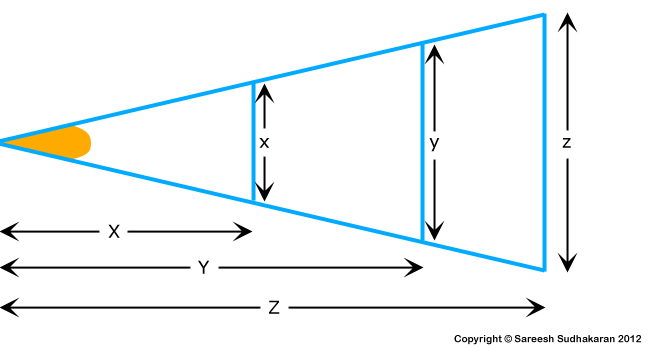
Therefore, we can safely say that the average resolution of a good eye is between 0.4 and 1 arc minute. Before these figures can be translated to pixels or displays, one needs to realize that the size of the pixel will vary with distance.

What’s the formula?
![]()
where
d is the distance in mm
α is the angle in degrees
A very young child can focus at about 2 inches, but the average adult can focus no closer than 4 inches (100 mm). We can assume the lowest value of d to be 100 mm. At this distance, the pixel/dot size p is 0.0116 mm or 11.6 microns – for 0.4 arc minutes. For 1 arc minute, it works out to be 29 microns.
An inch is 25.4mm. So how many of our pixels can fit into an inch? @0.4 arc minutes, it is 2190 ppi (dpi). @1 arc minute, it is 876 ppi (dpi)
Maximum Resolution of the Eye
So this is how it is. If a healthy adult brings any display screen or printed paper or whatever 4 inches (100 mm) from his or her face, the maximum resolution he/she can see at is 2190 ppi/dpi. It doesn’t get any better than this for 99.99% of us, except maybe during pre-kindergarten years.
But the legally accepted norm of 20/20 vision only asks for 876 ppi/dpi at 4 inches!
Let’s have some fun:
Magazines and Fine Art Prints
If the average reading distance is 1 foot (12 inches = 305 mm), p @0.4 arc minute is 35.5 microns or about 720 ppi/dpi. p @1 arc minute is 89 microns or about 300 dpi/ppi. This is why magazines are printed at 300 dpi – it’s good enough for most people. Fine art printers aim for 720, and that’s the best it need be. Very few people stick their heads closer than 1 foot away from a painting or photograph.
Computer Monitors
The average computer monitor viewing distance is about 2.5 feet (762 mm). p@0.4 is 89 microns or about 300 ppi/dpi. p@1 is 222 microns or about 115 ppi/dpi. Now you can understand why most consumer computer monitors are about 100 ppi, and most professional computer monitors are slightly higher, but not by much.
The new iPad (3) has a resolution of 264 ppi, which isn’t as good as 300 dpi print but is much better than the average computer monitor. The new Eizo 36.4″ professional air traffic control 4K monitor is at 128 ppi.
Home television
Assuming the average viewing distance for television is 6 feet (1830 mm), p@0.4 is about 120 ppi and p@1 is about 50 ppi.
Most consumer large screen LCD and LED panels are about 50 ppi to 90 ppi, and average about 72 ppi. Now you know why. If your television gets smaller in size, then the higher ppi doesn’t really help. This is why 1920×1080 (at 100 ppi at 6 feet for a 50″ LCD/LED television panel) is good enough. The eye can’t really resolve a lot more at 6 feet.
Cinema
The width of a cinema screen can vary from 30 to 70 feet (360″ to 840″, 9144 mm to 21,336 mm). The closest viewing distance recommended is about 40 feet (3x height) – 12,192 mm. If one is projecting 2K on these screens, the ppi is about 2.4 ppi to 5.7 ppi. If one is projecting 4K, it is about 5 ppi to 11.4 ppi.
Is this what the eye needs?
p@0.4 works out to be 1.4 mm or 18 ppi.
p@1 works out to be 3.5 mm or 7 ppi.
As you can see, 4K comes very close to what the human eye can fully resolve in a cinema screen at average viewing distances. Obviously, many people sit in the front row, and they’d definitely appreciate higher resolution. Which is why we are moving towards:
8K and UHDTV
A 30 to 70 feet screen at 8K (8192 horizontal) gives me from 9.75 ppi to 22.8 ppi. This resolution beats what the eye can resolve at these distances. The future belongs to 8K.
But, to get 18 ppi (the best possible resolution) for a 70 feet screen, we’ll need a horizontal resolution of 15120 or 16K. This is about 128 Megapixels. Is anybody working on this?
This is as good as it gets in 2012.
Takeaways:
Next: Airy Disk and Pixel Density of the Eye
Previous: Focal Lengths of the Human Eye
Please share this primer with your friends:
July 21, 2012


[…] with perfect 20/20 vision would theoretically be able to see individual pixels at a density of 2190ppi on a screen just 4” (~100mm) from their eyes, and for the average person with 20/20 vision, it’s about 876ppi. The […]
[…] with perfect 20/20 vision would theoretically be able to see individual pixels at a density of 2190ppi on a screen just 4” (~100mm) from their eyes, and for the average person with 20/20 vision, it’s about 876ppi. The […]
[…] the Human Eye Pero eh, que Dario dice que no, y F I N EDITO: Toma, otro articulo interesante: http://wolfcrow.com/blog/notes-by-dr…the-human-eye/ […]
[…] According to his article, Dr. Optoglass tells us that the perfect resolution of the eye can see 2190 PPI at 4 inches from the screen. However, none of us holds our phones that close to our faces, at least I hope you don’t, because that actually is bad for your eyes. In addition, the average visual acuity of a human is about 1 arc minute, which simply refers to a person with 20/20 vision. A person with 20/20 vision at 4 inches (the closest a healthy adult can focus) can see up to 876 PPI, which is considerably lower than the ideal eye, which can see at .4 arc minutes. […]
[…] http://wolfcrow.com/blog/notes-by-dr-optoglass-the-resolution-of-the-human-eye/ […]
[…] este c? Apple nu a spus de la ce distan?? nu po?i vedea pixelii, dup? cum a relevat un studiu de la acea vreme. Pe scurt, la o distan?? de 10 cm de ochiul uman, retina noastr? poate percepe […]
[…] este c? Apple nu a spus de la ce distan?? nu po?i vedea pixelii, dup? cum a relevat un studiu de la acea vreme. Pe scurt, la o distan?? de 10 cm de ochiul uman, retina noastr? poate percepe […]
[…] In summary, it seems that at this moment in time for mobile you do well to get anything north of 300. For computers you are doing well with anything north of 200. Resolution of a screen has to do with the distance you are from it. From a distance, your eyes can only make out so much, but from up close you can see much more details. You hold your mobile phone closer to your eyes than you would hold your monitor, so you need a higher resolution on your mobile phone. It seems PPI much higher than 300 could be well worth it, and there are already models out with far higher numbers, but at this moment, 300+ will do. Incidentally, 300 is what most magazines print on (measures in Dots Per Inch), so this is why we are now seeing a move towards 300. More reading here and here. […]
[…] PPI of 538 is far beyond the maximum resolution that the human eye can recognize. There is a bit of controversy as to what the highest practical PPI is for a 5.5 inch screen held 12-18 inches away from the eye, […]