

Back in 2013, Rec. 2020 was introduced as the future of color spaces, promising a wider gamut and greater color depth for Ultra High Definition (UHD) displays. But over a decade later, it’s still not as widespread as we might expect.
While its potential is undeniable, there are several reasons why Rec. 2020 hasn’t become the standard yet. We’ll dive into these limitations and discuss where the future of color spaces might be headed.
But first, let’s understand what Rec. 2020 is.
Most modern computer and video displays conform to sRGB or Rec. 709. There are billions of displays all over the world designed for these color spaces.
Why on earth do we need a new one?


What is Rec. 2020?
Rec. 2020 is the designated color space for Ultra High Definition TV, or UHDTV, in both its variants: 4K and 8K.
It gets its name from the standards classification: ITU-R Recommendation BT.2020. “Rec” stands for ‘recommendation’.
Rec. 2020 (or Rec. 709 for that matter) isn’t the name for the color space. Rec. 2020 represents the full range of specifications under UHDTV, while Rec. 709 represents the full range of specifications under HDTV.
However, because no official name is given to the color spaces under these standards, we refer to them as Rec. 709 or Rec. 2020 color spaces. It often leads to confusion though.
In this article, I only refer to them as color spaces.
How does it compare to other color spaces?
Rec. 2020 is ultimately designed for television, and not cinema.
Therefore, it is to be expected that its properties must behave according to current TV standards.
As far as color bit depth is concerned, it allows for a maximum of 12 bits, which as we know is more than enough for humans.
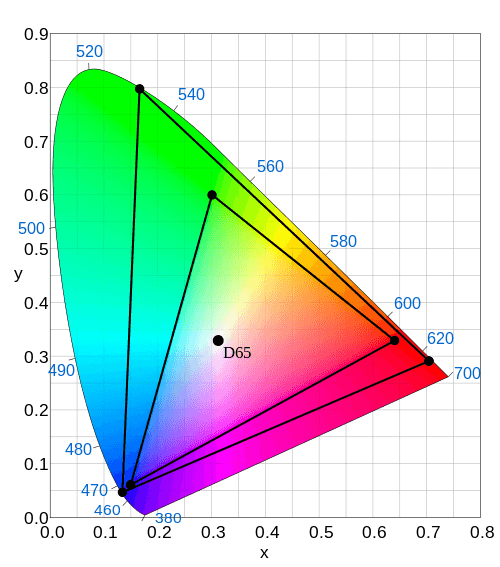
The bigger triangle is Rec. 2020, while the smaller one is Rec. 709. Clearly, there’s a huge difference. They share the similar D65 white point.
So, how does it compare to other color spaces? Check out the table below:
| Standard | Percentage of CIE 1931 |
| HDTV (Rec. 709) | 35.90% |
| Digital Cinema (DCI P3) | 53.60% |
| UHDTV (Rec. 2020) | 75.80% |
Modern professional grade computer displays are capable of reaching Rec. 709 and DCI P3. UHDTV, on the other hand, is a different ball game. It goes beyond what anyone has ever experienced, except in real life!
Some might want a theoretical color space wider than what the human eye can see. Rec. 2020 is a color space for practical applications, meant for cameras, displays, delivery and distribution. Wide gamut spaces are good for algorithms crunching numbers, but totally unnecessary in the real world.
Now that we know what Rec. 2020 is, let’s figure out why Rec. 2020 hasn’t fulfilled its promise of replacing Rec. 709.
Why Isn’t Rec. 2020 Still Widespread in 2024?
Here are some good reasons:
1. Display Technology Limitations
One of the main reasons Rec. 2020 hasn’t become ubiquitous is the limitation of current display technologies. Most consumer-grade displays are still designed to handle Rec. 709, which has a much smaller color gamut compared to Rec. 2020.
While OLED and high-end monitors can support wider color gamuts, they still fall short of fully displaying Rec. 2020’s expanded range.
Rec. 2020 requires displays to reproduce colors that are more vivid and more varied than most panels can manage. Even high-end televisions that claim to support HDR and Rec. 2020 don’t come close to covering its full color space. In fact, as of 2024, very few consumer displays can achieve more than 70-80% of Rec. 2020.
Until display technology catches up, the true potential of Rec. 2020 will remain unrealized.
2. Production and Distribution Challenges
Another hurdle in the widespread adoption of Rec. 2020 is its use in production and distribution. While cameras and production tools are increasingly capable of capturing content in wide color gamuts, the post-production pipeline is still largely built around Rec. 709 and DCI P3.
This makes it more challenging to edit, color grade, and distribute content that utilizes Rec. 2020’s full capabilities.
I can give you a personal example. For my film Gin Ke Dus, initially, I wanted to master it in the Rec. 2020 color space to make it future proof. However, I realized the companies that handle theatrical distribution didn’t even have a Rec. 2020 to DCI XYZ transform in their software!
And adding to that, even streaming platforms currently don’t accept or support Rec. 2020. So I gave up on that idea. Gin Ke Dus was mastered in Rec. 709, for which transforms are readily available.
Sadly, most content delivery platforms, whether it’s Blu-ray, streaming services, or broadcast television, and even YouTube, are still optimized for Rec. 709.
Even with the rise of HDR content, which often uses Rec. 2020 as its reference color space, most of the final output is down-converted to Rec. 709 to accommodate the limitations of current displays.
To know more about HDR, watch this:
3. Compatibility and Industry Standards
For an industry-wide transition to a new standard like Rec. 2020, it’s essential that all parts of the ecosystem – cameras, displays, distribution, and content creation – are aligned. Unfortunately, the industry hasn’t made a full push towards Rec. 2020, partly because of the fragmented approach to HDR standards.
HDR10, Dolby Vision, and HLG each have different approaches to implementing wide color gamuts, which has slowed down Rec. 2020’s progress as the go-to standard. Watch the video I’ve linked to to understand this mess.
Furthermore, since the average consumer is still using Rec. 709-capable devices, there isn’t enough of a demand for widespread Rec. 2020 content creation. Until there’s a larger market push or a technological leap that makes Rec. 2020 more practical for consumers, it’s unlikely we’ll see an industry-wide shift.
4. Cost and Accessibility
As with any new technology, cost plays a significant role in its adoption. Displays that come closer to Rec. 2020’s full range, such as high-end OLED or MicroLED screens, remain expensive, limiting their accessibility to average consumers.
For content creators, working in Rec. 2020 requires specialized equipment and workflows, which can increase production costs.
The film and television industries are always cautious about investing in new technology unless it becomes a clear necessity. With the cost of Rec. 2020 workflows still high, there’s little incentive for many production houses to fully adopt it.
5. Human Perception Limitations
Interestingly, even though Rec. 2020 can theoretically display more colors than Rec. 709, there’s an argument to be made about the limits of human perception. The human eye can only discern so many colors, and while Rec. 2020’s wider gamut is impressive on paper, the practical difference for viewers may not always be as noticeable as expected.
In some cases, the jump from Rec. 709 to Rec. 2020 might be subtler than consumers anticipated, making it harder to market as a revolutionary upgrade.
I have studied footage on both Rec. 709 and Rec. 2020 color spaces on my Flanders Scientific monitor, and the juice isn’t worth the squeeze.
While Rec. 2020’s wider color space allows for more vibrant and natural colors, the average viewer might not notice a drastic improvement unless they’re watching on a display that fully supports the gamut and are trained to recognize the subtleties.
This limits the “wow factor” and urgency for its adoption. It’s an extremely hard sell.
6. HDR and Competing Technologies
The TV industry (ahem, mafia) decide where technology is headed.
HDR is a broader technology that doesn’t rely exclusively on Rec. 2020. Competing HDR formats like Dolby Vision and HDR10+ offer dynamic metadata and other enhancements that are their own thing.
These formats sometimes use different approaches to color and dynamic range management, further complicating Rec. 2020’s path to becoming the de facto color space standard.
Until a unified HDR and color space standard emerges, Rec. 2020 will likely remain one of several competing options.
Should you work in or master in Rec. 2020?
That’s the million dollar question, isn’t it?
As filmmakers, the only advantage to working in Rec. 2020 is the wider color space. However, there are better options out there, like ACES and Davinci Intermediate, etc., that will do the job better and support most workflows.
Sadly, even after a decade, I can’t recommend Rec. 2020 for anything. Avoid it for now.
Rec. 2020 represents a bold vision for the future of color spaces, but several factors like current display limitations, cost, industry standards, and human perception have slowed and possibly stalled its widespread adoption.
Rec. 2020 could still be the color space of the future. It’s just going to take a long time.

BumbleBritches51 Obviously you haven’t read the article.
No, Rec. 2020 ISN’T more color than the eye can see, the CIE 1931 color space AKA XYZ color space, the one that Rec 2020 is a subset of, is based on what the human eye can see and this misunderstanding devalues your entire article to the point of being worthless.
Bumble, your ‘correction” just restates what I read in the article. I think you misunderstood part. The newer Macs, including devices like iPads and iPhones, are all calibrated to the P-3 projection cinema standard, which looks much brighter on my ViewSonic pro monitor than the Adobe RGB space, but the Adobe RGB space seems to work best with my pro wide-spectrum Epson printer. I’d love to experiment with other wide spaces to see if I can get even better results, so this article was very interesting to me. This makes me think the 2020 space would be the best option for video work. But would that mean the colors will look anemic on many displays? I’ve read the new Pro iMac displays only show about 75-80% of the Adobe RGB space, making me think this is a war between Apple and Adobe over a color standard. The main difference I can see between the Adobe RGB space and the Apple adopted P-3 is that Adobe’s space favors cool tones in prints, and P-3 favors warm tones. Very interesting article, thank you!