
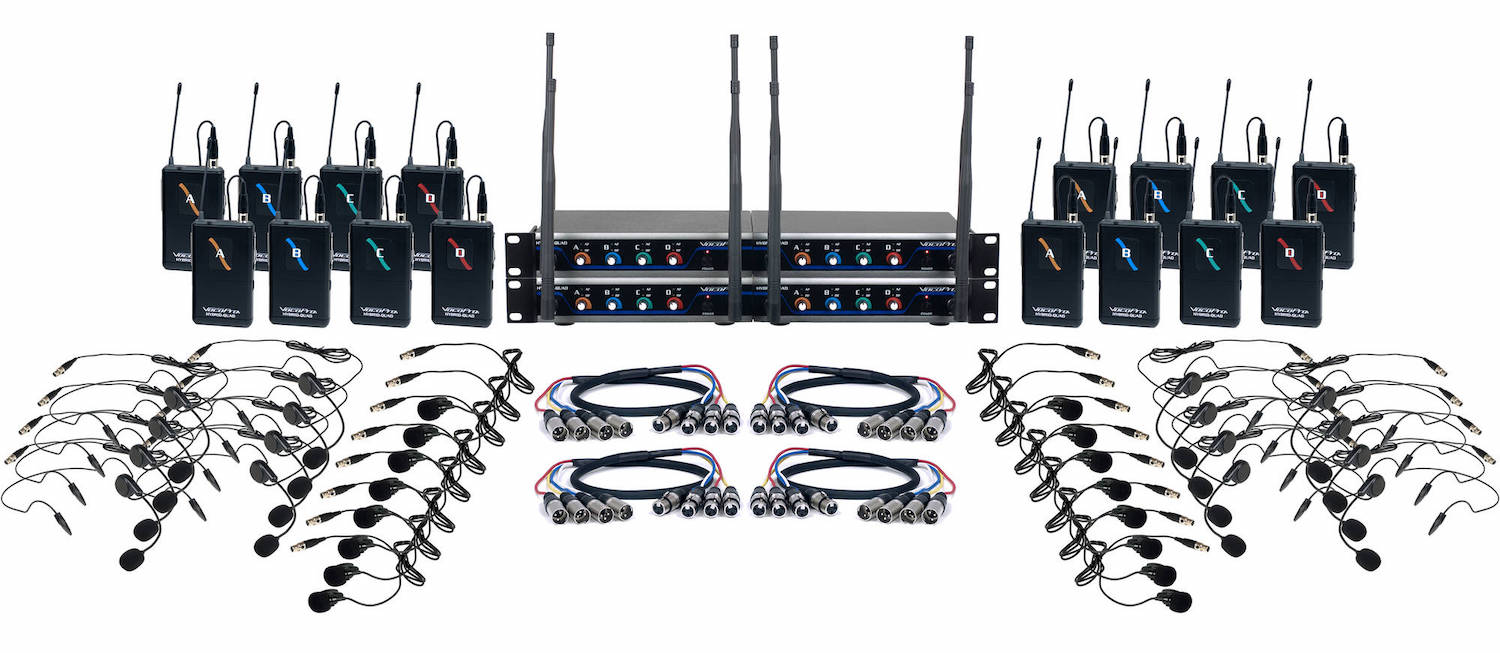

This article looks at five important wireless microphone systems that are the standard fixtures at productions around the world. Why use wireless systems at all? Three reasons:
- To avoid cables, especially when multiple microphones are required.
- To hide cables so it won’t show in the shot – important when you’re covering a long shot and can’t show cables running down the pants of your lead artist.
- When the distance to transmission is too large and impractical for cables.
Just to be sure, even though I call this a wireless ‘microphone’ system, it doesn’t really involve the microphone. However, for video production, such systems are mostly used to interface remote microphones with mixers or recorders. For general communication, walky-talkies are better, and more legal.
The main features of a wireless microphone audio system
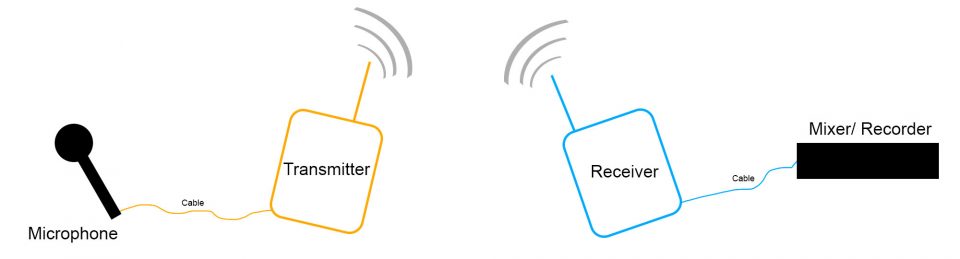
A wireless audio system contains just two parts:
- Transmitter – connects to the microphone and transmits the signal wirelessly
- Receiver – connects to the mixer or recorder and receives the wireless signal transmitted
Sometimes the transmitter and receiver is the same instrument, and is called a tranceiver. You still need two of them, though.
Here’s what it looks like:
When choosing wireless systems, here are the important ‘technical’ considerations (in addition to audio quality) one must keep in mind:
- Transmitting power, measured in mW or milli Watts (sometimes written as ‘mw’) – this decides how much range/distance it can transmit over. Usually 10-125 mW.
- Frequency band/group – it is expensive to have one system efficiently transmit all frequencies of the spectrum. Moreover, if a certain range is illegal, it is pointless to waste resources on it. For this reason, you’ll find systems divided into different ‘frequency blocks’. Choose the one important to you.*
- Resistance to interference – needs to be tested in the real world, every other way is too complicated and unnecessary. Low frequencies are better generally because they ‘bend around’ walls better. If you’re in an area with a lot of ‘chatter’ things will quickly get complicated.
- Reliability – how strong is the signal from end to end? The number and type of antennas tells us how reliable it is. More than one is always good.
It is not uncommon for audio professionals to dump the microphones that come with these kits and use their own preferences instead.
- For 5 budget wired lavalier microphones, click here.
- For 5 budget studio microphones, click here.
- For 5 budget shotgun/boom microphones, click here.
The common input and output connectors are LEMO, XLR, 1/4″ or 3.5mm TRS. In many cases you’ll need additional adapters.
Five important wireless audio systems you should be aware of
Here, in order of price (proprietary microphone, transmitter and receiver only) are five important wireless audio systems for video production:

1 Shure PGXD14/93
Here are the specs of the Shure PGXD14/93:
| Features | Shure PGXD14/93 |
| Transmitter Type | Bodypack |
| Receiver Type | Tabletop |
| Transmitting Power | 10 mW |
| Dynamic Range | 108 dBA |
| Battery | 2x AA batteries |
| Battery Life | 9 hours |
| Display / Indicator | LED |
| Audio Input | 1x TA4/Mini XLR 4-Pin |
| Audio Output | 1x XLR 3-Pin 1x 1/4″ |
| Maximum Transmitters per Band | 5 |
The Shure PGXD14/93 is a Digital wireless Omni lavalier microphone system which can operate 5 mic channels up to 200 feet range. It has a LED display to show mute, battery, and lockout status. The housing is made of plastic. It has dual fixed antennas. The maximum audio gain range is 26 dB. The kit includes a lavalier microphone and TA4F connector, lavalier clip, windscreen, power supply, 2x AA batteries and a carrying case.
There are people who say the Shure is mainly used in the music/concert/events space and are not that great for video production work. If it works for those tough environments, it can withstand the demands of video production as well.
For Shure PGXD14/93, click here to know the frequencies approved in your region.
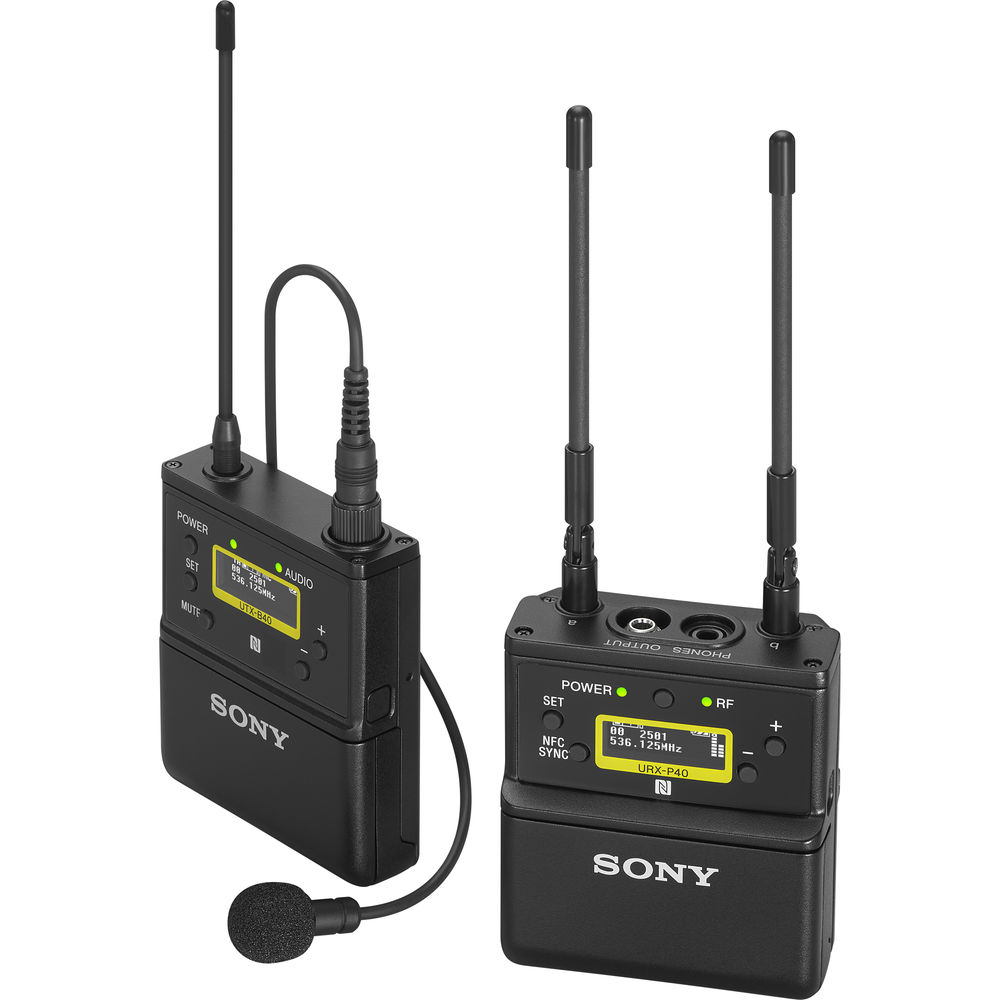
2 Sony UWP-D21
Here are the specs of the Sony UWP-D21 (Amazon, B&H):
| Features | Sony UWP-D21 |
| Transmitter Type | Bodypack |
| Receiver Type | Camera-Mount |
| Transmitting Power | 5 – 30 mW |
| Dynamic Range | 102 dB |
| Battery | 2x AA batteries |
| Battery Life | 6 hours |
| Display / Indicator | OLED |
| Audio Input | 1x 1/8″ / 3.5 mm TRS Female |
| Audio Output | 1 x 1/8″ / 3.5 mm TRS Male |
| Maximum Transmitters per Band | 16 |
The Sony UWP-D21 (Amazon, B&H) is a Omni lavalier microphone system which has a housing made of metal. It can operate 16 wireless microphones simultaneously at the same place at a range of 33o feet. The microphone system offers a 72 MHz bandwidth with 2772 UHF frequencies.
The Sony UWP-D21 (Amazon, B&H) wireless microphone system has a OLED display to view AF level, Battery status, Channel, Frequency, Menu navigation, Mute, Peak and RF level. It has a USB connector for power supply. It works on 2x AA batteries which has to be purchased separately.
The kit of the Sony UWP-D21 (Amazon, B&H) includes a lavalier mic, mic clip, windscreen, belt clips, shoemount adapter for URX-P40 Receiver, 3.5mm to 3.5mm and 3.5mm to XLR-M output cables.
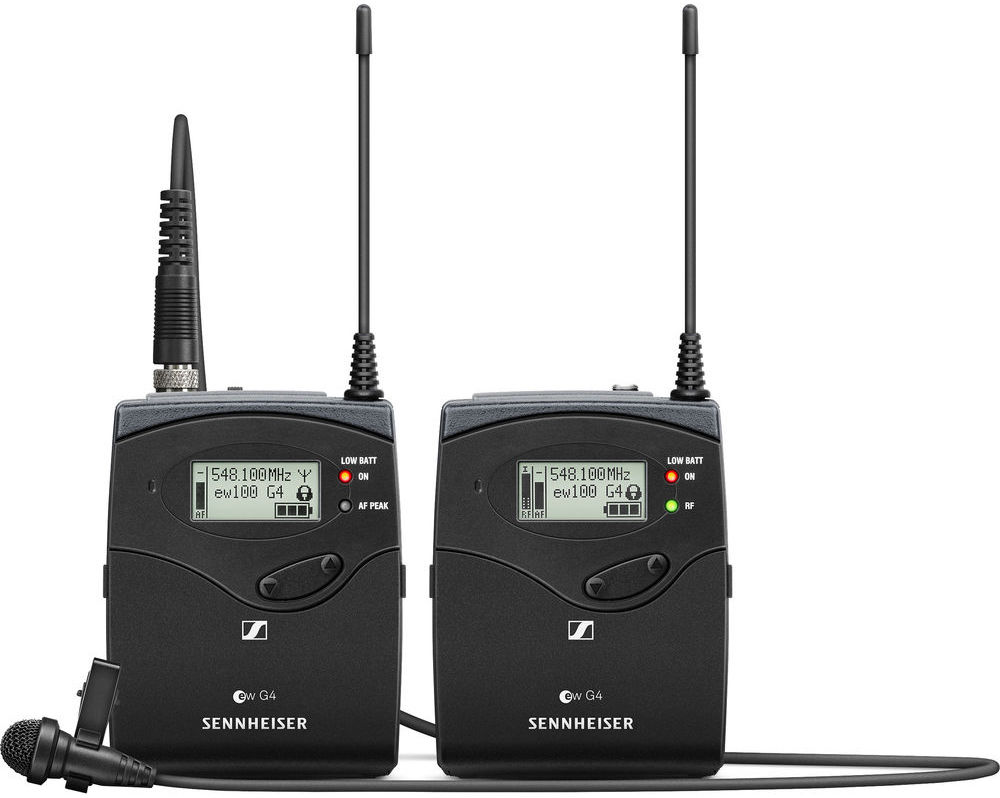
3 Sennheiser EW 112P G4
Here are the specs of the Sennheiser EW 112P G4 (Amazon, B&H):
| Features | Sennheiser EW 112P G4 |
| Transmitter Type | Bodypack |
| Receiver Type | Camera-Mount |
| Transmitting Power | 30 mW |
| Dynamic Range | 110 dBA |
| Battery | 2x AA batteries 1x Sennheiser Accupack |
| Battery Life | 8 hours |
| Display / Indicator | LED |
| Audio Input | 1x 1/8″ / 3.5 mm TRS |
| Audio Output | 1 x 1/8″ / 3.5 mm TRS |
| Maximum Transmitters per Band | 12 |
The Sennheiser EW 112P G4 (Amazon, B&H) is a camera-mount type wireless lavalier microphone system. It has an Analog UHF wireless technology. The housing of the transmitter is made of metal. It can operate up to 12 wireless mics on set with a range of 330 feet. It has an daylight-readable LED displays to shoe the reception quality, battery status and audio level.
The Sennheiser EW 112P G4 (Amazon, B&H) can be easily mounted on a camera with a shoemount adapter which is included in the kit. The kit also includes a lavalier microphone with 3.5mm locking connector, 4x AA batteries, 1/8″ male mini jack to XLR-Male cable, 3.5mm to 3.5mm Output cable.
For Sennheiser, click here to know what frequencies are appropriate for your region (US only).
*The next two systems are what one can call ‘industry standards’.
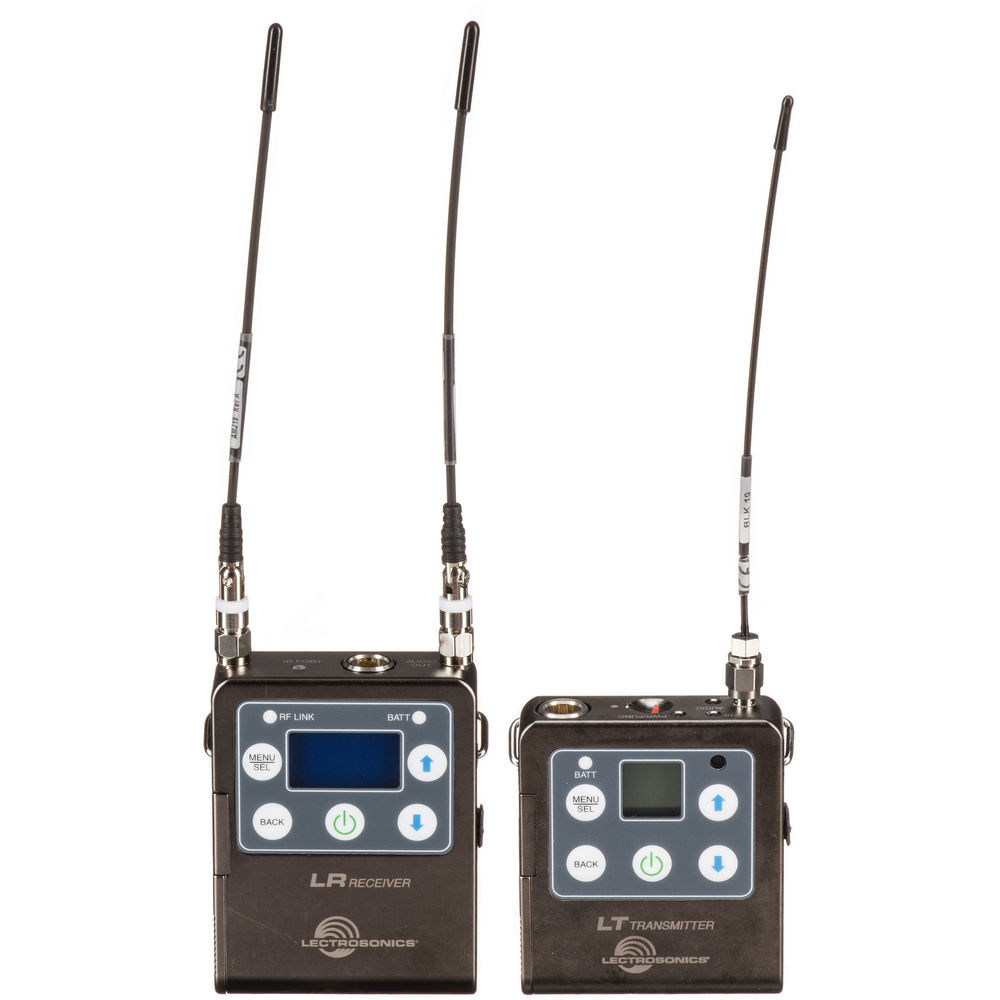
4 Lectrosonics L Series ZS-LRLT
Here are the specs of the Lectrosonics L Series ZS-LRLT:
| Features | Lectrosonics L Series ZS-LRLT |
| Transmitter Type | Bodypack |
| Receiver Type | Camera-Mount |
| Transmitting Power | 50 / 100 mW (Switchable) |
| Dynamic Range | N/A |
| Battery | 2x AA batteries |
| Battery Life | 4 hours |
| Display / Indicator | LCD Backlit |
| Audio Input | 1x TA5 / Mini XLR 5-Pin |
| Audio Output | 1x TA3/Mini XLR |
| Maximum Transmitters per Band | 30 |
The Lectrosonics L Series ZS-LRLT is a camera-mount wireless microphone system. It has an Analog UHF wireless technology and a wide tuning bandwidth of 75 MHz. The housing of the microphone system is made of rugged aluminum. The microphone system can to up to 30 mics on a set with a range of 350 feet.
The Lectrosonics L Series ZS-LRLT has a LCD display with backlit to view AF level, Battery status, Diversity, Frequency and RF level. The kit includes a lavalier microphone with TA5F connector, a Lectrosonics LRSHOE receiver mount kit, a Lectrosonics MCLRTRS TA3F to 3.5mm cable, a Lectrosonics MCSRXLR TA3 Female to XLR Male cable, 2 x Belt Clips.
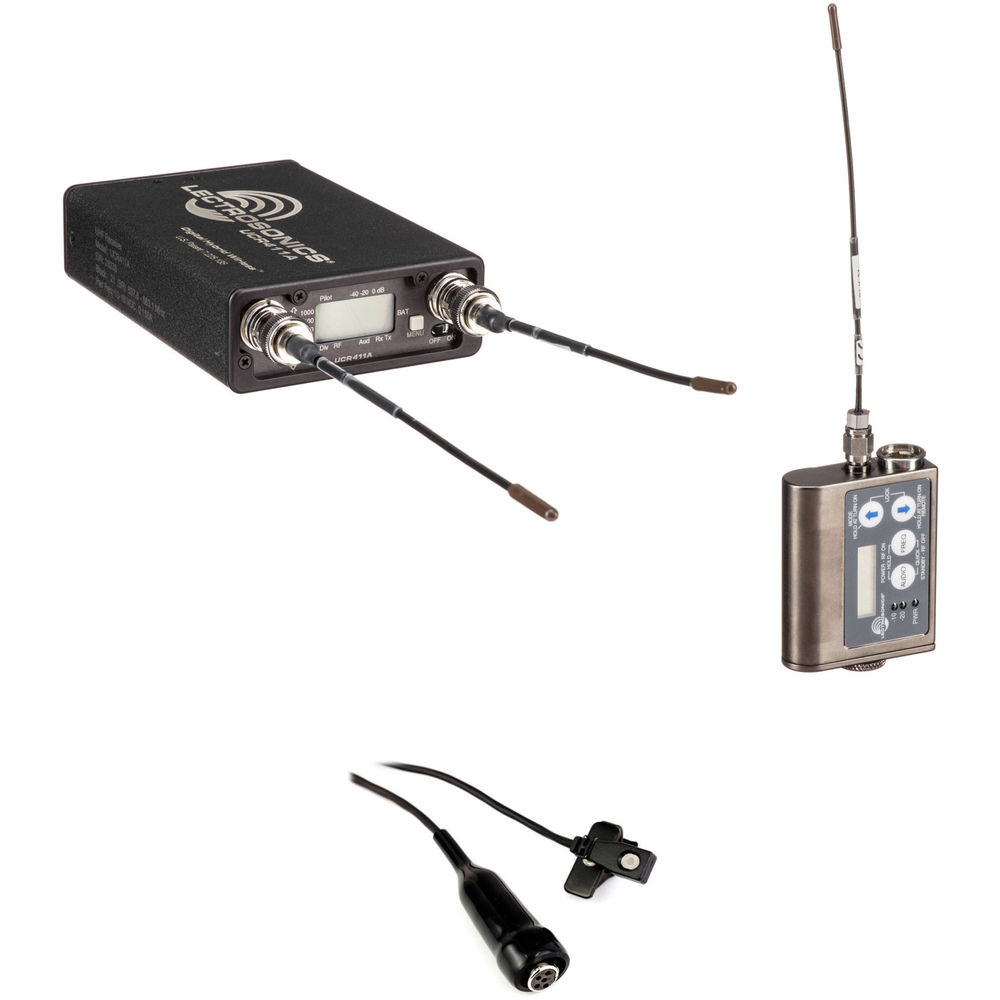
5 Lectrosonics UCR411a
Here are the specs of the Lectrosonics UCR411a:
| Features | Lectrosonics UCR411a |
| Transmitter Type | Bodypack |
| Receiver Type | Triple conversion, superheterodyne |
| Transmitting Power | 50 / 100 / 250 mW (Switchable) |
| Dynamic Range | 125 dB |
| Battery | 1x AA battery |
| Battery Life | 6 – 8 hours continuous |
| Display / Indicator | LCD |
| Audio Input | 1x TA5/Mini XLR 5-Pin |
| Audio Output | 1x TA5/Mini XLR 5-Pin |
| Maximum Transmitters per Band | N/A |
The Lectrosonics UCR411a is an Omnidirectional lavalier microphone system which features an omnidirectional polar pattern that picks up sound from all around the mic and provides a consistent frequency response. It can access both battery and External DC input. It has a backlit LCD display to see Audio level, Battery status, Channel and Group.
The Lectrosonics UCR411a has a Compander-free digital hybrid audio. The microphone system is water resistant. The kit comes with Mic connector kit, 2x Foam insulating pads, Windscreen, Belt clip and Carrying pouch.
For Lectrosonics, use the Television Station Lookup to know what frequencies are appropriate for your region.
When in doubt, ask other audio professionals in your area, and also reconfirm with the dealer/manufacturer directly. Some frequencies and transmitters might be legal in one country while illegal in another. This is your responsibility to figure out.
There you are. You can see that the higher-end models offer more dynamic range, more transmission power, etc. I’ve barely scratched the surface here, and this list is only intended as a ‘point-of-entry’ information piece. You must now do further research on what makes each system special, and different, and then choose the best one for your needs.
