
Watch the video:

Here are six tips that will help you elevate your film to legendary proportions:
1 Kill the lights
Literally. In The Texas Chainsaw Massacre, they literally didn’t have enough light on set.
It was shot in 16mm film, which has a sensor area (10.26 mm × 7.49 mm) smaller than Micro Four Thirds, and at an ASA of 25. In today’s ISO terms, that’s about ISO 50, and you can push that in the lab to about ISO 100. That’s it.
The film stock they used, Eastman Ektachrome 25T 7252, was rated for tungsten, so when they used a CTB filter on their lights, that cut down the available sensitivity even more.
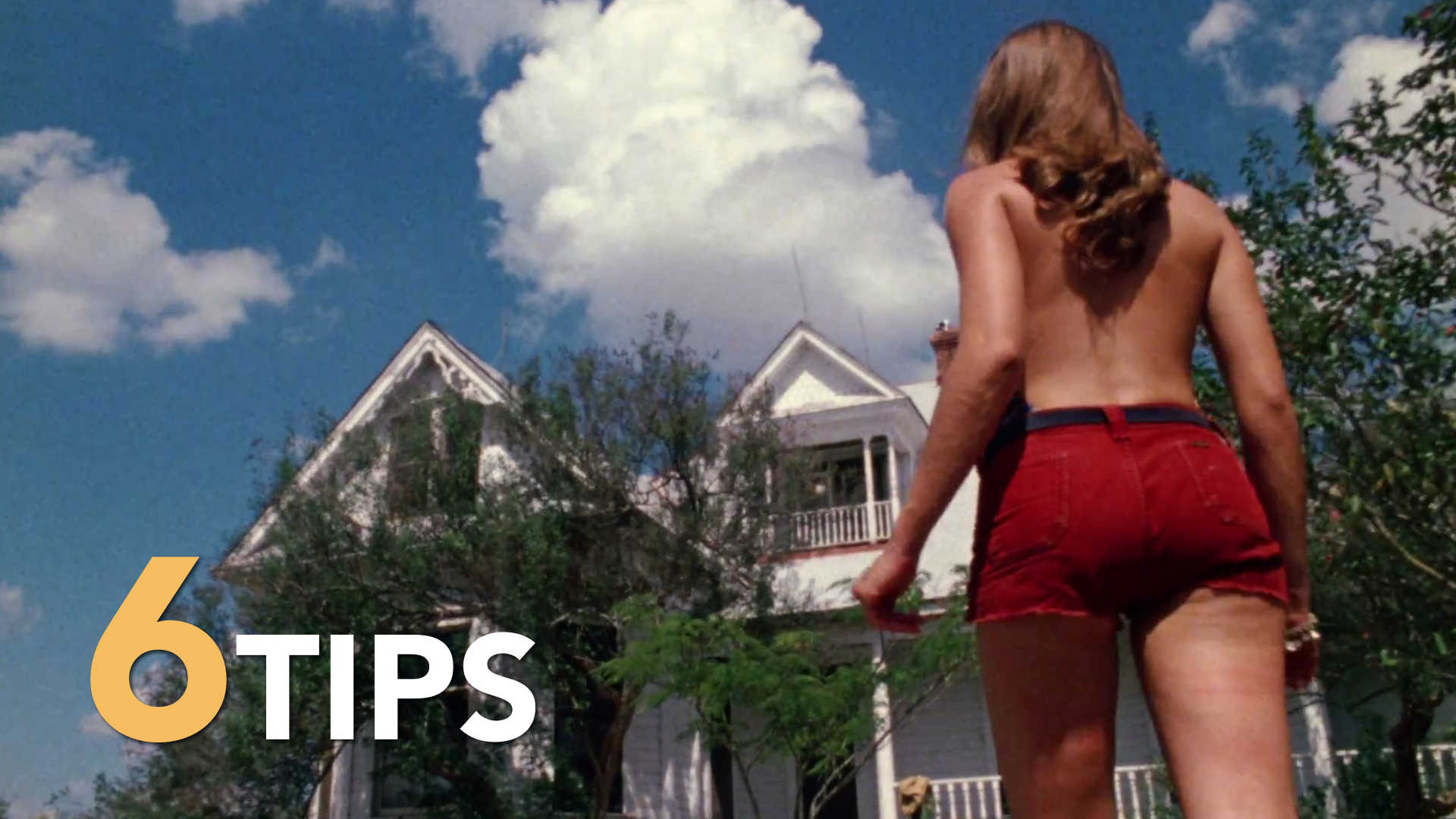
They decided to do the best they could. This meant using light to their advantage. In an iconic scene when Pam walks into the dreaded house, she doesn’t know what’s ahead, and neither do we. The cinematography focuses our attention on a tiny area, giving us just a glimpse, instead of lightning up the place like it was Leatherface (2017).
Instead of complaining you have only one light, be happy you have one light, and use it creatively. The iconic dinner scene is another great example of using what you have in interesting ways. Simple household practicals are dressed in such a way you think there’s a lot more going on than is.
In The Texas Chainsaw Massacre they used the 1+1 technique. They had one light and one practical in most situations. This could be a flashlight, headlights or the lights in a house, but they used what they had in ways that made sense.
2 Shoot “clean”
If filming gritty isn’t for you, there’s a case to be made for recording the cleanest image possible.
Friday the 13th was shot on 35mm film, and you can see the clarity and resolution is just night and day. They had a bigger budget, and better film stock. It’s easier nowadays to make a clean frame gritty, but you can’t do the reverse without compromising greatly in some other area.
In The Texas Chainsaw Massacre many shots are on the verge of complete underexposure. You might burst a blood vessel in your eye by just witnessing the limits of 16mm film. Today, reflectors are cheap, cheaper than your underwear, so you know which one to hang out to dry to get some fill light in the shadows.
In comparison, Friday the 13th is lit up like a Coca Cola commercial, which is a product placement both movies share.
One way to get cleaner and crisper images is to use a good amount of fill light and a camera with great sensitivity, which most cameras have nowadays. Even the worst camera today is better in many respects than what they had in The Texas Chainsaw Massacre.
3 Pay attention to colors
The standout feature of both films, even with their tiny budgets, is their discipline towards a color story. Both films share the same red-green ideas. The gas station has both red and green elements. In Friday the 13th the entire town is green and red.
Every car, prop and location was chosen based on this. The same applies to Friday the 13th, you can see both green and red vehicles, and the clothes are neutral. I’ve made a video on how most films use the 60-30-10 color rule, and you can use that to give your films a unified look:
Today, we have a lot more freedom. If one or two elements are out of place, we can color grade them to match our overall vision, but you really don’t want to color grade everything. That’s just counterproductive.
4 Shoot car interiors during the day
In an interesting and thrilling scene in the van, from The Texas Chainsaw Massacre, they pick up a hitchhiker and drive along as things unfold. However, the van isn’t really moving.
They show you the beginning and the end, but most of what happens inside is in a static car. The camera is placed low so you see the ceiling and feel claustrophobic as a side benefit. Discomfort was one of the perks of working on The Texas Chainsaw Massacre.
In Friday the 13th the day car interiors were all shot in real moving cars. When you have a truck you really don’t want to do the poor man’s process. This is the “homeless man’s” process, where you roll wherever you are, whenever you are….ready or not.
5 Make a shot list, and don’t stick to it
After a week of shooting The Texas Chainsaw Massacre the producers wanted director Tobe Hooper to make a shot list. He did, but never used it.
Shot lists are important, until they get in your way. Sometimes all the plans you made sitting in a coffee shop sipping latte will turn into your worst nightmare on a film set. When that happens, throw them away.
And don’t forget to shoot B-roll. When the van drives by the slaughterhouse, you see cattle. They don’t show anything horrific, but what they show makes a lot of sense because when they show it, that’s the last thing we want to see. Just like Psycho, The Texas Chainsaw Massacre is great because it doesn’t show any gore. It’s all in your head. It was always there. That’s why you decided to watch it!
Of course, the cliched rule of shooting the moon and sun is important as well, you never know when you need inserts. Speaking of which…
6 Use sunlight
Use natural sunlight and golden hour to your advantage. I have a whole video on how to shoot at any time during the day without lights or reflectors. It’s not free any more, and is only available to members:
Both films use sunlight to great advantage. Mostly as back and side light, especially during golden hour. The prettiest and most important scene in Friday the 13th was shot in pure natural light.
That’s six tips on cinematography. There are of course, other filmmaking tips. Copy Psycho for one. Use similar music if you must. Sometimes you create a MacGuffin just to throw people off. You show a dead patriarch who might or might not be dead, you kill a lady you thought was the protagonisht at the beginning in a shock twist.
And most of all, you pick the last woman standing based on how well she can scream.
I hope you found this useful. Feel free to add more tips and suggestions in the comments below.

excellent scholarship as ever.
Thank you. You used pretty much my favorite movies to teach me.
You’re welcome!