

Watch the video:

A cinematography style is different from a film genre or directorial style. E.g., you can make a surreal film, but you could have infinite types of dream-like styles as far as cinematography is concerned. I’m focusing on just the ones that are established in cinema.
Secondly, this classification is based on lighting predominantly. You could use any cinematography element to classify styles – wide angle lenses, filters, composition, there are infinite possibilities.
There’s a lot of grey areas, and you shouldn’t get too logical here.

1. The naturalistic style
You could also call it the documentary style. I use the word ‘naturalistic’, because that’s what I learned from Sidney Lumet. The images look like they were shot on a cheap video camera, or CCTV camera, or other consumer device with the objective of making it look un-staged.
Found footage horror is a great example of this style. In a non-horror category The Office is a great example, where the objective was to portray fiction as if a real camera crew were recording everything.
The naturalistic style uses our inner belief as the audience that footage that looks like it was shot on a video camera is more authentic. Of course, that world is soon changing. Maybe in about twenty years even the cheapest cameras will look very cinematic. Kids born in that generation would probably grow up without this belief that we presently have. It is quite possible that found footage as a genre will cease to exist in the future, but not yet.
The strongest sign of the naturalistic style is the lack of lighting, or at least the appearance of that illusion. That’s what differentiates it from the next one.

2. The realistic style
The realistic style is when the cinematography tries to portray realism, but in a filmic way. 99% of movies we see are shot with this style.
The objective is not to draw attention to the cinematography or camera work. The lighting is natural looking but cinematic, and the focus is on raising the production values of each shot.
With the realistic style, there is a dedicated attempt to compose and light in the traditional cinematic sense. The key is, the lighting takes on a more functional role as opposed to being a style statement.
It’s hard to define the realistic style!
It’s easier to say it’s not ‘this’ or ‘that’, or any of the other styles in this list. Even if you shoot with the most expensive camera in the world, the absence of lighting will give it a documentary feel, which is the naturalistic style. The realistic style just doesn’t want to advertise being any different.

3. The high key style
This is the style where the world is always a happy place!
The faces are almost always well lit, and the shadows are all kept to a minimum. In fact, shadows only exist because they have to, and to give depth and dimension. Every square inch of the frame is lit, like you’re in a bright mall all the time.
Most sitcoms and romantic comedies are lit in this fashion. There is a strong objective here, of keeping things light-hearted. It doesn’t happen by accident. The lighting has to be carefully prepared to get this look, and to maintain it throughout a film.
Other examples are cartoons for kids, and beauty commercials. They’re all selling happiness and joy. But what if you aren’t?

4. The expressionistic style
This is heavily influenced by German expressionism in cinema. From The Cabinet of Dr. Caligari to Fritz Lang’s M, to Hollywood film noir, the focus is on extreme contrast, more than you’ll typically see in real life.
You’ll also see hard shadows, and lots of shadows. The goal of the expressionistic style is to use lighting in a less subtle way. That’s derived from the classic expressionistic style in painting and fine art. You have fierce brush strokes of light and shadow, and the result is always moody and sombre.
David Lynch’s films have a lot of expressionistic elements. He uses in-camera effects like double images, dissolves and flashes as part of this cinematography style. Many would call Lynch’s cinema surreal, but the cinematography is expressionistic through tradition.
Another director whose work people will call surreal is Dario Argento, but his use of color is expressionistic. Strong, bold and definitely beyond what you’d see in real life.
Even though expressionism is mostly obtained through lighting and color, you can also use camera tricks like playing with the shutter speed or frame rate, as you see in some scenes of Chungking Express. Even slow motion can be considered expressionistic. Any effect achieved in-camera or in editing can be considered expressionistic.
Another less subtle example of the expressionist style is the The Matrix. The lighting is natural when we are in the Matrix, but the color is green. So obviously realism isn’t the cinematographic goal. In the real world the expressionistic style is clearly visible. You also get the bullet time effect, which is done with multiple cameras firing in a sequence. For me, The Matrix is definitely expressionistic.
Another good example of the expressionistic style is Zack Snyder’s work. 300, Watchmen, Sucker Punch and the movies in the later DC universe are in the expressionistic tradition. On the other hand, Christopher Nolan’s DC universe is realistic, and the Marvel Universe is also in the realistic style.
What if you want to push the expressionistic style to even more extremes? Is that possible? Yes.
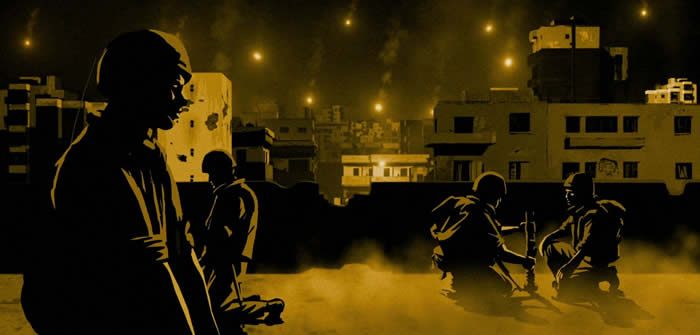
5. The ‘stylized’ style
The reason I use the word ‘stylized’, is because the filmmakers go out of their way to draw attention to the style. Sin City is one great example, where you have expressionistic lighting, but the style is pushed to a level that almost makes it look like an animated film.
A Scanner Darkly is another great example, as is Waltz with Bashir, which are movies that have had animation drawn over live action. This is different from movies with animated characters in them, like Who Framed Roger Rabbit or Space Jam. Here, the goal is to present a very stylistic representation of reality, and there is not doubt it’s stylized.
Visual effects isn’t mandatory. You can have this kind of stylized filmmaking without used CGI. Some of the scenes and work of Wes Anderson are purely stylized. Not all, though.
Andrei Tarkovsky’s films can have multiple styles in the same film. E.g., Stalker has stylized cinematography as well as realistic cinematography.
You can even have animated movies that are fully stylized. A lot of Japanese anime is highly stylized in its cinematography. But not all animation is stylized. Avatar is in the realistic style.
Movies can be multiple styles. Raging Bull has realistic lighting, but in some scenes it has expressionistic lighting.
The first Blade Runner is in the expressionistic style. The second one, Blade Runner 2049, is in the realistic style.
And on and on it goes.
As a practical tool these styles are basically words you can use to communicate with other crew members, or your colorist. If you dwell too much on the logical aspect, you’ll get into unnecessary arguments!
What do you think?

This was an insightful read! I love how you broke down the different cinematographic styles and their impact on storytelling. It’s fascinating to see how each style can evoke different emotions and enhance the viewer’s experience. Thanks for sharing!
You’re welcome!