

Two cameras both potentially suitable for Netflix – the Canon EOS R5 (Amazon, B&H) and the Panasonic S1H (Amazon, B&H). Which one is a better investment for serious filmmakers?
Here’a fun comparison.
Important!
Treat this as a fun comparison, or a placeholder article, with currently available information.
In many ways, I’m writing this article to understand the distinction myself. Do these cameras serve an overlapping market, or will they appeal to different sets of filmmakers?
I have shot with the S1 and have played around with the S1H a little bit. Check out my comprehensive real world review of the Canon EOS R5:

What kind of filmmaker needs autofocus?
I recently shot a documentary. I had an assistant who also operated a DJI Ronin S (Amazon, B&H).
The idea is, I could potentially have shot the documentary myself, with the entire kit in a backpack.
For the solo filmmaker, having AF is a tremendous advantage. But it has to be reliable. The importance of good autofocus for corporate videos, interview situations, gimbals and weddings cannot be stressed enough. It just saves you a lot of time and money.
If absolutely and critically need autofocus, then the Canon EOS R5 (Amazon, B&H) can’t be beat. The AF on the S1H is poor and unreliable.
The rest of the article assumes you don’t need world-class AF.
Who are these cameras aimed at?
Canon has clearly aimed the R5 as a B-cam for Canon’s video flagships, the Canon C300 Mark III and the Canon C500 Mark II. The S1H can stand alone, but is also aimed as a B-cam for the Panasonic Varicam.
Ruggedness is critical. It is assumed you are not pulling out your camera in air-conditioned halls all the time.
Sometimes you might travel to dangerous locations, sometimes to dusty ones. Sometimes you might travel to a country where a replacement is hard to find. Or maybe you need something light enough to fit carry-on or trek with. Reliability is key.
And finally, we come to the price – which is where image quality is also important. Even if you have indie filmmakers pining for 8K RAW or whatever, the reality is theirs films don’t really warrant it. There is little or zero ROI on independent projects or low budget films.
So, even if they can buy these cameras, they are not really the market these cameras are aimed at. If you’re not earning good money already it is hopeless to spend money on expensive gear.
I’m personally only interested in both cameras as A-cams, but I’m not the main market for them!
I know a lot of readers will find this disappointing, but poor filmmakers are not the primary market for these cameras. These companies hope to sell cameras to more affluent productions in need of a B-cam, or solo professionals in need of a B-cam. The additional group in the case of the R5 is photographers, but that’s it.
This article, though, will try to balance both worlds.
Quick menu
- Comparison of sensors and video features
- Exposure, focus and ergonomics
- The costs of media and batteries
- Which is cheapest to own?
- Verdict. Who wins?
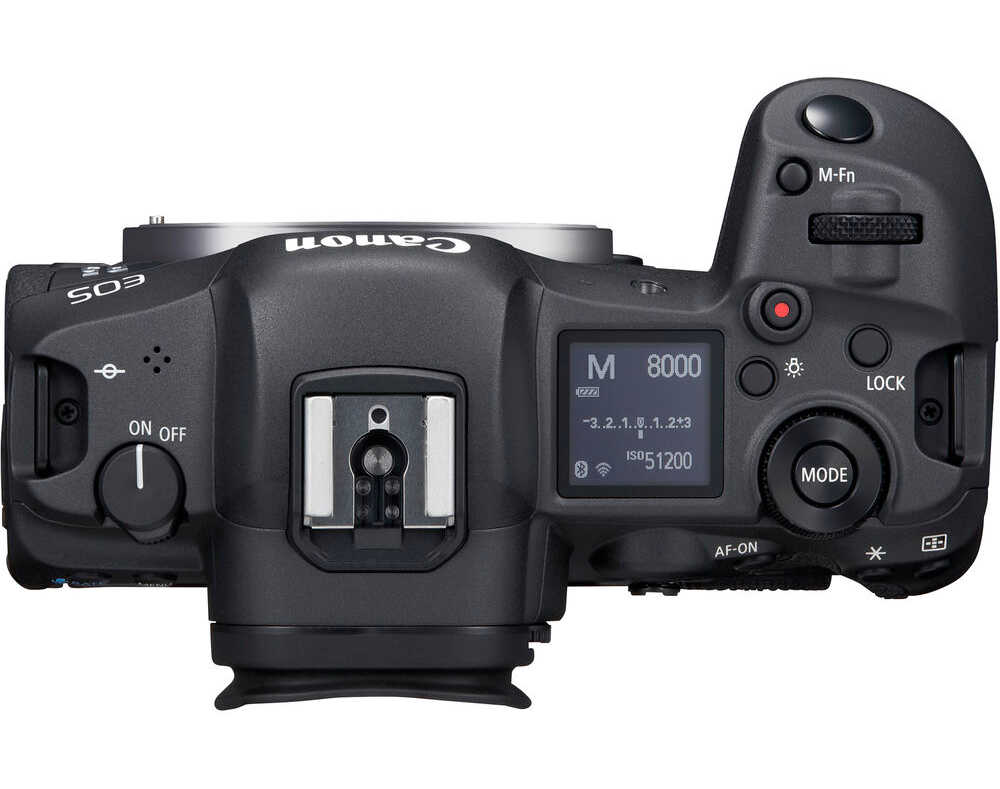
Comparison of sensors and video features
Here’s how the camera sensors compare for video:
| Camera | Resolution | Maximum FPS* | Video ISO Range^ |
| Panasonic S1H | 5952 × 3968 | 24p | 640-51,200 |
| Canon EOS R5 | 8192 × 4320 | 29.97p | Unknown |
* Maximum fps at 4K is 60 fps for the S1H and 120 fps for the R5.
^Even though the cameras seem to go to impressive ISOs, that’s only in stills mode. The ISO range for video is limited.
4K frame rates?
| Camera | Max fps at 4K | Dynamic Range | Max fps at 1080p |
| Panasonic S1H | 60 fps | 14 stops | 180 fps |
| Canon EOS R5 | 119.88 fps | 12 stops* | 59.94 fps |
*The R5 is supposed to have similar DR to the R6, which shares the same sensor as the 1D X Mark III (which has 12 stops).
The S1H has more DR in V-Log, and has better fps for 1080p. On the other hand, Canon has better Fps in 4K. Also, the S1H has probably better low light performance.
If only filmmaking and cinema is covered, 4K 120 fps is more important than 1080p180. So it’s a hard call.
The major downside of the Canon EOS R5 is overheating limitations. It can only record up to 20 minutes in 8K until it needs to cool down. It has similar restrictions for 4K as well (in its best modes). I’ll need to test this in the real world, though it looks like you don’t want to record in more than 10-minute spells.
So, here’s what I would advise:
If you are a run-and-gun operation, where things (actors, schedules, lighting, etc.) are unpredictable, the Panasonic S1H (Amazon, B&H) is clearly the better choice.
However, if you have a controlled production, with well-trained actors, and lighting is available, the Canon EOS R5 (Amazon, B&H) will give you more opportunities.
Next, the codecs and color information:
| Camera | RAW and Code in 4K and Higher | Color Information |
| Panasonic S1H | H.264/H.265 ALL-I | 10:bit 4:2:2* |
| Canon EOS R5 | Canon RAW Lite | H.264/H.265 ALL-I, IPB | RAW | 10-bit 4:2:2/8-bit 4:2:0 |
Here you see the first big limitation of the S1H. It is restricted to compressed codecs internally, and for 6K you only get 4:2:0. However, if you’re restricting yourself to 10-bit 4:2:2 4K in V-log, you should be okay.
The RAW format in the EOS R5 is Canon RAW Lite, written as a *.CRM file. The RAW compression ratio is typically 3:1. The file sizes can get really large for RAW.
Canon RAW Lite is universally supported by editing and grading programs, and play nice with hardware.
The S1H is supposed to give us RAW externally, though at the time of this writing things are still vague. Even if it did give us that feature, that would just add to the expense and the headache that is Prores RAW at the moment (for post production).
| Camera | Expected Rolling Shutter Performance |
| Panasonic S1H | Rolling Shutter is Average |
| Canon EOS R5 | Rolling Shutter is Bad* |
The rolling shutter in the 1D X Mark III is terrible, and I expect the R5 to be just slightly better in 4K. In 4K and 4K cropped mode the rolling shutter might improve and be “par for the course” for the mirrorless segment. Though I would give this to the S1H.
I’ll not talk about the audio features since that needs to be tested in the real world. They have similar features and ports.

Focus and exposure aids, and ergonomics
What’s the point of RAW if you can’t expose it correctly? The little things make all the difference:
| Camera | Exposure |
| Panasonic S1H | Waveform, Vectorscope, Zebras, Histogram, Meter, 3D LUTs |
| Canon EOS R5 | Histogram, Meter |
The S1H is clearly better in this regard. Both have focus peaking.
As far as size and weight are concerned:
| Camera | Ergonomics | Weight |
| Panasonic S1H | It has a fan and it is audible, grip is painful, not the most pleasurable to hold. | 1052g |
| Canon EOS R5 | No fan, I expect the grip to be okay-ish (but not DSLR-like). | 650g |
Weather sealing is promised on both cameras, even though the S1H has a fan.
The LCD screens on the R5 are full tiltable and swivel out. Overall, for ergonomics I’ll give it to Canon.
Image Stabilization
Both the Canon EOS R5 (Amazon, B&H) and Panasonic S1H (Amazon, B&H) have internal image stabilization (IBIS). If the lens doesn’t have IS, then I think it’s limited to about 3-5 stops.
Canon clearly has the greatest range of lenses available. The L system has limited lenses and are more expensive as well.
Batteries and media cards
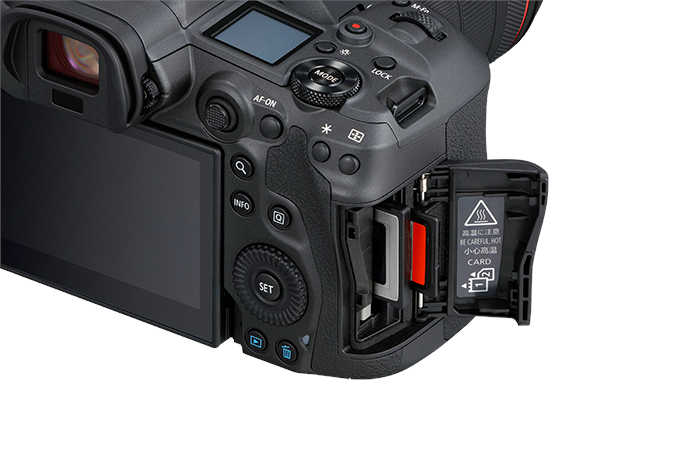
Here’s a look at the media
| Camera | Dual card slots | Price per GB for 512 GB* |
| Panasonic S1H | Yes, SDXC | $0.33/GB |
| Canon EOS R5 | Yes, CFexpress Type B and UHS-II SD Card | $1.17/GB and $0.33/GB |
CFexpress cards are not cheap (comparing Sandisk Extreme Pro to be fair). For practical shoots, you will need multiple cards. This could really add to your budget for RAW shooting.
And, the dual cards are useful, but you can’t record RAW to both cards at the same time with the R5. You can record RAW to one card, and 10-bit 4:2:2 to another.
For the R5, there is a record limit of 30 minutes. The overheating issue in the R5 makes it even worse in 8K RAW mode and HFR 4K mode.
What about battery life?
| Camera | Battery life | Cost one one battery | Cost of 6 hours of operation |
| Panasonic S1H | 60 minutes^ | $88 | $528 |
| Canon EOS R5 | Unknown, but probably not as good. | $79 | $600* |
I’m going to give this a tie because you can always opt for third-party solutions, cheaper batteries, etc.
Which is cheaper to own?
Let’s just add up the costs:
| Camera | Canon EOS R5 | Panasonic S1H |
| Camera body | $3,899 | $3,998 |
| Media and Accessories^ | $600 | $62 |
| Batteries* | $600 | $528 |
| Recorder^ | $0 | $695 |
| Total | $5,099 | $5,283 ($4588)# |
^If you need RAW to equalize both. Note, I’m only adding the cost of the recorder, though you need accessories, batteries and SSDs for it.
#Price without recorder
The prices are really similar to both. The external recorder will add costs to the S1H if you need RAW (which as of this writing is still not available). You also have to remember the R5 is a 45MP photography beast with 20 fps shooting. The S1H is limited to 24 MP and 9 fps.
The Canon EOS R5 (Amazon, B&H) really stands out as a photography tool, so this is strictly not an apples-to-apples comparison as far as price is concerned.
Recap
First, a recap:
| Feature | Winner |
| Sensor and ISO | Panasonic S1H |
| Video features | Tie |
| DR and Color | Panasonic S1H |
| Rolling Shutter | Panasonic S1H (Estimated) |
| Exposure Aids | Panasonic S1H |
| Media | Tie |
| Lenses | Canon EOS R5 |
| Ergonomics | Canon EOS R5 |
| Ports and Monitoring | Tie |
| Audio | Canon EOS R5 |
| Autofocus | Canon EOS R5 |
| Battery life | Tie |
Before we take our final decision, we’ll let the cameras tell us what they offer that the others don’t:
| Camera | USP | Major Cons |
| Panasonic S1H | Exposure tools, unlimited recording | Fan noise, you need to buy an external recorder for RAW |
| Canon EOS R5 | 4K fine and crop mode, 8K RAW, 4K 120 fps, 45MP | Overheating, expensive media for this price-class |
My Verdict
I said I’ll try to provide a balanced overview, even though it’s hard. Here’s what I think:
| Type of Filmmaking | Preferred Camera | Major Reasons |
|---|---|---|
| Short documentaries and corporate videos | Panasonic S1H | Long recording times and no overheating. AF not that critical. |
| Major documentaries or B-cam to the same | Panasonic S1H | Long recording times and no overheating. AF not that critical. |
| Short or feature films | Both | Depends on AF, as mentioned earlier. |
| Music Videos | Canon EOS R5 | 8K crop to 4K, 120 fps 4K, AF |
| Journalism | Neither | Budgets are too low for either. |
| Wildlife | Panasonic S1H | Even with AF the overheating spoils it for the R5. |
| Weddings and Events | Canon EOS R5 | Color grading rarely necessary. AF is very important. |
| Photographers who need a bit of Video | Canon EOS R5 | Color grading rarely necessary. AF is very important. |
I know people won’t care if they can afford the camera they want, regardless of what might be best for them. If you’re under a budget and seriously considering which camera is best, I hope this comparison helps you some.
For me, the Panasonic S1H (Amazon, B&H) wins. It’s the camera I would pick if I had to fulfill multiple roles as a video shooter or cinematographer. For this class of shooter the R5 has major issues:
- Too expensive to shoot RAW.
- Overheating.
- Recording limits even when there’s no overheating.
Hopefully I’ll get my hands on the Canon EOS R5 (Amazon, B&H) soon (I’ve placed pre-ordered one) to put it through its paces.
What do you think?
