

The Sony a7S III (Amazon, B&H) has been due for ages. What’s really new about it?
The most important news is:
Up to UHD 4K 120p, 10-bit 4:2:2 internal recording
16-bit RAW output to an Atomos Ninja V
HLG & S-Log3 gammas
Better low light ability than the a7S II
759-point fast hybrid AF for video
It’s natural for a serious video shooter and filmmaker to be interested in this camera. Let’s go over some important quirks and features of the Sony a7S III (Amazon, B&H) for cinematography and video.
4K 60p
What’s the bottom line? Here are you questions answered in a nutshell:
- It is full frame 4K, no crop.
- You get only 4K UHD (3840 x 2160). No 4K DCI internally.
- Log can be shot internally in 10-bit 4:2:2.
- Dynamic range is 15 stops in S-Log3.
- Best file format is XAVC S-I H.264. Then XAVC HS H.265.
- Both are available in 10-bit 4:2:2.
- There is no record limit in any mode (but there is overheating, see below).
What is the crop factor in 4K?
There is no crop factor up to 4K 60p.
At 120p the crop factor is 1.1x. E.g., a 35mm lens will become the equivalent of a 38.5mm lens.
What are the data rates for 4K?
Here are the data rates for 10-bit 4:2:2 for the Sony a7S III (Amazon, B&H):
| Resolution | Codec | Data rate |
|---|---|---|
| 4K 23.976p to 119.88p | H.265 XAVC HS | 50 to 280 Mbps |
| 4K 23.976p to 59.94p* | H.264 XAVC S-I | 240 to 600 Mbps |
| 4K 23.976p to 119.88p | H.264 XAVC S | 100 to 280 Mbps |
You can also shoot in. 10-bit 4:2:0 and 8-bit 4:2:0 modes, though I’m not listing them here.
One thing to note is that, if you want to grade your image, you might want to stick to H.264 XAVC S-I (ALL-I), because it gives you the least compression in 10-bit 4:2:2. 600 Mbps is 75 MB/s.
Just to put some perspective, this equates to:
- About 14.5 minutes on a 64 GB card at 600 Mbps.
- About 31 minutes on a 64 GB card at 280 Mbps.
This is the highest data rate Sony has ever provided in a mirrorless alpha series camera.

What about 1080p or HD?
The maximum frame rate for HD is 240 fps. No crop.
What is the recording time limit for 4K ?
There is no internal recording time limit. However…
What are the overheating limitations of the Sony a7S III?
According to Sony, here are the answers:

In a nutshell:
- Up to 60 fps: The Sony a7S III overheats after one hour of recording in ALL-I.
- At 120 fps: The Sony a7S III overheats after 30 minutes of recording in ALL-I.
- Up to 30 fps: No limit.
This is for 25°C, as long as the battery lasts. It shows the battery doesn’t last for over an hour. It’s better than the EOS R5, though not by a lot.
Also, it seems there is a setting in camera called Auto Power Off Temperature, which should be set to High. This means the camera will only shut off once the maximum safe temperature is reached.
As of now Sony hasn’t listed how long it will take to cool the camera after overheating.

What media card do you need?
The Sony a7S III (Amazon, B&H) has dual UHS-II SD slots. These slots can also be used for CFexpress Card Type A cards.
To record 4K 120 fps, you need CFexpress Type A cards. That’s a bummer, because Sony doesn’t include one in the basic package. Sony does include a memory card “kit”, with one 160GB Type A card, but no reader!
That is a strange oversight.
Type A is not really popular, as other cameras have preferred to use the faster Type B CFexpress card. Does this mean y ou can’t shoot 120 fps 4K yet? CFexpress cards are hard to buy right now, and readers are even rarer, especially in India. The USA is luckier in this regard, though.
The Type A CFexpress cards are not available at the moment in the market, so most people will stick to UHS-II SD cards. You can record up to 4k 60 fps on SD cards.
I recommend Sandisk Extreme Pro SD cards (Amazon, B&H), at 128 GB or higher.
What is the ISO range for 4K?
The ISO range for video is 160 to 409,600 in S-Log3. The native ISO hasn’t been published yet, but I think it might still be ISO 800 as with the a7 III.
What. is clear from the launch video is the low light performance has improved a lot. I guess it should be easy to shoot with this camera to 25,600 ISO without penalty. It remains to be seen what effect it has on dynamic range.
Is there IBIS (image stabilization) in the Sony a7S III?
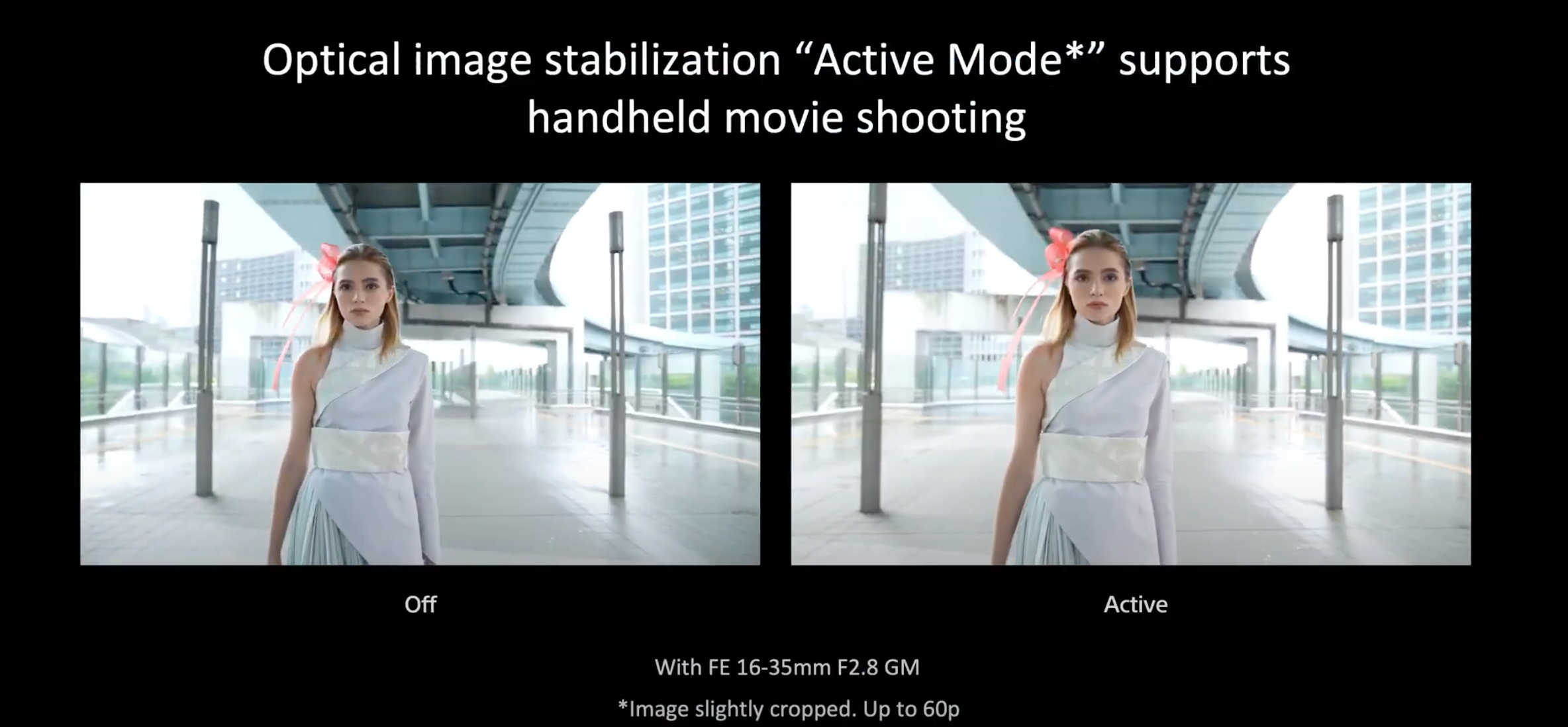
Yes, the same 5-axis IBIS is there, but there’s also a new mode called ‘Active mode’, which is dedicated for movie recording, up to 60p.
Sony claims no gimbals are required when used with Sony wide angle lenses.
Image is slightly cropped in Active mode, as you can see below:
What video exposure tools are available in camera?
Just the in-camera meter (Exposure Level Meter) and Histogram (Luma and RGB). You also get an electronic level.
The Sony a7S III (Amazon, B&H) also has Zebras and Focus Peaking.
What about the LCD?
This is something new for Sony Alpha users:
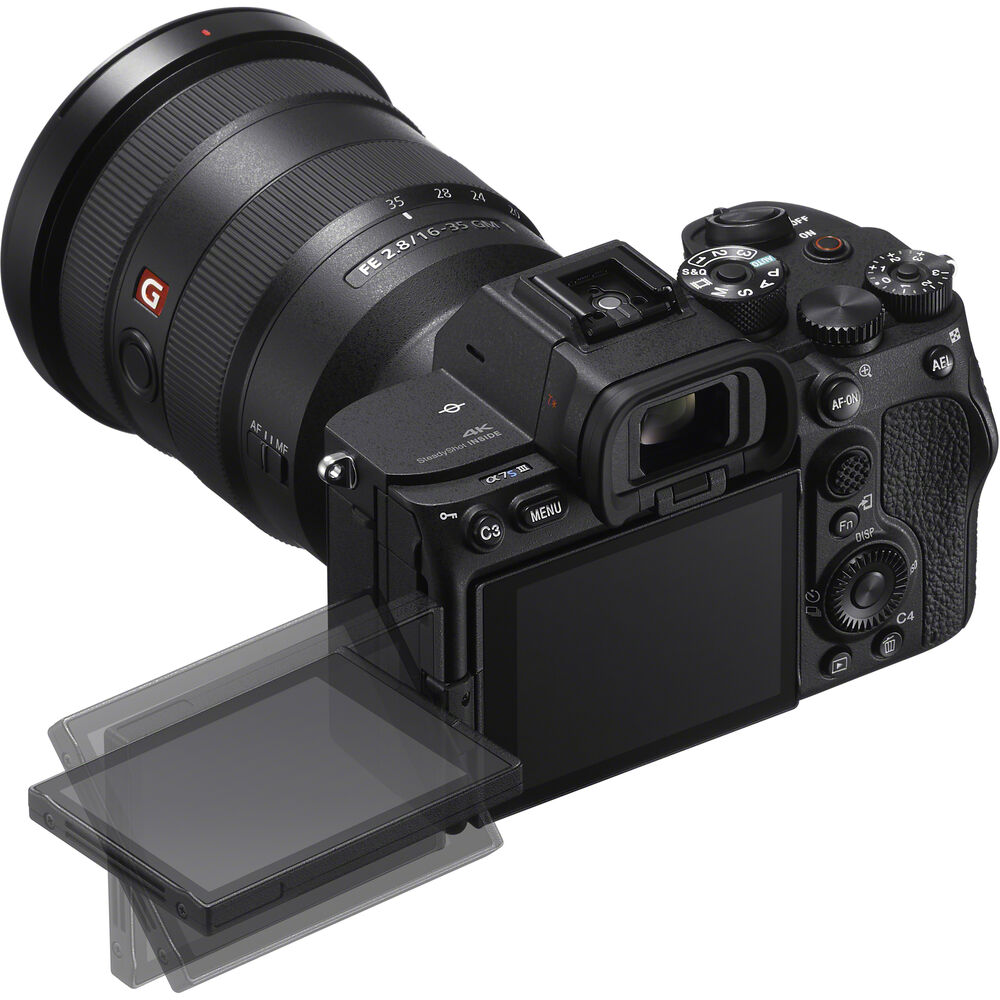
The camera finally has a tilt and swivel LCD screen, also called a Fully Articulating Screen. This is incredibly important for video work, where you might have to place the camera at all kinds of video angles.
Finally! I hated the old design.
Can you upload and use LUTs in the camera?
No. But you can use LUTs in software.
What is the best format for external video recording?
The best video format that can be exported is 16-bit 4.2K (4264 x 2408) RAW via HDMI Type A.
The maximum frame rate is 59.94p.
The 16-bit is converted to 12-bit in the Ninja V. From Atomos:
The data-rich 16-bit linear RAW output of the Alpha 7S III is compressed and recorded in the Ninja V as 12-bit ProRes RAW at up to 4Kp60.
The combination will record ProRes RAW video for as long as you have disk space on your SSD and power for the camera and recorder. The active cooling employed means that internal record time limitations can be bypassed making a perfect setup for performances and long interviews. Optionally, RAW video can also be captured on the Ninja V at the same time as compressed video is recorded internally to memory card on the Alpha 7S III, providing several workflow options and a useful backup
Atomos
The. RAW update is scheduled to come in September 2020. The camera ships in August, so I guess that’s fine – as long as there are no delays similar to the S1H.
The Sony a7S III uses a full size Type A HDMI port. You definitely need HDMI 2.0 or better cables (also called high-speed HDMI) for RAW. This will be available at a future date, possibly via the Atomos Ninja V.
An HDMI cable protector is included with your purchase.
What format should I choose for the best video quality on the Sony a7S III?
I suggest 4K S-Log3, XAVC S-I (ALL-I) in 10-bit 4:2:2.
And maybe Prores RAW in the future. I need to test the camera to know for sure.
How is the rolling shutter performance of the Sony a7S III?
According to Sony, the rolling shutter in the Sony a7S III (Amazon, B&H) is three times better as compared to the Sony a7S II.
That’s great news!
What about HDR?
You can shoot HDR with the Sony a7S III (Amazon, B&H) in HLG. No PQ in-camera. However, you can use the Ninja V to record or monitor in either HLG or PQ.
Can you record simultaneously to the other SD card?
Yes, you can record 4K on both SD cards at the same time. However, according to Sony’s overheating chart above, 120 fps might only be possible with CFexpress Type A cards.
There is also a Proxy recording mode, so you can record to a lower quality on the second card.
We’ll have to wait to see how this works in the real world.
How good is the autofocus for video?
It’s going to be amazing, if Sony’s marketing video is to be believed. Active eye tracking looks great. More testing is required!
The good news is AF is available in all 4K modes, including 120p!
The AF sensitivity goes from -6 to +20 EV, which is one stop higher than the Canon EOS R6.
It is quite clear the Sony a7S III (Amazon, B&H) will probably have more dynamic range than the a7S II, the a7 III and the Canon EOS R6 – in S-Log3.
New menu!
There is a new menu design!

What are the audio specs?
The audio is recorded as Linear PCM in 24-bit mode. The cold shoe can transmit power directly to a Sony mic or XLR adapter. Good for vloggers and basic event shooters.
It has a 3.5mm microphone jack and 3.5mm headphone jack.
Any word on battery life for video?
From the official specs:
Normal recording:
Approx. 80 min (Viewfinder) / Approx. 95 min (LCD monitor)
Continuous recording:
Approx. 130 min (Viewfinder) / Approx. 135 min (LCD monitor)
So, lower than the a7 III but much, much better than the a7S II. How do I know this? The a7S III uses the same NP-FZ100 battery, rated for 600 shots (The a7 III was about 700 shots).
You get one Sony BC-QZ1 charger and one battery with the kit (Amazon, B&H). The power consumption is 7.3-7.6 Watts in movie mode.
You can also power the camera or charge a battery via USB-C. A cable is provided with the camera.
Is the Sony a7S III weather sealed?
I don’t think so. Sony didn’t really mention it. But it claims to have improved weather resistance:
Reliable, durable construction
To maximize dust and moisture resistance, additional sealing has been applied to all body seams and to the battery compartment cover, and the media slot cover has been redesigned to handle harsh outdoor environments. A filter in front of the image sensor oscillates at an ultrasonic frequency of 70,000 cycles per second to remove dust from the sensor surface. The camera chassis is highly durable thanks to full magnesium-alloy construction.
The Sony a7S III (Amazon, B&H) is one hell of a camera for low budget shooters – primarily:
- Wedding filmmakers,
- Journalists,
- Event filmmakers, and
- Documentary filmmakers
Here’s my comprehensive review:
What do you think?

Thanks for going over the details for us . I’ve watched many videos on this camera but going over the specs and your thoughts/explanations on them also helps .
I really looking hard into this camera . I need high iso and dynamic range many time shooting events, festivals and live music shows with both photos and videos. I’m gathering footage for a documentary at the moment also . Much is run and gun . We (2) of us shoot 5-7 cameras at the live music shows videography. Setting up the lighting, sound capture and cameras. We do an interview with the bands along with using some of the same cameras and light for the stage . So running and gunning . Long days and longer nights . One festival we get up at 7:30-8 and got to bed at 3:30-4 for 6 days . This camera looks as maybe an asset.
You’re welcome! Check this out: https://wolfcrow.com/10-ways-the-sony-a7s-iii-is-better-than-the-sony-a7-iii/
One of the best and most concise A7s III round-up of features I’ve read over the past day or two. No fluff! Well done.
Thank you!
Nice wrap up…The camera is looking real good :)
We dont need the CFexpress Type A card for 4K120fps.
You can shoot with a Sony Tough SDXC too.
Only if you need that 4K 120fps slowed down processed file via S&Q, then you will need that Type A.
Thank you for the clarification. Hopefully I’ll get the camera in my hands soon.
? ? ? ? Good write up..
Thank you!