

The Canon EOS C70 (Amazon, B&H) is the latest entry level addition to Canon cinematic range of cameras, with one major distinguishing factor. It is Canon’s first RF mount cinema EOS camera.
Canon has tried their best to reduce the body size and weight of the camera making it perfect for run and gun shooting situations.
In this article let’s look at a few important quirks and video features of the Canon EOS C70 for cinematography
The Camera Sensor
The Canon EOS C70 (Amazon, B&H) has a Super 35mm-sized 26.2 x 13.8 mm sensor. However, the size changes when you shoot in UHD to 24.2 x 13.8 mm.
That’s a crop factor of 1.08. Negligible for all but the widest angles.
Canon boasts a Super 35mm Dual Gain Output (DGO) sensor, similar to what you get with the C300 Mark III. They claim it provides dynamic range measuring up to 16+ stops (-6 to 54 dB Gain). The DGO sensor reads out each pixel as two different degrees of gain, like two drastically different exposures for each frame. One “exposure” protects details in highlight areas and the other emphasizes shadow detail.
Is it as good as what the Alexa has (the only other cinema camera with dual gain architecture) or is it just a marketing gimmick? We can only tell once we get our hands on it.
There is also a Super 16mm mode which might be beneficial in some use cases. With this mode, the sensor reduces to 12.32 x 8.21 mm and the crop factor is about 2x (less than Micro Four Third’s size). This might be a turn off for most people.
One area where the Super 16mm mode becomes useful is if you want higher frame rates up to 180fps.
The Canon EOS C70 (Amazon, B&H) also has the legendary dual pixel AF system, but improved:
The EOS C70 is also the first Cinema EOS camera to feature EOS iTR AF X, a new AF algorithm that improves subject detection and tracking as well as incorporating head detection
Canon Usa
Does the Canon EOS C70 shoot RAW?
The Canon EOS C70 does not shoot RAW. The best codec is 10-bit 4:2:2 XF-AVC.
High Frame Rate
Frame rates range from 15 fps to 120 fps in Super 35mm and 15 fps to 180 fps in Super 16mm.
| Sensor Mode | Time Base | FPS |
|---|---|---|
| Super 35mm | 23.976/24p | 12-120 fps |
| 29.97p | 15-120 fps | |
| 25/50p | 15-120 fps | |
| 59.94p | 15-120 fps | |
| Super 16mm (cropped) | 23.976/24p | 12-180 fps |
| 29.97p | 15-180 fps | |
| 25/50p | 15-180 fps | |
| 59.94p | 15-180 fps |
You get 4K up to 120 fps, and that’s handy to anybody.
In-built ND Filter
The Canon EOS C70 (Amazon, B&H) is equipped with an in-built mechanical and motorized ND (neutral density) filter with up to 10 stops allowing users to shoot in different lighting conditions.
You get five steps from 0, 2, 4, 6, 8 and 10 stops. 8 and 10 are extended stops.
Canon provides two ND control buttons on the left side of the body for easy access.

Dual Card Slots
The Canon EOS C70 (Amazon, B&H) has dual SD card slots that both support UHS-II SD cards.
These are the various ways you can use dual cards:
- Relay recording: Relay recording allows you to carry on your recording from one card to the other, i.e. if while recording one of your memory card is filled up relay recording will start writing on to the second memory card instantaneously. However, Relay recording is not available during slow motion recording or in combination with double slot recording.
- Double Slot recording: This mode of recording allows you to basically create a backup of your recording parallel to your first recording. The official claim of the Canon EOS C70 is that you can record two different codecs at the same time.
- Proxy recording allows you to record 10-bit 4:2:2 to one card and a proxy 8-bit 4:2:0 format (see below) in the other card as backup.
ISO range and base ISO
The Canon EOS C70 has an ISO range of 100 to 102,400 with its native ISO being at 800 in both Canon Log2 and Canon Log3. Theoretically it seems like the C70 is a handy low light camera, though we’ll have to test it to know for sure how well it performs.
Recording Formats
The best bit rate the C70 offers is 410 Mbps and will fill up a 64 GB card with 19 minutes of XF-AVC Intraframe (H.264). You get intraframe and interframe codecs, and a proxy codec.
All codecs are a variant of XF-AVC H.264. You can shoot in 10-bit 4:2:2 in all modes, except the proxy mode which is in 8-bit 4:2:0.
| Resolution | Compression | Data Rate | Max FPS |
|---|---|---|---|
| 4K DCI and UHD | Intraframe | 410 Mbps | 30p |
| 4K DCI and UHD | Interframe | 260/160 Mbps | 60p |
| 4K DCI and UHD | Interframe | Not mentioned by Canon | 120p |
| 2K | Intraframe | 310 Mbps | 60p |
| 2K | Interframe | 50 Mbps | 60p |
| 2K | Interframe | Not mentioned by Canon | 180p |
| 1080p | Intraframe | 160 Mbps | 60p |
| 1080p | Interframe | 50 Mbps | 60p |
| 1080p | Interframe | Not mentioned by Canon | 180p |
| 2k and 1080p | Interframe | 35mbps/24mbps | 60p |
Does the Canon EOS C70 have an Electronic Viewfinder (EVF)?
The Canon EOS C70 (Amazon, B&H) does not come with an electronic viewfinder. Which is strange, because why would it be styled like a mirrorless/DSLR body? The viewfinder is its most distinctive feature!
The LCD screen might not be enough, especially in sunny, overcast weather. One might need to attach a monitor but this defeats the purpose of making such a small cinema camera in the first place.
I’m not sure I agree with Canon’s logic here. It seems they just tacked on the sensor to an existing mirrorless design without thinking it through. This makes more sense when you consider the placement of some of the buttons and ports.

Ergonomics
Size and weight
Considering this is a cinema camera the size and weight of the body is on the low side.
Here’s how it compares to some of the competition:
- Red Komodo: 0.935 kg
- Canon C200B: 1.43 kg
- Arri Alexa Mini: 2.3 kg
- Z Cam E2 – s35 version: 1.09 kg
- C70: 1.43 kg
The Canon EOS C70 is a very light and compact Cinema camera and it should come in at under 2kg for most shooters needs. Of course, you can use Canon’s legendary cine zooms and that’s another ball game.
Buttons and dials
It has 18 buttons out of which 13 are customizable for a more convenient and efficient shooting experience.
Since we have no EVF what was the point of putting the record button in the front of the body as if we were ever going to raise the Canon EOS C70 to our eye level? Without the EVF that (and the shape of the grip or even its existence) makes no sense.
You can customize one of the back buttons to be the record button, though, so it’s not a deal breaker.
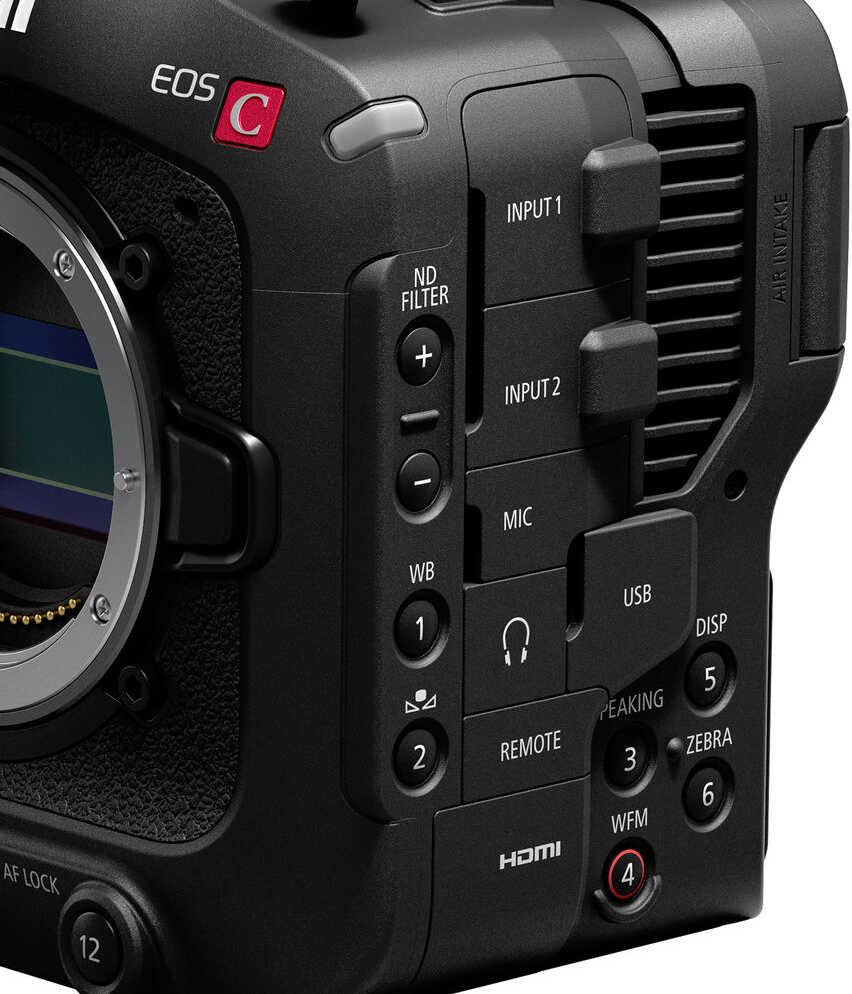
All the buttons are on the left, which makes life very easy for a solo operator. However, they screwed it up by having all the XLR inputs on the same side!
Imagine all those cables right next to your head while you shoulder mount this camera. Try not breaking those mini XLR inputs or that flimsy HDMI adapter while you’re running around your subject.
Then there’s the control dial that’s hidden behind the LCD. If you’re on the left side, how will you reach that?
And that’s not all. The bane of all mirrorless and DSLR bodies is an LCD that swivels right out to where the cables are. You can flip it so you can use it as a selfie cam, but not if there are any cables in the way. The C70, designed for no reason like a mirrorless camera, has the same issue.
You have dedicated buttons for exposure and focus tools.

You have three threads at the bottom for plates and a tripod. There is a registration hole to keep the camera centered, but you’ll have to find the right baseplate. I wish Canon had provided an extra thread for a vertical orientation – similar to what you get with cinema cameras.
Finding horizontal plates is not practical for tripod work, though they might be useful to space the camera for the perfect gimbal balance. Two of the threads are 1/4″ while the one in the middle is a more rugged 3/8″-sized thread.
Vertical Shooting
The Canon EOS C70 (Amazon, B&H) has integrated vertical shooting to its hardware and software. The UI can be modified to whichever mode you are shooting by rotating it to 90 or 270 degrees to suit the needs of shooters of vertical videos.
Mounts are also available on the right hand side of the camera to fix the camera on a tripod and facilitate shooting vertically without any hassle (except for blocking the card slot).
Many professionals are called upon to multitask nowadays, and you won’t have to say no to work just because your camera can’t support it!

Exposure and Focus Tools
The Canon EOS C70 (Amazon, B&H) has an in-built False Color tool which a lot of professionals will love.
It also has a Waveform monitor which has line, RGB, YCbCr modes and is HDR compatible. This allows you to shoot directly to YouTube’s HDR standards (no HDR10 though), and makes life easier for professionals who don’t have the luxury of post production budgets.
The C70 supports PQ and HLG modes, as is the case with other Canon cameras.
It sports two different types of Focus Peaking which you can customize for different scenarios. This means you get two different settings to switch to and fro for a quicker focus reference. You can set one Focus Peaking for close focus and the other one for the far focus. The two primary colors that can be used are Red and Yellow.
Does the Canon EOS C70 have IBIS?
No. The Canon EOS C70 has a digital stabilization. This is a let down, considering how good Canon EOS R5’s IBIS is. You would have thought it would have been trivial to add IBIS at this price point. Many operators would have welcomed this feature.
It also supports my earlier notes on the mirrorless camera design aesthetic. Who’s going to handhold this camera without IBIS?
Does the Canon EOS C70 have an SDI port?
The Canon EOS C70 (Amazon, B&H) only has HDMI Type A output. It does not have SDI. This will definitely turn off many professionals as HDMI isn’t a solid standard, and definitely not on the operator’s side!
The highest recording format that you can record externally is 4K 59.94p.
What are the audio input options for the Canon EOS C70?
The Canon EOS C70 has 2 Mini XLR inputs. While some might consider this progressive or innovative, professionals might consider it as an added cost of adapters for a whole lot of nothing.
Having used such an adapter for the BMPCC 6K/4K, I know it’s not fun. I think this is an interesting misstep on Canon’s part, especially when you have the C200 as a competitor!
Does the Canon EOS C70 have Genlock and Timecode?
The Canon EOS C70 has a BNC connector, Drop Frame and Non-Drop Frame timecodes. No Genlock.
It has four different timecode modes:
- Regeneration
- Record Run
- Free Run
- External Source
What is the battery life of the Canon EOS C70?
The power draw of the Canon EOS C70 is 14.6 Watts. If you’re using a Canon BPA 30 battery, rated at 45 Wh, you get about three hours of usage. That is a decent result.
With 2-3 batteries, you should be able to get through an entire day.
Or you may choose to just get a Canon BPA 60 battery with 90 Wh of power. This will last you for 6 hrs straight and you can keep the BPA 30 as a backup.

Who is the Canon EOS C70 for?
After looking at the specifications in great detail, the Canon EOS C70 (Amazon, B&H) will make sense to:
- Wildlife filmmakers
- Some high-end wedding filmmakers who need continuous run-time.
- Event videographers
- Documentary filmmakers
- Journalists
- Social Media content creators
It will also turn off professionals already used to Canon’s existing range of Cinema EOS cameras. The lack of full size XLR, no SDI, wrong side for ports, unintuitive design and button layout, etc.
I hope you found this useful. When we get our hands on the C70 we’ll take a more in-depth look, wolfcrow-style. We should also have a comparison article coming soon, comparing the C70 to the C200 and even the 1DX Mark III.

Hello Sareesh,
Thanks for your review.
Your crop factor calculations are bizarre to me…
Crop Factors are calculated vs Full Frame which is 24mm*36mm.
Having this reference in mind,
the crop factor of the 4k DCI is 1.46 vs FF
the crop factor of the UHD is 1.55 vs FF
and the crop factor of the S16 is 2.9 vs FF
Have a good day.
Eric
Good observation on cabling positioning! I’ve read/seen everything I could find on this camera, and only recall once seeing that downside mentioned — in a Zacuto video about upcoming accessories for the C70: https://www.youtube.com/watch?v=RRAj4pmd3Fw&t=1s (they have some sort of strain relief attachment and right-angle adapter to get the cables out of your head).
Alexa isn’t the only other camera sensor using DGO. In fact, all of the Blackmagic cameras except for the 4K/6K pocket are DGO. The 4K/6K have dual ISO, so no DGO there of course. But every other Blackmagic cinema camera model is a DGO sensor.
Interesting. Can you link to an official page or document from Blackmagic Design confirming this?
It looks very portable, easy to rig up. I am interested in the 4K at 120, for Music videos and weddings. The footage looks amazing! This is a camera I am very interested in.
Thanks for a no BS look at this camera Sareesh. I am an amateur BMPCC 6K user. I have learned a lot from your articles.
I was really tempted to look at the C70 but its price is too much for me. Besides, for my amateur video work my BMPCC4k and 6K are just fine. I will even use my R5 with the latest heat-controlling firmware upgrade for work I don’t want to use the other two for (i.e., I have smallrig cages for all three).
Yes, that makes sense. The C70 is a professional’s camera.
i gather it is not weather sealed, if so this rules it out for me to use in the field for wildlife.
It’s weather resistant, but the active fan and vents don’t make it weather-sealed. Still, people have used Red cameras in wet tropical conditions, so I’d be surprised if the C70 couldn’t handle that.