
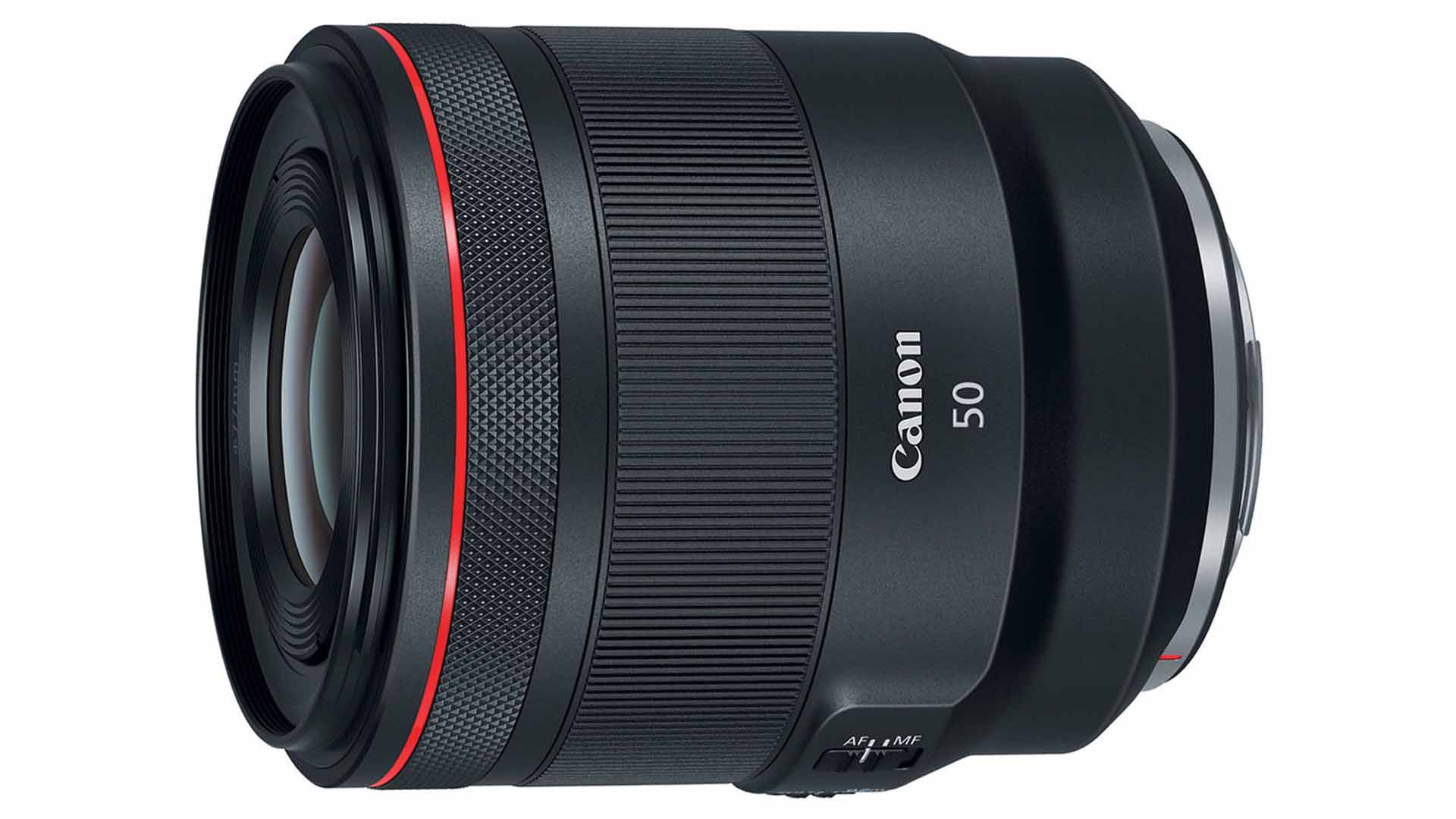
The Canon RF 50mm f/1.2L USM (Amazon, B&H) is primarily a photography lens, though it will be used for video.
In this article let’s take a comprehensive look at the important features and specifications of the Canon RF 50mm f/1.2L USM and see how good it will perform specifically for video, cinematography and filmmaking.
The aim of this article is to provide you with enough information and perspective so you can decide for yourself whether this lens is right for your film or video.
Important: This article is a comprehensive overview of the lens with available information; and an analysis based on our experience shooting for almost two decades. It is not a hands-on review. If and when we get hold of the lens we’ll be sure to publish a detailed review. If this is not your cup of tea you can stop reading.
Click to what you want quickly:
- TLDR;
- EF vs RF:
- Features:
- Control:
- Basics:
- Alternatives to the RF 50mm f/1.2L USM

TLDR;
What you need to know for video work about the Canon RF 50mm f/1.2L USM (Amazon, B&H):
- The Canon RF 50mm f/1.2L USM is a great general purpose focal length. Many would consider this how “the human eye sees”. This lens will work great in low light and should provide soft bokeh thanks to its 10 blade aperture.
- The constant f/1.2 aperture is great for video and low light work.
- Focus ring can be changed to fly-by-wire for follow focus work.
- Control ring can be de-clicked for a small fee at a Canon service center for aperture transitions.
- The lens doesn’t have Image Stabilization, but you will get some stabilization with a Canon R camera (R5, R6, etc.) that has IBIS.
- Great dual pixel autofocus for video.
- It exhibits breathing.
Can be great for the following types of filmmaking:
- Wedding filmmaking
- Documentary filmmaking
- Low budget music videos
- Gimbal use
- Fashion filmmaking
- Corporate videos and low budget commercials
EF vs RF: What’s the difference?
Difference between the RF and EF mount
Both are lens mounts specific to Canon. Let’s take a look at some important distinctions.
Flange focal distance
The RF is a new lens mount, with a smaller flange focal distance.
Here’s how the flange focal distance compares:
| Mount | Flange Focal Distance |
|---|---|
| RF | 20mm |
| EF | 44mm |
EF lenses were designed for DSLRs. Now with the mirror gone, that’s space and weight savings. However, that’s not the only advantage.
Canon (and every one else) maintains the smaller flange focal distance allows for larger apertures (for some focal lengths), better corner to corner sharpness and reduced light fall off.
Ergonomics
RF lenses are supposed to be lighter, making them easier to handle for photography, but slightly problematic for video. Weight gives better stability and smoother movement for most use cases. For gimbal, drone and steadicam use, the lower weight is an advantage because a lighter lens puts less strain on motors, and the human arms that have to hold it up.
The RF mount is equipped with 12 communicator pins compared to 8 pin connection of the EF mount. Canon claims this contributes towards quicker autofocus, better AF tracking and improved image stabilization.
Canon has redesigned the focus actuators for a hassle-free filming. They claim the new Nano USM and Dual Nano USM have been designed for video. Canon claims that the introduction of these actuators in RF lenses will result in a quieter and quicker autofocus.
The last major change is in the optics. Canon have redesigned the optics from the ground up to account for the smaller flange focal distance. This one simple change considerably changes the optical characteristics and challenges.
Naturally the prices of RF lenses match the high quality Canon have put into these series! The assurance is, the quality isn’t compromised, and with proper care Canon RF lenses should last for years. Let’s compare the EF version of the 50mm with its newer RF counterpart.
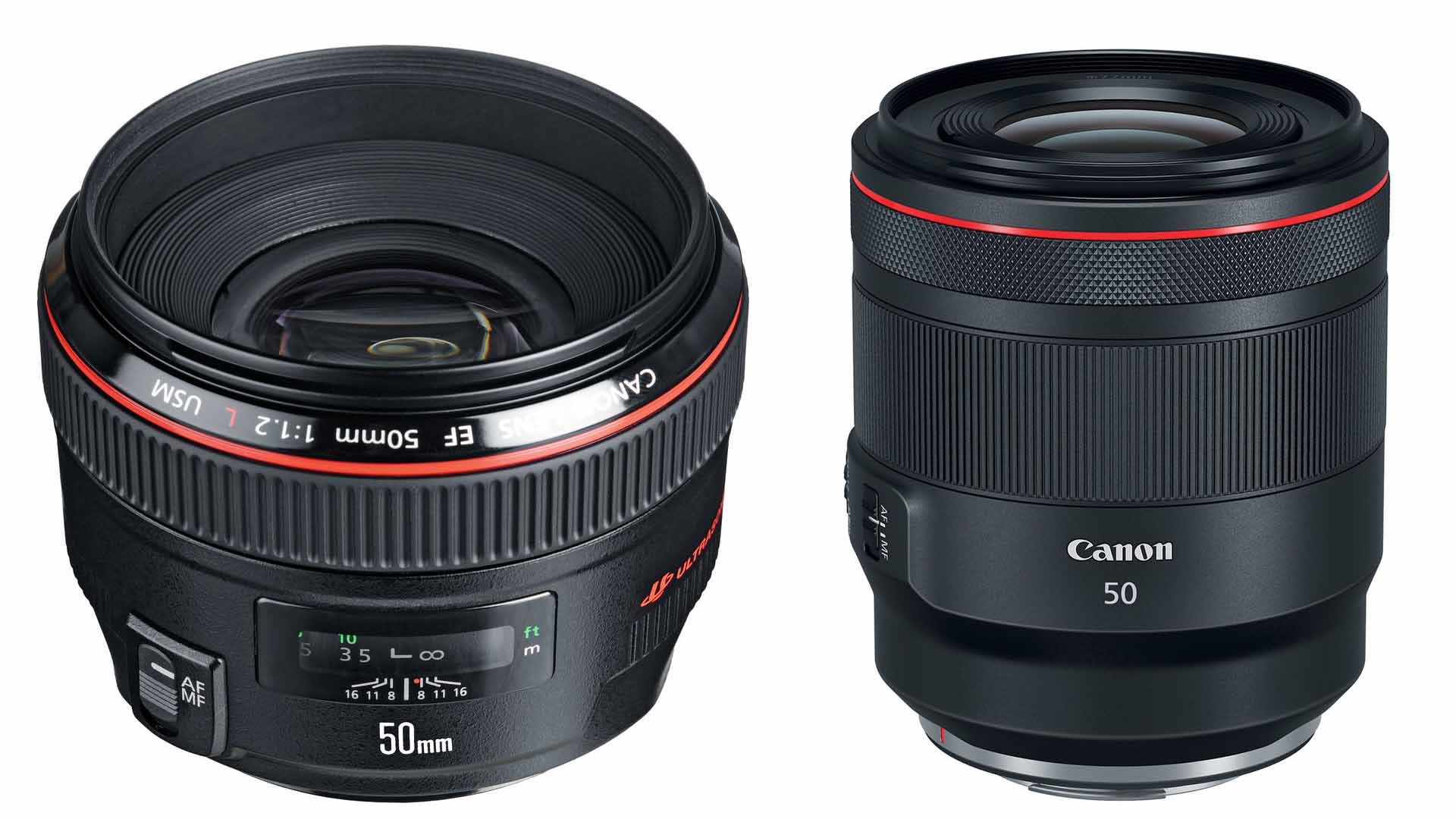
EF 50mm f/1.2L USM vs RF 50mm f/1.2L USM
| Lens | RF 50mm f/1.2L | EF 50mm f/1.2L |
| Filter Thread | 77mm | 72mm |
| Size | 89.8mm x 108mm | 85.8mm x 65.5mm |
| Weight | 950g | 580g |
| Lens Control | Ring control | none |
| Closest focusing distance | 0.4m | 0.45m |
| Max. Aperture | f/1.2 | f/1.2 |
| Min. Aperture | f/16 | f/16 |
| Aperture Blades | 10 blades | 8 blades |
| Angle of View (Diagonal) | 46° | 46° |
The Canon EF 50mm f/1.2L USM (Amazon, B&H) is quite lighter and smaller than the RF 50mm f/1.2L USM (Amazon, B&H).
The RF 50mm f/1.2 has closer focusing distance than EF 50mm f/1.2 by 5 cm. I don’t think that will tug any heart strings
Canon claims that RF has smoother and a quieter autofocus. That would be great, because EF lenses have noisy motors for continuous AF.
RF lenses come with a special customizable control ring this can be customized to change exposure on the go. This is only available on cameras that natively have an RF mount.
The RF 50mm f/1.2L has more blades in the aperture for a supposedly softer bokeh than the EF 50mm f/1.2L. This needs to be tested in the real world, because the Canon EF 50mm f/1.2L USM (Amazon, B&H) is a legend for a reason.
Here’s a video I shot with it on the 1D X Mark III:
Features
Coverage
The RF 50mm f/1.2L USM (Amazon, B&H) is a full frame lens. It is designed to completely cover a sensor the size of 36mm x 24mm.
If you are considering this lens for an APS-C sensor or other cinema camera, check out this article:
Focal Length
The focal length is 50mm. This is considered normal on a full frame 35mm sensor.
This focal range is very useful for mid shots, interviews, and close ups. In exterior situations you can shoot wide long shots as well.
Aperture
The maximum aperture is f/1.2 and the minimum aperture is f/16.
Having f/1.2 is great for low light. Most people will use it at f/1.4 to f/2 for this purpose.
The RF 50mm f/1.2L USM (Amazon, B&H) has 10 rounded diaphragm blades. One expects a smoother bokeh but it’s not always a given. If you want more blades, you might want to take a look at the Canon Sumire primes.
Resolution
From Canon’s official MTF charts:
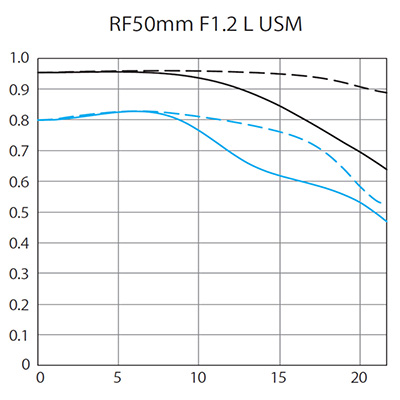
The Canon RF 50mm f/1.2L USM (Amazon, B&H) is sharp in the center but falls off quickly. I believe the chart is at f/1.2. In that case this is expected and is on similar lines compared to the EF version.
People expect this from an f/1.2 lens at f/1.2.
With the variance in the Sagittal and Tangential lines, you can infer (somewhat) that the bokeh won’t be proportionally smooth as the best prime lenses on the planet. However, it should have great character, and they correlate to each other well so there is some harmony in the design.
If you really want this lens at its sharpest you’re better off stopping down to f/1.4 or even f/2 for best results.
If you are curious and want to read the MTF chart for yourself. Here’s a guide on how to read them easily.

Close Focus
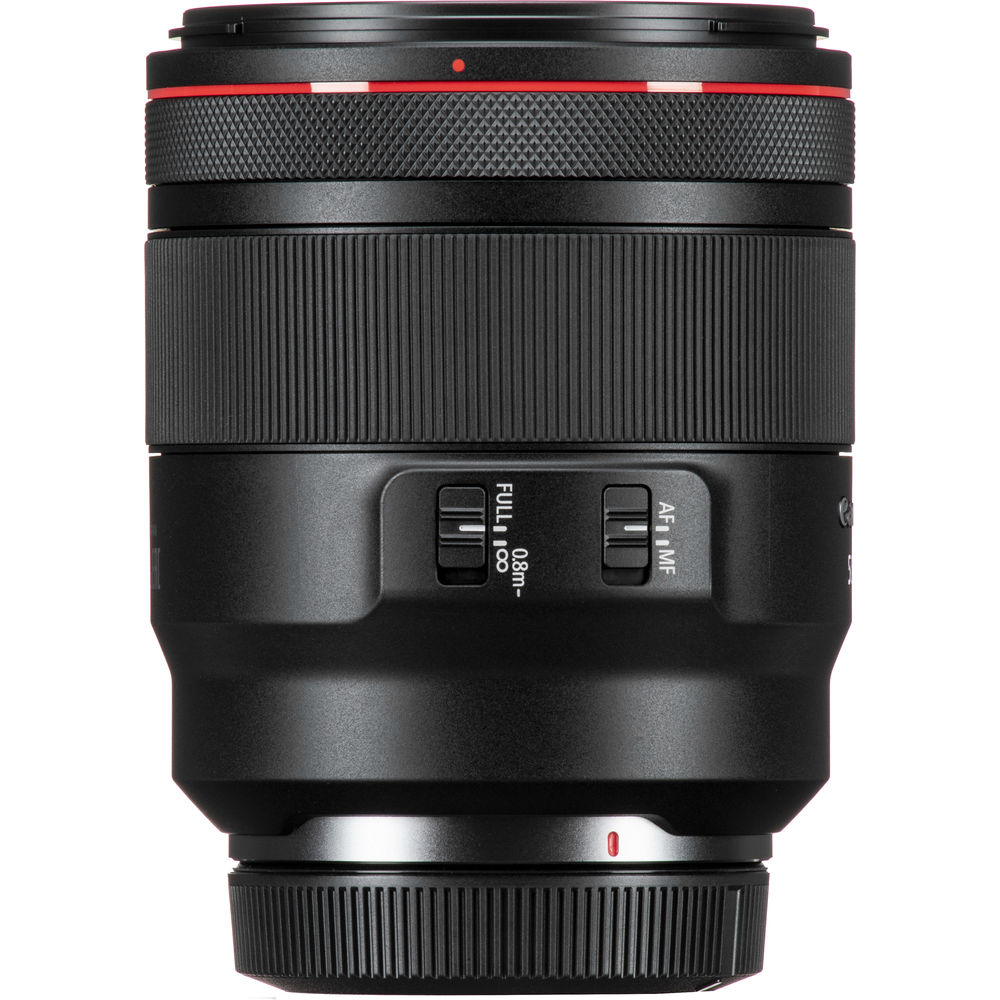
The closest focusing distance is 0.4 meters or 1.31 feet. It does come with a focus limiter which prevents the lens to focus on anything closer than 0.8m if you choose to switch it on.
It’s not a macro lens. I wish with the added weight and size the close focus distance could have been reduced to one foot or less. Alas!
Image Stabilization
The Canon RF 50mm f/1.2L USM (Amazon, B&H) lens doesn’t have Image Stabilization. This is a disappointment. Why is this lens so huge, then?
Pairing the 5-axis IBIS-equipped Canon EOS R5 or Canon EOS R6 with this lens can deliver some level of stabilization, so all is not lost. This can be toggled on and off if you choose so.
Control
Manual focus system
By default the Canon RF 50mm f/1.2L USM (Amazon, B&H) is set to ‘fly by wire’.
Even though the Canon RF focus ring is technically a ‘focus by wire’ system, the RF lenses are the first line of lenses in the world which have enabled turning focus by wire off.
What is the meaning of focus by wire and fly by wire?
Focus by wire: Let’s say you turn the focus ring to change focus from point A to B. You’d expect the focus to shift accordingly. When you stop point B will be in focus. Now bring the focus point back to A and try again, but at a different speed. Slower or faster, doesn’t matter. Now, even if you precisely rotate to the exact same degree, the focus will not be on point B! The speed of rotation determines which point it is focused on. That’s just completely useless for follow focus work. If an actor or person moves at a different speed, evens lightly, you’ll never get the same focus. Avoid focus by wire lenses like the plague (for video work).
Fly by wire: The distance of focus shifted is directly proportional to the speed at which the ring is turned. This is how a manual focus ring is supposed to operate for video and cinematography.
How to change to fly by wire on RF lenses
You can switch to ‘link to rotational degree’ where the focusing distance will be directly proportional to the rotational degree regardless of the rotational speed.
It is a quick two-step affair that requires you going into the Canon menu and switching the RF manual focus ring sensitivity to ‘linked to rotational degree’ instead of ‘varies with rotational speed’.
This feature will be exceptionally useful for anyone who wants absolute control over the focus ring.
This feature makes an RF lens a game changer for many videographers, filmmakers and cinematographers.
Autofocus system
Dual Pixel Autofocus is, without a doubt, one of the most revered video autofocus systems in the world. Canon claims the new AF actuators will help focusing to be smooth and phantom-quiet.
They have made the motors smaller and smoother with the new Nano USM and Dual Nano USM. The practical application of these new motors can only be judged in real time scenarios.
The dual pixel AF system works better (in theory) than original EF lenses on native EF bodies. I don’t think anyone will be disappointed with its performance.
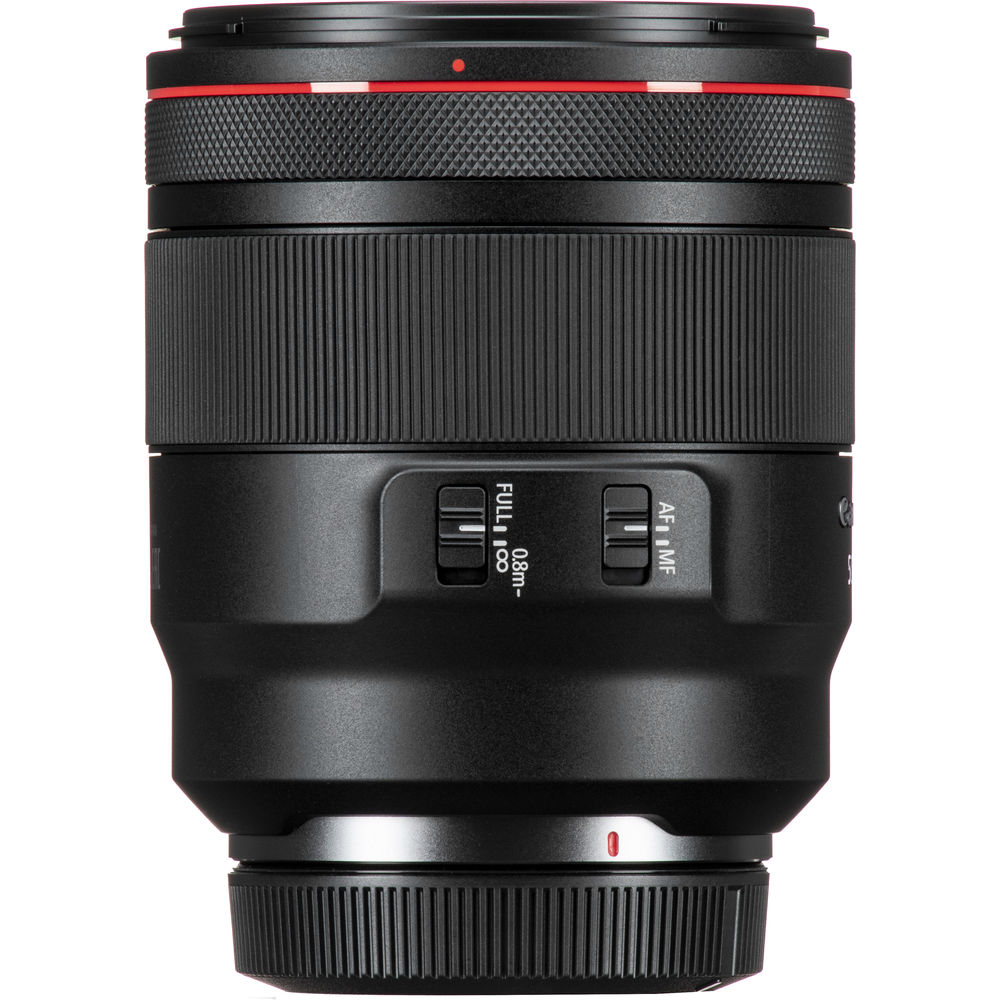
It does come with a focus limiter, this switch will prevent the lens from focusing on any subject closer than 0.8m.
Control System
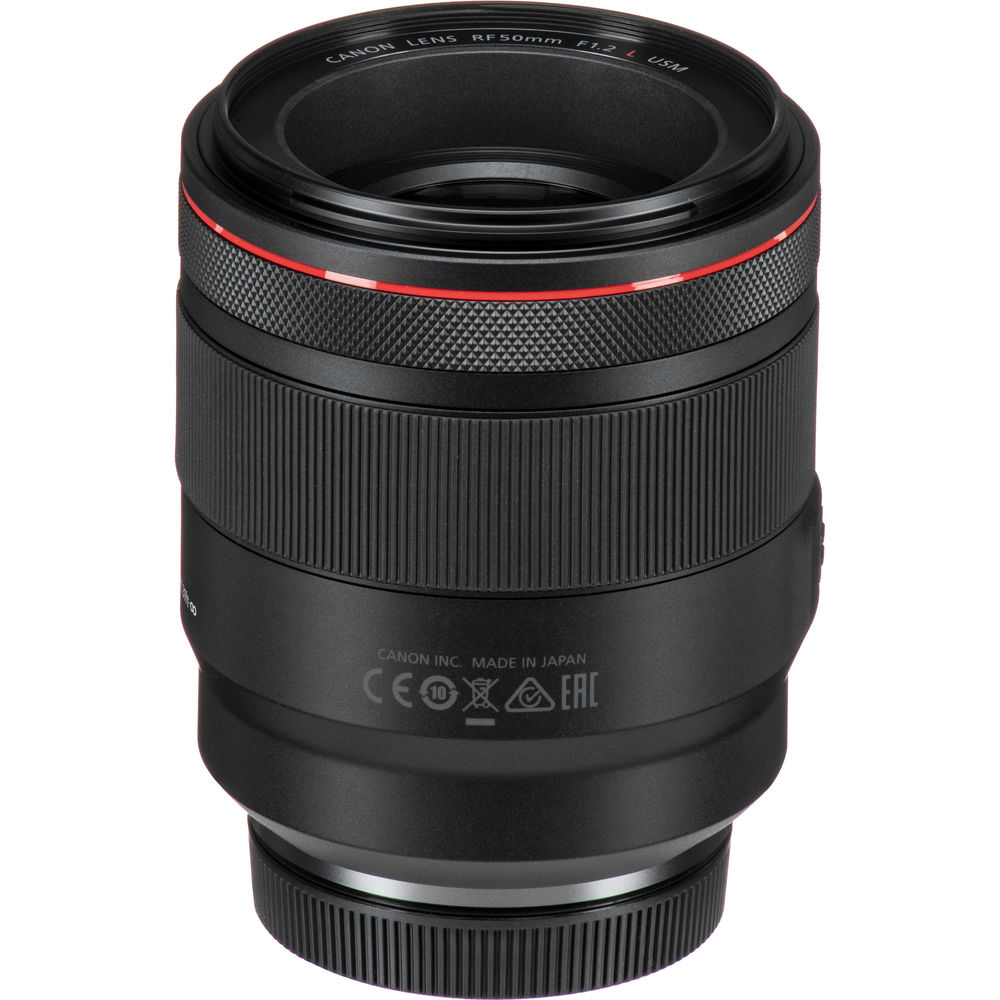
Canon RF lenses come with an extra customizable ring. See the photo below. The ring is a second ring, in addition to the focus ring.
This ring is only customizable with cameras that have a native RF mount, such as the Canon EOS R5/6 and Canon EOS C70.
To toggle the Control Ring on and customize it to control one of the exposure determinants, follow these steps:
- Go into Settings
- Go to the Customize dials option
- Select Control Ring and switch it to Enabled.
- Now you can customize it to control aperture, shutter speed, ISO and exposure compensation.
Some videographers will find it helpful in riding the aperture due to its favorable placement right on the lens close to the focus and zoom ring.
Although the turn of the ring appears to be smooth, there is a soft clicking sound. Some might find it inconvenient. If you want to remove the sound you can.
The clicking of the control ring on every RF lens is removable through a chargeable service fee of about $79.99 (depending on your country) at your nearest Canon service center.
Basics
Filter Thread
The Canon RF 50mm f/1.2L USM (Amazon, B&H) has a filter thread diameter of 77mm. This is the most common “large” filter diameter.
Build Quality
The majority of the lens exterior is plastic, though the lens doesn’t feel cheap.
The optical design consists of 15 elements in 9 groups, including three aspherical and one UD glass element.
Size and Weight
The RF 50mm f/1.2L USM has a diameter of 89.8mm and a length of 108mm. It is larger and heavier by almost twice than the EF variant.
It is surprisingly large and heavy for a prime lens. Since there’s no IS or other gimmickry one expects most of the weight has gone into the optical performance.
Weather resistance
Canon claims that all RF lenses are weather sealed. But again this only holds true if the camera body you will be using is also weather sealed. No camera is truly and officially weather sealed, so the best you can hope for is reliable weather resistance.
Canon L series lenses have performed well in the past, and I’d be surprised if the RF 50mm f/1.2L can’t match established standards.
What’s in the box
This is what you get in the box (other than the lens):
- Lens cap (E-77 II)
- Lens dust cap (D1)
- Lens hood (ES-83)
- Drawstring soft pouch (LP1319)
The hood might be useful for photography, but the shape and design makes it mostly vestigial for video work. Some people like to put it on to protect the front element in case of a fall. The hood takes the impact and shatters, but saves the lens. I’d keep it on unless you have good reason not to.
Alternatives to the Canon RF 50mm f/1.2L USM Lens
The Canon RF 50mm f/1.2L USM (Amazon, B&H) is in a class of its own. If you don’t want f/1.2 and blurry backgrounds this lens is not that useful for you. There are only two alternatives:
- Recommended: Canon EF 50mm f/1.2L USM (Amazon, B&H) – Same aperture, lesser blades. Lighter and smaller, and also cheaper.
- Cheapest: Canon RF 50mm f/1.8 STM (Amazon, B&H) – Cheaper but with a smaller aperture. It’s lighter and smaller. It has a closer focusing distance and also a silent STM motor. For a lot of people that don’t need f/1.2 or f/1.4, this should be good enough.
I hope you found this overview of the Canon RF 50mm f/1.2L USM (Amazon, B&H) useful. If we have missed out on something, please let us know in the comments below.
