
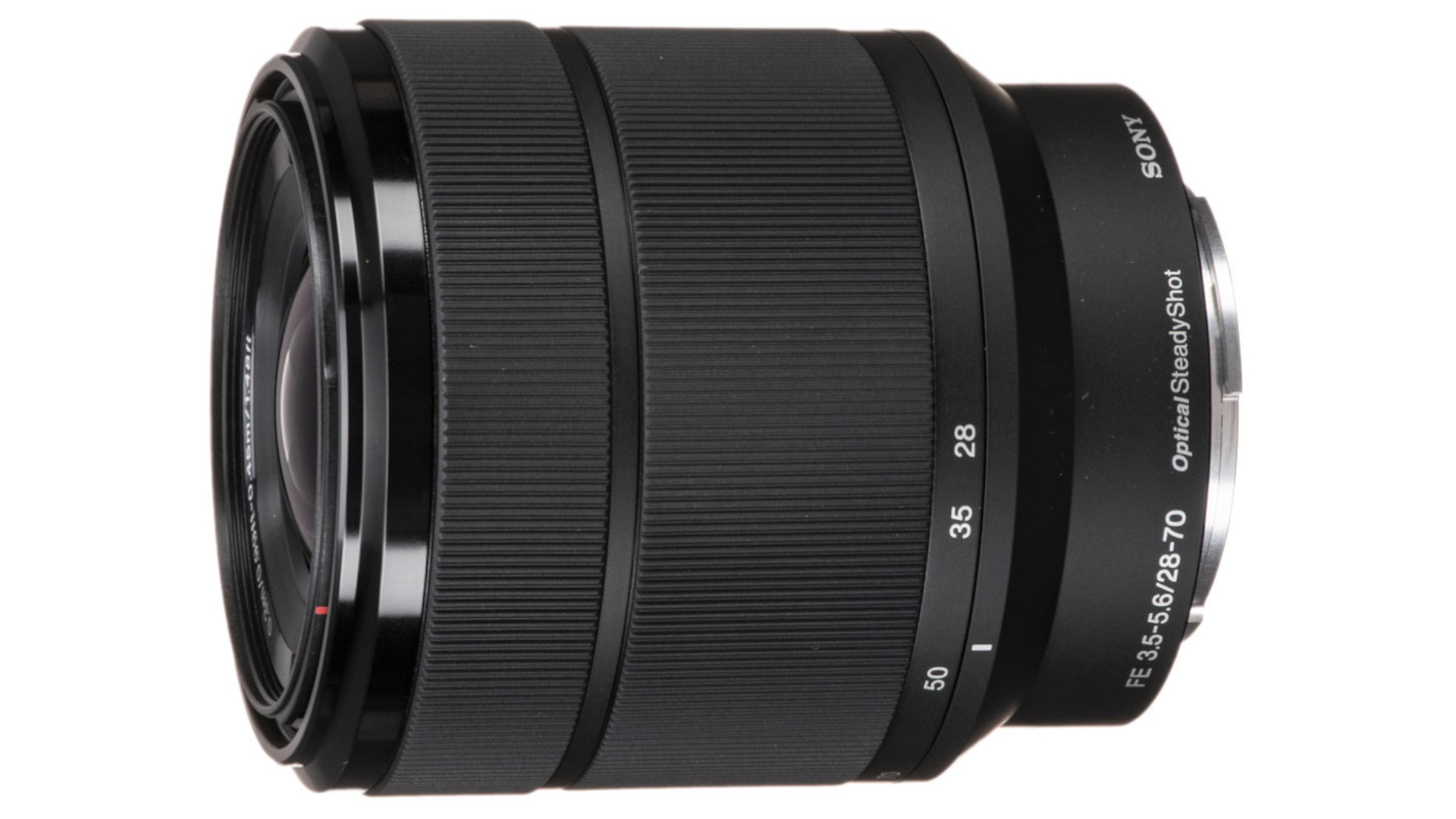
The Sony FE 28-70mm f/3.5-5.6 OSS (Amazon, B&H) is primarily a photography lens, though it will be used for video.
In this article let’s take a comprehensive look at the important features and specifications of the Sony FE 28-70mm f/3.5-5.6 OSS and see how good it will perform specifically for video, cinematography and filmmaking.
The aim of this article is to provide you with enough information and perspective so you can decide for yourself whether this lens is right for your film or video.
Important: This article is a comprehensive overview of the lens with available information; and an analysis based on our experience shooting for almost two decades. It is not a hands-on review. If and when we get hold of the lens we’ll be sure to publish a detailed review. If this is not your cup of tea you can stop reading.
Click to what you want quickly:
- TLDR;
- Sony FE 28-70mm f/3.5-5.6 OSS vs Sony FE 28-60mm f/4-5.6 vs Sigma 28-70mm f/2.8 DG DN Contemporary
- Features:
- Control:
- Basics:
- Alternatives to the Sony FE 28-70mm f/3.5-5.6 OSS

TLDR;
What you need to know for video work about the Sony FE 28-70mm f/3.5-5.6 OSS (Amazon, B&H):
- The Sony FE 28-70mm f/3.5-5.6 OSS is a decent “kit” lens.
- The f/3.5-5.6 variable maximum aperture is okay for low light work, especially with modern sensors.
- It’s small and lightweight.
- 7 blade aperture for average bokeh.
- The lens does have OSS, and you will get combined stabilization with a Sony a7S III or the Sony Alpha 1 that has IBIS.
- It exhibits breathing.
Can be great for learning filmmaking or as a backup lens. I wouldn’t recommend it for professional work.
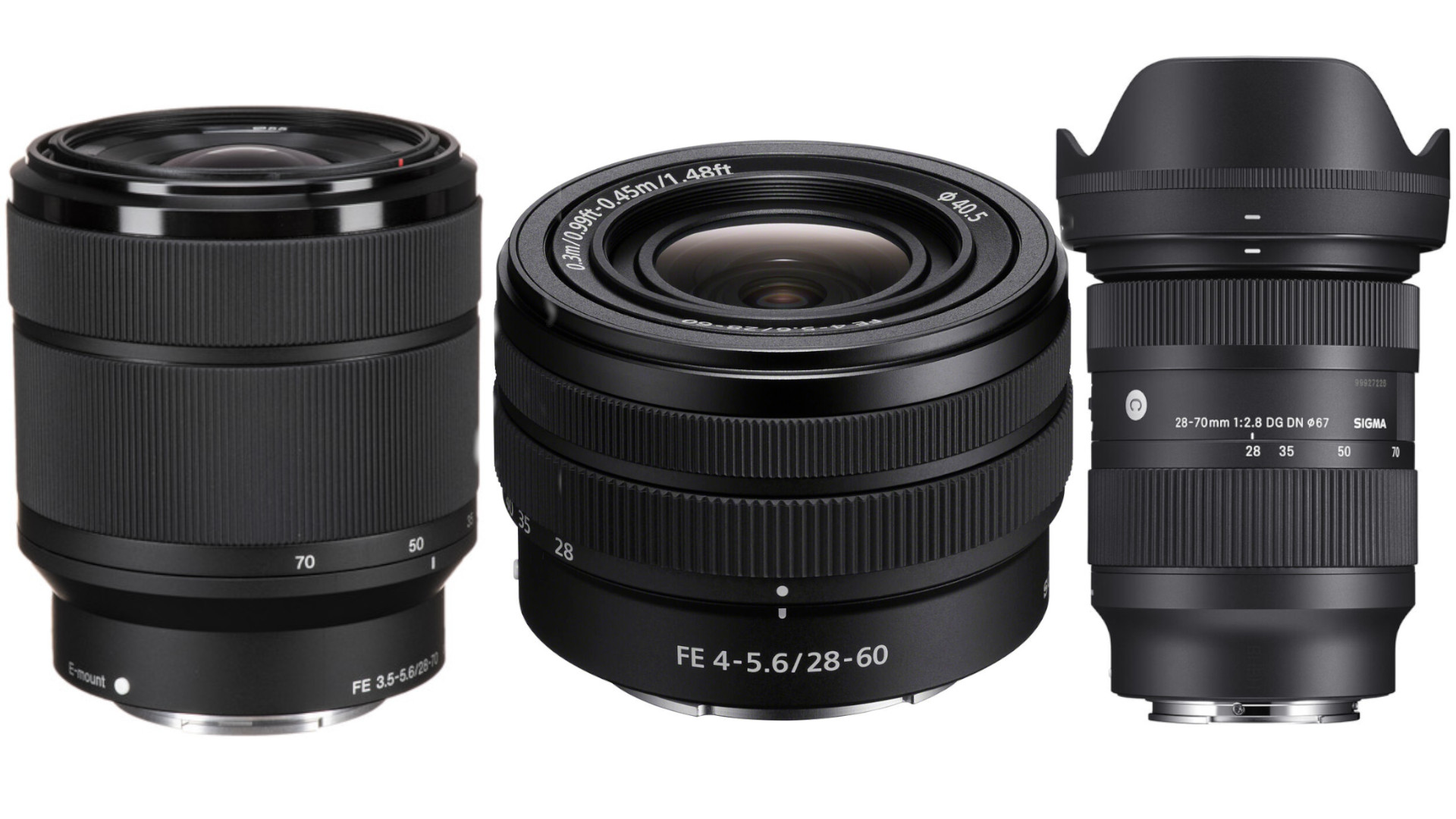
Sony FE 28-70mm f/3.5-5.6 OSS vs Sony FE 28-60mm f/4-5.6 vs Sigma 28-70mm f/2.8 DG DN Contemporary
| Lens | Sony FE 28-70mm f/3.5-5.6 OSS | Sony FE 28-60mm f/4-5.6 | Sigma 28-70mm f/2.8 DG DN Contemporary |
| Filter Thread | 55mm | 40.5mm | 67mm |
| Size | 72.3mm x 83mm | 73mm x 94.5mm | 72.2mm×103.5mm |
| Weight | 295g | 167g | 470g |
| Closest focusing distance | 0.3m-0.45m / 0.99-1.48ft | 0.3m-0.45m / 0.99-1.48ft | 0.19-0.38m / 0.59-1.24ft |
| Max. Aperture | f/3.5-5.6 | f/4-5.6 | f/2.8 |
| Min. Aperture | f/22-36 | f/22 | f/22 |
| Image Stabilization | OSS | None | None |
| Aperture Blades | 7 blades | 7 blades | 9 blades |
| Angle of View (Diagonal) | 75°–34° | 75–40° | 75°–34° |
| Price | $398 | $698 | $899 |
The Sigma 28-70mm f/2.8 DG DN Contemporary (Amazon, B&H) is the biggest and heaviest of them all.
The Sigma 28-70mm f/2.8 DG DN Contemporary opens up to a constant f/2.8 and has a much closer minimum focusing distance by at least 10cm. The Sigma 28-70mm f/2.8 DG DN has 9 aperture blades which should, theoretically, give you a better bokeh.
However the Sony FE 28-70mm f/3.5-5.6 OSS does have in built image stabilization which can make it a preferred lens for run and gun shoots.
Here’s a resolution comparison:
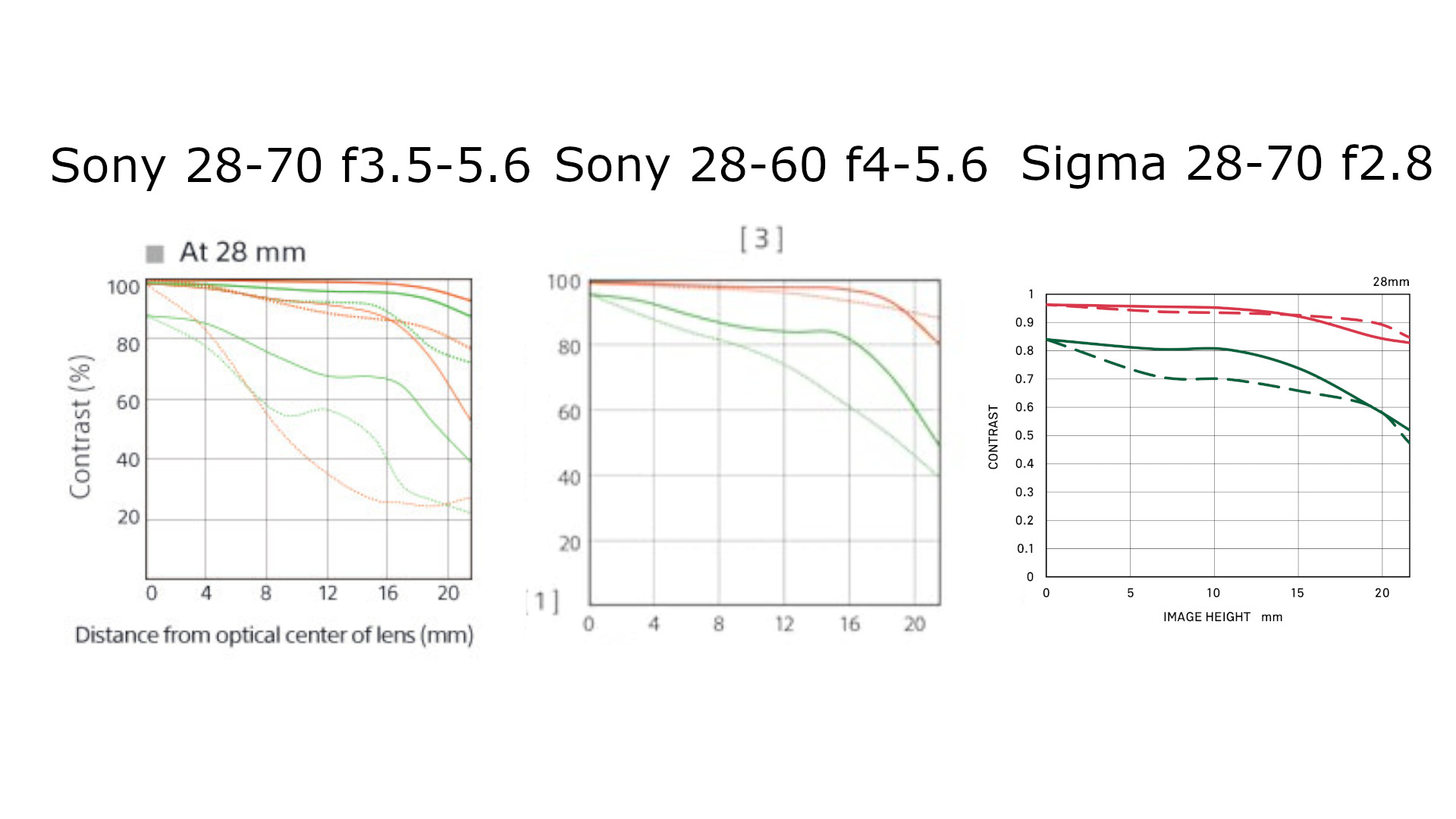
The FE 28-60mm f/4-5.6 has the worst performance of them all. If money is not a problem for you, then you are better off with the Sigma 28-70mm f/2.8. If you need that stabilization, then the FE 28-70mm f/3.5-5.6 OSS is the lens for you.
Features
Coverage
The Sony FE 28-70mm f/3.5-5.6 OSS (Amazon, B&H) is a full frame lens. It is designed to completely cover a sensor the size of 36mm x 24mm.
If you are considering this lens for an APS-C sensor or other cinema camera, check out this article:
Focal Length
The minimum focal length is 28mm. This is considered wide on a full frame 35mm sensor.
The maximum focal length is 70mm. This is considered telephoto on a full frame 35mm sensor.
This focal range is very useful for long shots and wide shots. It also provides you the versatility to get up close to your subjects.
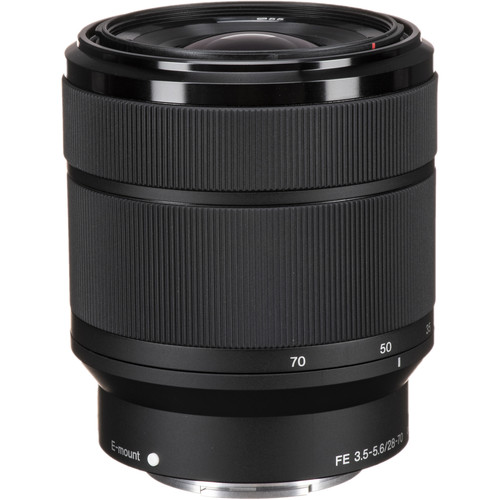
Aperture
At 28mm, the maximum aperture is f/3.5 and the minimum aperture is f/22.
At 70mm, the maximum aperture is f/5.6 and the minimum aperture is f/36. Below is how the aperture varies depending on the focal length you are using.
I cannot figure this out:
- 24-26mm – f/4.0
- 27-36mm – f/4.5
- 37-49mm – f/5.0
- 50-62mm – f/5.6
- 63-79mm – f/6.3
- 80-105mm – f/7.1
Not having a constant aperture can be crippling at times for video and cinematography. Imagine you’re covering a scene or event where the light doesn’t change. You cannot move quickly from wide to telephoto at a variable aperture without compensating for exposure. That’s a difference of almost 2 stops of light!

The Sony FE 28-70mm f/3.5-5.6 OSS (Amazon, B&H) has 9 circular diaphragm blades. One expects a smooth bokeh, considering the number of blades, but it’s not always a given. To know more about bokeh:
Resolution
From Sony’s official MTF charts:
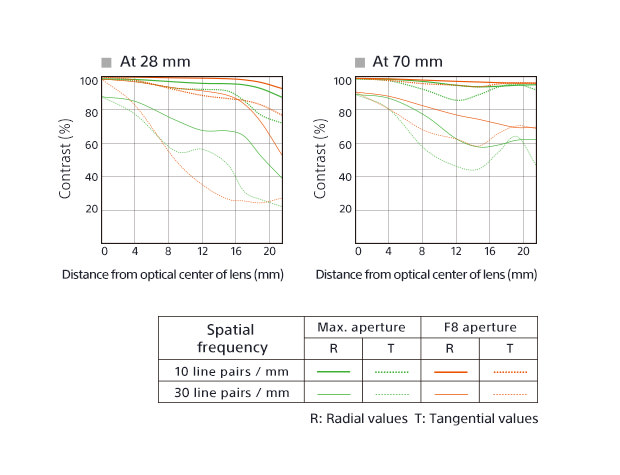
The Sony FE 28-70mm f/3.5-5.6 OSS (Amazon, B&H) is sharp enough in the center but has a steep falloff at 28mm f/3.5, this lens really shows it age.
While at 70mm f/5.6 the performance is much better than at 24mm f/3.5. Matching footage can be a problem.
With the variance in the Sagittal and Tangential lines, you can infer (somewhat) that the bokeh won’t be as smooth as the best prime lenses on the planet.
If you are curious and want to read the MTF chart for yourself. Here’s a guide on how to read them easily.

Close Focus
The closest focusing distance is 0.3 meters or 0.99 feet at 28mm. At 70mm, the closest focusing distance is 0.45m or 1.48 feet. That’s nice for this focal length because you can use it for close ups as well as wide shots.
Image Stabilization
The Sony FE 28-70mm f/3.5-5.6 OSS (Amazon, B&H) lens does have OSS. This makes it a preferred lens for some run and gun shoots.
Is it Parfocal?
The Sony FE 28-70mm f/3.5-5.6 OSS is not a parfocal lens. To know what a parfocal lens is, check this out:
Control
Manual focus system
The Sony FE 28-70mm f/3.5-5.6 OSS (Amazon, B&H) has an infinite turn ring for its focus ring and can turn infinitely one way or the other. Unfortunately, the 28-70mm f/3.5-5.6 OSS does not have Linear Manual focus or fly by wire focus set by default.
What is the meaning of focus by wire and fly by wire?
Focus by wire: Let’s say you turn the focus ring to change focus from point A to B. You’d expect the focus to shift accordingly. When you stop point B will be in focus. Now bring the focus point back to A and try again, but at a different speed. Slower or faster, doesn’t matter. Now, even if you precisely rotate to the exact same degree, the focus will not be on point B! The speed of rotation determines which point it is focused on. That’s just completely useless for follow focus work. If an actor or person moves at a different speed, evens lightly, you’ll never get the same focus. Avoid focus by wire lenses like the plague (for video work).
Fly by wire: The distance of focus shifted is directly proportional to the speed at which the ring is turned. This is how a manual focus ring is supposed to operate for video and cinematography.
This decision to exclude Linear MF in this lens by Sony can turn away many professional videographers and cinematographers.
Autofocus system
Sony’s Autofocus is, without a doubt, one of the most revered video autofocus systems in the world. However, there are no claims on the autofocus performance of this lens. There is no switch on the side of the body to switch from autofocus to manual focus, you will have to go into the in camera menu settings.
Zoom Ring
The zoom ring allows you to manually change the focal length from 28mm to 70mm and anywhere in between. Being of telescopic design, the lens does extend at least a couple of inches at 70mm.
There is no zoom lock, which will prevent the lens from extending while traveling.
Basics

Filter Thread
The Sony FE 28-70mm f/3.5-5.6 OSS (Amazon, B&H) has a filter thread of 55mm. This is an uncommonly small filter diameter.
Build Quality
The majority of the lens exterior is plastic, though the lens doesn’t feel cheap.
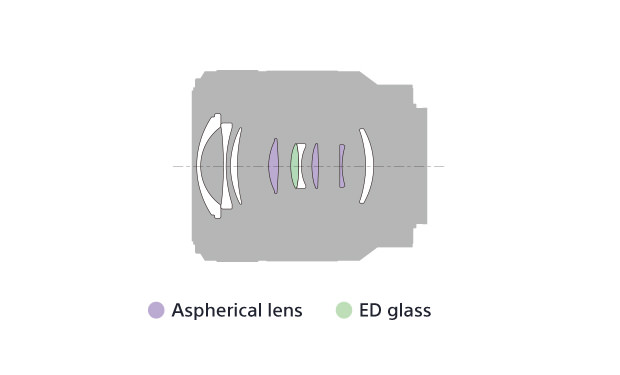
The optical design consists of 9 elements in 8 groups, including one ED (Extra-low Dispersion) glass element and three aspherical lenses.
Size and Weight
The Sony FE 28-70mm f/3.5-5.6 OSS (Amazon, B&H) has a diameter of 72.5 mm and a length of 83 mm. It weighs around 295 grams. It is pretty light for its class and lens construction.
Weather resistance
Sony, surprisingly, makes no claims when it comes to the weather resistance of the FE 28-70mm f/3.5-5.6 OSS. It would be safe to assume you should not take this lens in the harshest of environments.

What’s in the box
This is what you get in the box (other than the lens):
- Lens hood (ALC-SH132: petal shape, bayonet type)
- Lens front cap
- Lens rear cap
The hood might be useful for photography, but the shape and design makes it mostly vestigial for video work. Some people like to put it on to protect the front element in case of a fall. The hood takes the impact and shatters, but saves the lens.
Alternatives to the Sony FE 28-70mm f/3.5-5.6 OSS Lens
The Sony FE 28-70mm f/3.5-5.6 OSS (Amazon, B&H) is a cheap kit lens. It’s okay for learning cinematography or as a backup lens. I wouldn’t recommend it for professional work.
If you need a good lens I recommend the Sony 70-200mm f/4 G OSS (Amazon, B&H).
I hope you found this overview of the Sony FE 28-70mm f/3.5-5.6 OSS (Amazon, B&H) useful. If we have missed out on something, please let us know in the comments below.
