

In this article we take a look at ARRI Signature Primes and why you should consider them for your next project.
ARRI Signature Primes are cine lenses i.e. they are specifically designed to facilitate cinematography in the most efficient manner possible. There is a reason why cine lenses are so expensive.
To know more about cine lenses in detail:
The aim of this article is to provide you with enough information and perspective so you can decide for yourself whether these lenses is right for your film.
Important: This article is a comprehensive overview of the ARRI Signature Prime series with available information; and an analysis based on our experience shooting for almost two decades. It is not a hands-on review. If and when we get hold of the lenses we’ll be sure to publish a detailed review. If this is not your cup of tea you can stop reading.
Arri’s official video
Arri released a video where their in-house cine lens specialist, Art Adams explains the key features of the Arri Signature Primes or as he likes to call it, “the four unique properties that I see in every Signature Prime.”
Designed for 8K imagery
Adams claims that the Signature Primes capture the skin tones in a very flattering manner and yet are designed to make it look authentic. Judging Arri’s Master Primes and Ultra Prime performance, the Signature Primes won’t be a disappointment.
Adams explains further that the Signature Primes, by design, introduce more of a filmic quality to the image by retaining resolution. This retention of resolution is necessary for 8K.
Bokeh Preservation
Adams claims that every Signature Prime rolls out of focus very smoothly. It blurs the background subtly to eliminate any hard edges. Hard edges in blurred out backgrounds can distract the audience from the main subject in the frame. Especially on the big screen.
Adams claims that the Signature Primes blur the background to give a smooth, artistic look that will not distract the audience or muddy up the frame.
Hard edges attracts your eye. Arri Signature Primes eliminate that. When there is nothing in the background to distract you, your eyes will naturally go towards the main subject in the frame
Art Adams, Cine lens specialist at ARRI

Virtually No Lens Distortion
Arri Signature Primes have covered every focal length imaginable. Ranging from 12-280mm and lenses at minuscule increments of focal length, the Signature Primes are one of the most extensive lens series you will ever find.
Art Adams claims that the Signature Primes have less that 1% of distortion even at the widest of their lenses i.e. 12mm. Anyone with any experience with wide lenses (below 35mm), would know that wide angle lenses always come coupled with lens distortion. But with Signature Primes, that seems to be almost eliminated.
Elegant Preservation of Lens flares
Art Adams claims that Arri thinks that lens flare can sometimes overpower the frame. They have designed the Signature Primes so that these distracting lens flare
Adams claims that they have tried to make the lens flare soft and soothing instead of hard and distracting.
bbbb
Expert Insight
Arri did an interview with the Academy Award winning cinematographer Sir Roger Deakins, talking about his experience with the Arri Alexa Mini LF and Signature Primes.
Deakins claims that the Signature Primes are the cleanest, sharpest lenses he found at the time. He also claims that the Signature Primes have minimal breathing, minimal flares and no vignetting.
I want a lens that captures or records the world as I see it and Signature Primes are the cleanest lens I have used.
Sir Roger Deakins, DOP for 1917
The only complaint I heard from Sir Deakins is that they are a bit big for his personal taste but it seemed like that was a compromise he was willing to make for the clean, proper look for his film.
Click to what you want quickly:
- Features:
- Control:
- Basics:
Features
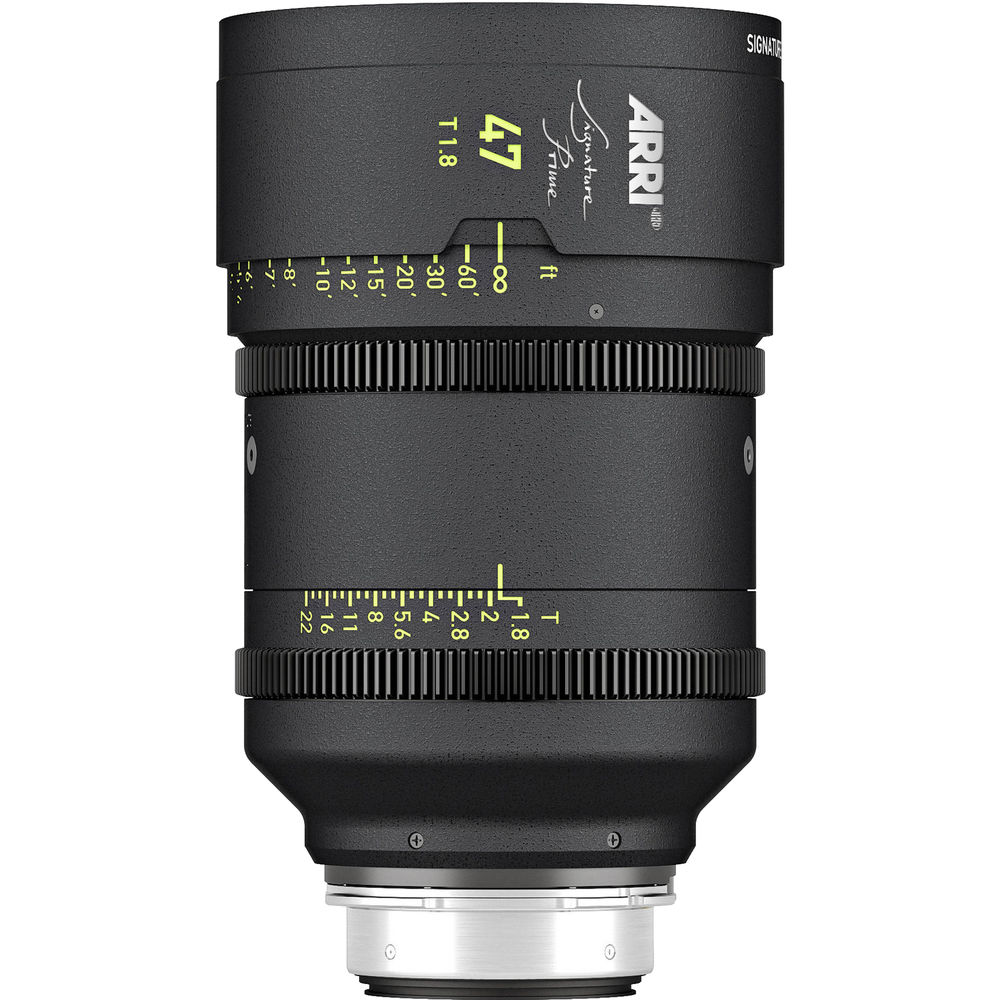
Mount
The ARRI Signature Primes are fitted with LPL mounts or large positive lock. These LPL mounts have been designed by Arri especially for digital capture in large format. LPL Mounts are wider in diameter (64mm) and a shorter flange focal distance (44mm) than the PL mount (52mm).
Arri claims that the LPL mount provides with a “telecentric” image, which is void of aberrations at the edges of the frame.
Light striking at steep angles may not be full detected by the sensor, or lead to photo site “crosstalk” when absorbed by the wrong photo site. Also, digital cameras usually incorporate a filter package in front of the sensor, which contains an optical low-pass filter as well as spectral filters. At all points other than the center of the frame, light from a non-telecentric lens passes through this filter package at extreme angles, which causes aberrations at the frame edges. Telecentric optical designs, made possible by the LPL mount, eliminate these effects.
Arri
The shorter flange focal distance has contributed to the decrease of chromatic aberration, distortion, field curvature and spherical aberration in high speed lenses.
Arri is looking forward to make the LPL mount the new industry standard by placing no restrictions on the mount’s compatibility with other manufacturers and third party lens manufacturers.
Coverage
The ARRI Signature Primes are designed to fit full frame sensor and large format sensors. Therefore, it will easily completely cover a sensor the size of 36mm x 24mm. These lenses can cover an image circle of 44.7mm.
However, you hardly shoot in an aspect ratio lower than 1.77:1 (16:9). This restricts the sensor dimensions to about 36mm x 20mm.
Focal Range
Here is the list of their focal lengths in the Signature Prime series:
- 12mm T1.8
- 15mm T1.8
- 18mm T1.8
- 21mm T1.8
- 25mm T1.8
- 29mm T1.8
- 35mm T1.8
- 40mm T1.8
- 47mm T1.8
- 58mm T1.8
- 75mm T1.8
- 95mm T1.8
- 125mm T1.8
- 150mm T1.8
- 200mm T2.5
- 280mm T2.8
It is evident that Arri has completely committed to the Signature Prime series just by looking at the range of focal lengths available. From 12mm to 280mm, Arri has covered every focal length imaginable for even the most demanding cinematographer.
Aperture Range
Most ARRI Signature Prime lenses have an aperture range of T1.8-T22. They have managed to keep the maximum aperture constant even at extreme focal lengths such as 12mm and up till 150mm. Only at extreme telephoto focal lengths such as 200mm and 280mm, the aperture goes up to T2.5 and T2.8 respectively.
If we are being fairly honest, xyzzy might be a bit disappointed that Arri could only go up to T1.8 whereas Zeiss Supreme Primes open up to T1.5 and don’t cost as much as the Signature Primes.
All Arri Signature Prime lens have 11 iris blades, which should be more than enough for a theoretically smoother bokeh. You can expect some lovely 22 point sunstars if you stop it down to below T4.

Close Focus Distance
The ARRI Signature Prime lenses have two different ways to measure close focus distance (or MOD, Minimum ). Here is the list of the close focus distances at different focal ranges:
| Focal Range | Closest focusing distance from the front of the lens |
| 12mm | 0.07m / 2.6″ |
| 15mm | 0.1m / 4.3″ |
| 18mm | 0.13m / 5.1″ |
| 21mm | 0.13m / 5.1″ |
| 25mm | 0.13m / 5.1″ |
| 29mm | 0.13m / 5.1″ |
| 35mm | 0.13m / 5.1″ |
| 40mm | 0.13m / 5.1″ |
| 47mm | 0.23m / 9.0″ |
| 58mm | 0.23m / 9″ |
| 75mm | 0.43m / 17” |
| 95mm | 0.63m / 2′ 1″ |
| 125mm | 0.78m / 2′ 7″ |
| 150mm | 1.25m / 4′ 2″ |
| 200mm | 1.54m / 5′ 1″ |
| 280mm | 2.18m / 7′ 2” |
Below 58mm Arri has managed to maintain the close focus distance to under 25cm. This allows cinematographers to get up close and personal with their subject. The 12mm T1.8 has a close focus distance of only 7cm, which can make for some pretty interesting shots with a snorricam rig.
Magnetic Rear Filter Holder
The detachable ARRI Magnetic Rear Filter Holder allows cinematographers to use different filters for different creative needs.
This filter holder can save you the hassle of dealing with a matte box.
Glass elements can be used to simulate vintage lenses, or anything from fishing line to stockings and vintage fabrics can be tried—each of them affecting bokeh, flaring, and diffusion in different ways.
Arri has their own line of modifiers from wires to distortion nets in different colors. Being magnetic, they seem pretty easy to attach and detach.
Control
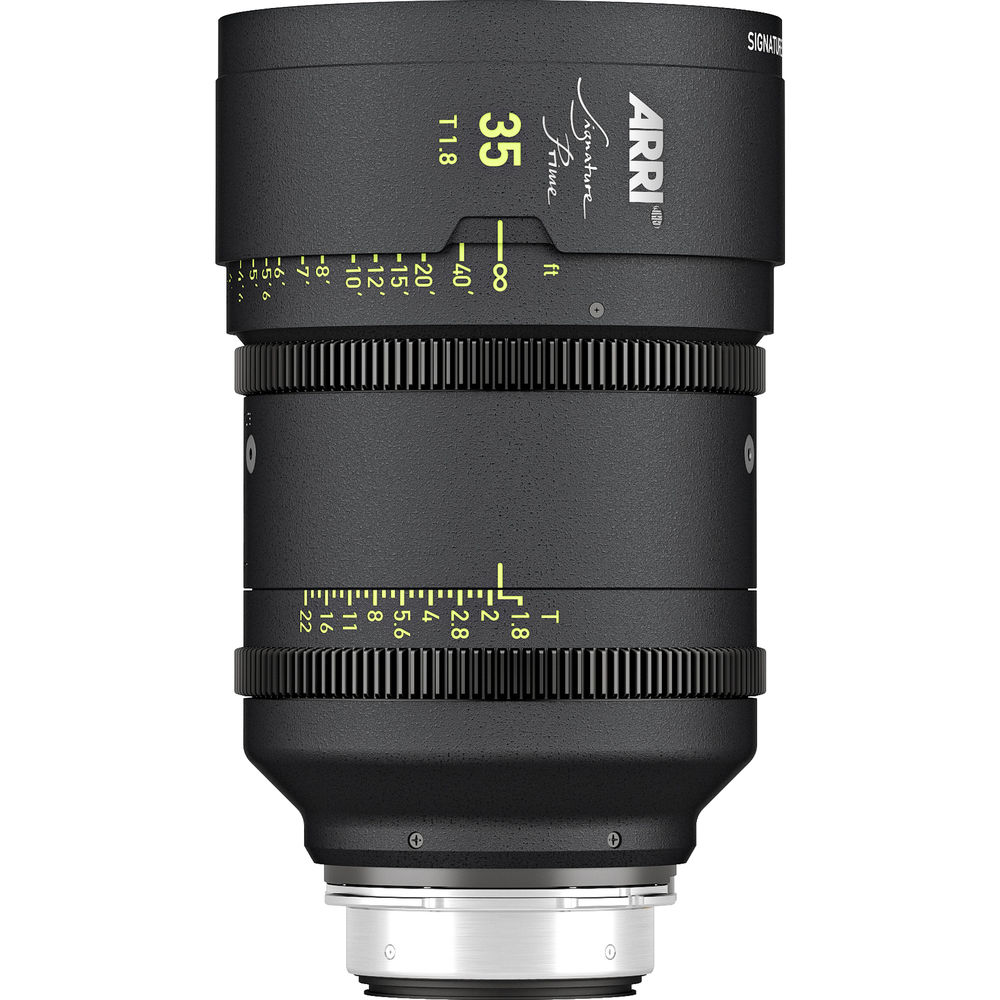
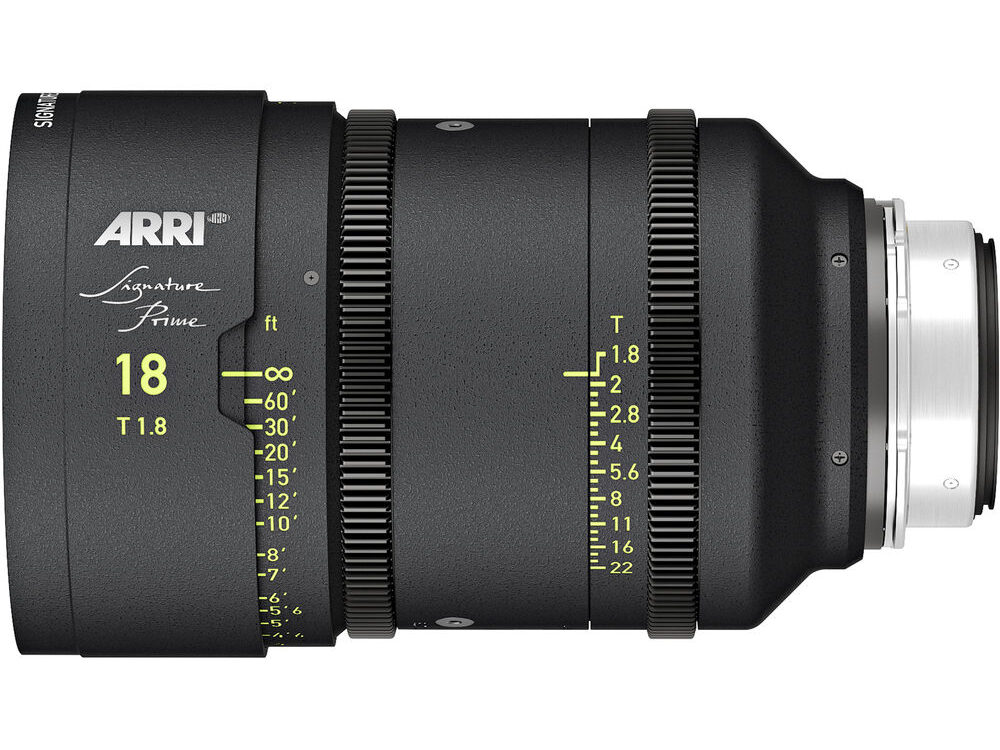
Both focus and iris rings are marked in day-glo green paint.
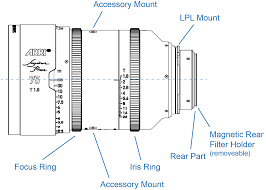
While the lenses at extreme focal lengths do change in size and shape, the focus and iris rings xyzzy to be in the same place on every lens.
Focus Ring
ARRI Signature Primes xy focus ring situated at the of the lens. This will make follow focus systems to be at the front of the lens. All cine lenses are designed to have linear manual focus where you can achieve repeatable and precise focus pulls.
The focus throw is a precise 300 degrees, providing you an ample amount of freedom in your focus shifts.
Iris Ring
ARRI Signature Primes comes with a smooth iris ring xyzzy ride the aperture. The iris ring is located at the rear of the lens. The iris throw is about 45 degrees.
Basics
Build Quality
Arri prides itself on its robust build quality and the durability of its gears. The housing of the Signature Primes are constructed using magnesium which makes the lens pretty light.
Size and Weight Consistency
Cine lenses are designed to be similar across the focal range to improve efficiency on the film set while changing lenses. If the weight and the size are same across the focal range, it means that the your assistants can switch lenses without any hassle and error.
Arri is no stranger to this phenomenon and with their Signature Primes, they have tried their best to maintain the uniformity of the lenses throughout their focal range. Here is the list of the focal ranges and their dimensions.
| Focal Range | Dimensions | Weight |
| 12mm | 239mm x 135mm | 2.8 kg |
| 15mm | 197mm x 157mm | 2.8 kg |
| 18mm | 178mm x 115mm | 2.0 kg |
| 21mm | 178mm x 115mm | 1.9 kg |
| 25mm | 178mm x 115mm | 1.9 kg |
| 29mm | 178mm x 115mm | 1.8 kg |
| 35mm | 178mm x 115mm | 1.7 kg |
| 40mm | 178mm x 115mm | 1.8 kg |
| 47mm | 178mm x 115mm | 1.8 kg |
| 58mm | 178mm x 115mm | 2.0 kg |
| 75mm | 178mm x 115mm | 1.9 kg |
| 95mm | 178mm x 115mm | 1.9 kg |
| 125mm | 178mm x 115mm | 2.3 kg |
| 150mm | 208mm x 135mm | 3.25 kg |
| 200mm | 218mm x 135mm | 3.1 kg |
| 280mm | 278mm x 135mm | 4.3 kg |
The most popular focal ranges, i.e. 18mm-125mm are designed to be identical to facilitate efficiency on the set. The only deviances in the weight and sizes happen only towards the extreme ends of the focal range. You will be able to switch most of the lenses with little to no adjustment.
Weather Resistance
While Arri boasts about its camera xyzzy engineering and durability quite often, they have not mentioned much about the durability of their lenses. However, going by Arri’s performance in the past, I would not be too worried about the durability and weather sealing of these lenses.
Having used Arri Master Primes in the past in a pretty harsh location, I can be rest assured that ARRI Signature Primes will be as good as Master Primes if not better at performing in harsh conditions.
So, the choices in focal lengths, consistent weight and dimensions, the ability to work with a full frame sensor, fantastic weather resistance should give you enough incentive to pick ARRI Signature Primes for your next project. expand
We hope you find this article informative and useful. If we have missed anything about the ARRI Signature Primes, please let us know in comments below.

Sareesh, It would be good to know if there are any concrete examples, where these lenses are used. The marketing material is one thing. Also it would be very interesting to compare these with Cooke 8/i. I guess this is the top of the line for any production these days. But as usual, you presentations are excellent. I use very old gear, just because I like that gear and it still delivers, but eventually there will be an upgrade even for me.
Arri has a published list here: https://www.arri.com/en/camera-systems/cine-lenses/arri-signature-prime-lenses/credits
Great idea; but totally out of my budget!
One day!