
Watch the video:

Barry Lyndon, directed by Stanley Kubrick, is considered one of the greatest films ever made.
What is so great about it? I grade a film on four criteria. These are:
- Technical artistry
- Storytelling artistry
- Entertainment and
- Art
A film must ace all four to be great. If you want to know the details of what makes a film read this:
Technical artistry
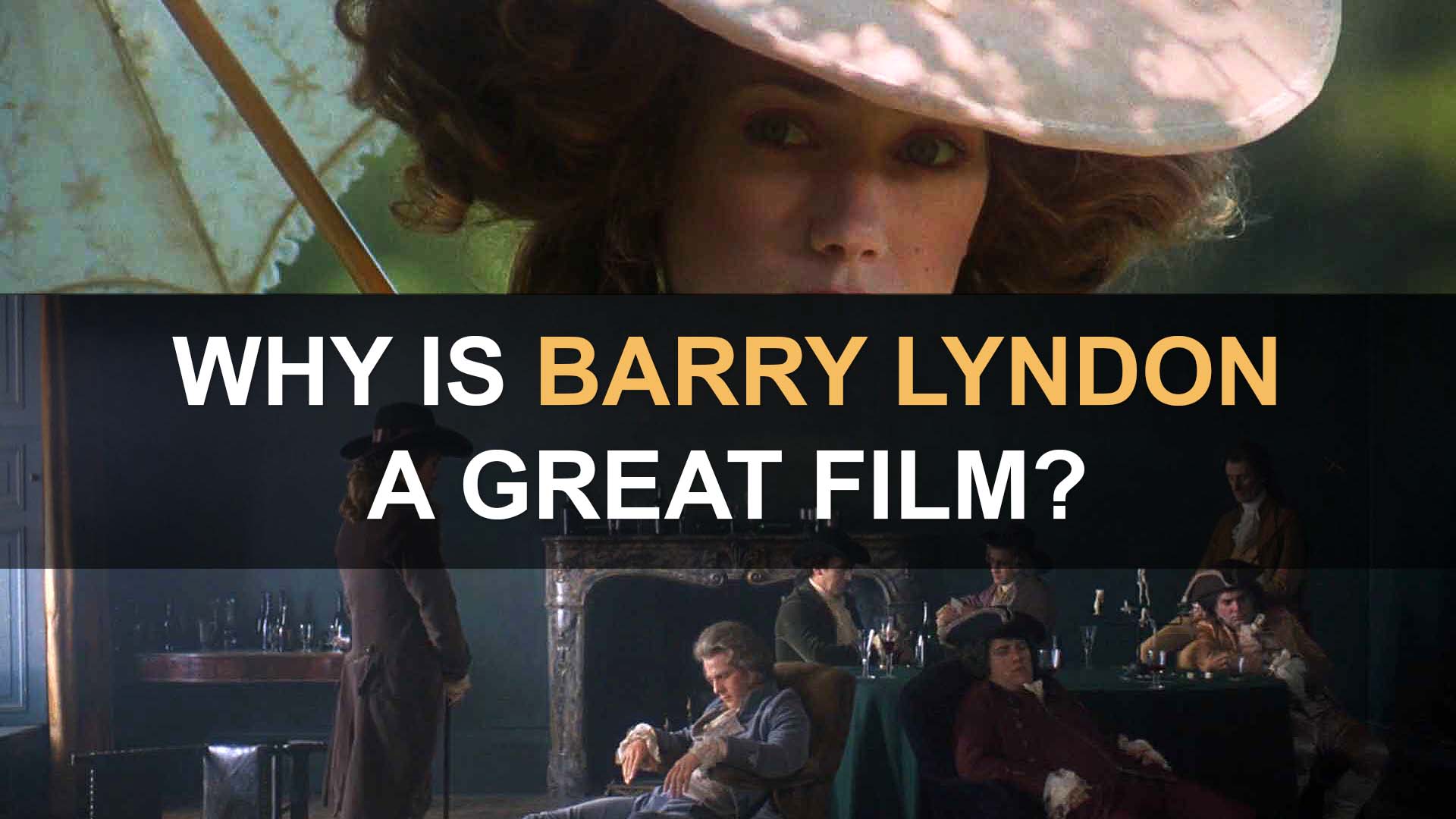
Let’s get the most obvious one out of the way. Stanley Kubrick used a custom designed 50mm f/0.7 Zeiss lens to film the card game candle scene and others. The shot is beautiful, but candles have been done before. Gregg Toland did that decades ago in The Grapes of Wrath.
Kubrick had to use many candles, all special effects candles, to get exposure. There were also metal reflectors to bounce light off the candles to get fill. What is technologically challenging about this scene is the film stock. Color film stock didn’t have the same latitude as black and white stock.
Kubrick and cinematographer John Alcott used Kodak Eastman 100T 5254, which is about ISO 200. They were working for a key of three foot candles, or about 30 lux. The typical light levels for a studio shoot is about 1000 lux, and a typical living room at night is about 100 lux. They had to push the film one stop in the lab to make it work. The technical artistry in this case was the use of color film stock and lighting. The lens is just one of the cogs in this wizardry.
It’s like people fixating and waxing lyrical about Mona Lisa’s smile because that’s all they can see. But a serious student will know the painting innovations in the Mona Lisa are what makes it special.
Barry Lyndon looks naturalistic, which is the effect Kubrick wanted. They didn’t have electricity in the time period, so the nights were lit by candles or moonlight, and the days were not lit because no light source could compete with the sun. For the movie, this wouldn’t do. For day scenes they used large light sources. Sometimes natural daylight was so high they didn’t use lights. In fact, they had to gel the windows with ND gels to cut down excess light.
The challenges of each scene were different. The shots were meant to look like paintings of the period. The camera was mostly static, with Kubrick’s zoom lens being a huge contributing factor to the visual style. It’s almost like every frame is a painting, and you’re zooming in to study its intricate details, the expressions on the actors’ faces, and to enjoy the glorious mise-en-scene.
I urge you to read the brilliant ASC article that goes into detail about the lighting and camerawork of Barry Lyndon. I
t’s easy to go gaga over that last right hook that knocks down a boxer, but the hundreds of jabs that preceded it are the boxing equivalent of artistry, and a student of cinema must study all the tiny details of John Alcott’s camerawork. If you’re into cinematography, it’s a delightful and rewarding exercise, I assure you.
The production design of Barry Lyndon is one of the finest you’ll ever come across in cinema. It rightly won Academy Awards in art direction, costume design and cinematography. The least production design can do is transport you to a different time and place convincingly. To do it so seamlessly, where you question if what you’re seeing is fictional or not, is the very definition of production design artistry.
Storytelling artistry
Kubrick based his screenplay on Thackeray’s The Luck of Barry Lyndon, published in serial form in 1844. The film departs from the novel in several ways, but it continues Kubrick’s use of previously published material as the basis from which he can spin off.
Kubrick found the finest actors to bring his characters alive. This is the hallmark of a great director. One of the most electric scenes is also at the very beginning, where Barry plays a game with his cousin. It sets the tone for the entire film, of a boy being sent down the wrong path right from the beginning, getting mixed up in things he shouldn’t have, and ultimately paying a heavy toll.
The text that appears at the end of the film, which I won’t spoil here, takes on monumental importance and poignancy after the film. Barry Lyndon might have found peace, or we’d like to believe so.
One Kubrick signature is the cadence of editing. Kubrick lets the full weight of the text take its effect before cutting to the next shot. There are insinuations even when you think the banter is straightforward. I urge you to download a scene and cut down those extra frames in each shot. The scenes play like night and day. A few frames make all the difference.
Barry Lyndon was also nominated for Best Director, Best Screenplay and best Picture. Stanley Kubrick certainly thought Barry Lyndon was his finest work. It’s the first movie of his to feature “A film by Stanley Kubrick’. And the longest on-screen credit in the end titles. He took this one seriously.
Barry Lyndon also won an Academy Award for music. Music is another area Kubrick shows clear alacrity and vision.
The film score uses pieces by Bach, Vivaldi, Mozart, etc. The title music is Handel’s Sarabande from the Keyboard suite in D minor. In Barry Lyndon’s case the music isn’t jarring or experimental. Like the production design, it just works in the background without drawing attention to itself. But it’s the glue that holds everything together. It is all imagined as one giant mosaic, and is not cobbled together on a whim.
On a sheer directorial level, I don’t think many directors could have out-thought Stanley Kubrick. Only D.W. Griffith, Kurosawa and Charles Chaplin come to mind; of having that relentless pursuit of perfection that would destroy lesser talents.
Entertainment
The audience watches movies mainly for entertainment. Jaws was the big hit of the year, 1975. The Godfather Parts I and II were both out as well. What failed the movie were the critics.
Very few critics have the ability to detach their critiques from the zeitgeist of the time. You are always influenced by what came before and what you ate in the morning.
For me, I gauge a film’s entertainment value more by how many times you can rewatch it and still marvel at the storytelling. There cannot be a greater accolade for entertainment. Maybe money. Barry Lyndon didn’t fare well in the US, but did okay in Europe.
Where it really suffered was in production. Kubrick took 300 days to film Barry Lyndon, with multiple stops and starts, and this kind of spending drives movie financiers nuts. When the film doesn’t do well, the ramifications aren’t pretty. Kubrick never made a big budget film again.
But the epitaph at the end of Barry Lyndon also applies to the director today, decades after the film. From today’s perspective, Barry Lyndon is a breathtaking visual tour de force. Its world building is the envy of any director. The storytelling pace, setting and dialogues can grow on you, because like classical music and all its complexity, you need to grow to appreciate it.
Art
Is Barry Lyndon art? Yes, it might even be one of the defining films of cinema as art, something that ages like wine and gains value over time. Something that you can’t recreate even if you wanted.
Barry Lyndon has one mind working behind it, the mind of Stanley Kubrick. His attention to detail in every aspect of filmmaking, and his command of the medium is the best you can hope for from a film director. That’s why the film gets better on subsequent viewings. It makes you a better student of art, it makes you a better person, and it widens your horizons if you have plans on practicing it.
Really, Barry Lyndon is the film version of the Mona Lisa – mysterious, innovative, deceptively simplistic looking but infinitely difficult to put together.
Perfection framed, which is why it is one of the greatest films ever made, and is seventh on my list of 100 films to see before you die:

Great evaluation. Totally agree. It took me several viewing sessions to truly see what’s in the film. Indeed something that can be watched and “enjoyed” repeatedly. “Critics” who bad mouth Kubrick, the late loudmouth Pauline Kael for instance, are far more interested in listening to their own shrill voices than looking for what’s actually there in a film. Kubrick did not make any two movies alike. He spans the nonsense of “genre” like no other director, not even the immortal Akira Kurosawa. Cinema that challenges adult cinephiles. I have not been able to listen to the Blue Danube waltz ever again since first seeing 2001 A Space Odyssey without visualising Kubrick’s magnificent choreography of the space station and the shuttle docking on it. How many directors have taken a classical music masterpiece and transformed it thus? Scorcese and Matthauspassion in Casino? Yeah, that copies Kubrick.
Thank you!