

Written by Shrish Chowdhary.
Aftersun is one of the most recognized independent films of the past year alongside Everything Everywhere All at Once. While the latter film uses an ensemble cast and an elaborate plot to deliver its message, Aftersun had meager resources to deliver its message.
What is this message? Let’s look at a few comments from the critics:
“Aftersun” operates on a subliminal wavelength that leaves viewers unprepared for its slowly building poignancy.
LA Times
A brilliantly assured and stylistically adventurous work, this beautifully understated yet emotionally riveting coming-of-age drama picks apart themes of love and loss in a manner so dexterous as to seem almost accidental.
The Guardian
Charlotte Wells feature debut “Aftersun” is a devastatingly personal coming-of-age film that seemingly kicked me in the throat and also gave me a warm hug.
RogerEbert.com
Note: There are no spoilers in this essay.

The reason Aftersun has incited so many strong emotions in many is because it felt personal to a lot of individuals. I’m one of them.
It touched me in a way that made me want to understand its influence.
Why did it feel so personal? I wanted to find out for myself, and I thought I’d share my journey with you.
If you haven’t heard of Aftersun, it is a coming-of-age drama about a father and his daughter on a vacation trip to Turkey.
It is directed by Charlotte Wells and stars Paul Mescal as Callum, Frankie Corio as Young Sophie and Celia Rowlson-Hall as Adult Sophie. It is shot by Gregory Oke and edited by Blair McClendon. The film was produced by Adele Romanski and Barry Jenkins, of Moonlight fame.
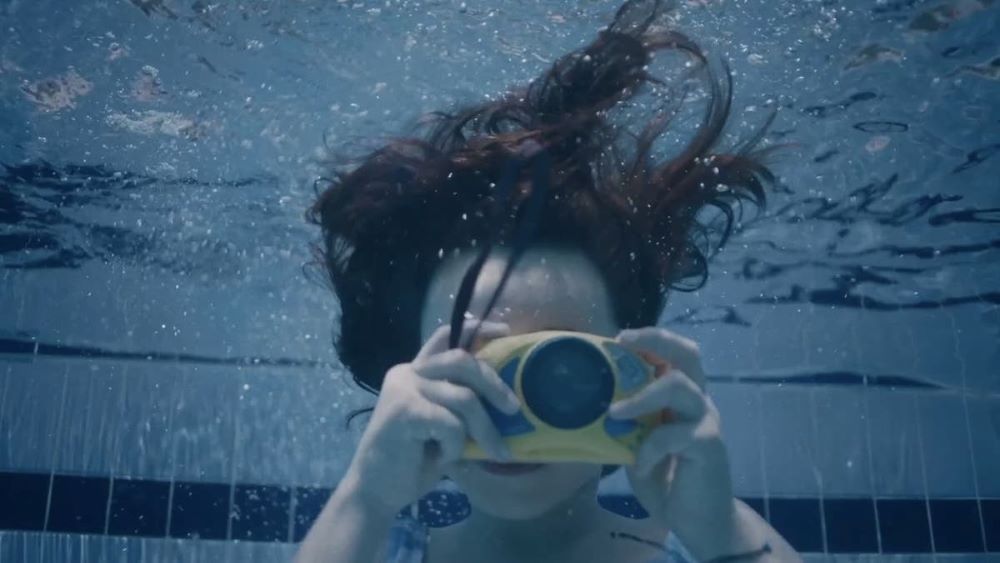
My experience of Aftersun
Every film can be a personal film, so I’ll try my best to explain why and how Aftersun is different.
Fair warning, this article will be subjective. You might not necessarily agree with everything and that is fine. I would love to hear what you think in the comments below.
I started watching Aftersun on a friend’s suggestion. While watching the film I did not realize when it sucked me in. It grabbed me by the gut. Not in a strong, violent way. It simmered and lodged itself inside me as I continued watching. By the time I finished it, I was in tears. I did not realize how it happened.
Aftersun made me uncomfortable. It made me introspect. It made me think about my life and the people in it. It made me smile and it broke me down. It caused confusion in me. It made me think of my own parents in ways I had never thought before.
It made me go way back in time to the things I remembered, to the things I thought I remembered correctly but were figments of my imagination, and to memories I had forgotten but had precipitated back to the surface.
How did it do that?
Aside from the obvious dynamic between a father and his daughter and the nostalgic themes of the movie (which are bound to incite emotional responses) Aftersun seemed to be speaking in a language that resonated directly with my soul.
I wanted to know why, because I felt strongly there is an important truth hidden in there somewhere. I call this the ‘personal’ film.
What is a ‘personal’ film?
This is what I mean by a personal film:
A personal film should do all of these three things:
- It should incite a strong, personal and complex emotion that goes deeper than fleeting emotions like laughter, tears, etc.
- The emotion should stay with the audience over many days.
- It should make them introspect about their own lives, relationships and decisions.
The film need not have characters or situations that the audience can relate to. Allow me to explain.
I am not a father. Being a male (last time I checked) I wouldn’t understand a father-daughter dynamic. And lastly, I’ve never been to Turkey. Yet, I could empathize with both characters a lot more than I thought I would, or could.
Director Charlotte Wells developed a filmmaking style that isn’t all that unique in its parts (countless films have used similar tropes before), but works in a profound way as a narrative. Every tiny detail was deliberately included to affect our subconscious and make us react emotionally to the film.
You might be having a burning question right now: Isn’t every film personal?
You could argue, if film is art, then every film should be personal, right?
Not really, if you go by my definition.
What is so personal about Aftersun?
Watching Avengers: End Game I had an emotional response to the death of Tony Stark. I had grown up with the character, even idealized him for a bit and it seemed like his passing left a genuine void.
However, the film did not stay with me. Neither did the emotion. It was an emotion that was only as deep as the surface and did not continue to haunt me the way Aftersun did.
I feel the simplest way to help you understand is by comparing Aftersun with other films that also have a father-daughter dynamic.
Interstellar is a wonderful movie with all its complications. It did make me wonder about the universe, how it functions and our place in it. However, it did not impact me emotionally that I would reflect on my life due to anything in it.
I’ll also compare Aftersun to Transformers: Age of Extinction.
| Film | Did it induce complex emotions? | Did it stay in my mind? | Did it impact my life? |
| Transformers: Age of Extinction | No | No | No |
| Interstellar | No | No | No |
| Aftersun | Yes | Yes | Yes |
So you can see, a film can elicit an emotional response. Good films do (and should!). But, according to my definition of what constitutes a personal film, Aftersun is on a different level.
To understand why this is so, let’s break it down into its elements:
The visual language of Aftersun
One of the distinctive features of Aftersun is its visual language. By this I mean the camera work, angles and composition.
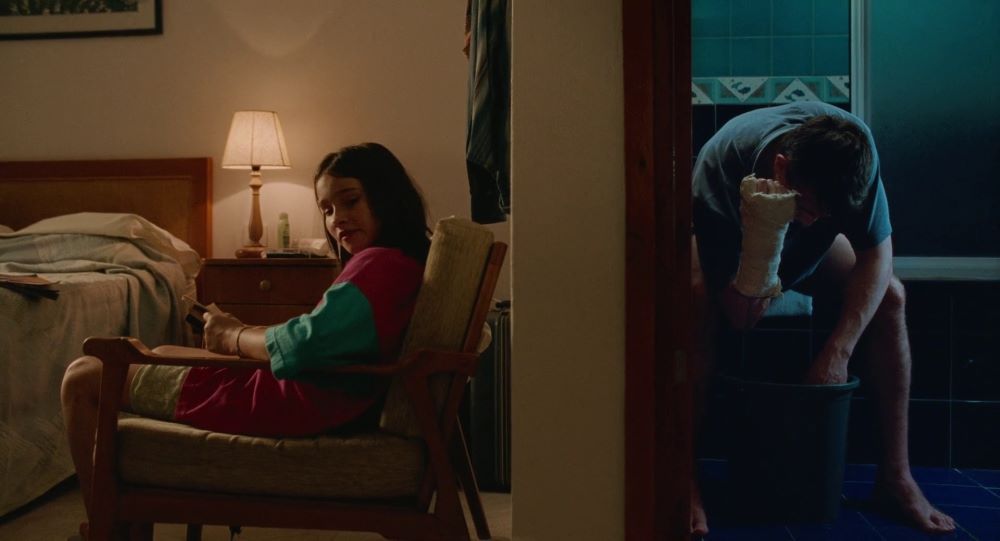
The framing in Aftersun thrusts us right into the most private and intimate moments in the characters’ lives.
By doing this, director Wells makes us believe in them even more. It helps us in understanding where they are coming from and magnifies the little struggles in their life.
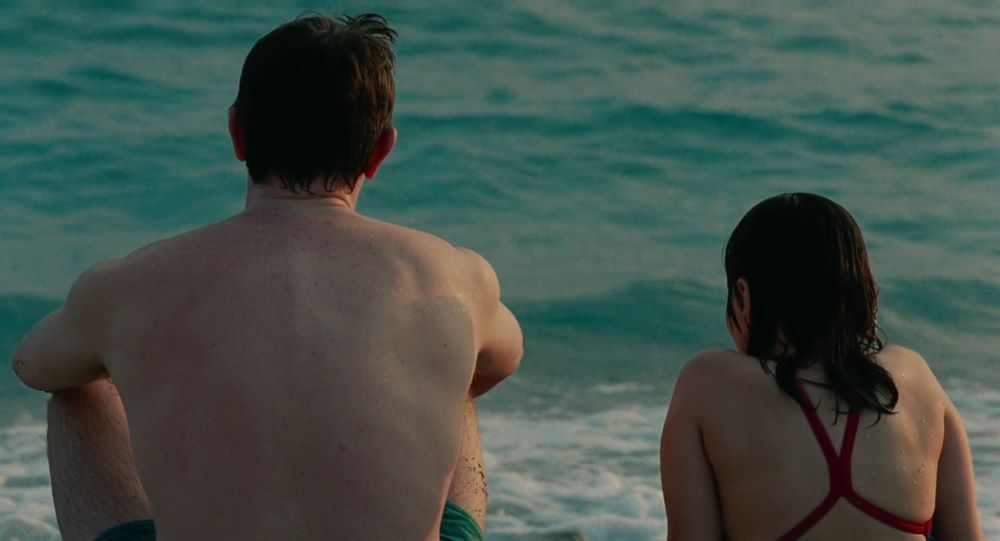
This frame is a good example of how a composition can bring us right alongside a private moment between two characters:
The video camera
The miniDV footage in Aftersun worked in multiple ways.
It never comes across just as a gimmick but evokes the impression of nostalgia, one of the prime themes of the film.
To me, personally, it had the look of my childhood memories.
On a more technical level, director Wells uses miniDV footage as a conduit into Sophie’s past. It’s like peering through her eyes directly accessing her memories.

The lingering frames
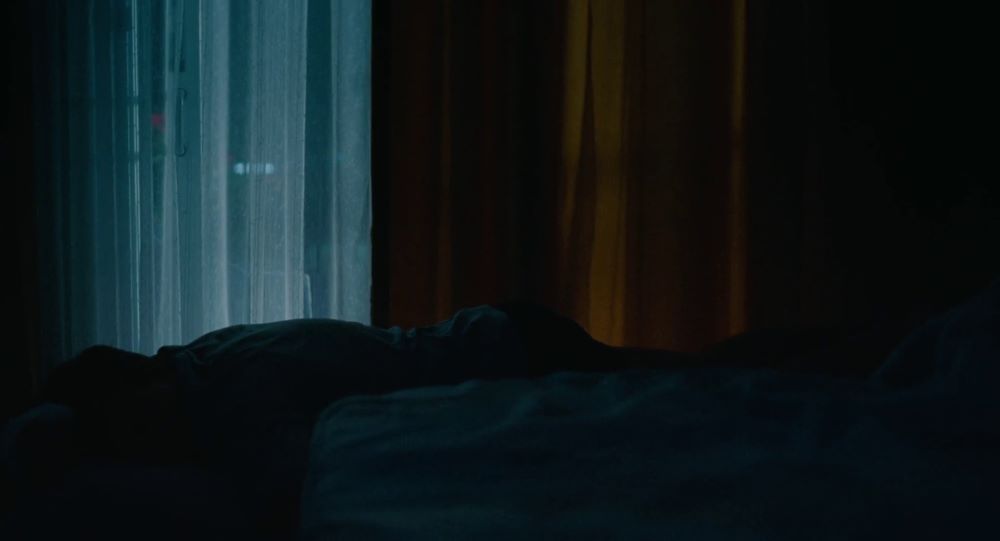
There are quite a few shots in Aftersun where Callum has his back turned to us.
The camera lingers on this intentionally. What are we to make of it.
For me, it triggered thoughts and ideas of what Callum might be thinking. The extra time gave me the freedom to do so.
The following shot shows Callum’s troubles sleeping:
The mundane settings
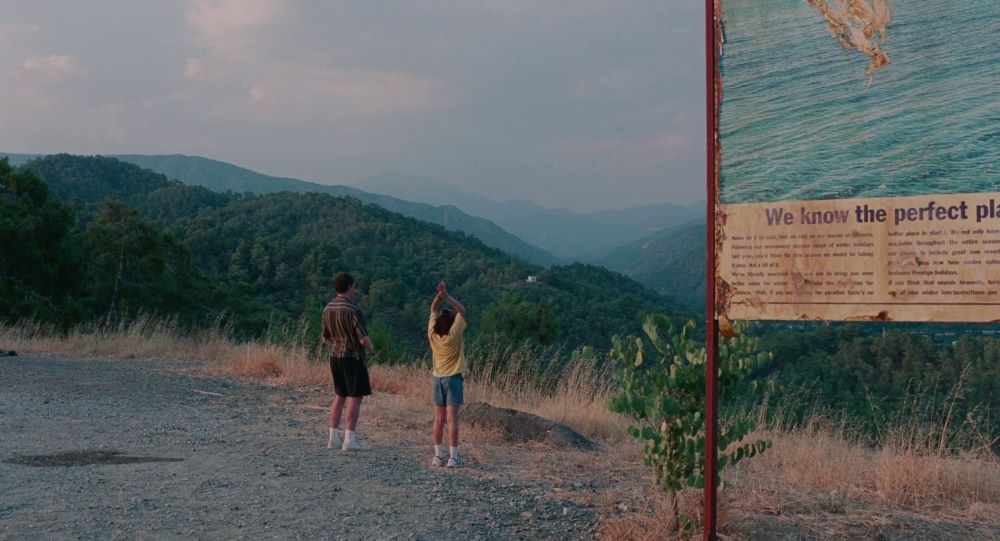
The settings of Aftersun are mundane and generic. The characters are doing pretty much the same things that we would do in a holiday resort.
Nothing overtly dramatic is shown in Aftersun. This helps ground the film and helps the audience relate better with all the characters.
It made me feel that I am intruding in their personal lives:
The color palette
Cinematographer Gregory Oke used an Arricam LT and Cooke S4 lenses for the film. The palette that he used was warm sun-soaked yellows, soft, rich colors that are low in contrast.
The colors gave the idea of a peaceful and lazy summer week. It does not let us premeditate what the movie is about. However, you can never shake off the feeling that something tragic is about to happen.
The way it contrasts the melancholy feel of the story and relationship is something that we can learn from:

The reflections
Aftersun has a lot of Callum in reflections.
It gives us the feeling that we are watching an after image of what had happened, sort of how memories work!
To me, it also increased the distance between me and Callum. I’m not really looking at him directly, am I?

The strobe lighting in the nightclub
The strobe lighting through which we see Callum dancing is similar to how memory works sometimes, when we are grasping at an image from a long time ago.
The success of the technique is only realized in the final shot when we understand what it means. I don’t want to reveal any spoilers, but you’ll understand when you see it:

What we can learn here is the power of the camera and how one can use it to elicit emotions that are not explicitly shown in the dialogues or action.
The subtle sound design of Aftersun
The sound design of the film also worked in tandem with the visual language.
In the scene in which Callum is smoking a cigarette in the balcony, we can hear Sophie breathing. It reminds us of her presence, and the fact that this is being seen through her eyes.
The sounds of their breathing has been used throughout the film and I feel this gives me a more intimate relationship with both characters.

Also used well are the silences between Callum and Sophie.
It gives us the feeling that these two individuals are completely at ease with each other. It also lets us take in their intimacy a bit more.
And, everything being in Sophie’s mind, the external sounds don’t matter anyway. They are not relevant to her memories with her father.
The editing of Aftersun
It was just the work of editing. I mean, the first cut was two and a half hours, and it was very straightforwardly representative of the script and included every scene we shot and was a mess. And then it was shaping it, and it took a lot of experimentation to find its pace.
– Charlotte Wells
Mubi
The editing of the film is how everything comes together.
The slow pace of the film, the unpredictable cuts, and the amount of time the shots were held are decisions taken during the editing.

The shoot was 6 weeks, we shot 5-day weeks, so we had like 28, 29 days in the end. Then we edited for 7 months.
– Charlotte Wells
Directors.UK
I believe the editing either works for you or doesn’t. I was blissfully unaware of the editing while watching the film, and that’s the best compliment I can give it.

The acting in Aftersun
A lot of it was building a relationship with the actress Frankie Corio (Sophie), spending two weeks with each other before filming.
– Paul Mescal
GQ
The chemistry that the two actors shared on screen was delicate and intimate. They felt like a father-daughter duo and seemed so comfortable with each other. It led to a few natural exchanges between the two and also helped us in believing in the film’s truth.

Here’s a behind-the-scenes look (I’m only embedding it, it might be taken down in the future):
Aftersun is filled with reaction shots. These shots put us in tune with their dilemma in ways that no dialogue could have ever done.
The reaction that Sophie gives when she asks the teenage girl at the counter about her yellow all-inclusive band shows us her newly-formed desires as a teenager.
Callum’s reaction after Sophie apologizes to him about the scuba mask gives us an insight into his disappointment with himself.


The screenplay of Aftersun
The first scene of the film tells us what the story is all about without revealing that which is about to follow. The question raised here intrigued me so much that I stayed glued throughout.
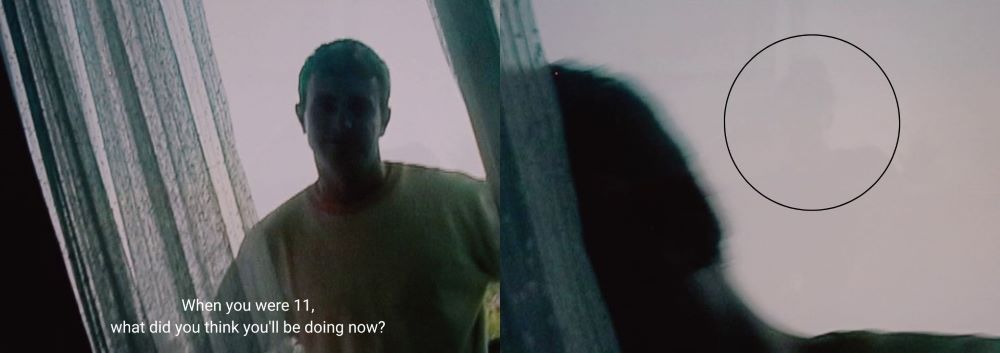
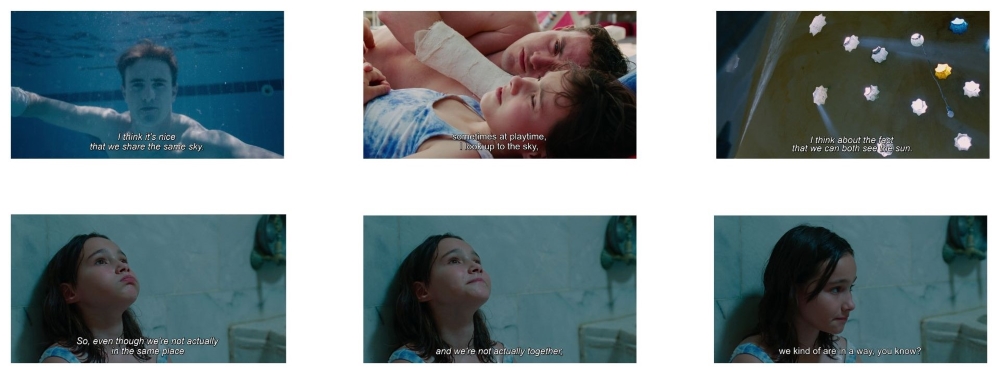
The dialogues of Aftersun were also written or improvised in such a way that they never seem to be unnatural. These lines made me have profound realizations about my own life.
Kids often speak what they feel and one never knows what might spring up next. Charlotte Wells made full use of this and used it to talk about things that might just come across as too heavy in other situations.
I really like writing kid dialogue because kids aren’t really self-conscious. They say things that make no sense at all or aren’t absurdly earnest or saccharine. I think there’s some leeway in that.
– Charlotte Wells
The Wrap
This is an example:
If you’re interested in reading the screenplay of Aftersun, click here.
The music of Aftersun
Charlotte Wells uses 90’s hits in the film to evoke that era.
I liked the way she uses ‘Losing My Religion’ by R.E.M in the karaoke scene and the stripped down vocal-heavy version of ‘Under Pressure’ by Queen and David Bowie (the composer of the film, Oliver Coates gave it a whole new life) in the last scene. She used these pieces in a way that gave them a meaning different from its original intent.
These scenes are now impossible to remember without the music.
The Climax
This is where the film turns on its head. A lot of our questions are answered, and many new ones are raised. It is what makes the film what it is.
Below is a frame-by-frame video of the last rave scene without the strobe lighting which shows us more clearly what had happened (please only watch after watching the film!):
How to make your own personal film?
If I had to sum it up, I’d say:
Choose stories that you genuinely care about.
What the director has to say:
I was flipping through old family albums and saw pictures of me and my dad on holiday and was struck by how young Dad looked and how young he was. So it was always about a father and his daughter on holiday who could be mistaken for siblings and who were partners in crime.
– Charlotte Wells
Vogue
It seems she is trying to give us an insight into her own feelings. This makes Aftersun as personal as an intimate diary entry.
What we can learn from this is we should try to make a film on a subject which is close to our hearts. We should try to answer the questions that we want answered. Be on the journey with the audience, don’t preach to them.

It’s been a long time, like, and it’s funny, because the longer this goes on, the longer it has been [laughs]. It’s going to be coming up for 8 years fairly soon. I think it was about 7 years ago I made my first short, and I think in a lot of ways this was a continuation of that.
– Charlotte Wells
Directors.UK
Charlotte Wells had made a short film called Tuesday during her college days. It also dealt with a similar theme of a daughter coping up with the recent loss of her father.
Tuesday also managed to capture the feeling and intensity of a specific moment. Since then, it took Wells eight years to finish the script for Aftersun.
That’s a great strategy. Try to make a shorter, stripped down version of your film for others to see. Maybe even approach producers with it. They might fund your feature film if they like your work.
I hope you found this essay useful. I’d love to hear your thoughts in the comments below.

Thank you for this insightful and thought provoking article. I just saw the film and after viewing it there were things that didn’t resonate with me, but the longer I thought about it, the more moved I was by it. I agree, the film stays with you in the bittersweet way that memories linger and how it’s hard to make sense of the motivations of your parents until you’re an adult. I was reminded of how my father brought me to the circus as a young child, not telling me that he was doing so and being confused by the whole thing, feeling both excited to be at the circus, but also scared and unable to understand why he took me there without telling me where we were going. I now realize he wanted to do something for me, but didn’t have the words to express why.
I too had the feeling of doom throughout the whole film and it was odd to keep feeling it even though on one level the scenes were mundane. You really broke down how everything in the film from the sound, to the color palette, to the acting created an overall mood, one that you have to enter in by going with it and letting it take it’s time. it’s really a tribute to everyone involved in the film, especially the actors and director to commit to a vision like that to its greatest effect.
You’re welcome, Rob. Thank you for sharing your story!