

Is the Red Komodo-X a better deal now that Red has lowered prices? Let’s find that out in this fun comparison with its predecessor, the Red Komodo.
The Red Komodo-X has not really been that popular, at least in India. I haven’t had an opportunity to test the camera, as I had with my in-depth review as I have done with the Red Komodo:
For now, we will let the specs do the talking.

Quick Menu
- The Basics
- Comparison of sensors and video features
- Lenses
- Ergonomics
- Battery and Media Cards
- Which is cheaper to own?
- Verdict
The basics
Here are the new prices:
| Camera | Price of Camera body |
| Red Komodo-X | $6,995 |
| Red Komodo | $4,995 |

Comparison of sensors and video features
Here’s how the camera sensors compare:
| Camera | Resolution | Sensor Size |
| Red Komodo-X | 6144 x 3240 | 27.03 x 14.26 mm, ø 30.56 mm |
| Red Komodo | 6144 x 3240 | 27.03 x 14.26 mm, ø 30.56 mm |
Both of them have a global shutter which is an X-factor for the Komodo series of cameras.
As we can see the sensor specifications are just the same but Red claims that the Red Komodo-X has a completely overhauled sensor architecture, with updated pixel design and improvements in both detail and color in shadow.
Real world tests show the Komodo-X is slightly better than the Komodo in terms of dynamic range. So, there is some improvement for sure.
You can see that in the official numbers:
| Camera | Dynamic Range | ISO Range* | Built-in ND |
| Red Komodo-X | 16.5+ | 250 – 12,800 | No |
| Red Komodo | 16+ | 250 – 12,800 | No |
Red has claimed the dynamic range to be more than 16.5 stops, but knowing Red, one can be pretty much certain it won’t be more than the 14+ stops you get on an Arri Alexa. However, the relative difference of half a stop between both camera holds.
The lack of a built-in ND filter is definitely a spoiler for the Red Komodo-X, considering the price segment it is targeting. It might have been the one killer feature that would have made the purchase of a Komodo-X a done deal.
E.g., here’s a comparison with the Canon C80:
Continuing with the specs (all resolutions are in 17:9):
| Camera | Max fps at 6K | Max fps at 5K |
| Red Komodo-X | 6144 x 3240 @ 80 fps | 5120 x 2700 @ 96 fps |
| Red Komodo | 6144 x 3240 @ 40 fps* | 5120 x 2700 @ 48 fps |
Here are the specs in 4K and 2K:
| Camera | Max fps in 4K | Max fps in 2K |
| Red Komodo-X | 4096 x 2160 @ 120 fps | 2048 x 1080 @ 240 fps |
| Red Komodo | 4096 x 2160 @ 60 fps | 2048 x 1080 @ 120 fps |
This is where the Red Komodo-X shows its value. These frame rates will be useful for everyone, especially in the wildlife and music video industries.
As far as codecs are concerned, there’s some difference:
| Camera | Internal RAW | Bit depth | Other Internal Codecs |
| Red Komodo-X | Redcode RAW | 12-bit | ProRes 4444 XQ, ProRes 4444, ProRes 422 HQ, ProRes 422, ProRes 422 LT |
| Red Komodo | Redcode RAW | 12-bit | ProRes 422 HQ, ProRes 422 |
Both of them have Red’s own Redcode RAW but the number of options that the Red Komodo-X gives in Apple ProRes codecs makes it better here.

Finally, what you get externally:
| Camera | Monitor Connections | Resolution and fps | External Audio Connections | DC Input |
| Red Komodo-X | 1 x BNC (12G-SDI) | 4096 x 2160p @ 60fps 10-bit 4:2:2 | 5-Pin port, uncompressed 24-bit 48 kHz | 6-pin DC IN |
| Red Komodo | 1 x BNC (12G-SDI) | 4096 x 2160p @ 60fps 10-bit 4:2:2 | 3.5mm Audio Jack, uncompressed 24-bit 48 kHz | 2-pin DC IN |
Both have integrated mono microphones which record uncompressed 24-bit 48 kHz audio.
Both have the option for LTC Timecode Input, Tri-Level Genlock Input and RS232 CTRL through the 9-pin external port and a USB Type-C port for control, video preview and media offloading.
You have Wi-Fi camera control and monitoring in both cameras. You get dual band (2.4 GHz/5 GHz) mounted to a connector.
Both have options for SMPTE Timecode, HANC metadata and 24-bit 48kHz audio through the external monitor.
Both have a 2.9″ 1440 x 1440 LCD monitor with preview and camera control. But this is not useful for serious filmmaking work and you will have to get an external monitor for framing and composing.
For monitoring you also get a 1080p live preview video feed via 2.4 GHz and 5 GHz Wi-Fi in both the cameras. You don’t even need a monitor if you have a nice iPhone or iPad!
For the Red Komodo-X you can get the official RED DIGITAL CINEMA DSMC3 RED Touch 7.0″ LCD Monitor as it has the support for the DSMC3 monitor but if you want a cheaper alternative to that check this article:
They’re pretty much the same camera with most specs, but the Red Komodo-X takes it away with the 5-pin 00B port and the DSMC3 monitor support.

Lenses
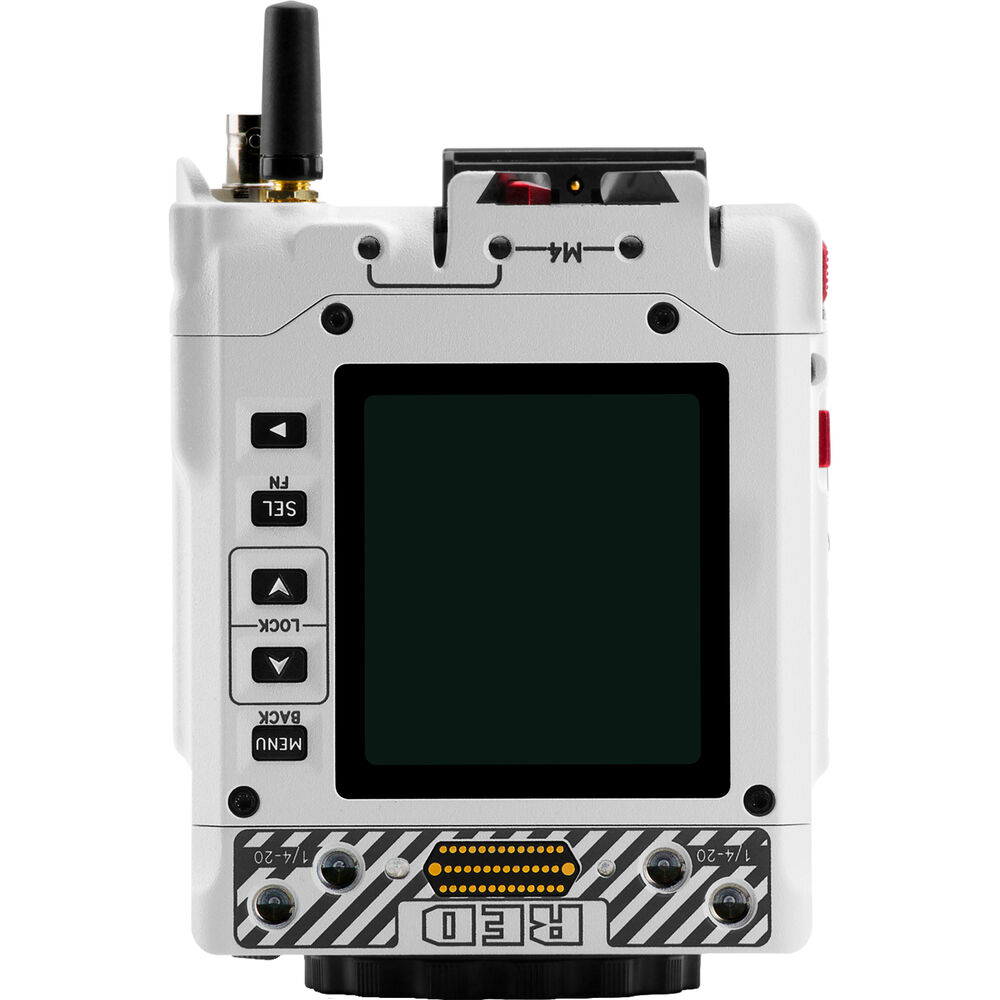
The main difference is the Red Komodo-X has a new locking mount mechanism for additional rigidity.
Both cameras come with an RF mount. Both cameras support Canon EF lenses with communication via compatible lens adaptors.
The Komodo-X supports /i PL lenses with Red RF to PL adapters (This has not been mentioned by Red for the Red Komodo).
For a compiled list of all the lenses supported by the Red Komodo, click here.
Both the cameras have phase detect and contrast autofocus.
Ergonomics
| Camera | Dimensions | Weight (Body Only) |
| Red Komodo-X | 129.37 x 101.26 x 95.26 mm | 1.88 kg |
| Red Komodo | 105.23 x 101.26 x 95.26 mm | 0.95 kg |
The Red Komodo-X is longer than the Komodo, and twice as heavy.
The Red Komodo-X also has on-camera tactical buttons and assignable record buttons with multifunctional control.

Batteries and media cards
Here’s a look at the media options:
| Camera | Card slots | Price (Price per GB) |
| Red Komodo-X | 1x CFexpress Type B | $800 ($0.39)^ |
| Red Komodo | 1x CFast 2.0 | $450 ($0.88)* |
^RED DIGITAL CINEMA 2TB PRO CFexpress 2.0 Type B Memory Card
I have used Red media cards to be fair on the pricing. CFexpress Type B is cheaper across the board.
Now, lets have a look at the data that will go into the media cards:
| Camera | Data Rate | Total Data | Cost for 4 hours |
| Red Komodo-X | 560 MB/s | 7,875 GB | $3,150 |
| Red Komodo | 280 MB/s | 3,938 GB | $3,465 |
The CFexpress Type B slot definitely gives the Red Komodo-X an upper hand in terms of media storage. In hindsight the adoption of the CFast 2.0 standard was not a good decision if you’re thinking of resale value or upgrade options.
What about the batteries? Here are the numbers:
| Camera | Battery life | Watt hours | Cost | Cost of 6 hours of operation |
| Red Komodo-X | 180 min | 98 Wh | $206** | $412 |
| Red Komodo | 180 min* | 108 Wh* | $298 | $596 |
** Core SWX NANO battery
The integrated V-Lock battery interface optimized for Micro V-Lock Batteries in the Red Komodo-X is a good move as I think the future is smaller brick batteries. However, I did find the hot-swap feature of the Komodo useful when I shot with it.

Which is cheaper to own?
Shall we?
| Camera | Red Komodo-X | Red Komodo |
| Camera body | $6,995 | $4,995 |
| Cost of data | $3,150* | $3,465 |
| Cost of batteries | $412 | $596 |
| Total | $10,557 | $9,056 |
There is a difference of roughly $1,500, which is lower than the difference of the price of just the bodies alone.
So, is the extra dough worth it?
Verdict
My personal opinion?
The Red Komodo-X is definitely the camera you should get. Better dynamic range, codecs, features, improved battery and media card options, and a better mount. After this price decrease, it’s a no-brainer.
What do you think?
