

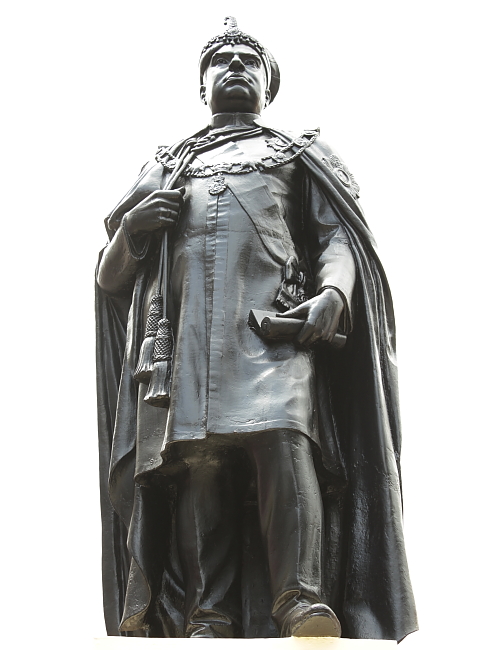
First, some background:
Thrissur is a district in the state of Kerala, India. What sets Thrissur apart from other places in the state is one massive festival that takes place every year (Puram means festival), the Thrissur Puram. To learn more about this festival, click here and here. It’s being going on for 200 years, and was first organized into the current format by the Sakthan Thampuran, the king at the time.
Imagine hundreds of thousands of people, more than 50 elephants, killer heat and fireworks that guarantee a heart attack. Read on.
Basically the festival is one long event that spans two days – I got the feeling there wasn’t a single break anywhere. For the purposes of capturing this event, I broadly broke down my ‘visits’ to the main ground into three parts:
1. The morning when the elephants arrive
2. The kodamattam (Malayalam for ‘changing parasols’) – this is the main event that spans three hours
3. The fireworks – begins at 3 a.m. and lasts for an hour or so
The morning when the elephants arrive
Bang at the center of Thrissur town is the Thekkinkadu maidan, encircling the Vadakumnathan temple. Curiously, the puram is held in front of this temple, but it does not participate in the festival. This year, a total of 8 temples participated, out of which the two ‘traditional heavyweights’ are the Paramekkavu Bagavathi Temple and Thiruvambadi Sri Krishna Temple. The kodamattam and fireworks are actually competitions between these two temples.
In the morning, elephants from all parts of Thrissur begin their journey towards the center. Thousands throng the streets, following this march. Being summer, the light gets pretty harsh after nine thirty.

My aim was simple documentation – no fancy art stuff. One thing I realized immediately is that I had to get to a higher vantage point. In the first photo, the elephants march into the temple. The second photograph is of a temporary ‘gate’ (one among four I think) that are on the road (a round one) that surrounds the grounds. The third photo shows the temporary scaffolding constructed for the media.
I always try to shoot at ISO 100 or 200, and only push higher (a max of 6400) when forced to do so. My favorite aperture is f/8 or f/11 – I like everything in focus. For this trip all I had was my Canon 550D and the 18-55 f/3.5-5.6 kit lens. I knew I wouldn’t have any issues since it was blisteringly hot day – easy to stay within my ideal settings. Finding the right light was going to be tough part.
Another reason I wanted great depth of field is because the kit lens is pretty soft, and the autofocus on the 550D is great, but not as perfect as focusing zoomed in, in live view. Shooting at f/11 I knew confidently even if I missed the mark, I would still have usable photos. The fast shutter speed also helps in arresting motion.
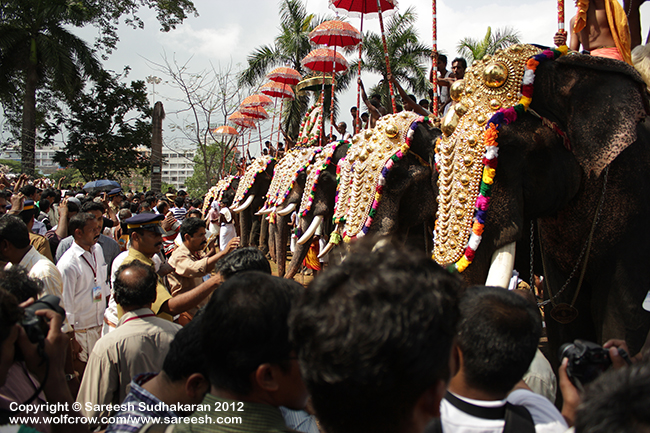
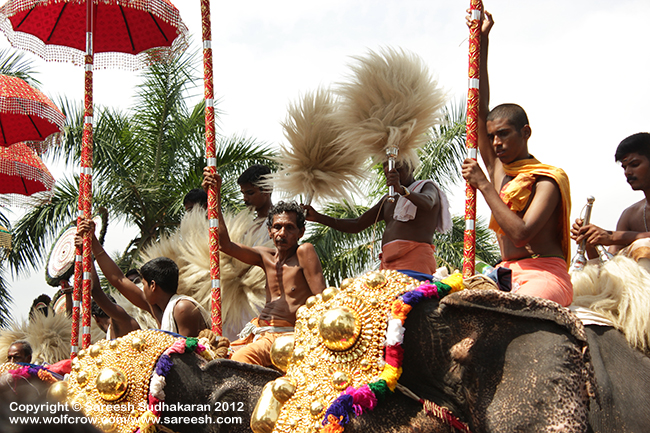
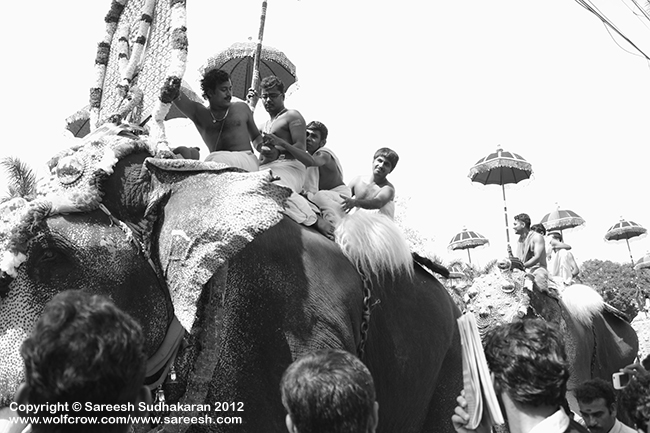

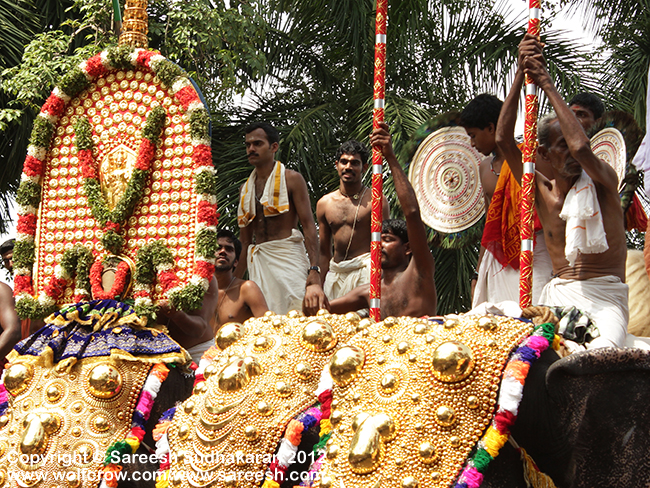

Manual mode wasn’t going to be fast enough. Even in the morning the crowd was tremendous, and constantly moving. I was with my family, and I didn’t want us to lose each other. I came to the disappointing realization that I wouldn’t be able to carefully compose my shots or find exciting angles. I had to make do with what I got. I set my camera into aperture priority mode.
The elephants stand in a line, facing the main temple. Each elephant has three riders – the mahout, and two devotees. It is a long ritual that will go on for hours. The lines come in waves, and the elephants are extremely well-behaved, especially when facing all kinds of humans with cell phone cameras and DSLRs in their hand.


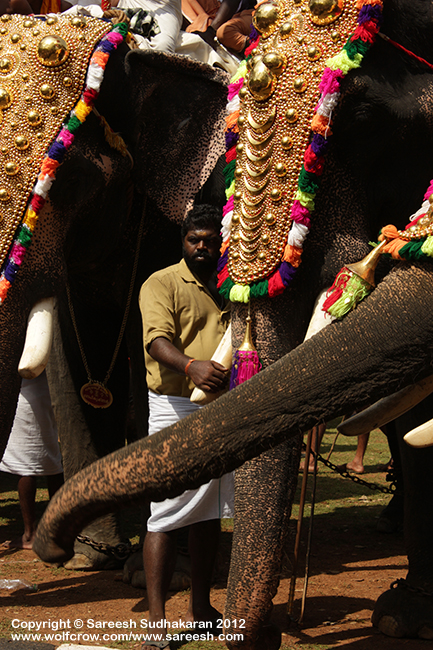
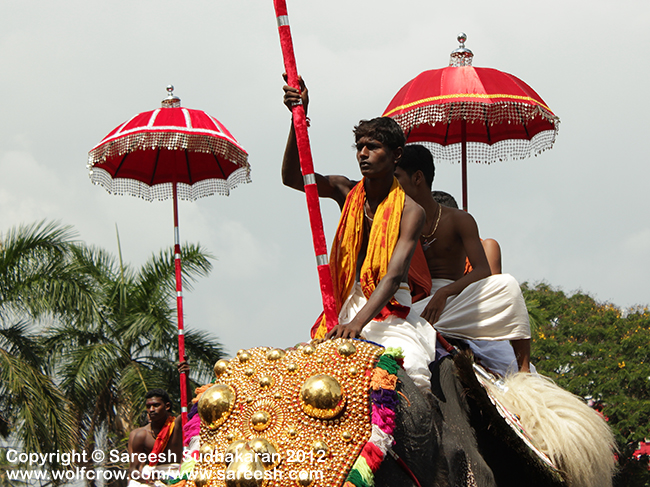

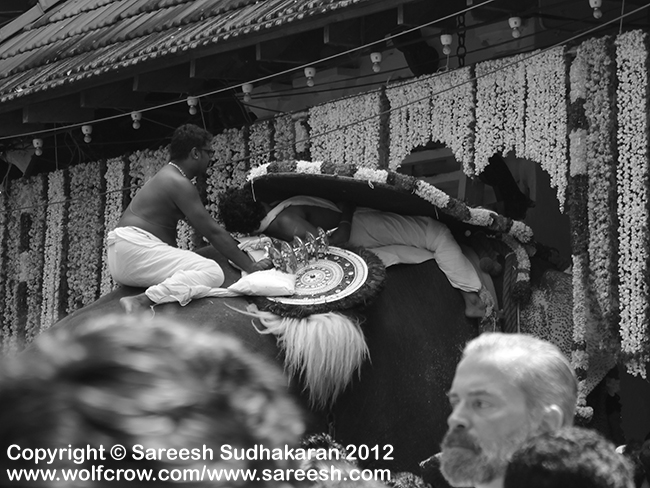
The third image (first among the last six) is probably one of the rare moments when I tried shooting at f/4.5. At the telephoto end the kit lens has a maximum of f/5.6 – not very useful in this circumstance, so I let that idea drop.
Being an amateur, I was trigger happy – until I got bored, that is. After all, they were repeating the same patterns again and again. I decided to look for something else:


It was not just manners that kept the elephants so disciplined! There have also been incidents (one this year too!) of elephants going haywire – and this is a live televised event. In fact, my dad was interviewed by a television channel.


The first image shows preparations for the fireworks that will happen early the next morning. That’s what I was here for!
If I had to sum up the morning with just one shot, this would be it:

After this I moved on to lunch. We had to be back for the main event post lunch. The elephants weren’t going anywhere.
The kodamattam
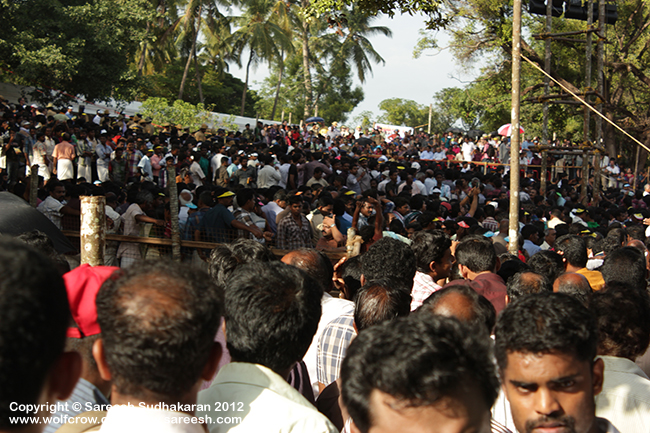
Post lunch we walked back to the grounds to cover the main event. If I thought the crowds in the morning were crazy, I was totally unprepared for this. It was rock concert that began at 5pm and ended at about 8pm. In between, the light would change from bright and harsh to golden hour and then dark.
To make matters worse, my ‘VIP pass’ gave me an excellent vantage point – for my eyes. But for a photographer – even though one should count oneself lucky to have a close up view of everything up on a podium – it was not very promising. I couldn’t move from where I was. I had two views: left and right, like a CCTV camera. Creativity was forgotten. I resigned myself to taking pictures instead of making them.
I was on matrix metering, and aperture priority was going to be a problem – I was in the shade, near the main temple, but half the action on the left was still in sunlight. I dialed in an exposure compensation – about half a stop to a stop, depending on changing conditions. I was shooting JPEGs, with my white balance on shade (my favorite) and my profile in neutral (favorite again due to natural color tones, and it is also the least ‘baked-in’ profile). Since I knew light was changing constantly, ISO was set to auto. Aperture at f/11 and f/8. The histogram was practically useless (the sky was going to be blown out anyway) but I still chimped occasionally. I was ready as can be.


The kodamattam begins with the first team of 15 elephants (from the first temple) arriving through the main temple and walking down the road to the edge of the ground.
Then the second team arrives with its 15 elephants and takes its place at the temple.


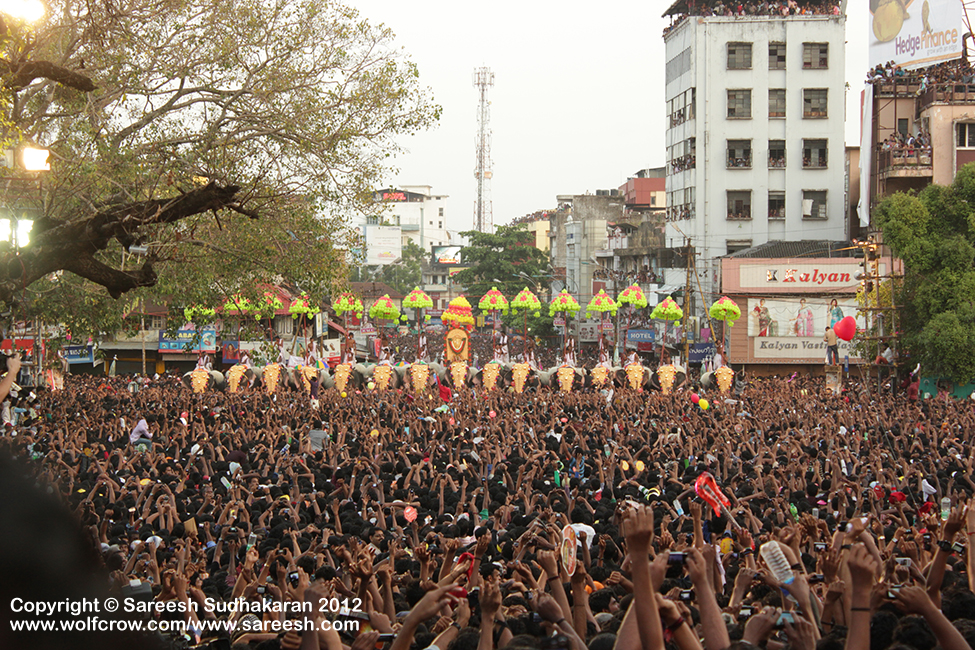
By now a hundred thousand people have gathered around the elephants, as far as the eye can see; on the road, rooftops and windows. There’s no sane way in or out.
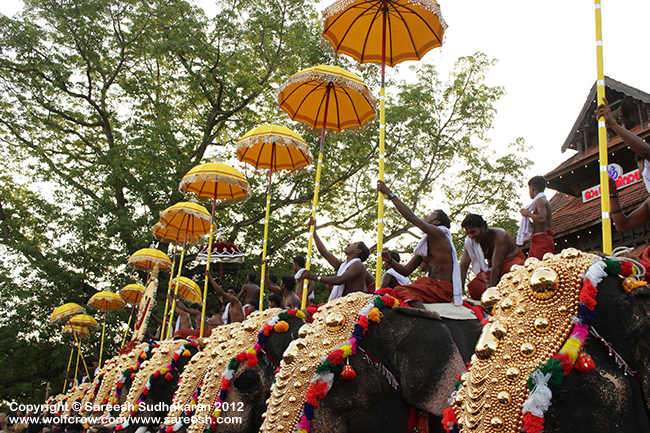
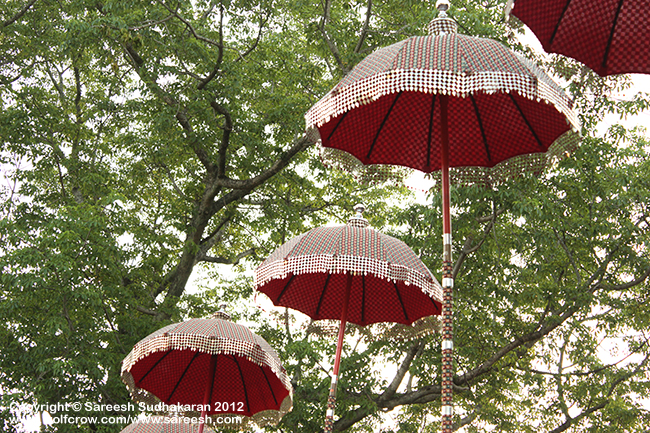
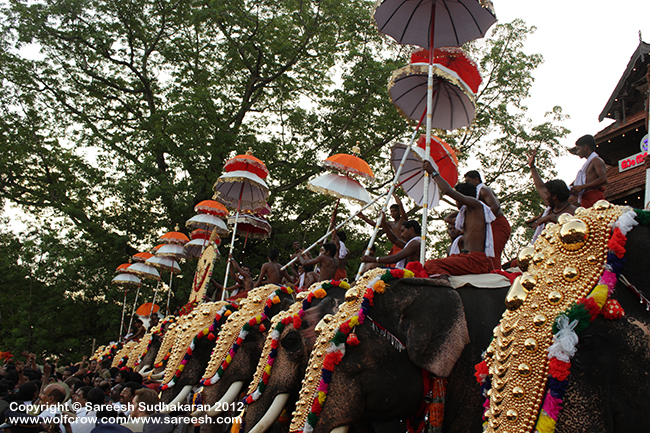
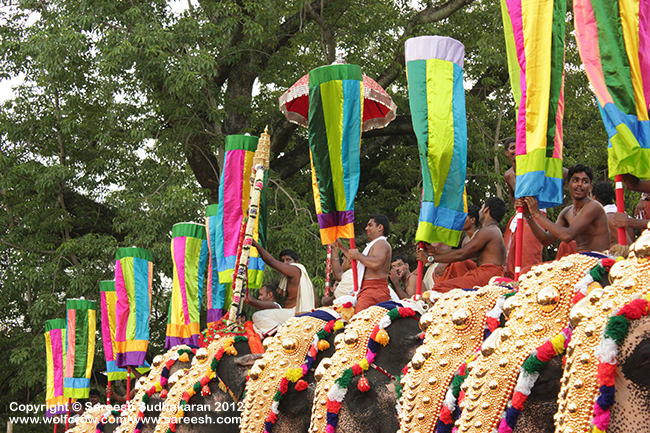
Without warning, the first team brings out their beautiful parasols. It’s like this: the team that displays the best designed parasols wins at the end. The puram is not really about competition, but it certainly whips people into a frenzy. Traditional trumpets and drums sound continuously without a break. The second team replies almost instantly. The party has begun!


The lighting was changing as quickly as the parasols. My exposure compensation was mostly okay (a slight underexposure when the light dropped) at about half a stop under. In the big shot above I would have spoiled the details in the parasols if I had exposed for the bodies. I knew I could compensate in DPP, the first processing point of my images. And, if I managed to luck out with an exceptional image, I could always dodge and burn.
The first team (the one near me) seemed to be doing much better. However, the other team also had some cool parasols up its sleeve.





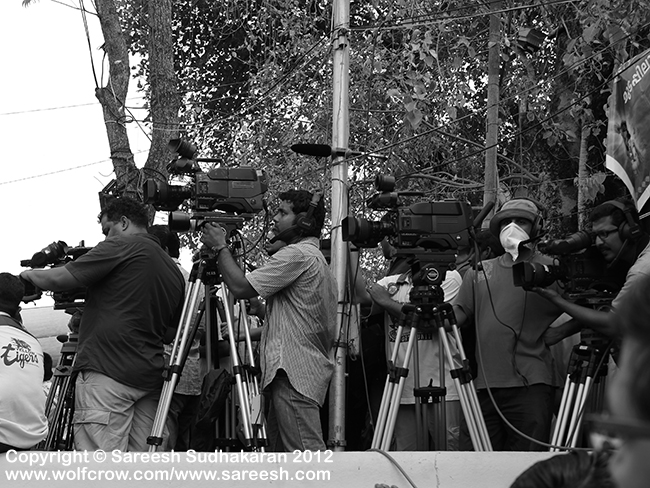
So, what kind of cameras were people using? The greatest number used mobile phone cameras (a hint to camera manufacturers?) and small sensor consumer digital cameras. Most of the Indian amateur and professional crowd were using Canon and Nikon DSLRs. A few foreigners were using mirrorless cameras, like the Olympus Pen series and the Sony NEX series cameras. Here are two guys at the opposite ends of the spectrum:


The LeicaR+Canon+Zacuto guy was most definitely shooting video, but he was on ground level! I can’t imagine what he saw from that viewpoint, but I hope for his sake it was good. The iPad, on the other hand, was a real surprise – street photography gear of the future? I think not.
The pictures at golden hour seem to be the best, with an ethereal quality to them. The best parasols came after sunset though – some of them I find hard-pressed to label ‘parasols’!
I had a major problem with flare when the lights came on – I used my hand to shield the lens, but it didn’t do much good. I dropped my aperture to its lowest setting: f/3.5-5.6, the shutter stayed equal to or above 1/30th at low ISOs, as I was in aperture priority mode with an exposure compensation of -1 (I wanted the lights to look as natural on JPEG). Sometimes the auto ISO pumped the ISO to as high as 3200. The elephants near me were mostly shot as wide as possible, and the elephants at the far end were shot at the opposite end of the zoom range. Both of these extremes were the least sharp, but for web purposes it was okay.


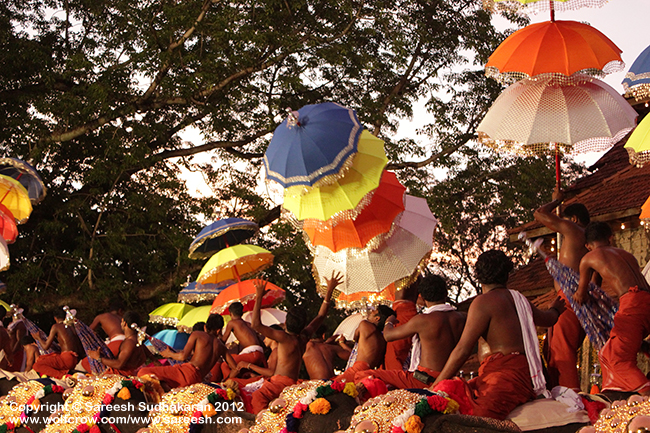
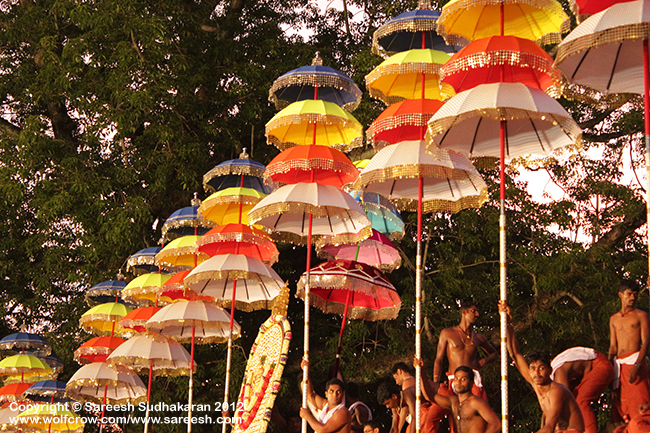


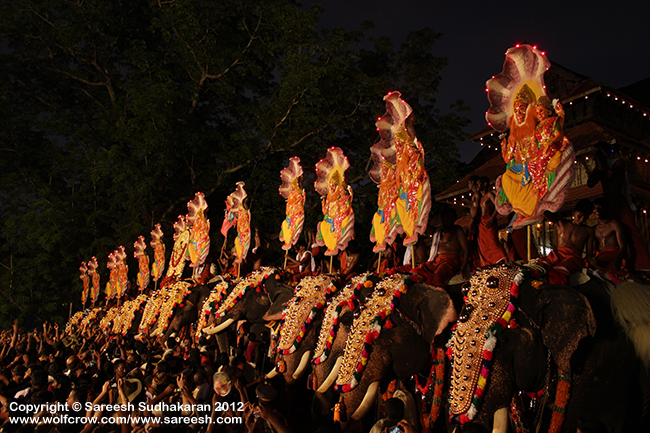
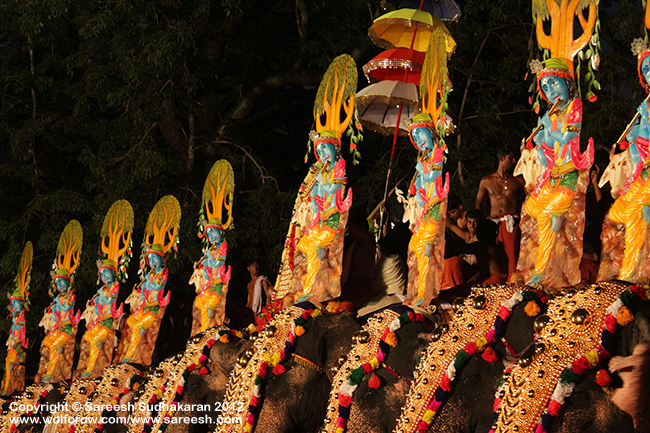
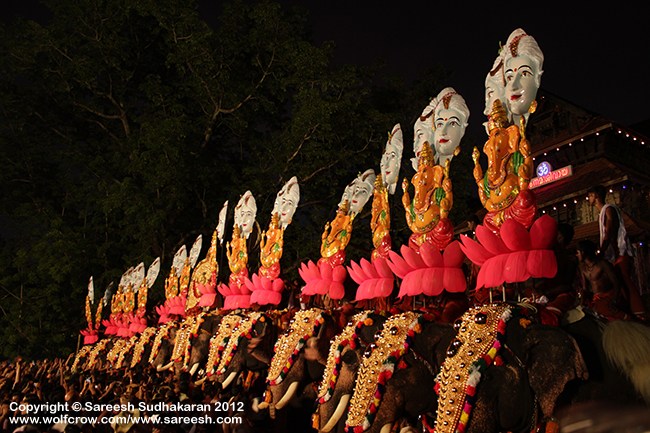


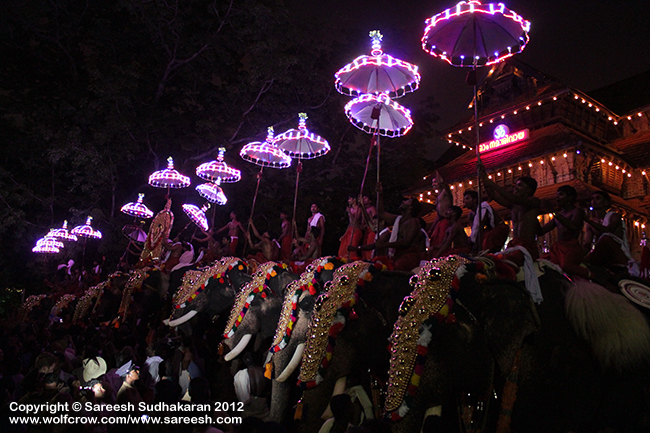

Finally it was the end, and the elephants left in a line. It was a great experience, but it is nothing compared to what came next.

The Fireworks
I had a seat on top of a building at the edge of the main ground. Again, this was a ‘nowhere to turn’-type position. We waited for four hours so we could occupy the best seats, and thankfully the fireworks began at 3 a.m.

The Thrissur Puram fireworks show is again a competition between the two major temples. This isn’t a show for the faint-hearted, and I don’t mean that in jest. It is truly shocking, earth-shattering and mind-numbing – it is as close to witnessing a cluster bomb a 100 yards away from you. It is so bright it lights up the night sky for miles. It is so loud it can be heard at the ends of the Thrissur state.
I had already seen the fireworks show about ten years ago, from a similar vantage point. I knew it was going to get very bright. Think sun against the night sky. I quickly spot metered off a lit structure and a street light. I could barely make 1/30s shutter, so I decided to use shutter priority mode, with my shutter at 1/30s. I wasn’t going to capture fine detail. The ISO was on auto and the aperture was all over the place – no issues since I was manually focusing at infinity anyway. Since the light was going from zero to extremely bright in milliseconds, I was on continuous drive mode, blasting away like a soldier against enemy artillery shells.
This was one time I regretted not bringing my tripod, as I would have preferred to shoot this in video. But I didn’t need the tripod for stills, not at 1/30s.


What can turn this:

Into this:

Unbelievable! All that waiting had drained me. This woke me up big time! In the future I would probably shoot RAW instead of JPEGs to get as much dynamic range as possible. There was also a lot of magnetic interference that gave me weird but cool artifacts. That should tell you something. Here’s the fireworks in all its glory:
The fireworks are in two rounds, with each round lasting roughly 7-10 minutes. While reviewing the first batch on my LCD screen, I realized highlights were being blown out. If I would have exposed for the highlights I wouldn’t get the same impact of the experience. Those monster cloud formations were as tall as skyscrapers. To add scale I included people in the foreground. Remember, we are already on the rooftop of a three-storey building.
No amount of photos does justice to this spectacle. Here’s an edited video, shot by my wife, on a Nokia N8, of the end of the first round of fireworks. Please watch till the very end – it’s scary enough on video. Enjoy:
