

In this article I’ll explain how we can approximate the dynamic range of the human eye, as it pertains to cinematography.
First, watch the video:

Check out the following image:

We see an object because light reflects off it. Light reflecting off a tea cup has one luminance value; light reflecting off the tea has another and light reflecting off the spoon has yet another.
See it differently in terms of luminance values:
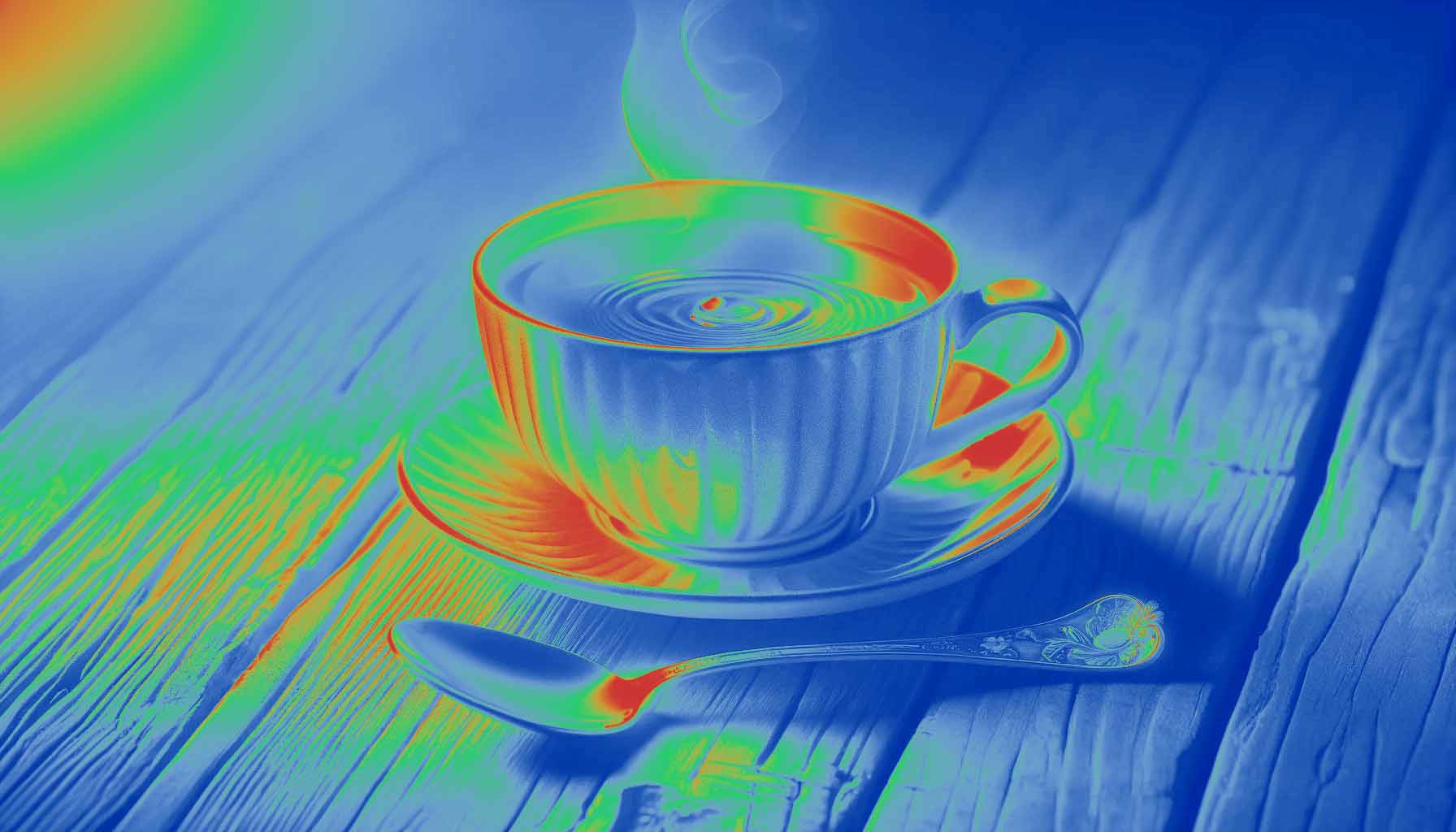
The brightest is red and the darkest is deep blue. Green is somewhere in the middle.
Each point in space has its own luminance value, depending on the nature of the object reflecting the light.
The difference between luminance levels is contrast. If you need a quick primer on how the eye works and what contrast is, check out this video and article:
The ratio between the highest luminance value to the lowest luminance value of an image or scene is the contrast ratio.
When there’s no difference, there’s no contrast. The blocks on the first row in the following image have the exact same luminance values, and you can’t tell them apart:

Here, the contrast ratio is 1:1.
When the difference is as stark as having both white and black, an image is said to have maximum contrast. The two luminance values of a scene – the highest to the lowest – is as high as it can be when it is black or white.
However, there is no universal definition of white or black!
What is the blackest object known to man?
The blackest object known to man is Vantablack, which is essentially a forest of vertical carbon nanotubes. When light strikes Vantablack, instead of bouncing off, it gets trapped and is deflected amongst the tubes, eventually becoming absorbed and dissipating into heat.
Vantablack absorbs up to 99.965% of visible light, making it the closest thing to a total black we know.
What is the brightest object known to man?
The brightest object known to man is a type of quasar known as a blazar. What distinguishes blazars from other quasars is that their jets are pointed almost directly towards Earth.
Blazars are exceptionally bright because the material falling into the black hole emits an immense amount of electromagnetic radiation. Furthermore, the jet, which is a stream of particles traveling at nearly the speed of light, is directed towards us, enhancing their apparent brightness.
To us humans though, worried about our cinematography, the brightest possible thing is the sun.
The Sun is much brighter in our sky due to its proximity. Sure, blazars can outshine entire galaxies, which contain hundreds of billions of stars like our Sun. But they are too far away from us to matter on a cinematography level.
The sun’s luminance is about 109. That’s a billion nits (cd/m2).
To keep things simple, just remember that nits is used when we’re talking about light sources, and lux is used when we want to measure incident light (light falling on something).
If the light source is in the scene, then the light itself is the brightest object, far brighter than any reflected light. When we film, we are always encountering specular highlights and reflected light. Incident light is not that helpful for determining the limits of dynamic range.
What is the absolute dynamic range of the human eye?
Here the relative luminance values the eye can see, in nits (cd/m2):
| Stops | ND | Nits (cd/m2) | Lux | Shade |
|---|---|---|---|---|
| 0 | 0 | 1,000,000,000 | ||
| 1 | 0.3 | 500,000,000 | ||
| 2 | 0.6 | 250,000,000 | ||
| 3 | 0.9 | 125,000,000 | ||
| 4 | 1.2 | 62,500,000 | ||
| 5 | 1.5 | 31,250,000 | ||
| 6 | 1.8 | 15,625,000 | ||
| 7 | 2.1 | 7,812,500 | ||
| 8 | 2.4 | 3,906,250 | ||
| 9 | 2.7 | 1,953,125 | ||
| 10 | 3.0 | 976,563 | ||
| 11 | 3.3 | 488,281 | ||
| 12 | 3.6 | 244,141 | ||
| 13 | 3.9 | 122,070 | ||
| 14 | 4.2 | 61,035 | 191,650 | 11 |
| 15* | 4.5 | 30,518 | 95,825 | 12 |
| 16 | 4.8 | 15,259 | 47,913 | 13 |
| 17 | 5.1 | 7,629 | 23,956 | |
| 18 | 5.4 | 3,815 | 11,978 | 14 |
| 19 | 5.7 | 1,907 | 5,989 | |
| 20 | 6.0 | 954 | 2,995 | |
| 21 | 6.3 | 477 | 1,497 | |
| 22 | 6.6 | 238 | 749 | |
| 23 | 6.9 | 119 | 374 | |
| 24 | 7.2 | 60 | 187 | |
| 25 | 7.5 | 30 | 94 | |
| 26 | 7.8 | 15 | 47 | |
| 27 | 8.1 | 7.5 | 23 | |
| 28 | 8.4 | 3.7 | 12 | |
| 29 | 8.7 | 2 | 6 | |
| 30 | 9.0 | 1 | 3 | |
| 31 | 9.3 | 0.4657 | 1.46 | |
| 32 | 9.6 | 0.2328 | 0.73109 | |
| 33 | 9.9 | 0.1164 | 0.37 | |
| 34 | 10.2 | 0.0582 | 0.18277 | |
| 35 | 10.5 | 0.0291 | 0.09139 | |
| 36 | 10.8 | 0.0146 | 0.04569 | |
| 37 | 11.1 | 0.0072 | 0.02285 | |
| 38 | 11.4 | 0.0036 | 0.01142 | |
| 39 | 11.7 | 0.0018 | 0.00571 | |
| 40 | 12.0 | 0.00091 | 0.00286 | |
| 41 | 12.3 | 0.00045 | 0.00143 | |
| 42 | 12.6 | 0.00023 | 0.00071 | |
| 43 | 12.9 | 0.00011 | 0.00036 | |
| 44 | 13.2 | 0.000057 | 0.00018 | |
| 45 | 13.5 | 0.000028 | 0.00009 | |
| 46 | 13.8 | 0.000014 | 0.00004 | |
| 47 | 14.1 | 0.000007 | 0.00002 | |
| 48 | 14.4 | 0.0000035 | 0.00001 | |
| 49** | 14.7 | 0.0000018 | 0.000006 | |
| 50 | 15.0 | 0.0000009 | 0.0000028 |
**The lowest light level we can see.
When you’re observing a solar eclipse, you are advised to use a shade number of 12, 13 or 14. 12 is the minimum recommended number, which corresponds to ND 4.5 (Neutral Density), or about 30,000 nits.
Side Note: The typical Gaffers Glass is rated at about ND 3.8 and is not good enough for this purpose! It is used only to look at the sun behind clouds, or at lighting fixtures on set.
The upper limit of comfort is somewhere in the range of 41,000 to 30,000 nits. The lowest limit is one millionth of a nit.
So, we have about three levels of dynamic range:
- About 50 stops, which should be the maximum dynamic range possible.
- About 34 stops, from comfortable viewing bright light to the darkest light we can discern. That’s about 102dB.
- About 30 stops, when we take into account that the really darkest darks are not quite useful from a cinematography perspective. It’s not something we can subjectively test or understand. 30 stops is about 90 dB.
What unit do cinematographers measure light in?
Cinematographers measure light in terms of lux and stops of light.
A reflected light meter reads the lux values at any spot it is pointed at. For comparison, check out this table (just focus on the column titled ‘Lux’):
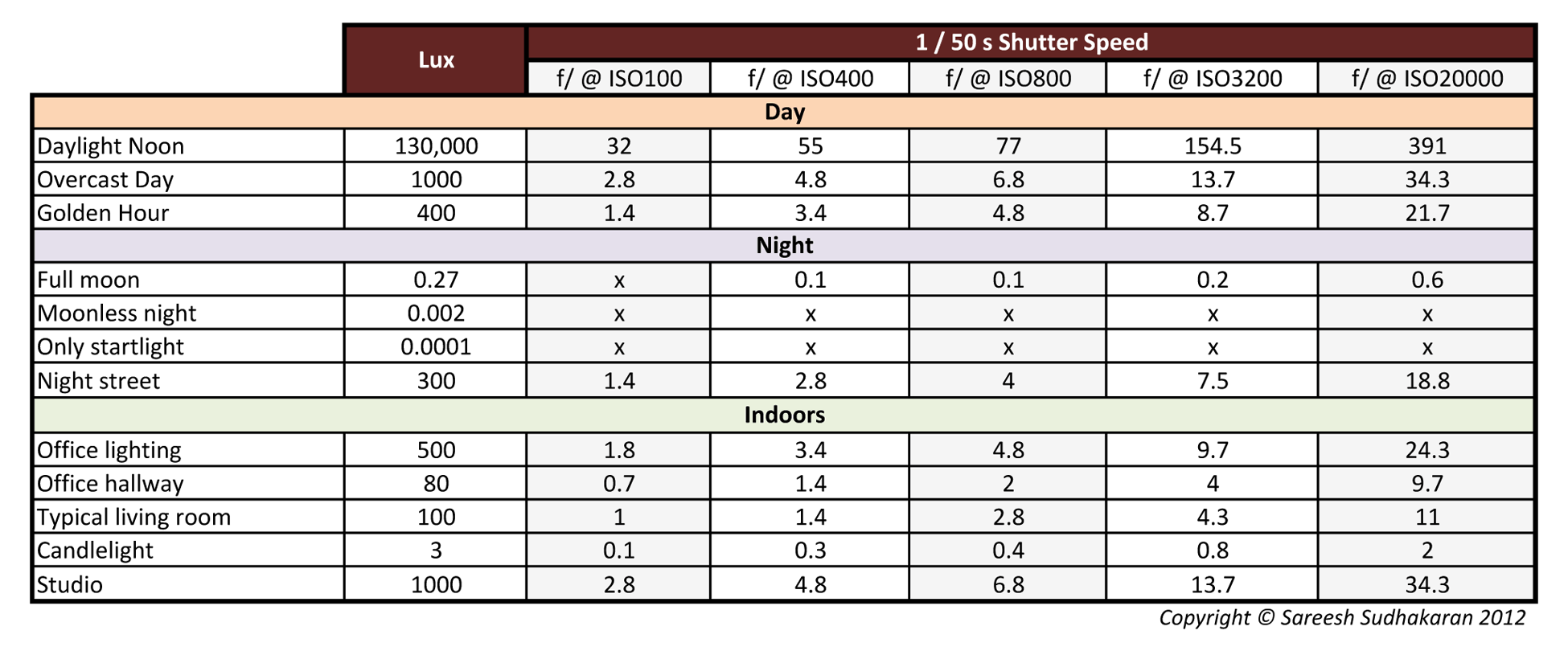
You can see the difference is from a highest of about 130,000 lux (noon) to just 0.0001 lux (starlight, no moon). That’s a contrast ratio of 1.3 billion:1. It does not include specular highlights, of course, but it does relate to the results we got above.
The question is:
Can the eye see 30 stops of light at the same time?
The human eye continuously shifts its operation, depending on the light levels. What we see in one instant isn’t the same as our perception of a scene. We always feel we’re seeing more dynamic range than we are.
This range is called the Dynamic Contrast Range or simply Dynamic Range because its value changes over time.
When someone steps into a dark movie theater during a film, they can initially only see the screen while the rest of the hall seems pitch black. After a few minutes, they can see both the screen and parts of the hall. After a while people with normal vision can see most of the hall while still facing the screen.
Another example is walking in a forest at night. If someone shines a flashlight in your face, you can’t see the forest anymore because your eyes are adjusting to the bright light.
The eye is always compensating based on the relative and total brightness in a scene. Let’s see how the eye works.

How is the dynamic range of the human eye distributed?
There are three ranges the eye operates in.
Photopic vision
Photopic vision is the vision of the eye under well-lit conditions.
In humans it gives the best color, image resolution and temporal resolution. Photopic vision is purely cone-based.
It kicks in from about 10 nits and up. That’s about 13 stops in total.
Mesopic vision
Mesopic vision is a combination of photopic vision and scotopic vision that kicks in in low light situations like nighttime outdoor and street lighting conditions.
This vision requires both cones and rods. Mesopic levels range approximately from 0.01 to 3.0 nits. That’s about 8 stops.
There is some overlap with Photopic vision. How do you know when it’s mesopic? You still see color, and things are still relatively sharp.
Scotopic vision
Scotopic vision is the vision of the eye under low light conditions. It is almost monochromatic in nature and is purely rod-based.
The image is not very sharp. This range is about 9 stops.
The eye is so good at adjusting between bright and not-so-bright situations, like, when you are looking outside the window and turn back in to face somebody in the other end of the room; even though the eye can only see 10 stops of dynamic range at any given time, our perception is that we’re seeing more than that.
So, what is the dynamic range of the human eye in terms of cinematography?
The total dynamic range of what the human eye is capable of seeing is about 30 stops.
However, the best estimate we can arrive at to get some sort of equivalence with a cinema camera, is the sum of the photopic and mesopic aspects of vision. This accounts for most of our daily activities.
This is about 21 stops. We might only be seeing 10 stops in one go, but we feel we’re seeing 21 stops. Any camera has to contend with that perception.
We know this because, even though we film with cameras with 12, 13 or 14 stops of dynamic range, we intuitively feel it isn’t enough, and doesn’t represent what we see.
Any images that have more than 20 stops of dynamic range look unnatural to the eye, like those hyper processed HDR images. They seem off.
The dynamic range of the human eye in terms of cinematography is about 21 stops.
The question is, when will the displays get there? HDR (High dynamic range) imagery is still well behind. Watch this video to know more:

Thanks a lot. Helps clear many things.
I LOVE your site and passion. You’ve come along way since I first subscribed. I am not a cine guy, rather a drawer of figures and heads. But, everything that happens in the arts also happens in the cinematic arts, your ‘brushes,’ sizings, gessos, canvases and varnishes are mostly lenses, lights, camera films, and of course, sound and music.
Thank you for the kind words!