

In this comprehensive comparison we test five tripod and fluid heads for filmmaking and cinema use-cases.
If you’re interested in knowing what a $25,000+ tripod system really does, or how different a $1,000 system is from a $3,000 one, then read this comparison.
If you’re in a hurry and just want my advice right now, click here.
Disclaimer: Smooth Camera Gear (SCG) sponsored this video (and my YouTube channel) and made it possible. They also sent me the T8 and StediFast HD system free of cost so I could review it. I own the Cartoni and photo tripods, and the rest were rented for this showdown.
Watch the video for a quick overview:

Tripods and Heads compared in this showdown
- Qingzhuangshidai (Similar to many Generic brands, like the ZOMEi Photo Tripod)
- Manfrotto 509HD and 502AH (discontinued). Similar to the 504X Fluid Video Head and Tripod with Mid-Level Spreader (Amazon, B&H)
- SCG Pro T8 and StediFast HD System
- Cartoni Focus HD (discontinued). Similar to the Cartoni Focus 10 and Red Lock System
- OConnor Ultimate 2575D Head & Cine HD 150mm Bowl Tripod System with Floor Spreader
I picked tripods in different price categories because that’s what a newcomer typically faces:
- Less than $500 budget
- ~$1,000 to $1,500 budget
- ~$2,000-3,000 budget
- ~$10,000+ budget
- Rental
I will have an answer for each budget class by the end of this comparison.
A note on why other brands were not considered: They are simply not available for testing or rental in Mumbai, where I live. I would have loved to take a look at Sachtler and Miller, but both brands have almost zero visibility in India. We spoke to the dealers, and they don’t stock demo copies.
Obviously one can’t test every single tripod and brand, so this is the cumulated wisdom from about 20 years of operating cameras. Take it for what it is.

Every tripod has two major parts:
- The head
- The legs
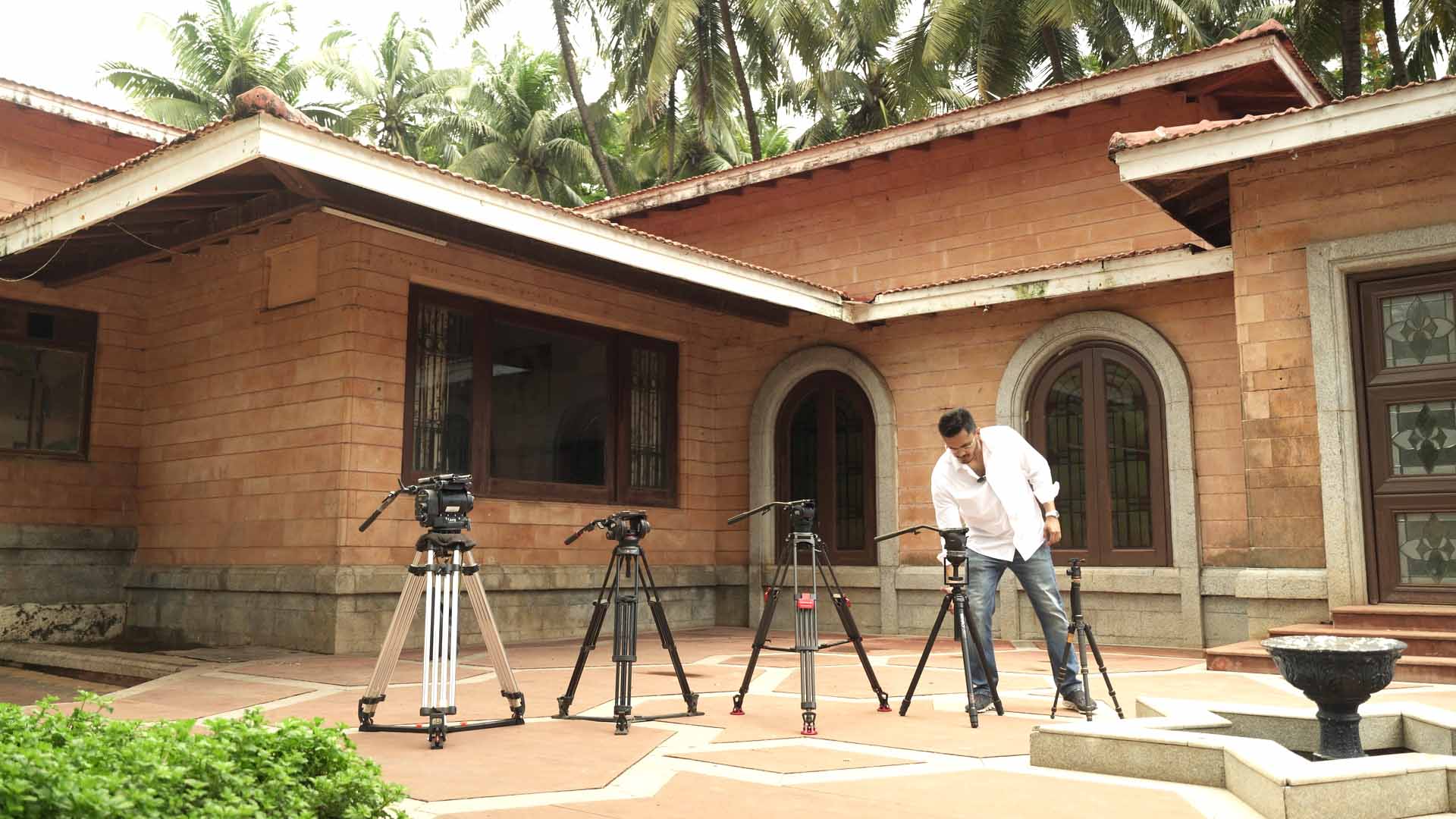
Comparison of Tripod Heads
First let’s take a look at the heads:
| Heads | Manfrotto 504X | SCG Pro T8 | Cartoni Focus 8 | Cartoni Focus 10 |
|---|---|---|---|---|
| Base Size | 75mm | 75mm | 75mm | 100mm |
| Base Type | Flat | Bowl | Bowl | Bowl |
| Price | $422 | $596 | $949 | $1,122 |
| Load Range | 2.2 to 6.5 kg | 2 to 10 kg | 0 to 8 kg | 0 to 12 kg |
| Safety Payload | 12 kg | 12 kg | 10 kg | 15 kg |
| Pan Levels | Continuous | 3+0 | Continuous | Continuous |
| Pan Handle | Fixed | Adjustable | Adjustable | Adjustable |
| Tilt Levels | Continuous | 3+0 | Continuous | Continuous |
| Tilt Range | -70° / +90° | -75° / +90° | -90° / +90° | -90° / +90° |
| Counterbalance Steps | 3 | 8 | Continuous | Continuous |
| Weight | 2 kg | 2.18 kg | 1.6 kg | 2.4 kg |
| Operating Temperature | -30 °C to 60 °C | -40 °C to 60 °C | -40 °C to 60 °C | -40 °C to 60 °C |
I’ve included the Cartoni Focus 10 because, as you can see, the price difference to the Focus 8 isn’t high; but you’re getting a greater payload capacity and a 100mm base for increases stability and smoothness.
Looking at the 75mm section, The Focus 8 is priced too high, and among the SCG T8 and Manfrotto 504X, the T8 wins because it is a bowl design for easier leveling, greater tilt range, more counterbalance steps and a better operating temperature.
It’s hard to recommend the Manfrotto here, because it’s sort of a hybrid fluid/friction head, and not a true fluid head like the others.
Top or Base Plate System
The Cartoni fluid heads use a proprietary top plate, and they are expensive to replace. The T8 uses a Manfrotto plate, and you can buy them for cheap even from no name brands.
Pan and Tilt Drag
I prefer stepped pan and tilt drag settings because you can go back to your preferred setting easier.
With continuous systems you forget where you were the last time, and if it changes you’ll have to “discover” your preferred setting all over again.
Counterbalance
The SCG T8 has eight counter balance steps, and it gives you great options to balance and counterbalance your camera setup.
The only issue I find is the low counterbalance setting. If all you have is a mirrorless camera and lens, it’s hard to reach the 2 kg minimum requirement on the T8. I preferred the older 0-8 kg range.
Pan and Tilt Locks
This has been an achillees heel for the Cartoni Focus range for years. The tilt lock on my system isn’t that robust. It’s not a disaster, but it doesn’t inspire that much confidence.
Pan Handle
The pan handle has to be extendable. Period. The Manfrotto has a fixed length. That’s a no-go for me.
There are too many situations in the field where you need to stand at weird angles to operate the head. That extra length can save you (and your back).
Bubble Level
You need illuminated bubble levels. I’m not sure the Manfrotto has it, but the others do.
Smoothness for simple pan and tilts
This is where experience plays a part. I fully expect the T8 and the Focus 8 to be close in terms of smoothness and precision.
However, for critical smoothness (the G-test), I would expect the Cartoni Focus 10 to be definitely better than any 75mm head.
Here are my sort-of-subjective scores (out of 5) from the laser S and G tests for each head I’ve compared:
| Head | S Test | G Test |
|---|---|---|
| Manfrotto 502AH | 2.5 | 1.5 |
| SCG T8 | 3 | 2.5 |
| Cartoni Focus HD | 3.5 | 3 |
| OConnor 2575D | 5 | 5 |
I’ll give my recommendations at the end of this article.
Comparison of Tripod Tandem Legs
Tandem legs are video legs, with more than one tube per foot. Carbon Fiber legs tend to be lighter, but are structurally prone to shattering.
Aluminum tripods are heavier, but won’t shatter. Steel tripods are extremely heavy, and should last a lifetime.
If you’re sticking to a particular brand, here are the specs:
| Tandem Legs | Manfrotto 645 Fast | SCG StediFast HD | Cartoni Red Lock 75 | Cartoni Red Lock 100 |
|---|---|---|---|---|
| Base Size | 75mm | 100mm with 75mm adapter | 75mm | 100mm |
| Leg Material | Carbon Fiber | Carbon Fiber | Aluminum | Aluminum |
| Price | $1,090 | $898 | n/a | $723 |
| Price with head | $1,512 | $1,346 | $1,278 | $1,989 |
| Safety Payload | 25 kg | 35 kg | 60 kg | 60 kg |
| Closed Length | 73 cm | 76 cm | 76 cm | 76 cm |
| Maximum height | 157 cm | 162 cm | 153 cm | 153 cm |
| Minimum height | 27 cm | 30 cm | n/a | 52 cm |
| Spreader | Mid level | Mid and Ground | Mid and Ground | Mid and Ground |
| Weight | 3.6 kg | 3.48 kg | 3 kg | 3 kg |
| Operating Temperature | -30 °C to 60 °C | -40 °C to 60 °C | n/a | n/a |
All the tripods here have fast lock systems, but the StediFast HD has a few advantages over the others:
- Both 100mm and 75mm (adapter included)
- Great minimum height (which the Cartoni’s don’t have)
- Mid and Ground spreaders (Manfrotto doesn’t have)
- Better operating temperature range
- Best height range
How fast can you unlock and lock the legs?
Unfortunately I don’t have direct experience with the exact tripod tandem legs mentioned here, though as I show in the video the StediFast HD is very fast and smooth to raise up or lower down. Just takes seconds.
What is a good weight capacity for tandem tripods?
You have to factor in the weights of the camera setup. With a matte box, follow focus, battery, rods and plates, it can easily hit between 5-8 kg. Larger cinema cameras will easily hit 15-25 kg.
Also, you shouldn’t forget to factor in the weight of adapters and filters. Glass filters can get heavy quite fast.
Then you have to factor in the weight of the fluid head and any accessories you’re going to hang off the tripod.
Going by this, I’d say the Cartoni Red Lock 100 certainly is value if you want a more robust setup. If you want the maximum smoothness out of the Focus 10, you have to pair it with decent tandem legs.
On the other hand, I’ve found the StediFast HD legs to be rock solid, so you can also consider the option of the Focus 10 on the StediFast HD for a great lower budget combination.
What does an OConnor 2575D really provide?
Here are the numbers:
| Features | OConnor 2575D |
|---|---|
| Base Size | 150 mm, Mitchell |
| Base Type | Bowl |
| Max Load Range | 0 to 40-60.5 kg* |
| Pan Levels | Continuous |
| Pan Handle | Adjustable |
| Tilt Levels | Continuous |
| Tilt Range | -90° / +90° |
| Counterbalance Steps | Continuous |
| Weight | 10.4 kg |
| Operating Temperature | n/a |
The OConnor 2575D is the gold standard of tripod fluid heads in the cinema space. It has a 150mm bowl head.
It has an incredible range of pan, drag and counterbalance options. You can achieve ultra-smooth and really precise movements with this tripod.
Also, it has a great plate adjustment range and it makes it easier to balance really lopsided setups. Just as a mountain is stable, but heavy; the heavier the tripod system, the more stable your setup will be.
All the locks and levers are stronger than you are. Your camera won’t be going anywhere, except in the case of human error.
You really have to try it to understand why the others can’t even come close!
How to test a new tripod
If you’re new to tripods it’s going to be hard to compare them. This is one area where extensive experience makes things a lot easier.
However, here are my tips:
- Raise and lower the tripod legs. How fast is the setup? How smooth is everything?
- Level the head on the tripod. Is it easy to level? Is the bubble level easy to read?
- Get your camera on the tripod. Notice how easy (or hard) it is to get it on or off.
- Important! Hold on to the pan handle real tight (you’ll know why soon).
- Reduce the pan and tilt drags to zero. If you haven’t held on to the tripod the camera will fall crashing down!
- Balance the camera by sliding it forward or backward. If you loosen your grip the camera should stay level. In theory, it should stay level even if you pulled your hand away.
- Now start the counterbalance to a step or position where the camera stays exactly where you leave it, in any angle. If you don’t know how to counterbalance watch the video above, or watch this one:
- How easy was it to counterbalance? Are the counterbalance steps enough for your camera setup? If yes, then proceed.
- Is the pan handle extendable? How easy is it to get it to different positions?
- Once the head is level, ensure the pan drag is set to zero and spin the camera around. Ensure the bubble level stays put during the entire 360-degree motion. It should not catch anywhere.
- Now adjust the pan drag to different settings and see how comfortable you are panning or tilting. Try whip pans, too.
- Do the same for tilt.
- Try panning and tilting together, at different angles. At different pan and tilt drag settings. Do you think you can pull off comfortable moves? If yes, set the head to a good pan or tilt setting you think is smooth enough.
- Try to trace a large curve or shape on the wall somewhere. It should feel comfortable.
- Now try to trace a smaller shape. I picked a ‘G’ for my test because it has curves and sharp turns. It does show you the difference quite easily. The smaller the shape, the harder things will get. This is what separates the men from the boys.
- Change leg heights to particular heights. How quick and easy is it?
- Pack everything down again to its travel size. Are you happy with that?
- Look for warranty and service information. Do they have service in your area?
After the tripod passes all of this, you can look at additional specifications and reviews for some gotchas. But that’s about it!
Enjoy your new tripod.

My Recommendations
Based on my years of use, with a healthy dose of subjectivity mixed with objective facts, here’s what I would pick:
| Budget Class | Budget Level | Head and Legs | Links |
|---|---|---|---|
| Newcomer, Low budget work | Less than $500 | E-Image EK60AAM | Amazon, B&H |
| Working professional, Videographer | ~$1,000 | SCG T8 + StediFast HD | SCG |
| Working Cinematographer (Light) | ~$2,000 | Cartoni Focus HD + StediFast HD | B&H, SCG |
| Working Cinematographer (Heavy) | ~$10,000 | Sachtler Video 18 S2 + Flowtech MS | B&H |
| Wildlife and Sports | ~$10,000 | OConnor 1040 + Flowtech MS | B&H |
| Heavy Cinema Class | $20,000+ | OConnor 2575D + Cine HD 150mm | B&H |
My reasons for the E-Image
To a beginner filmmaker, the biggest problem is the lack of experience, Even if you handed an amazing tripod and fluid head to a beginner, it will be lost on him or her.
It’s sort of like handing over a race car to someone who just got a license. You need to move up the ladder and operate tripod systems for years just to understand the nuances.
Also, most people will give up the profession in less than 3 years. So what’s the point of wasting money on a tripod and head when you don’t even know if you’re going to be doing this full time?
There are cheaper options out there, but the E-Image I’ve recommended will give you some decent panning and tilting action, just enough to get your short films out the door with minimum acceptable smoothness.
I recommend E-image because I know people who have owned it for 10+ years, and rental houses with E-Image tripods that have withstood the test of time. What more reason do you want?
My reasons for Smooth Camera Gear
Since SCG have sponsored this comparison and have provided the system for review, you could take it as bias.
I’ve been skeptical about SCG in the past. However, I’ve owned and used the T8 and the older tandem legs for about 5 years now, and they have held up well.
Moreover, I’ve had many conversations with SCG about their products, materials and usability and they assure me their tripods and heads really do achieve -40 °C to 60 °C and are made of materials good enough to play with the big boys.
And lastly, they are crazy enough to give a 3-year warranty and 30-day money back guarantee on their products. Who does that?
That’s why I have no hesitation in recommending them.
My reasons for Cartoni
Cartoni is an outlier brand. Their fluid heads are smaller than Sachtler and other brands, yet offer the same performance.
They are also cheaper. This is why I invested in a Cartoni Focus HD (now discontinued) about 10 years ago, and it still can hang with the best. The plate is battered, the oil is leaking, but the damn thing is still smooth as butter.
I would not hesitate to buy another Cartoni. Too bad, like Sachtler and Miller, they are mostly invisible in the Indian market. There is no decent way to test their products, and no rental company stocks them.
I hope this comparison helps you make a decision on the kind of tripod system right for your work.
If you have any questions or comments please let me know in the comments section below. I’ll be happy to answer any questions.

Hi Sareesh.
May I please put in a vote for Ronford Baker in your heavy cinema class. They do amazing kit, rock solid and well designed. They also offer repairs and support for all their old products. They refurbished my F4 and it works as good as new. It will never look as good as new due to age, now at least 30 years old, but it is as smooth as silk with any reasonable load, e.g. fully rigged Arri 435. Suits my XTR beautifully. LLAP. Matt
I’ve heard good things about Ronford Baker. Never seen one, though! Thanks for sharing, Matt.