

This article is specifically written for film enthusiasts and filmmakers who want to preserve their work. It doesn’t apply to most moviegoers and content consumers worldwide.
Let’s start with Blu-ray.
What is Blu-ray?
Blu-ray is an optical disc format that was meant to replace DVD. The fundamental difference between them is that DVDs support standard definition, while Blu-ray supports high-definition, up to 1080p.
The three most important kinds of Blu-ray are Single Layer, Dual Layer, and XL. Here’s how the differ:
- Single Layer – 25 GB
- Dual Layer – 50 GB
- XL – Greater than 100 GB
Most Hollywood movies are sold on either Single Layer or Dual Layer discs. The maximum frame rate supported at 1080p is 30 fps.
There is one other major difference between DVDs and Blu-ray, and that is the compression codec employed. DVD uses MPEG-2, while Blu-ray supports both H.264 and H.262 (MPEG-2).
How is it that Blu-ray can store more data than a DVD? It uses a laser with a smaller wavelength. 405 nm to be precise. 405 nm is at the blue end of the light spectrum.
The following image will make it clearer:
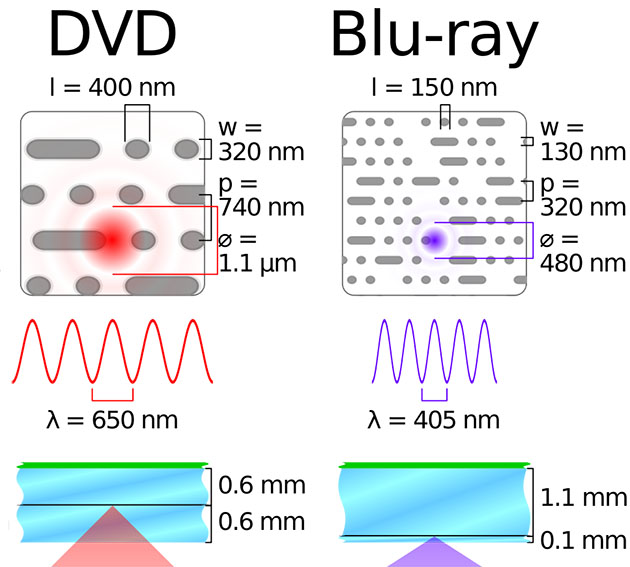
By employing a smaller wavelength, a Blu-ray disc can store data more closely.
See where the name comes from?
Blue wave laser = blu-ray.
Is Blu-ray worth getting into at this point?
Not really. Same as DVD, to be honest. Here are some numbers:

It’s pretty obvious people are buying less and less Blu-ray or DVDs to watch movies.
However, the Ultra HD Blu-ray variant of Blu-rays do offer some advantages that passionate home entertainment enthusiasts and movie buffs need to know about.
What is Ultra HD Blu-ray?
Ultra HD Blu-ray is the successor to the Blu-ray disc, launched in 2016.
UHD Blu-ray discs provide content in 4K resolution (3840×2160 pixels). These discs are designed to deliver the highest quality home viewing experience, with improved color depth, contrast, and audio fidelity.
Technical Specifications of Ultra HD Blu-ray
Here’s a breakdown of the key technical specifications:
- Resolution: 3840×2160 pixels
- High Dynamic Range (HDR): UHD Blu-ray supports HDR10 and Dolby Vision.
- Bitrate: UHD Blu-ray has a maximum bitrate of 128 Mbps, with an average of around 82 Mbps.
- Audio Formats: UHD Blu-ray supports advanced audio formats like Dolby Atmos and DTS:X.
- Storage Capacity: UHD Blu-ray discs come in three sizes: 50 GB, 66 GB, and 100 GB. The larger capacity allows for higher quality video and audio, as well as additional content like behind-the-scenes footage, commentary, and special features.
- Compression: The format uses the High-Efficiency Video Coding (HEVC) or H.265, which is more efficient than the H.264 used in standard Blu-ray.
The Resurgence in UHD Blu-ray
Despite the rise of streaming services, UHD Blu-ray has experienced a resurgence over the past few years. This trend can be attributed to several factors:
- Collectors’ Market: There is a growing community of movie enthusiasts who appreciate the tangible nature of physical media. Collectors value the permanence of a disc that won’t be removed from a streaming service and the often superior quality of the content.
- Quality-Conscious Consumers: As home theater systems become more advanced, there’s a demand for content that takes full advantage of these setups. UHD Blu-ray’s superior video and audio quality appeal to consumers who want the best possible experience.
- Limited Editions and Special Releases: Studios have tapped into the collectors’ market by releasing limited edition and special packaging versions of popular films. These editions often come with exclusive content and higher production values that aren’t available on streaming platforms.
- You can’t watch every movie on streaming platforms. Due to various licensing deals and changes, your favorite movie(s) might not be available on any platform. Or, you’ll be in a situation where you have to subscribe to multiple platforms just to watch your favorite films.
Do I think UHD Blu-ray is here to stay?
It’s hard to say, even if I had to guess. My collection of DVDs are borderline obsolete. And, I’m wary of investing in UHD blu-ray for the same reason.
Either UHD Blu-ray will entirely be abandoned, or something else will replace it. Yet, there is a special case to be made for investing in it.
Before we get to that, let’s see how UHD Blu-ray compares with streaming and Cinema.
UHD Blu-ray vs. Streaming vs. Cinema
When it comes to image quality, UHD Blu-ray is often cited as the gold standard for home viewing.
Here’s a table comparing four of the current most popular formats:
| Specification | UHD Blu-ray | Streaming | Cinema DCP | YouTube |
|---|---|---|---|---|
| Maximum Bitrate | 128 Mbps | 25 Mbps | 250 Mbps | 45 Mbps* |
| Average Bitrate | 82 Mbps | 5-25 Mbps | 125 Mbps | 8-15 Mbps |
| Resolution | 3840 x 2160 | 3840 x 2160 | 4096 x 2160 | 7680 x 4230 |
| HDR Support | HDR10, Dolby Vision | HDR10, Dolby Vision | SDR | Limited HDR10 |
| Color Depth | 10-bit | 8-bit, 10-bit | 12-bit | 8-bit |
| Audio Formats | Dolby Atmos, DTS:X, Dolby TrueHD, DTS-HD Master Audio | Dolby Digital Plus, Dolby Atmos | Uncompressed PCM, Dolby Atmos, DTS:X, THX, IMAX | AAC |
| Audio Channels | Up to 128 channels | Up to 7.1 channels | Up to 64 channels | Up to 5.1 channels |
| Compression Standard | HEVC (H.265) | HEVC (H.265), AV1, etc. | JPEG 2000 | VP9, AV1 |
Here are some strong advantages of the UHD Blu-ray format that the others lack:
- Major studios continue to release new films and remaster classics on UHD Blu-ray. As long as there is a demand, studios will likely continue to produce UHD Blu-ray films.
- Currently, there is no other physical format that competes with UHD Blu-ray. This lack of competition allows UHD Blu-ray to maintain its position as the premium choice for home entertainment.
- The word ‘blu-ray’ is known and understood by people worldwide. It doesn’t have to sell itself.
- You get to own the film you like, and any content on it. There is no law stopping you from watching it as many times as you want, as long as there’s a reader around to play it.
Compared to Streaming, UHD Blu-ray has some distinct technological advantages:
- The difference in bitrate translates to more data being used, resulting in a sharper, more detailed image on UHD Blu-ray.
- Streaming services often use aggressive compression to reduce file sizes and ensure smooth playback. This can lead to compression artifacts, such as banding, blocking, and loss of detail in dark or fast-moving scenes. UHD Blu-ray avoids most of these issues. It’s very similar to the bit rate of cinema.
- Audio Quality: Streaming services often compress audio to reduce data usage. Think MP3 vs WAV. UHD Blu-ray offers uncompressed or lossless audio tracks, providing a more immersive and high-fidelity sound experience. It also supports a lot more channels, similar to what you can experience in a cinema theater.
In short, streaming services use technology that serves the masses, while UHD Blu-ray is designed for a niche audience.
Is There a Better Format for Collecting Movies?
In the battle for the best picture and sound, Ultra HD Blu-ray emerges as the clear winner.
Its superior bitrate, richer color depth, and uncompressed audio formats provide a viewing experience that streaming platforms, despite their convenience, simply cannot match.
How do you future-proof UHD Blu-ray discs?
I don’t know the legality of this, so don’t follow my advice. However, the first thing I would do with my Blu-ray collection is rip and transcode everything to a format that preserves the quality of my content.
You can store these digital files somewhere so they’re always available to you, in its best format.
What formats do I recommend?
- Apple Prores HQ or 422
- DNxHR HQ
- WAV for audio
What I wouldn’t do is recompress Blu-ray content to H.264 or H.265, because at that point you might as well just stream the film. However, you can create a small version just for quick viewing.
You can use a professional grade software like Davinci Resolve to load your films and audio to play the way you want it in your home theater environment. You might have to invest in some hardware to go with your PC.
This means, don’t invest in consumer grade home theater hardware, use professional grade systems that can interface with Resolve.
That’s what the pros do. Why can’t you?
If all you want to do is play UHD Blu-ray discs, get a player that’s professional grade that will last many years.
How to Burn an Ultra HD Blu-ray Disc at Home
If you’re a filmmaker and want to burning an Ultra HD Blu-ray disc at home for your own movie, here are some tips.
As for hardware, you need:
- A Ultra HD Blu-ray burner, from Pioneer or ASUS, or whatever is available in the market.
- Blank Ultra HD Blu-ray discs, probably from Verbatim or Sony. Pick the right size: 50 GB, 66 GB, or 100 GB BD-R discs depending on the size of your content.
- A powerful PC, which I think won’t be an issue nowadays for a lot of folks.
- A NAS, like those made by Synology, to store the content longterm. You can also use a service like Backblaze to store content cheaply over the long term.
As for software, you need what are called “authoring software”:
- Roxio Creator NXT Pro
- TMPGEnc Authoring Works 7
- DVDFab UHD Creator, etc.
With the right equipment and software, you can create professional-quality Ultra HD Blu-rays right at home.
I hope this article was useful to you. Let me know what you think in the comments below.
