
The 65mm format holds a special place in the hearts of filmmakers worldwide. But what exactly makes this format so special today?
The 65mm format has experienced a resurgence in digital cinematography. Many films like Joker, Barbie, The Batman and so on, have embraced 65mm cinematography. Even streaming shows like House of Dragon, Ted Lasso, and so on have adopted 65mm.
Today, the format is a hallmark of ambitious, visually stunning filmmaking. Let’s get to it, then!
Use this menu to get what you want quickly:
- What is the 65mm format?
- What is the 65mm look?
- 65mm vs other film and digital formats
- How lenses render space
- Wait, isn’t all this BS? Aren’t the formats equal geometrically?
- Would you lose the 65mm look when projecting at 2K?
- Would you get the same look with a higher resolution sensor?
- Is the 65mm look the same as the anamorphic look?
- Which is better: Super 35, Full Frame 35mm, Anamorphic or 65mm or IMAX?

What is the 65mm format?
The 65mm format emerged as a response to the growing demand for higher-quality images and a greater cinematic spectacle. Immersion was the name of the game.
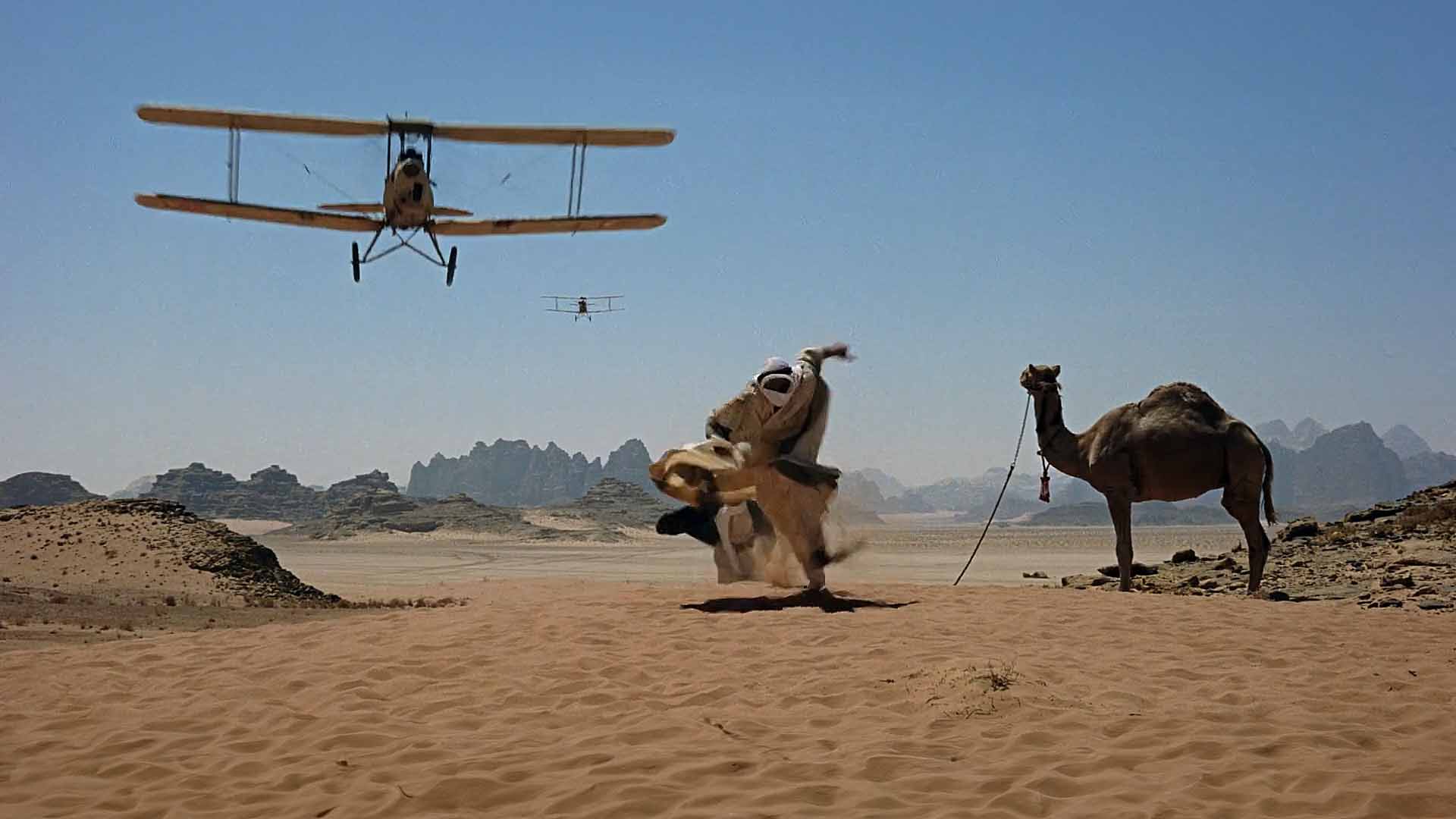
The format was first introduced in the 1920s, but it only gained widespread recognition in the 1950s with epics like Lawrence of Arabia (1962), 2001: A Space Odyssey (1968), and Ben-Hur (1959).
There were multiple 65mm variants, but the format most associated with 65mm today is the Super Panavision 70 format.
Super Panavision 70 is a spherical format, similar to Super 35. There are two steps to this process:
- You film on 65mm film stock.
- The footage is printed onto 70mm film. The extra 5mm is used for the 4-strip magnetic soundtrack.
Is it 65mm or 70mm? Which is it?
A lot of people confuse 65mm and 70mm. Here’s the difference between 65mm and 70mm:

The 70mm comes from the answer print, which is what people see in theaters. 65mm is what the film is shot on. As you can see, the 70mm frame works out to be smaller than 65mm.
Why is it called a 70mm film though? Marketing. Theaters and chains liked to market the larger number, too.
All you have to remember is film projection is rare today. If many countries it’s mostly obsolete. A movie is most likely to be distributed in a digital format in cinemas.
This means, as far as 65mm film for modern cinematography is concerned, 65mm refers to the negative size.
Therefore, 65mm or 70mm is 65mm. Period.
Now let’s take a look at what makes it visually special.
What is the 65mm look?
The best introduction to the 65mm format is to understand the look on a visceral level. You must watch films shot on 65mm film or digital 65mm formats in cinemas, preferably on the largest screen possible with the best sound possible.
How else are you going to understand the immersion and the spectacle aspects of 65mm that are the raison d’etre of the format.
To give you an idea, watch my video on Lawrence of Arabia:
I mentioned Lawrence of Arabia because it’s one of the few films not to use any visual effects, and you can fully study the geometry and impact of the format.
There’s no simple way to define the effect. The images look three-dimensional, so life-like, as if you are there witnessing the action yourself. However, it is not universally true. At the end of the day, you watch movies to be entertained.
Important: Not every film is helped by the 65mm format. It’s just a tool, like every other tool in cinematography. Many modern films using the format don’t really need it, and they should have saved their money.
Before we dive into why 65mm delivers a 3D life-like look, let’s see how the 65mm format differs from other formats.
65mm vs other film and digital formats
Here’s a comparison of different film and digital formats in the “65mm space”:

IMAX film is the largest current cinematography format, and it’s film only. The film stock is expensive to procure, store and process. The cameras are heavy and not readily available.
Short of that, the 65mm format is the next best thing to 645 medium format photography. The Arri ALEXA 265 and the Blackmagic URSA Cine 17K are two modern 65mm digital cameras.
The Fuji GFX ETERNA is smaller than 70mm projection, but not by much. It is larger than 35mm full frame, and if you can use anamorphic lenses on it you will be able to get a close-enough look – it’s own thing.
How lenses render space
The crop factor of 65mm is about 0.7.
Let’s say you want to shoot a wide scene with a 24mm lens on a full frame camera. Now you want to get the same angle of view on 65mm. You’d need a 35mm lens.
How does this change contribute to a change in look? Let’s find out.
Here’s an image shot on a 35mm lens on a full frame 35mm camera (all apertures are at f/5.6):
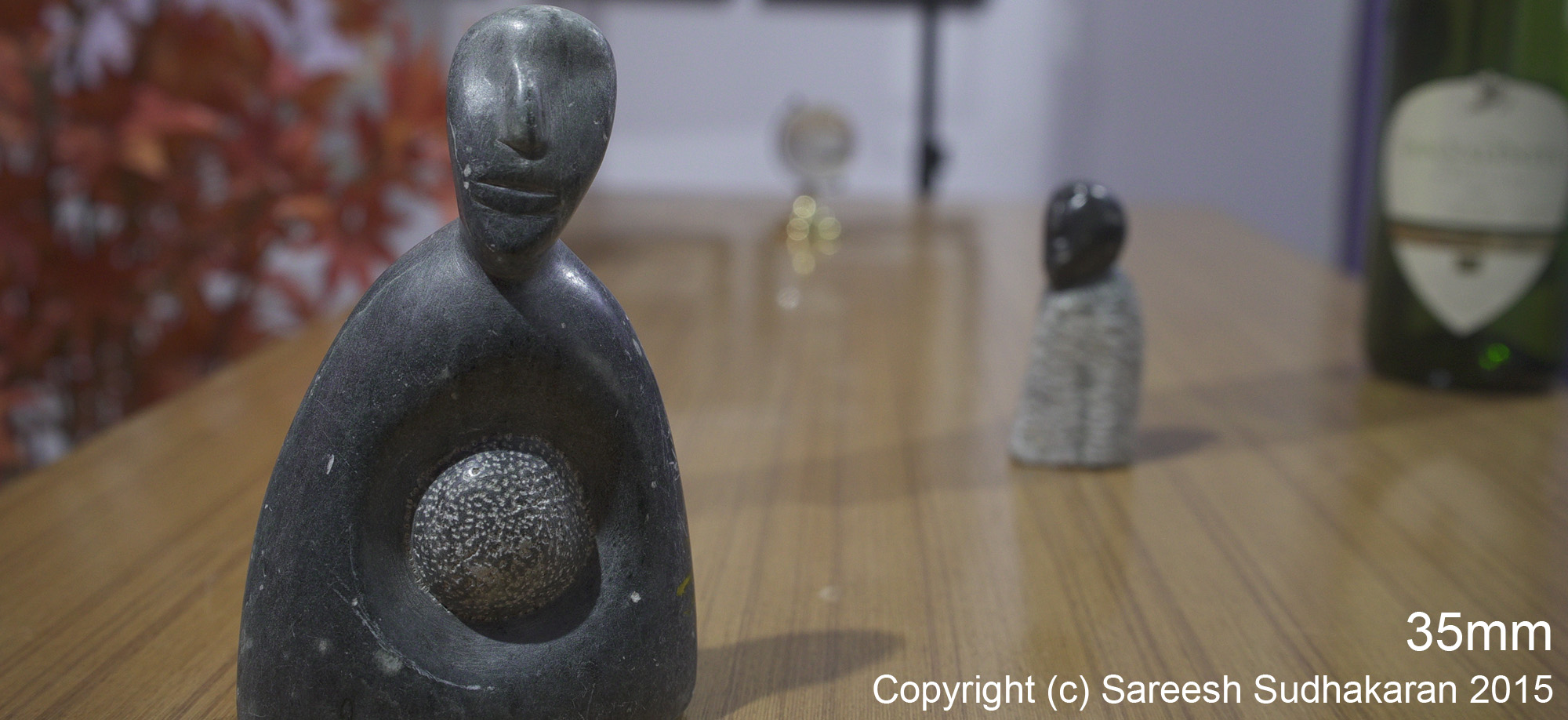
Here’s an image shot on a 50mm lens on a full frame 35mm camera (it was pulled back to get a similar frame):

We tried to achieve the same angle of view, but something’s different, isn’t it?
The camera had to move to achieve the same frame. So, the perspective has changed. It always changes when you move the camera.
The background looks different, too. It’s more out of focus, but let’s set that aside for now. What else is different?
What’s different is how the ‘space’ is rendered.
Because the 50mm is a longer lens, the background is brought closer. Secondly, on the 35mm, the features are more distorted. This is a characteristic of the properties of wide angle lenses.
There’s a lot to take in, but let’s continue with our example for now.
Here’s the same scene from a stitched file for a 35mm lens equivalent (50mm on 65mm approximation; achieved with a two-shot stitch, 70mm, f/5.6):

We get the same angle of view as the 35mm, but the subject-to-background-relationship of a 50mm!
How’s this example different? We didn’t move the camera. But, we did change lenses to get the same angle of view, but the ‘look’ is totally different.
There are some caveats here, but let’s understand this further before I address them.
Plane of focus and circle of confusion
There’s one more significant factor that contributes to the 65mm or medium-format look. And that’s bokeh. Basically, every point that lands on a sensor is a ‘circle. If something is out of focus, the circle of confusion is larger.
The way the point blurs depends on its focal length. E.g., here’s a graph that shows the difference in circle of confusion relative to where an object is, if a scene is focused at 4 feet (f/2.8, 50mm and 35mm lenses):

Don’t let the graph intimidate you. All you have to know is, as the objects in the scene go further away from the plane of focus, it blurs faster on telephoto lenses.
This means, for the same f-stop, a 65mm sensor will provide two unique features:
- If full frame 35mm is the shallow depth of field king, then 65mm is the shallow depth of field emperor. You get a 35mm angle of view, but with a 50mm bokeh (the bokeh on the image is too much because I had to stitch two 70mm frames, but you’ll get bokeh similar to 50mm).
- Objects in the scene at various depths are more distinctly separated (like layers in lasagna) so the image tends to have more ‘pop’ and 3D-like qualities. Psychologically, our eyes and brain work in tandem in the same way, as we try to pick objects one at a time.
Let’s tackle the elephant in the room.
Wait, isn’t all this BS? Aren’t the formats equal geometrically?
First of all, from a pure geometrical perspective, there shouldn’t be a different in formats. The depth of field and bokeh should be exactly the same on a theoretical level.
Here are two articles from cinematographer Steve Yedlin ASC that shows us this:
However, the history of cinema shows quite clearly that the format does look different. Why would cinematographers pick a more expensive format unless they actually felt the difference?
I urge you to film in the format to see if it matters to you or not, but first, let’s look at the differences that make the math somewhat irrelevant for practical cinematography.
Can you achieve the same look with 35mm or Super 35mm?
You could try to achieve the same out of focus characteristics by using a larger aperture. E.g., if you get one look with a 50mm f/2 on 65mm, you could get the same separation with a 35mm f/1.4, theoretically.
Practically, there are four issues that make all the difference:
1. The Resolution
65mm has a larger film or sensor area than 35mm, so for the same technology, the resolution should be greater.
The Blackmagic URSA 17K has a much higher resolution than any full frame cinema sensor at the moment.
Even if we take a camera like the ALEXA 65 and compare it to a Sony Venice, both being 6K having the same resolution, the former camera has larger “sensels”. This leads to better color and signal to noise characteristics, all other things being equal (which it isn’t).
There’s always something different between the formats, no matter how you slice it.
2. Individual lenses
Every lens system is different. A 50mm Cooke lens gives the “Cooke look”, while a 50mm Arri Master Prime lens has its own “look”. This is not disputed.
Even if a 35mm = 50mm on paper, when you change focal lengths and lens systems, there is bound to be differences in the way the image is rendered. You’ll never get the same image unless you’re using a similar lens system.
Different lenses are sharp in different areas of the frame. If a lens is designed for one format, it’s characteristics will take advantage of the format. Cropping the lens is losing some of those characteristics.
Typically a lens is sharper in the center and falls off along the sides, but it’s a lot more complicated than that. Read this article for a better understanding of how this works:
3. Wide vs Telephoto
Wide angle lenses have greater barrel distortion, telephoto lenses have greater pincushion distortion.
Every time you change the focal length, the image changes, no matter what you do. It’s a huge spanner in the works when you talk about 35mm equivalence.
4. You can’t step back or forward all the time!
In you pursuit of equivalence, you’re always looking to step forward or backwards to get the same frame. In photography, that’s a bit more practical.
In cinematography, you’re restricted by your location or actors:
- Some actors don’t like the camera too close to them. Three feet is okay, two feet is a “I’m not getting out of my trailer”.
- When you film on location, the walls of the room you’re in dictate how far you can step back, or go high, or low or whatever.
- When you build sets, you’ll have to build bigger sets just so you could step back. That raises costs. Is it worth it? Is it ethical?
These are just a few questions you have to ask yourself.
Here’s my advice:
Pick 65mm if the answer to all these questions is a resounding YES.
- Will a cheaper format tell the story effectively, maybe in a different way?
- Will your film really have a great theatrical release with the best sound and largest screens possible?
- If your film is streaming-only, can you achieve a similar look by using 35mm equivalence. You’ll lose some characteristics, but will anybody be able to tell?
- Will your film earn a profit on the difference in cost 65mm makes? In short, do you like your producer?
I won’t pretend the answer to these questions is easy. Sometimes you always want the shiny new thing even if it’s bad for you.
But at least now you know enough to be guilty either way!
Next, let’s answer a few questions pertinent to comparing 65mm with other “things”.
Would you lose the 65mm look when projecting at 2K?
No!
You’re just scaling down the image, so it should be the same look. What you might lose a bit is resolution (assuming you are filming with a larger resolution to begin with).
However, if you’re going to shoot 65mm and then crop, you’ll lose a lot of the magic of that makes 65mm unique. As long as you don’t crop, the 3D-like look will be noticeable even on Youtube on a mobile phone.
Would you get the same look with a higher resolution sensor?
No!
The resolution is a factor, but it is not the defining factor here.
Is the 65mm look the same as the anamorphic look?
No.
In some ways, you could argue it is. However, anamorphic has its own unique characteristics that make it a totally different format:
- Unique distortion characteristics
- Loss of resolution, especially at the edges
- Oval bokeh
- Vignetting
- Straight-line flare
- Issues with close focus
It’s a matter of taste. It’s not fair to call 65mm a replacement to anamorphic, or vice versa. There are enough differences to warrant the existence of both.
For example, you would get two different movies filming with an Arri ALEXA 265 and spherical glass vs a Fuji GFX ETERNA (ignoring the resolution, dynamic range, noise and color differences) with anamorphic glass.
Tons of movies pick the anamorphic format even though it does not do any favors to the film. Tons of great looking films don’t use the anamorphic format. That should tell you a lot.
Which is better: Super 35, Full Frame 35mm, Anamorphic or 65mm or IMAX?
That’s like asking whether you like mom or dad better, or whether chocolate is better than vanilla.
It’s a naive question. But to answer it for newcomers, all of these formats have their own unique looks, characteristics and trade-offs. Just as 35mm cannot give you the 65mm look, 65mm cannot give you the 35mm look!
Get it? They are just tools. Shoot will as many formats as you can, and the importance of each will present themselves.
To summarize, here’s what makes 65mm more three-dimensional and life-like:
- The use of longer focal lengths for ‘equivalent’ wider shots changes the characteristics of the image in practical ways.
- Faster transition to out-of-focus areas for greater separation.
- Unique characteristics of lenses made for different formats.
- Higher resolution definitely helps, but only as a supporting aspect. It makes its utility felt when projected on larger screens.
I hope this article is useful to help you understand the 65mm look.
What do you think? Do you see a difference?
