

When you only have the budget to buy one slider (Amazon, B&H), the choice of slider length can drive you insane.
Especially when the wrong slider length can make or break your shot. With that in mind, here are five steps to finding the right length of slider so you don’t have to pull your hair out later.

What is “length”?
Actually, there are three lengths to a slider, and the right length is not always clearly mentioned in the specifications:
- Total Length (End to End)
- Actual Length of Travel
- Length of Rods (Not that important)
First, there’s the total length of the slider from end to end. Then there’s the length of the rails or rods. And finally, the length you really want, the actual length of travel.
The actual length of travel is the distance between the center of the lens at each end.
The reason you don’t get the full “advertised” length is because the carriage (the part that moves underneath the camera) takes up some space. Also, some sliders have motion control and timelapse systems, or even magnets and other accessories that might eat up from the actual available travel length.
The two lengths we are more interested in are:
- The actual length of travel, and
- The total length of the slider from end to end.
I’ll explain why both are important. Let’s start with step one.

Step 1: Transportation
You need to get the slider (Amazon, B&H) from A to B. That might involve trekking, a car seat or trunk, or air travel. If you intend to take it on a plane, you have two options: carry-on or check-in.
The approximate maximum interior lengths allowed for international carry-on and check-in baggage (the actual lengths vary from airline to airline and from country to country, so please consult with your airline for the right measurements):
- Check-in diagonal inner length: 26″ to 48″ (the latter are the more generous airlines)
- Carry-on diagonal inner length: 26″
I’m considering the diagonal length so you can fit the longest possible slider into your luggage diagonally. If you need to keep it straight, the length reduces drastically.
Next, think about weight. The weight limit for carry-on is pretty low. If you intend to carry your most valuable items (camera and a few lenses), you already will reach the weight limit for carry-on. That means the only realistic solution is have a slider that’s a maximum length of between 36″ (3 feet) to 48″ (4 feet). Again, the latter length option is only applicable on few airlines.
What about trekking? If you’re walking long distances you want to have the lowest weight possible. When you’re carrying motion control equipment for time lapses it eats up valuable space and weight that the slider needs to compensate for. E.g., the weight difference between a 2-feet slider and a 3-feet slider might be 100 grams (5 ounces). It might sound insignificant, but to a trekker, the difference is not inconsiderable if you’re trying to shed every ounce possible.
If these are not issues for you, and your primary mode of travel is by car, you could (and probably should) carry longer sliders (either in the boot, in the car itself, or on the roof).

Step 2: One Tripod or Two?
If you need the slider (Amazon, B&H) at normal shooting height (not on the ground), you’ll need to carry a tripod and head. We have to ask ourselves: How many tripods can we carry?
For trekking and air travel, the painful answer is usually going to be: One tripod or stand. That’s it. If you’re traveling by car, you might be able to carry two if you want. Of course, if you’re able to pay more for extra baggage, or if there’s a crew with you, this might not be a big deal.
Typically you use two heavy duty light stands or tripods to support the slider at either end. This increases stability and is the preferred method of operating it.
Remember, the longer the slider, the lower its weight loading capacity. Those extra supports are really important. If you want a slider length longer than 3 feet, you need two supports. If you go over 5 feet you will probably need three supports (or more), depending on the system and its design and construction.
So the question is: How many tripods or stands can you carry? If it’s one, then your slider will max out at about 3 feet.
Even though transportation is not one of those things most people think about when buying a slider, it should be. You can’t use what you can’t carry.
Then we can move on to step three.
Step 3: The Angle
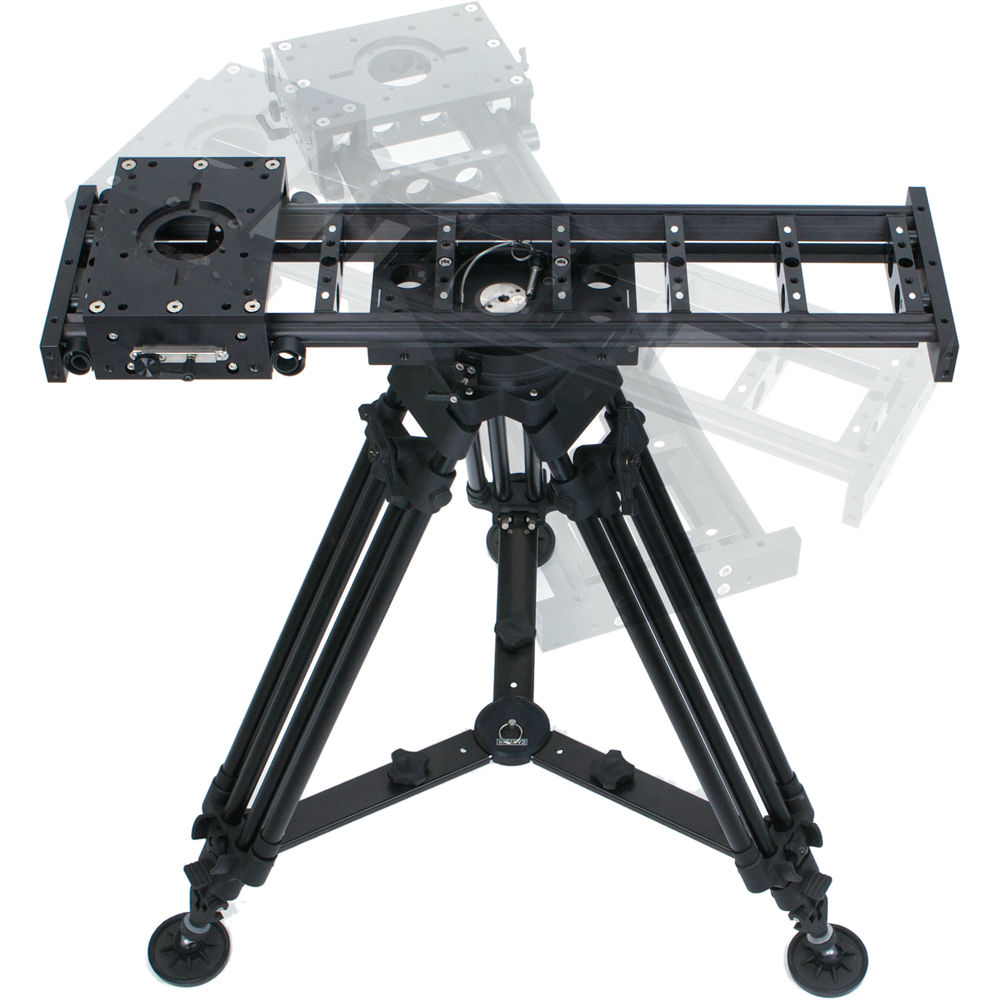
What if you want to slide (Amazon, B&H) at an angle? In this case, the actual travel length is not the vertical height.
E.g., if you want to travel from, say, a foot away from the ground to about five feet at an angle, the actual length of travel should be about six feet. A simple formula (assuming 45 degrees, the maximum) to find the maximum length at an angle is:
Necessary travel length = 1.4 x Actual travel length
So your slider needs to be longer. Vertical shots don’t have this problem though.
The point is, in the above example, if all you have is a 3-feet slider, the actual travel length may be only about 30″, and the vertical distance you’ll be able to achieve is 3 feet. Big difference!
So it’s important to know every way you might be operating the slider. Don’t just assume it’s going to be horizontal all the time (it might as well be). Be sure.
Step 4: Is There an Ideal Length?
So what’s the ideal length of slider (Amazon, B&H)?
If you need a compact, portable and convenient slider for air travel or trekking your choices are basically between 2 and 3 feet, and in this case, I say pick 3 feet (if everything else we’ve discussed above is agreeable as well).
Why three feet?
If you have a 3-feet slider, you can still make smaller moves as a 2-feet slider, but the reverse isn’t possible. Also, if some parts of your slider rods get damaged or dented, you might still have enough length to actually do something.
However, when I say 3-feet slider, you still need to find out the actual travel length. Some models come in 2 and 3-feet versions, while others might come in 2 and 4 feet versions.
Bottom line: Get the 3 feet slider if you can, if size and weight are critical factors. I’ve found it’s the most versatile length. When you go longer, you need added support, and really heavy sliders to keep everything stable. It’s also hard to level the slider correctly the longer it gets.
If three feet isn’t good enough, there’s always step five.
Step 5: Want more?
What if size and weight are not a problem? What if you are okay carrying two tripods or light stands. Then what?
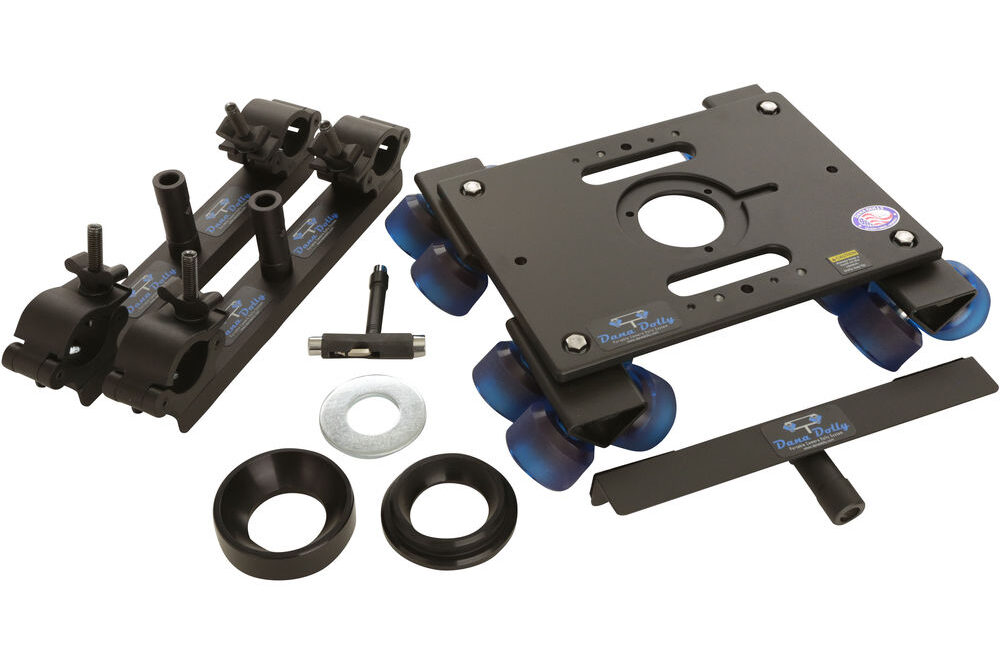
Then, rather than buying a slider (Amazon, B&H), I encourage you to look at its cousin: the dolly slider (Amazon, B&H). The dolly slider runs on plastic wheels (the slider runs on bearings) over pipe (it can be tough PVC, aluminum or steel). The most popular dolly slider used worldwide is the Dana Dolly.
The idea is to purchase just the carriage with wheels, and maybe also the two “track ends” to connect to a light stand – and you buy the rails from your destination. These are standard-sized pipes you can get anywhere in the world, and you can cut them to whatever length you want.
Many professionals usually buy two kinds of sliders: the smaller slider and a dolly slider when they need the longer travel dolly moves.
What about the 4 to 6 feet sliders?
You’ll see many sliders (Amazon, B&H) longer than 3 fee. Should you buy them? Sure, only if you know they’re exactly what you want.
The advantages of sliders over slider dollies are:
- Almost no setup time
- It can have flywheels for smoother movement
- You have good drag controls
- You get vertical travel
- You get motion control equipment that is specifically designed to be used with the slider
If these are important criteria for you, and you absolutely need more length, then go for it. But, they tend to be more expensive, and heavier. The longer the slider (Amazon, B&H), the wider it needs to get, and the more metal it needs to remain rigid when you move your camera.
You’ll rarely want to opt for monorail sliders longer than 3 feet, because they’re not very steady when you want to pan or tilt your camera over a manual move. To be honest, I don’t recommend monorail sliders at all, no matter the length. The first time you make a fast pan or tilt, you’ll see.
So bottom line, I recommend this combo if possible:
- Three feet slider, and
- If you need it – a dolly slider like the Dana Dolly
That’s it! I hope this guide has helped you make up your mind on the right slider length for your work.
