
YUV and Y’UV
A system that defines color via one luminance value and two chrominance values is called a luma-chroma system.
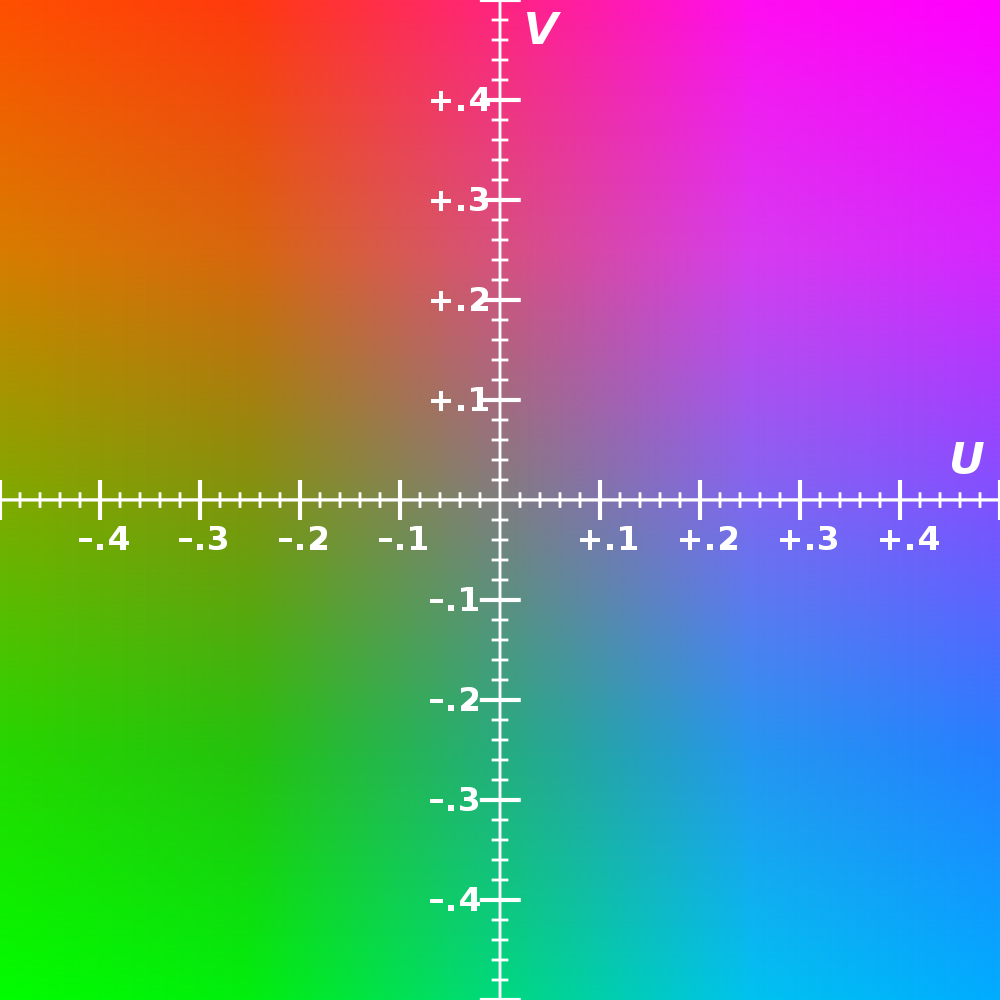
One such system is the YUV color model, where Y is the luminance component and UV stand for two chrominance (color) components. The YUV model was built based on how the human eye works.
As we have see on the article on gamma, in video, this model becomes Y’UV.
But why Y’UV and why not R’G’B’? The answer is: due to the ubiquity of black and white television sets.
When color was introduced into television, the black and white luma system couldn’t just be thrown away. Luckily, the YUV model is similar to the human eye, and it was relatively easy to incorporate the Y’UV color model and ‘ease it into the accepted scheme of things’.
Color information (U and V) was added separately via a sub-carrier so that a black-and-white receiver would still be able to receive and display a color picture transmission in the receiver’s native black-and-white format.
The PAL and SECAM systems were based on the Y’UV color model.
Y’IQ
The Y’IQ color model is similar to a Y’UV model, and is the basis of the NTSC television standard.
Y’ Pb Pr
Y’ Pb Pr is the luma-chroma color model applied to analog video, especially for transmission over cables. You’ve all seen the three color component cable for analog television – that’s Y’ Pb Pr.
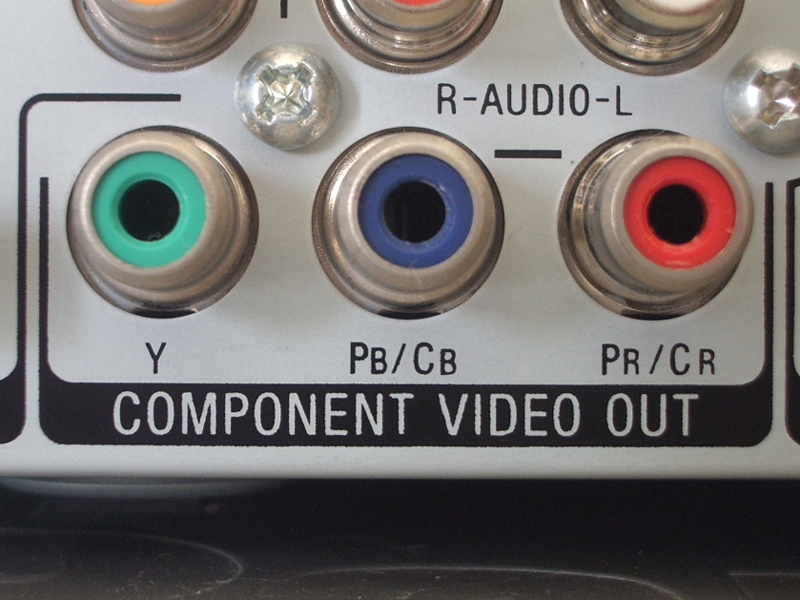
So if your favorite cocktail is RGB, then splitting it into three systems is defined by a set of rules, laid out by the Luma-Chroma system Y’UV. When you want these three components transmitted over three pipes, the three individual ingredients (signals) are called Y’ (gammafied luma), Pb and Pr (Chrominance).
Y’ Cb Cr
When digital systems came along it became necessary to design a system that also supported analog television. So, all the baggage that was analog broadcast television, was ported over to digital.
The digital equivalent of the Y’PbPr color model is the Y’CbCr model. Since we are in the digital world today, and most analog systems are speedlily hurtling towards their graves, the only color encoding scheme we need concern ourselves with is Y’CbCr.
Why is there a confusion if we only need worry about Y’CbCr?
As I’ve explained in Luminance and Chrominance, Y’UV, Y’IQ, Y’PbPr and Y’CbCr are NOT color spaces, but encoding schemes based on the luma-chroma color theory. Each one has its own mathematic properties and they are not interchangeable.
You’ll find many ‘experts’ and even Wikipedia articles using the these terms interchangeably, sometimes calling it a color space, and sometimes a color model. This is plain misleading.
And the manufacturers are making it worse. From all this jargon, they pick the easiest one to remember: YUV. What else do you expect from them? It’s become a fashion to use the term YUV to mean all of the other encoding systems, but that is incorrect. Save yourself trouble down the road, and use the correct terminology.
When in doubt, use this rule of thumb: YUV usually means Y’CbCr.
But what about PAL and NTSC?
Y’UV and Y’IQ are still the basis of PAL and NTSC. They haven’t gone anywhere, just taken a back seat. In digital land, the absolute ruler is the Y’CbCr model.

YIQ *is* a color space, and not because of some wikipedia article. The fact that there are encoding/mathematical schemes for conversion/representation don’t change the fact that the resulting Y,I, and Q represent different axis into a space.
That is a color space. That it is also an imperfect model has nothing to do with the coordinate nature of YIQ.
Yes, anyone that has spent any amount of time in the guts of color model conversion can see the foibles inherent in YIQ (the sensible ranges for each are odd and change, sometimes with oddball overlaps), and yes, YIQ was there specifically to solve a real-world problem of gluing 2D worth of color information to an existing luminance dimension. And yes, it was hacked *at implementation* considerably to approximate the calculations involved because certain calculations are much easier than others to emulate in analog circuitry.
But none of that changes the meaning behind the term color space, and how YIQ fits that definition both semantically and functionally.