

Lighting is the backbone of every great film, setting the mood, enhancing the visuals, and guiding the viewer’s eye.
But, simply having light isn’t enough. It needs to be carefully placed and controlled to achieve the desired effect on camera.
In this article, we’ll dive into the essential lighting gear you’ll encounter in film. I’ll explain the role of grip equipment. These are the unsung heroes that make sure the lighting does exactly what it’s supposed to.
If you’re a beginner looking to refine your skills, understanding these fundamentals is key to creating visually stunning films. Let’s get started!

Why do we need Lights?
The sun is a great natural light. But, it doesn’t stay consistent.
To light a scene consistently, you need tools that can manipulate sunlight.
The other natural source we have is fire. Fire was humanity’s first tool for lighting. However, it’s tricky to manage and not easy to setup. It’s also a safety hazard, and enough fire (or candles) will throw up a lot of smoke.
Both sun and fire are temperamental. It’s doable, but not really as economical as the other options available to us.
This is where electricity comes in. It’s reliable, easy to control, and accessible.
By harnessing electricity, we can produce various types of lighting effects, each with its own unique characteristics. This flexibility is essential for creating the right mood and look in your film.
Remember, filmmaking is not just about the ultimate quality you can bring, but is also about bringing that under budget and on time.
Some of the most widely used types of lighting in filmmaking today include Tungsten Filament, Halogen Quartz, Fluorescent, HMI, and LED. Each type offers different benefits.

TUNGSTEN FILAMENT BULBS
Tungsten Filament bulbs (Amazon, B&H) are pretty cool little inventions.
It’s a tiny wire, called a filament, made from a metal called Tungsten. This filament is inside a glass bulb. The whole this is sealed and filled with a special gas to keep everything working just right.
These bulbs are super cheap, easy to carry around, and can give off a decent amount of light.
But, they do have a couple of downsides. First, they’re not the brightest lights around. For the electricity they consume, the light output you get is not that high. Second, they can get really hot, like a little oven! You can add more bulbs to get more light, but that also means even more heat.
Because they’re small, Tungsten lights can be quite harsh, so filmmakers often use special covers or “modifiers” to soften the light and make it look better on camera.
Despite these challenges, Tungsten Filament bulbs are still a great option when you need affordable and easy-to-use lighting.

HALOGEN QUARTZ
Halogen Quartz bulbs are similar to Tungsten Filament bulbs in that they use a Tungsten Filament to generate light and are enclosed in glass filled with an inert gas (Halogen).
But, unlike regular Tungsten bulbs, Halogen Quartz (Amazon, B&H) uses a different type of glass that has a much higher Quartz content so that it can withstand much higher temperatures without breaking.
The Halogen allows the Tungsten Filament to run much hotter without breaking down (hotter than its melting point), and thus give more light.
Halogen lights are relatively cheap for their light output and quite common, but just like the regular filament bulbs, they are not very efficient at converting electricity to light and generate a lot of heat.
You have better options these days, so they are now being replaced mostly.
Some cinematographers still love them, though! Their great advantages is they have very accurate and excellent color rendition.
They have a wide output from 500W to 2500W, and can be turned off and on multiple times with zero wait times for warm up or between switching on and off.
You will find these in use in most traditional construction flood lights and security lights, car headlamps and in cinema, on the lower end of film lights.
Just like Tungsten lights, Halogen lights are hard so light modifiers are needed to soften and control the light.

FLUORESCENT
Fluorescent lights are tubes filled with mercury vapor and the inside walls of the tube coated with a fluorescent powder. When electricity passes through the tube it excites the mercury vapor which gives off UV light.
The UV light isn’t particularly useful on its own, but when it hits the fluorescent coating on the inside of the tube, the whole tube glows, giving us useable light.
Fluorescent lights, unlike Tungsten and Halogen, are much more efficient in converting electricity to useable light. They also give off very little heat compared and are fairly mobile. They also don’t need a lot of power to run and you can run several banks of fluorescent lights off household electricity.
They do cost more than Tungsten or fluorescent lights but because of how much more efficient they are, you need less wattage to get the same light output.
In most shoot setups, fluorescent lights are used in banks. What’s a bank?
One tube might not give you that much light to work with, so the tubes are clustered into rows of fluorescent tubes to increase the overall light output. This is called a light bank.
So, you may end up with a 2-bank, 4 bank or 6-bank set. They come in even numbers for some reason.
Fluorescent lights are also soft lights by design unlike Tungsten and Halogen lights which are hard lights. And when they are in a bank, you get an even larger and softer source of light, which means you don’t have to spend as much on modifiers to get soft, even light.
A major disadvantage of fluorescent lights is flicker, especially with household lights. The flicker is especially evident when you’re shooting at frame rates that are not in sync with the electricity frequency of the region.
Another disadvantage of fluorescents and CFL is poor color accuracy. You might sometimes get green color casts and color shifts from cheaper or older fluorescents.
Nowadays, fluorescent lights have fallen by the wayside for filmmaking, and have been mostly replaced by LED lights.

HMI
HMIs (short for Hydrargyrum Medium-arc Iodide), are special lights made just for movies and entertainment.
These lights have a special mixture inside the bulb, including mercury vapor and other stuff, all inside a tough glass bubble. When electricity goes through the bulb, it creates a super bright light, almost like a mini sun.
HMIs are some of the brightest lights out there for the electricity drawn, which is why they’re so popular in film productions. The light they produce is very similar to daylight, which is perfect for making everything look natural on camera.
These lights come in different sizes, from small ones to huge ones, and they need a lot of power to run. That’s why they’re often connected to ballasts and generators. Except for the low wattage HMIs, most HMIs 4K and higher need generator or three-phase industrial power to operate.
Older HMIs used to flicker when filming at different speeds, but modern ones are flicker-free and can handle super slow-motion shots up to 10,000 frames per second.
However, HMIs are big, heavy, and need a bit of time to warm up when you turn them on. You also have to let them cool down before turning them on again, or you might break the bulb. Another big disadvantage of HMI lights is that they can’t be dimmed, except for a typical 50% setting.
Lastly, HMIs also give off harmful UV light, so they need special lenses and bulbs to keep everyone safe. Always use high-quality parts to make sure everything works properly and safely.
Today, when you really want a lot of light output for the lowest power draw, you need HMIs.

LED
LEDs (short for Light Emitting Diodes), have become the new go-to lights (Amazon, B&H) for filmmaking, mostly replacing tungsten and fluorescent lights.
LEDs work by passing electricity through tiny diodes, which then emit light. They’re super efficient, turning over 75% of the electricity they use into visible light. This makes them much more powerful and energy-saving compared to older types of lights.
By nature, LEDs can only shine in one color. To create white light, manufacturers combine red, blue, and green LEDs. This clever trick allows them to produce light that has the full range of colors.
Some LED lights can be set to mimic daylight or tungsten light, while others can change colors entirely, giving filmmakers a lot of creative control that was never available before.
One of the coolest things about LEDs is that they can even run on batteries and don’t get nearly as hot as other lights. This makes them perfect for filming in tight spaces.
LEDs are getting brighter all the time! They use just a tiny fraction of the power that lights like HMIs or tungsten bulbs need. This is why they’ve started to replace these older types of lights, especially in the 100-1,000 Watt range.
LEDs have tons of advantages:
- They produce soft, even light with almost no harmful UV rays.
- They can be dimmed down to about 1% brightness without changing the color.
- They can change color or temperature without the need for color gels.
- They have a long lifespan and are eco-friendly.
- They’re tough, lightweight, and won’t explode if something goes wrong (unlike HMIs!).
The only downside is that LEDs can be expensive for the amount of light they produce. However, the technology keeps improving every day. The industry is pretty confident LED lights will replace HMIs in the near future, too. As of this writing, there are 2,400 Watt LEDs in the market already.
What are Light “Fixtures”?
When you combine a light with an enclosure for filmmaking, we call it a light fixture.
There are three main types of lights used in filmmaking: Open Faced, Fresnel, and LED Panels.
Open faced lights
Open faced lights (Amazon, B&H) have a bulb or LED emitter that is not covered or modified in the front side.
You can have reflector on the back or sides to redirect the light for better efficiency. You can also have a clear glass panel in front to protect the bulb or emitter.
These lights don’t have a lens on the front, so they typically can’t be focused. Open faced lights create hard light, which means they cast strong shadows.

Fresnel lights
Fresnel lights (Amazon, B&H) are open faced lights that have a special lens at the front called a Fresnel lens.
It is made of rings that help spread the light evenly.
With Fresnel lights, you can adjust the beam of light by moving the bulb or emitter closer to or further from the lens. This allows you to change the light from a narrow spot to a wider flood.
This gives you more creative control over how the light looks on camera.
LED Panels
This is a newer fixture made possible due to the power of LED technology.
Instead of one big bulb, LED Panels (Amazon, B&H) are made up of lots of tiny LEDs that work together to create a soft, even light. Somewhat like fluorescent light banks, but without the hassle!
LED panels are great because they don’t get hot, they can be powered by batteries. You can often change the color and brightness easily. LED Panels are perfect for lighting up larger areas or for getting soft light without harsh shadows.
You can also use a range of modifiers in front of these types of light fixtures to further control the look.
If you want to know more about the different light fixtures and why they are the way they are, then this video is a must-watch:
Now that we know the different types of light available on set, let’s talk about Grip.
Grip
The definition varies slightly depending on which part of the world you’re in. In the US, the Grip department takes care of all rigging needs on a set, which includes lighting.
In Europe, India and Australia, the Grip Department is only in charge of rigging the cameras and other equipment like cranes, tracks and stabilizers.
For the purposes of this article, we’ll follow the American system and assume Grip (specifically Grip Electric) means the department that’s in charge of modifying the light.
Let’s look at some key players in the grip department.
The Key Grip
Key Grip is the person in charge of setting up grip equipment to support the camera(s), crew and lighting equipment.
The Gaffer
The Gaffer is the person in charge of all electricals (lights and power) on set.
The people who report to the Key Grip and Gaffer are called Best Boy Electric and Best Boy Grip, respectively. They sort of act like foremen to:
- Electricians or Lighting Technicians (those who operate lights), and
- Grips (those who operate grip equipment)
How the Key Grip and Gaffer work on set
The Director will communicate his vision to the cinematographer or DOP. He or she will then collaborate with the Gaffer and the Key Grip. It is the job of the Gaffer and Key Grip to execute the cinematographer’s strategy.
The Gaffer’s main job is to do the actual setup of the lights and electricals on set. And, to make sure that all aspects of the electrical department are working as they should.
They need to have extensive knowledge of all things electrical. Such as, how much power they need on set, whether or not to bring generators, and so on.
Now that you have a basic understanding of the term, let’s look at some important grip equipment.

The C-Stand
The C-stand (Amazon, B&H), short for Century stand, is like the superhero of all stands on a film set. They’re made from strong metal and has a base that can fold up.
They have columns that can be adjusted, and a small pin on top to hold things.
But that’s not all! The C-stand also comes with a special arm and head, called a grip arm and grip head. These parts let you move and position things like light modifiers without having to move the whole stand. This is super helpful when you need to adjust things quickly.
The legs of the C-stand are designed in a way that lets them fit closely together with other C-stands, so you can place a bunch of them side by side without taking up too much space.
The grip arm on the C-stand is really handy when you need to place lights above something without the stand showing up in the shot.
To know more about C-stands in detail, read my article on light stands.
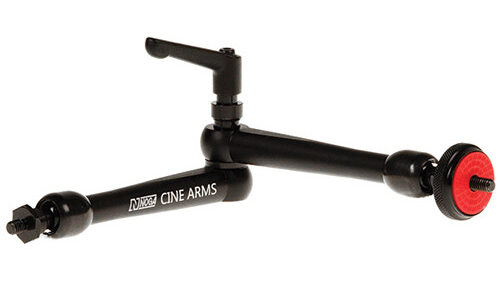
The Magic Arm or Noga Arm
A Magic Arm (Amazon, B&H), also known as a Noga Arm, is like a super flexible extra arm that you can attach mostly anything to.
It has special joints at both ends that can move in any direction, letting you position things just the way you need them.
One end of the Magic Arm has a little plate with a stud, and the other end has a mounting stud. You can attach small equipment like lights, microphones, or field monitors to it using a standard ¼’’ thread.
What makes the Magic Arm so cool is that it lets you place these items at tricky angles that would be hard to reach otherwise.
For example, you can use it to mount a monitor on your camera or set up a light or mic in a tight spot where regular stands just won’t work. It’s like having an extra hand that helps you get your equipment in the perfect position.
Clamps
Clamps make up a big portion of any grips arsenal of tools, and there are several different types.
We’ll look at three common types that you will definitely find on any film set.
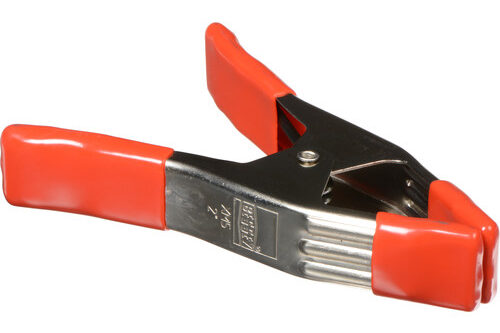
The A-Clamp
The A-Clamp (Amazon, B&H) is probably the most common type of clamp on a set. It’s a large metal peg with rubber tips to protect what it’s clamping.
It’s used to clamp gels to lights, sound blankets, flags, reflectors and thin bounce boards.
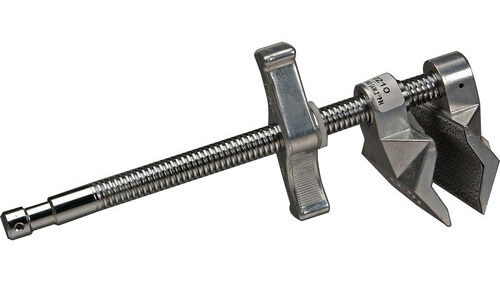
The Cardellini or Vise Clamp
A Cardellini Clamp (Amazon, B&H) is a vise jaw clamp that opens between 2″ to 6″ depending on the model. The other end is typically a stud (baby pin).
Cardellini makes many varieties of the clamp, but you find them under different brand names now.
I’ve found these clamps to be extremely versatile of lighting work. You can attach light fixtures to furniture, the ceiling, or any place to keep them out of shot.

The Mafer Clamp or Super Clamp
A Super Clamp (Amazon, B&H) is a super handy tool that acts like a strong, metal jaw.
It can grab onto pipes, poles, and other round objects tightly without slipping, thanks to the rubber pads on the jaws.
Sometimes, Super Clamps come with special baby pins attached so you can easily mount lights and other equipment. Other times, they have snap-in receivers that let you attach different kinds of connectors, like spigots with threaded studs.
It’s like a strong grip that helps you hold your gear securely in place, no matter where you need it!
This is just the tip of the iceberg when it comes to lighting and grip equipment.
If you want to learn more about which 10 important lighting and grip gear you should have on a low budget film set, check out this video and article:
I hope you have found this article useful in understanding basic lighting and grip gear.
Feel free to ask me any questions in the comments below.
