

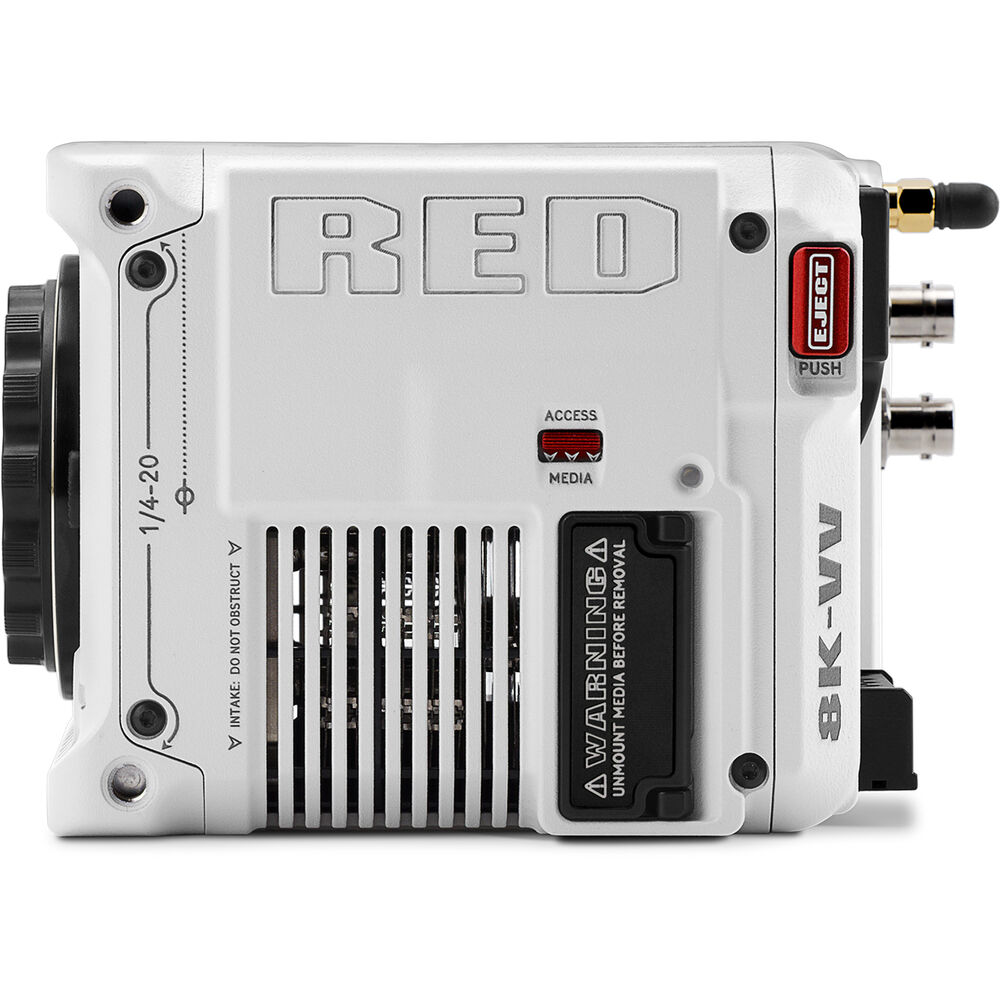
The Red V-RAPTOR ST 8K VV is officially DSMC3. it is the body of the future.
Where does that leave the Red Monstro 8K? At the time of this writing it’s still available on the Red store for $54,500 (brain only).
Does the Red V-Raptor replace the Red Monstro 8K? If not officially, unofficially perhaps? Let’s compare the two, with available information, to see which one comes out ahead.
Important!
Treat this as a fun comparison with currently available information. I’ll try to update this article when more factual information is available.
In many ways, I’m writing this article to understand the distinction myself. Do these cameras serve an overlapping market, or will they appeal to different sets of filmmakers?
Since we don’t get Red cameras easily in India, and the dealer isn’t very helpful with demos, it might be some time before I get my hands on one, so be patient!
If you haven’t already, check out my Red Monstro 8K review:
These are the camera bodies Red currently offers (excluding the Ranger series):
| Camera | Price for body | Resolution | Sensor size* |
|---|---|---|---|
| Monstro | $54,500 | 8K | Full frame |
| V-Raptor VV | $24,500 | 8K | Full frame |
| Helium | $24,500 | 8K | Super 35mm |
| Gemini | $19,500 | 5K | Super 35mm |
| Dragon-X | $14,950 | 6K | Super 35mm |
| Komodo | $6,000? | 6K | Super 35mm |
You can see the V-Raptor comes it at the same price point as a Helium 8K, and close to the Gemini. The inevitable question that arises is: Does the V-Raptor replace all of these cameras in one fell swoop?
In this article I’ll stick to the Red Monstro 8K.
What does the name V-Raptor ST VV mean?
ST stands for ‘Storm Trooper’, the white and black version. There will be a black/neutral version soon.
V could stand for anything. Jarred said in the live Q&A that it might stand for Veloci-raptor. It’s a trademark thing.
VV stands for Vista Vision, as in full frame 35mm sensor, similar to what the Red Monstro has.
We’ll just call it the V-Raptor.
What kind of films can one make with the Red V-Raptor?
Good ones, hopefully.
Or bad ones. Really, it’s not the cameras’ fault anymore. What I’m more interested in finding is the shooting envelope – what types of challenges can each camera solve, and how much is that worth to me.
Both the cameras on this list are Hollywood-level cameras. There’s no doubt about that. The question is: Is the Red Monstro 8K twice as good, though? No, that’s not the right question.
The right question is: Will it save me or make me twice the money?
Let’s find out!

Comparison of sensors and video features
Here’s how the camera sensors compare:
| Camera | Resolution | Shutter | Sensor Size | Dynamic Range |
| Red Monstro | 8192 × 4320 | Rolling | 40.96 mm x 21.60 mm | 17+ |
| Red V-Raptor | 8192 × 4320 | Rolling | 40.96 mm x 21.60 mm | 17+ |
The Raptor doesn’t have a global shutter like the Red Komodo. Red confirmed it’s not the same sensor as the Monstro, though the numbers are close enough.
Red has confirmed the V-Raptor has the highest dynamic range of any Red camera ever, so it has the edge here. It is slightly better in the highlights but definitely better in the shadows.
The other big improvement comes in the rolling shutter performance. From 15ms in the Monstro it has come down to half (8ms) in the V-Raptor. That’s double the improvement!
What about frame rates?
| Max Frame Rate | Red Monstro | Crop Factor | Red V-Raptor VV | Crop Factor |
| 8K | 60 fps (72 fps @ 2.40:1) | 1.00 | 120 fps (150 fps @ 2.40:1) | 1.00 |
| 6K | 75 fps (100 fps @ 2.40:1) | 1.25 | 160 fps (200 fps @ 2.40:1) | n/a* |
| 4K | 240 fps (150 fps @ 2.40:1) | 1.87 | 240 fps (300 fps @ 2.40:1) | n/a* |
| 2K | 240 fps (300 fps @ 2.40:1) | 3.74 | 480 fps (600 fps @ 2.40:1) | n/a* |
Here the Red V-Raptor wins. If you need high frame rates the choice is pretty much decided. The sensor is cropped at higher frame rates, which is nothing new for Red cameras so it is what it is.
| Codec* | Red Monstro (Redcode Wavelet) | Red V-Raptor VV (Redcode DCT) |
| 8K | 5:1 (24p), 12:1 (60p) | HQ (24p to 60p), LQ (120p) |
| 4K | 2:1 (24p), 3:1 (60p) | HQ (24p to 240p) |
| 2K | 2:1 (24p), 3:1 (60p) | HQ (24p to 480p) |
8K 120p is only available in LQ, the lowest quality possible.
There is no direct comparison between Wavelet and DCT codecs, though the same team has made both, and I fully expect the DCT variant (also found in the Red Komodo) to be good enough for cinema.
Red has confirmed that MQ is as good as the best in DSMC2, and HQ is better than Monstro. So it would surprise me if LQ wasn’t.
The Red Monstro has one ace up its sleeve:
| Alternate Codecs | Red Monstro | Red V-Raptor VV |
| 4K | Prores HQ, DNxHR HQX up to 30 fps | None |
| 2K | Prores 4444 XQ, DNxHR 444 up to 120 fps | None |
I’m not sure this is an advantage. There’s a tiny percentage of projects that ask for Prores or DNxHR, and that at reduced resolutions.
I’m sure a bigger percentage of Red owners get hungry during a shoot. Should Red have added a vending machine to the camera? You get my point. By now Red knows its market better than anyone.
Next, what you get externally:
| Camera | Connection | Best external resolution and fps |
| Red Monstro | 3G SDI | 1080p @ 60fps 10-bit 4:2:2 |
| Red V-Raptor | 12G SDI x2 | 2160p @ 60fps 10-bit 4:2:2 |
Finally, you have additional improvements like the ability to pre-record, faster operation and feedback from the system, ND filter system (in development), etc.
Overall, you have to give this round to the Red V-Raptor.
Audio
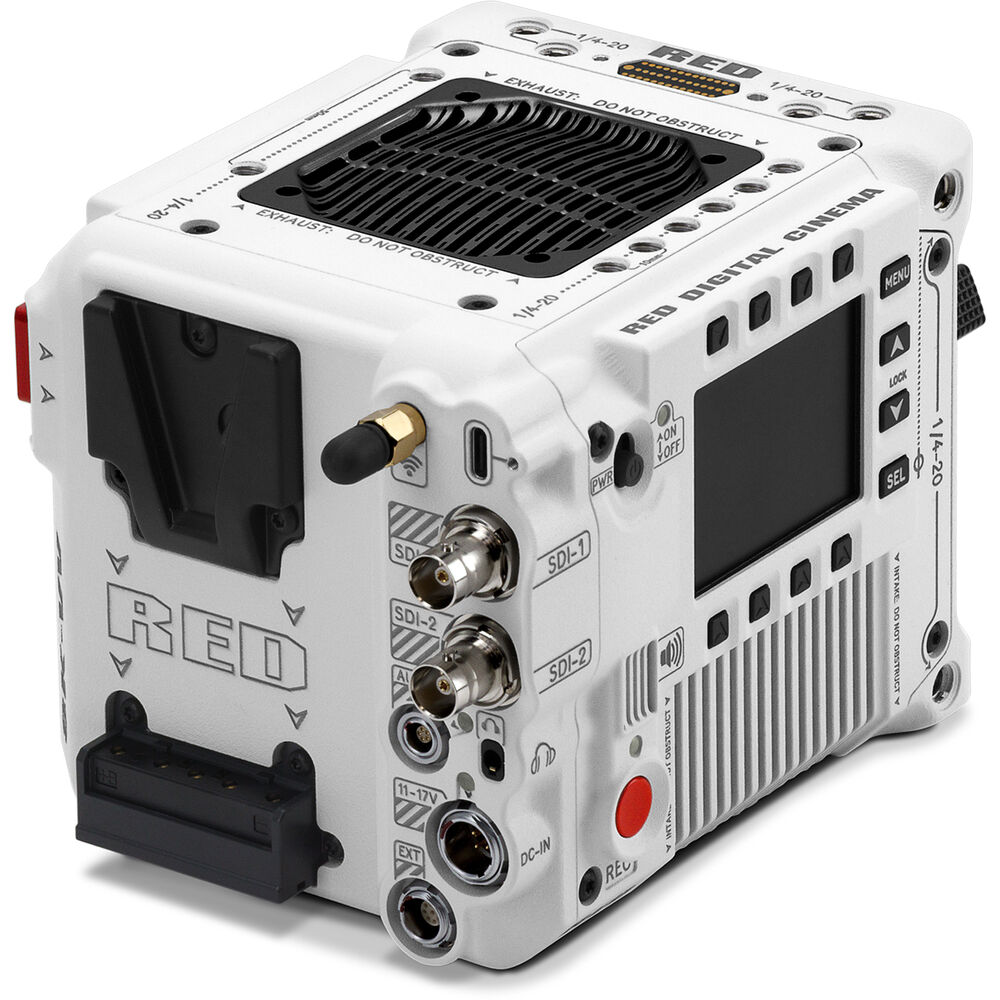
The Red V-Raptor has an advantage here:
| Camera | Connection | Specs |
| Red Monstro | Expander required | 24-bit 48 kHz |
| Red V-Raptor | Mic, Line +48V input via 5-pin | 24-bit 48 kHz |
With the right breakout cables you should be able to record XLR audio into the camera without recorders.
Huge advantage for the Red V-Raptor., considering the price difference.
Lenses
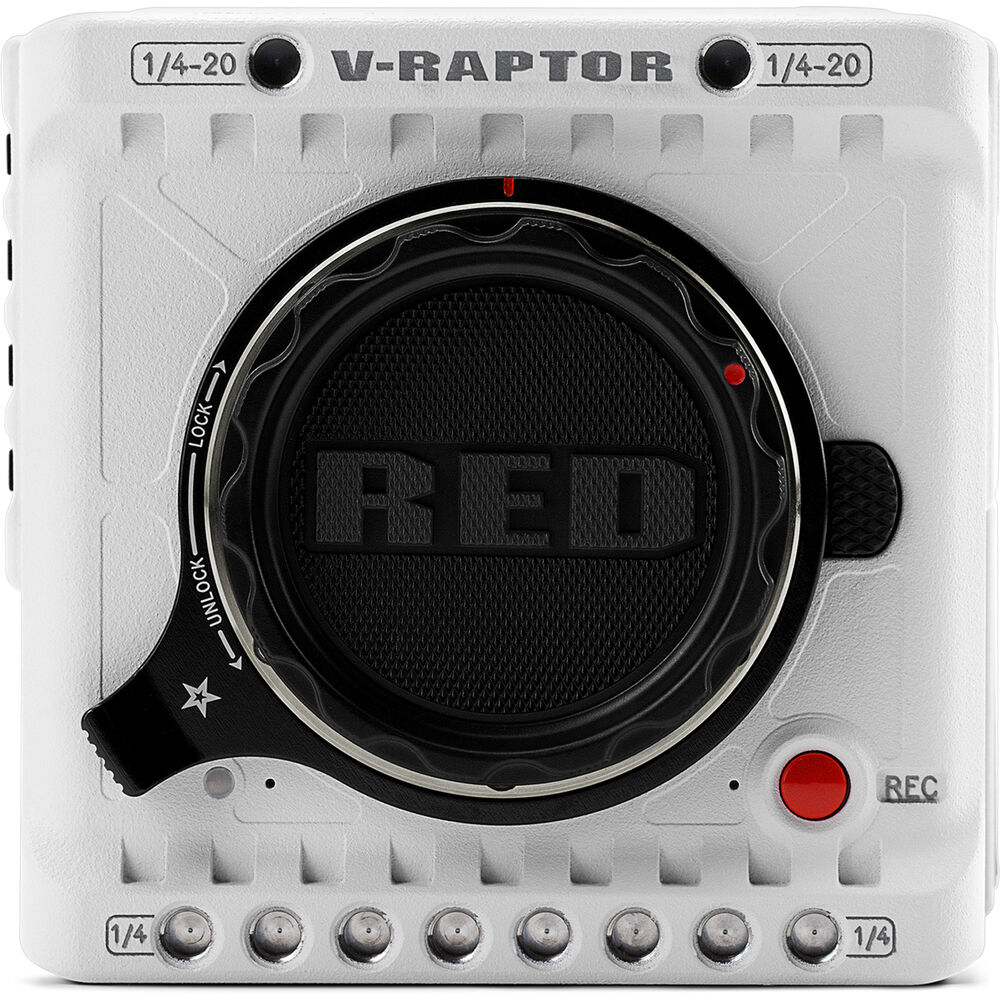
The Red V-Raptor has a locking Canon RF mount. The locking mount ensures adapters stay rock solid for PL lenses. It is fully electronic.
You’ll need adapters for PL. The Red Monstro can have a Canon EF, Nikon F, Leica M or Arri PL mount. The mount needs to be purchased separately so the costs do add up.
Red’s strategic choice of RF is clear. They are betting on Canon to come out with more RF lenses. Check out our comprehensive articles on all the currently available RF lenses:
You can get robust RF to PL (and any other alternative). The other possibility is the addition of autofocus in the Komodo. There’s no news about that for the V-Raptor, but it would be a killer feature.
Red cameras are also wildly popular in documentaries, and the Red V-Raptor is shaping up to be a killer documentary camera. They use Canon EF lenses and cine zooms a lot. Here’s a quick comparison:
| Camera | EF Mount | Price |
| Red Monstro | Canon EF | $900 |
| Red V-Raptor | Canon RF + EF adapter | $199* |
PL to RF adapters are slightly more expensive but still cheaper than Red’s proprietary mount ($950).
Why not the Nikon Z-mount?
Only Red knows. Jarred Land really likes Canon and what they’ve done with the RF mount. On the top of my head, I can think of two reasons (not speaking for Red):
- Nikon Z lenses have focus by wire systems for manual focusing, and don’t have control rings like RF lenses. This makes them not as useful for cinema work and focus pulling.
- That leaves AF. Nikon AF isn’t in the same league as Canon RF, Canon EF (both dual pixel AF) or Sony AF. So there goes the second argument to using Nikon Z lenses.
It just doesn’t make sense, seeing how Nikon hasn’t really stepped up to the video game.
Monitoring and ergonomics
What about weight?
| Camera | Weight |
| Red Monstro | 1.5 kg, 3.35 lbs |
| Red V-Raptor | 1.8 kg, 4.03 lbs |
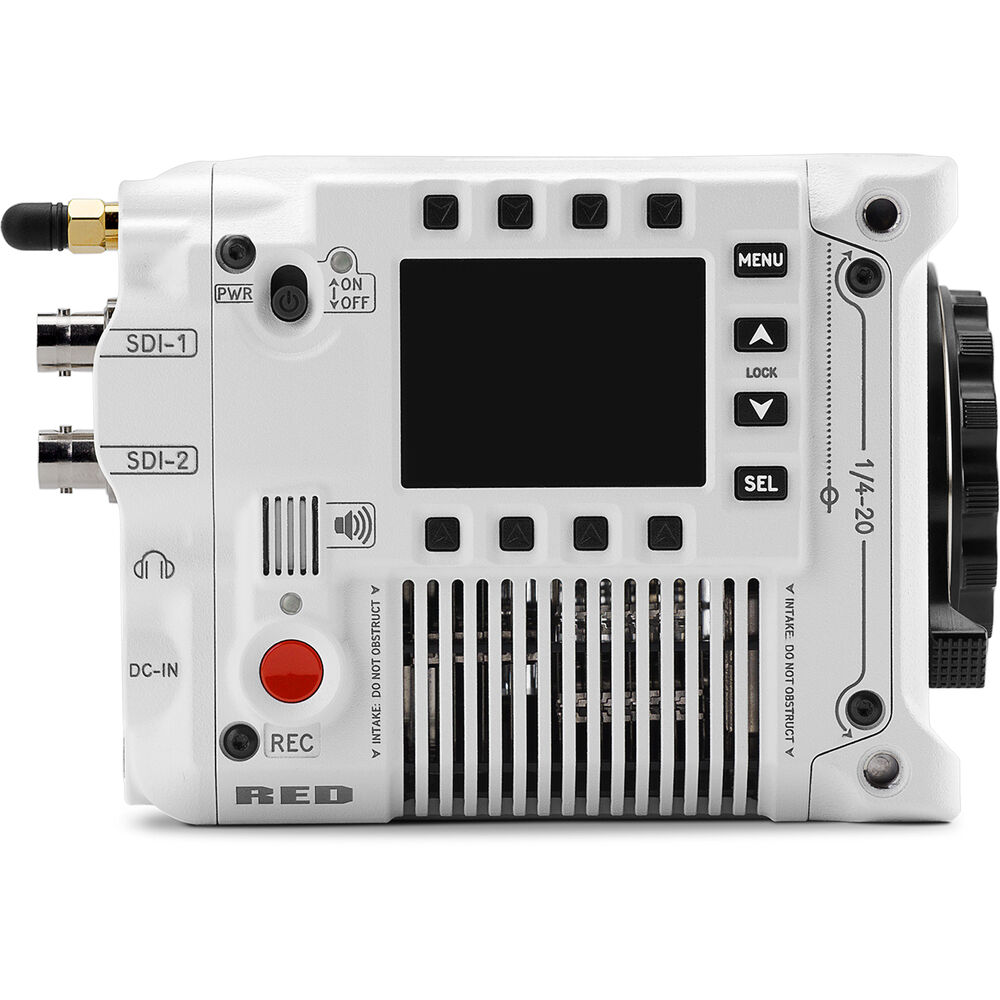
The Red V-Raptor is heavier, but it has a built-in touchscreen and Wi-Fi.
Then there’s monitoring:
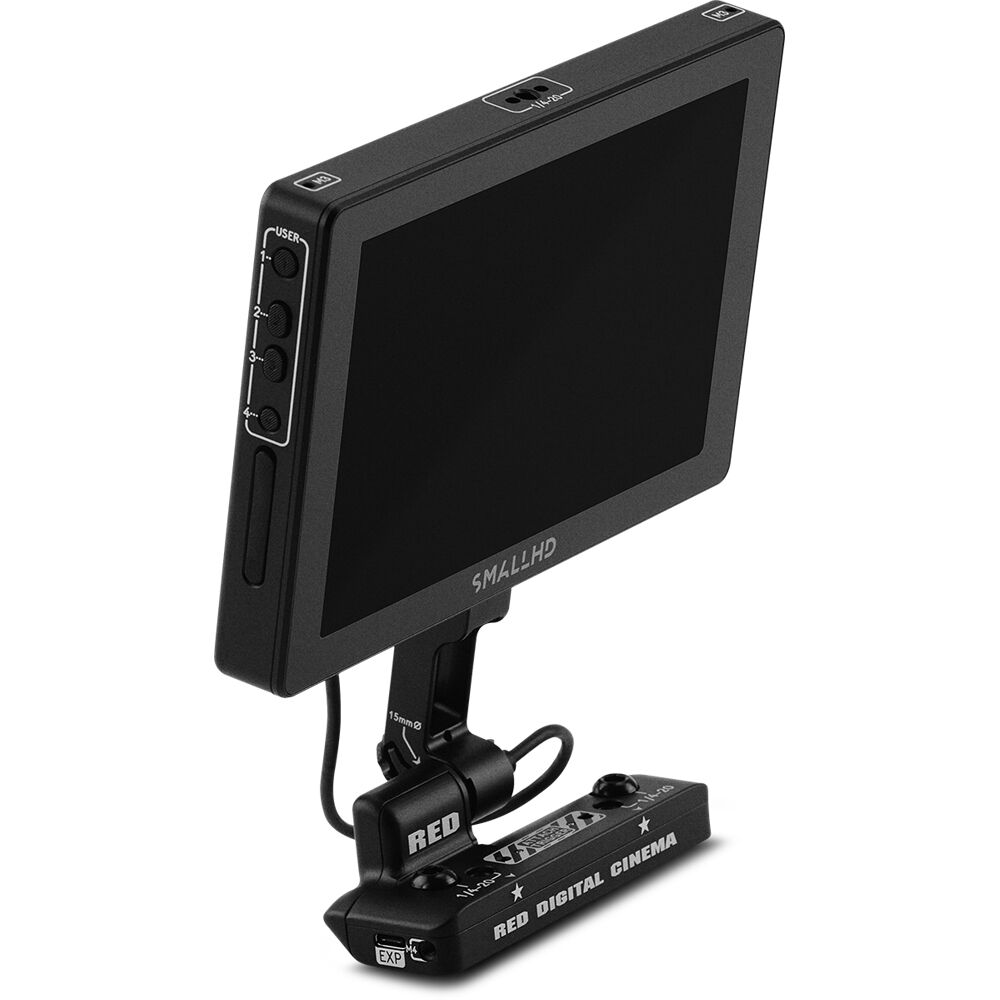
| Camera | Monitor* |
| Red Monstro | $1,450 |
| Red V-Raptor | $2,750 |
If you don’t want Red touch screens you can always get something else via SDI. No issues. The advantage of the Red touch screen is the direct connection to the camera.
Wireless monitoring and control
You have Wi-Fi camera control and monitoring, which is an excellent feature. You get dual band (2.4 GHz/5 GHz) mounted to a connector.
For monitoring you get a 1080p live preview video feed via 2.4 GHz and 5 GHz Wi-Fi. You don’t even need a monitor if you have a nice iPhone or iPad!
You can control the camera via wired USB-C or Gigabit Ethernet (compatible USB-C to Ethernet adapter required) allowing remote camera control, live video feed and remote media offload.
You also get Genlock, Timecode-in, GPIO and Ctrl (RS-232) via an integrated 9-pin EXT Port.
You can achieve a lot of this with the Monstro with additional modules (or the Ranger), but at added cost.
Clearly the Red V-Raptor isn’t fooling around. It has important features that allow it to be used on a multitude of projects. In this respect it wipes the floor with the Monstro.

Batteries and media cards
Red has its own ‘rebranded’ CFexpress Type B card, called the RED DIGITAL CINEMA PRO 660GB. It’s a rebranded Angelbird 660GB card, but not the one currently in the market. Angelbird is coming out with a Mark II that can sustain 800 MB/s, the highest data rate at 8K.
Here’s a look at the media options:
| Camera | Dual card slots | Price per GB for 960/660 GB* | Card Reader* |
| Red Monstro | No, Red Mini-Mag | $2.45/GB | Mini-Mag Reader ($195) |
| Red V-Raptor | No, CFexpress Type B | $1.45/GB | CFexpress Card Reader ($120) |
The price difference is huge for large projects. CFexpress Type B cards are getting cheaper, and Red is allowing users to use any card in the market as long as they hit sustained 800 MB/s write. Very few cards do at this time. For an updated list of compatible cards, click here.
What about battery life?
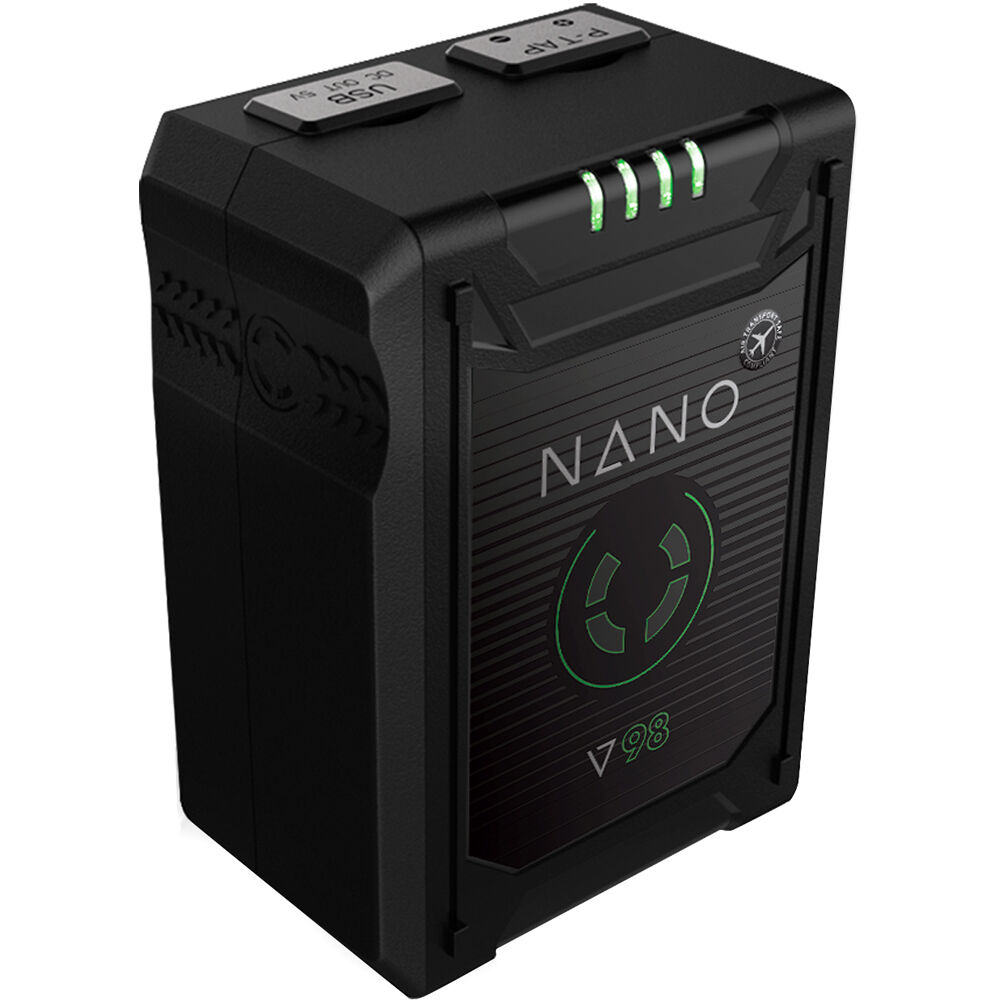
The Red V-Raptor has a 11-17 V 6-pin DC port. What is great is there is an integrated V-Lock battery interface optimized for Micro V-Lock Batteries. I think the future is smaller brick batteries so it’s a good move (except if you already have a ton of large bricks)
The battery life sucks though, you get about one hour on a 98Wh battery. It sucks power in 8K.
| Camera | Battery life with a 98Wh battery | *Cost of two batteries and charger | Cost of 6 hours of operation | Module |
| Red Monstro | 111 minutes^ | $549 | $1,780 | $950 |
| Red V-Raptor | 60 minutes | $549 | $3,294 | $0 |
When you consider the additional cost and weight of a battery module, the price isn’t that different.
Since both cameras would need a top handle, I’ll just discount that here.
Which is cheaper to own?
Shall we?
| Camera | Red Monstro | Red V-Raptor |
| Camera body | $54,500 | $24,500 |
| PL adapter/mount | $950 | $369* |
| Media (1 TB) | $2,508 | $1,485 |
| Batteries (6 hours) | $1,780 | $3,294 |
| Monitor | $1,450 | $2,750 |
| Battery Module | $950 | $0 |
| Total | $62,138 | $32,398 |
That’s twice the price!
Verdict
First, a recap:
| Feature | Winner |
| Dynamic Range | Red V-Raptor |
| ISO Range | N/A |
| Motion/Rolling Shutter | Red V-Raptor |
| Frame Rates | Red V-Raptor |
| Lenses | Red V-Raptor |
| Media | Red V-Raptor |
| Ergonomics | Red V-Raptor |
| Battery life | Red Monstro |
As far as I’m concerned, the Red V-Raptor wins.
Red is coming out with new accessories – XLR adapter, Gold mount adapter, Variable ND adapters, etc. This one’s a no-brainer.
There will also be a Red Ranger coming soon with built-in ND filters and better integration for a full cinema workflow. What’s not to like?
Watch the Q&A here for more info:
Hopefully I’ll get my hands on it sooner rather than later.
What do you think?

Sadly the Raptor lens mount isn’t robust enough to take the larger PL lenses even with an adapter as the locking mount ring has a tendency to slip. Overall the Monster is a far more solid built camera with rock solid lens mounts.
As a result the new cameras specs are marginally better but the body isn’t built to the same standard. Any pro movie maker should really be opting for the older Monstro. Maybe Red will update the Monsto spec to a new sensor or fit the Raptor with a better lens mount but until they do there is little point in changing from the Monstro.
That’s really concerning, I hope they fix it.
What do you have to say about the newly announced Blackmagic URSA Mini Pro 12K?
At 5,995 it’s good value for money.