
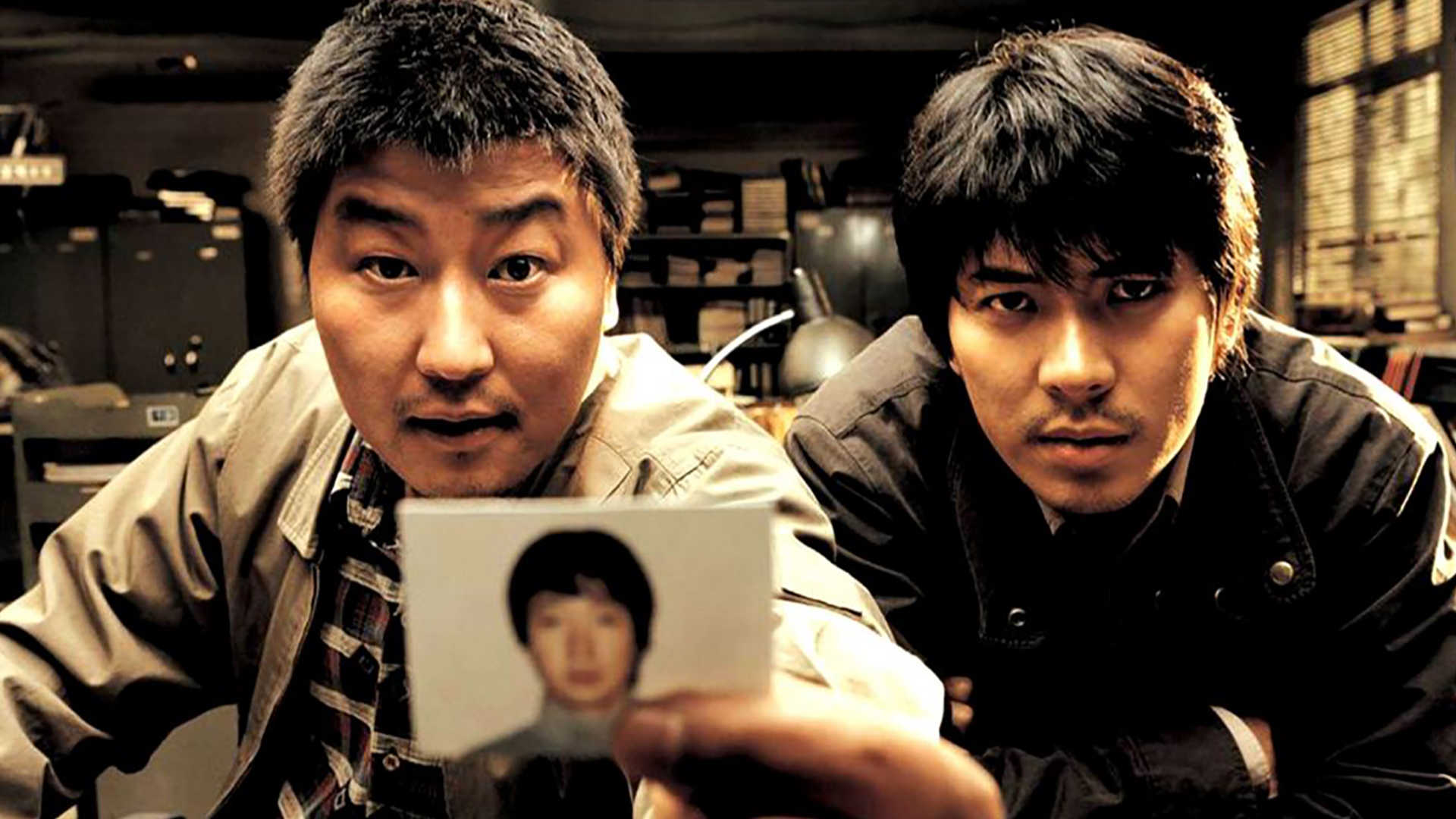
In this video I’ll show you how director Bong Joon-ho used the camera to show who the killer is, in his best film yet, Memories of Murder. There are spoilers ahead. I urge you to watch the film first because it will blow your mind:

Let’s start from the last shot. The main protagonist, Detective Park, looks right at us. The director wants to let the real killer know he’s not forgotten. At the time of filming it was an unsolved series of murders. Today, we know who did it, but director Bong Joon-ho didn’t, and he wanted to communicate directly with the killer.
This shot happens at the end of the film. Those who are not aware of the real case would expect some kind of revelation at the end. The ending works, because the director has been setting us along right from the first shot.
Memories of Murder shows you how a director can manipulate how the audience feels about a particular character, using just camera angles and editing.
This film is really about not knowing who’s guilty and who’s innocent. Early in the film the chief puts protagonist Detective Park to a simple test. Can he distinguish between a rapist and the victim’s kin? Of course, he can’t, and neither can we. Which is why the answer is never revealed.
The film has many such examples:
- There are two detectives – one follows traditional police methods, the other is more modern.
- There are two police chiefs – one likes Park and the other likes Detective Seo’s ideas better.
- There are two serious suspects to the crime, and there are two women who’re in the wrong place at the wrong time. Both are at great risk.
We are set up from the start not to have great expectations.
One thing we can be certain of is, Detective Park is the protagonist. We see the film and the story develop through his eyes. We feel what he feels. There’s no doubt from whose point of view this story is from, and actor Kang-ho Song is just brilliant. He’s one of the greatest actors ever to grace the cinema screen (watch Parasite if you want further proof).
Even if Song wasn’t in the film, the camerawork ensures whoever played the role of detective Park will endear himself to us.
However, what if the story is not told from his point of view, but from the point of view of the unknown killer?
In the very first scene, it’s a sunny day, beautiful sky; and we end the film in the exact same place, a sunny day, with Park, who’s no longer a detective. He is placed in the center both times, looking down. The first time we see a reverse point of view, as if the killer is there, looking back at him.
It’s as if the entire film is imagined by the killer, and Detective Park is a figment of his imagination. This explains the duality – two detectives, two chiefs, all these choices and doubts that would not only vex a police officer, but also the actual murderer himself.
The nature of this duality is evident even in the camera movement.
In a scene when they discover the second body, the camera follows Detective Park as he tries to control things on the ground. We are literally behind him, in an over the shoulder shot, just like you get with third-person shooter video games.
The choreography is the exact same done twice. He starts with the footprint, then walks back down to greet the police chief, who slips down into the paddy field. Park returns back when the tractor runs over an important bit of evidence, and we repeat the motion again as the forensic team arrives. The expert, too, slips down just as the chief had done.
The camera operating in Memories of Murder is world class. Very precise, very graceful, and adds a great rhythm to every shot.
Camera operators are one of the unsung heroes of filmmaking, so I hope you’ll watch the film keeping in mind how hard it is to follow actors around and get the compositions right.
Coming back to Memories of Murder, the killer could be looking right over Park’s shoulder. It is critical the camera’s point of view is Park’s, because the emotional bond the killer is supposed to feel is with him – otherwise the final look of the film doesn’t work. If the killer doesn’t care for Park, the movie fails.
Detective Seo is the logical one. The thinker, the Sherlock Holmes of the bunch. Yet, he isn’t shown in a very sympathetic light. When the case goes cold he vanishes. We never get to know what became of him. He gave up. Park returns. He cares.
Compare the shots in the police station and at the crime scene. The shots at the station are slow and methodical. The shots at the crime scene are fluid, energetic, with more motion and energy. The crime scene is where the killer went himself. It’s what he would get most excited about.
We return to the crime scene again and again. Not just the first time, but later as well. They even say out loud that killers often return to the crime scene. The real killer is taken back to his crime scenes again through this film. It is designed to jog his own memory, as morbid as it may seem.
Park’s the one the killer should be afraid of. He’s the one who never gives up. His tenacity at never letting go of the case is what the real killer is expected to fear. You better fear Detective Park, because he never stops hunting you down!
I’ve read a lot of reviews that assume the police work is shoddy and poor. I think that’s either lazy armchair expert writing or a lack of real world experience. I think Detective Park’s police work is excellent, borderline genius considering what resources he actually has.
Is Detective Park a good detective?
He looks at photos while eating, even though the police chief calls him out for it. Would a lazy police officer do that? He comes up with a really strange idea, and on first hearing we laugh it off. Even the police chief thinks it’s stupid. But Park follows through with it. He follows up on every lead, and in this chase scene he’s the one who finds the suspect with the red underwear.
Park is the most affected by this film. He’s changed jobs, he marries a prostitute, and tries to be a good father. On what looks like a sales call, he still finds time to stop and think about the case everyone else has forgotten. He never tortures a suspect. In fact, he hits a police officer, which the real killer would have liked seeing.
In a small locality with minimal staff to secure a crime scene he runs around trying to protect it. He shows compassion to everyone, good or bad. He talks to his suspects like they are human beings. When the logical one loses his marbles and tries to shoot a suspect, Park intervenes. Seriously, what more can you ask of a character that’s only a reflection of the times the film is set in? To most people’s eyes, he’s a flawed detective, but he’s designed to strike fear in the real killer.
The camera is always from Park’s point of view, which is also the killer’s point of view. Park is destined to fail. The real killer knows that. What the real killer couldn’t know while watching the film is whether the film had a definitive ending. Will the ending reveal some secret of his? And that’s what the final look was designed to achieve. Park looking the killer straight in the eye.
He knows, doesn’t he? The killer is looking in the mirror.
It’s all between the killer and himself, and the camera plays the role of facilitator. When looked at in this way, all the camera choices and staging take on a different meaning. The title, Memories of Murder, become the memories of the killer re-jogged, so he is reminded of his actions and past, and what might still be in store for him.
I urge you to study the beautiful compositions and camera movement of Memories of Murder. It is one of the finest movies ever made.
