
Watch the video:

Black Christmas (1974) is also the inspiration for Halloween, and is one of the earliest slasher-type films. It has inspired countless movies, and even The Lost World, by Steven Speilberg. I’ll tell you about that one a bit later.
There are spoilers ahead. I urge you to watch the film first because it shouldn’t be missed.
What points of view are we talking about?
You can tell a story from a particular character’s point of view. In Black Christmas the protagonist is Jess, though we never get to really know her very well. There is some empathy, of course, but it’s not like she’s the driving force. What I’m really talking about is, the point of view of the camera.
The first POV
In most of Black Christmas the point of view of the story is a third person, and that third person is us, the audience, as a fly on the wall in this sorority house.
We are privy to everything that’s happening. We know what the girls are doing, and we know what the killer is doing. Almost nothing is hidden from us, and we are helpless because we are stuck inside this house along with the victims.
This classic technique is from Hitchcock, who believed to create real suspense you must let the audience in on the secret.
We know from the very first scene the killer, Billy, is inside the house. He’s upstairs throughout the film. When something happens, we see what he’s up to from our own vantage point. It’s as if there’s a third unknown character in the house. By forcing the audience to be inside the house and be aware of everything, the sense of suspense and dread is heightened to a great degree.
Compare this to films where we don’t know where the killer is most of the time. Here we know, and the dread is that much more intolerable.
The second POV
The second point of view in this film is of Billy’s. We follow his actions from a wide angle camera positioned on his head. Cinematographer Albert Dunk created Billy’s POV shots by mounting the camera on his shoulder as he walked about the house and climbed the trellis and ladder.
Trivia: For most of Black Christmas, the camera used was the legendary Panavision R 200. For the head POV though, it probably would have been 16mm.
What’s most interesting about this technique is that we intercut between both points of view. We have the killer’s point of view, and our point of view.
The best example of this is the first scene itself, and let’s see how it was achieved, and what the effect is.
Analysis of the first scene
In the very first shot the sorority house is shown normally, from a normal camera perspective:
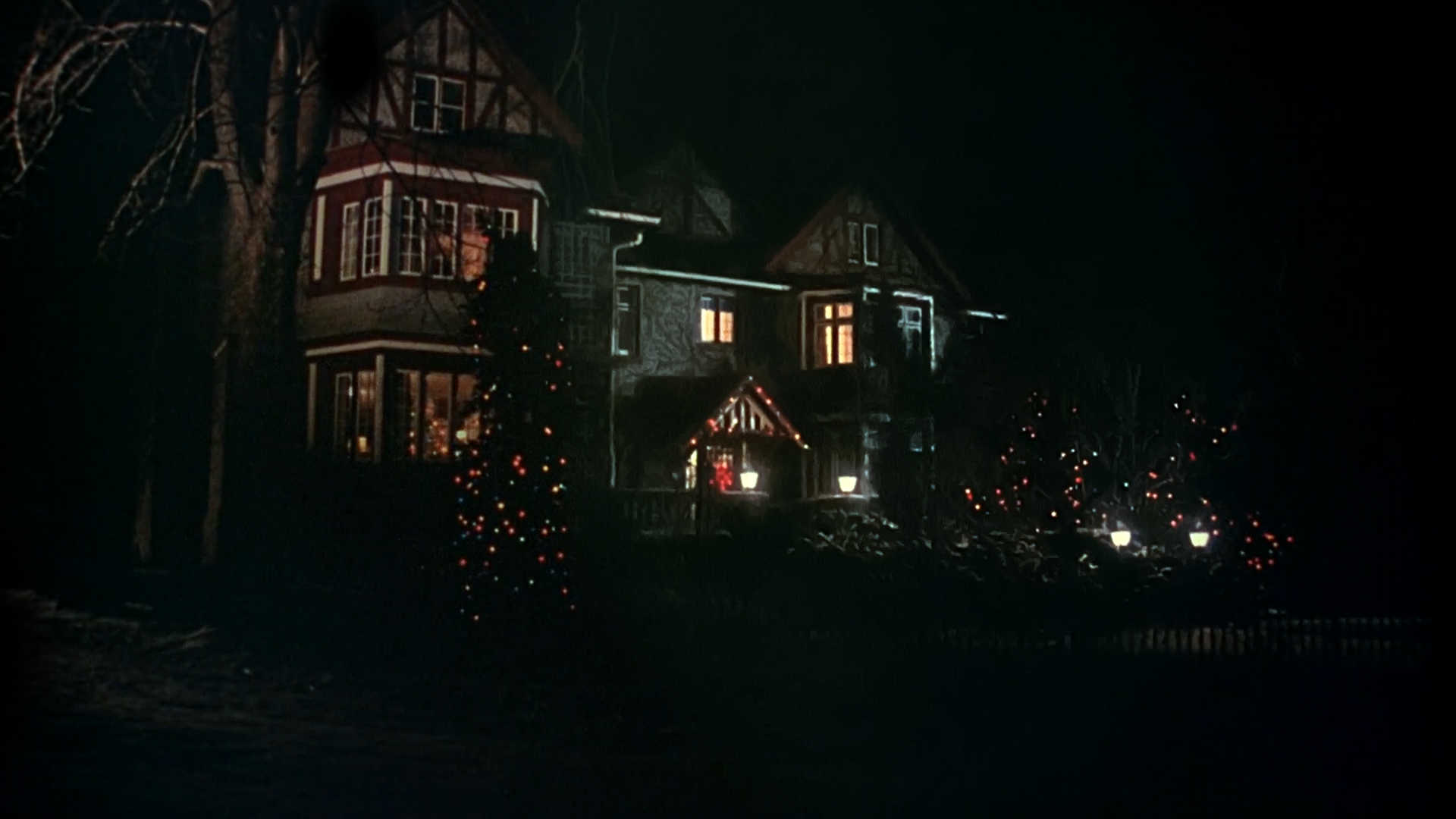
We’re outside looking in, like voyeurs. We are aware it’s Christmas time, and the girls are probably having a small party.
Then we cut to the killer’s POV:
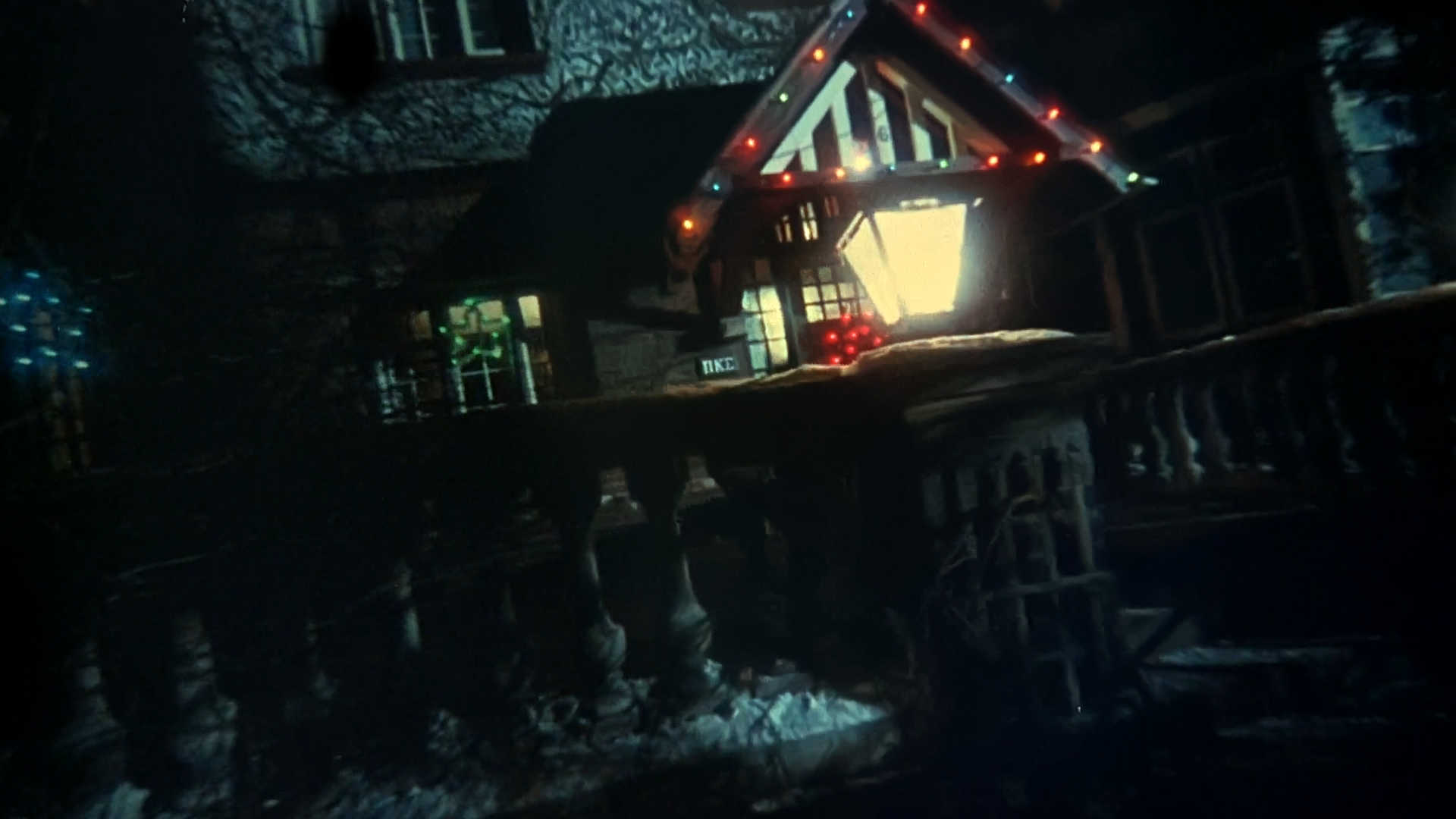
It’s very obvious, because the angle changes from a normal focal length to a wide angle lens. It’s almost always from the vantage point of a person looking at the world, so we are clearly aware it’s a person’s POV. The way the cinematographer walks, in slow steady steps, heightens this understanding.
Billy follows the same path we did earlier, front door, then left window. He looks up.
Then we cut back to our voyeuristic point of view, but this time Billy enters the frame to make us aware this is a separate point of view, ours.
The person who entered earlier (while we were watching) clearly closed the front door, and we never see Billy open the front door. So it must have been us. We entered through the front door! Sneaky us.
Billy couldn’t follow us because Barb slammed it shut. He finds another route. He climbs the trellis and we intercut between wide POV and normal POV:
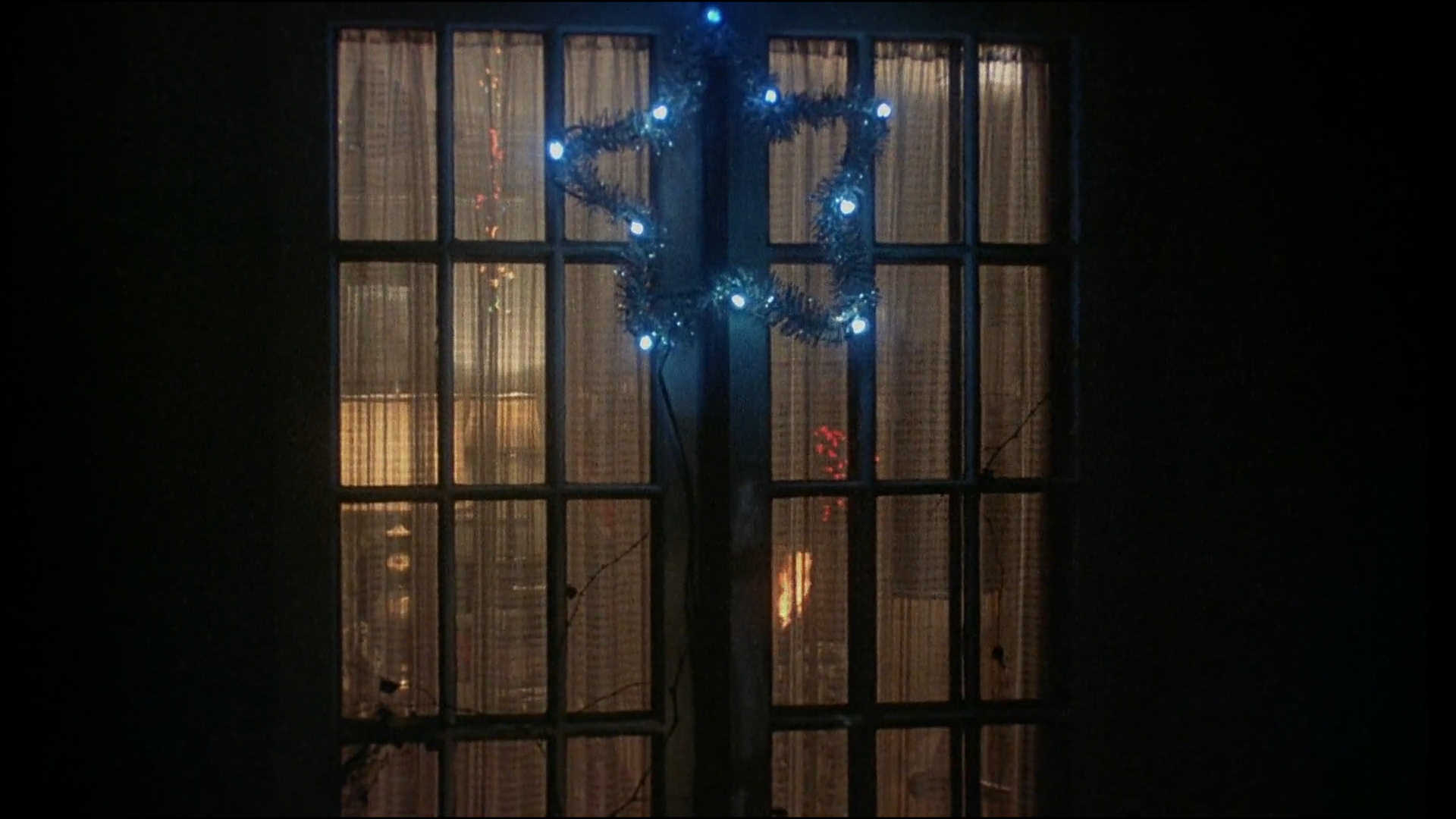
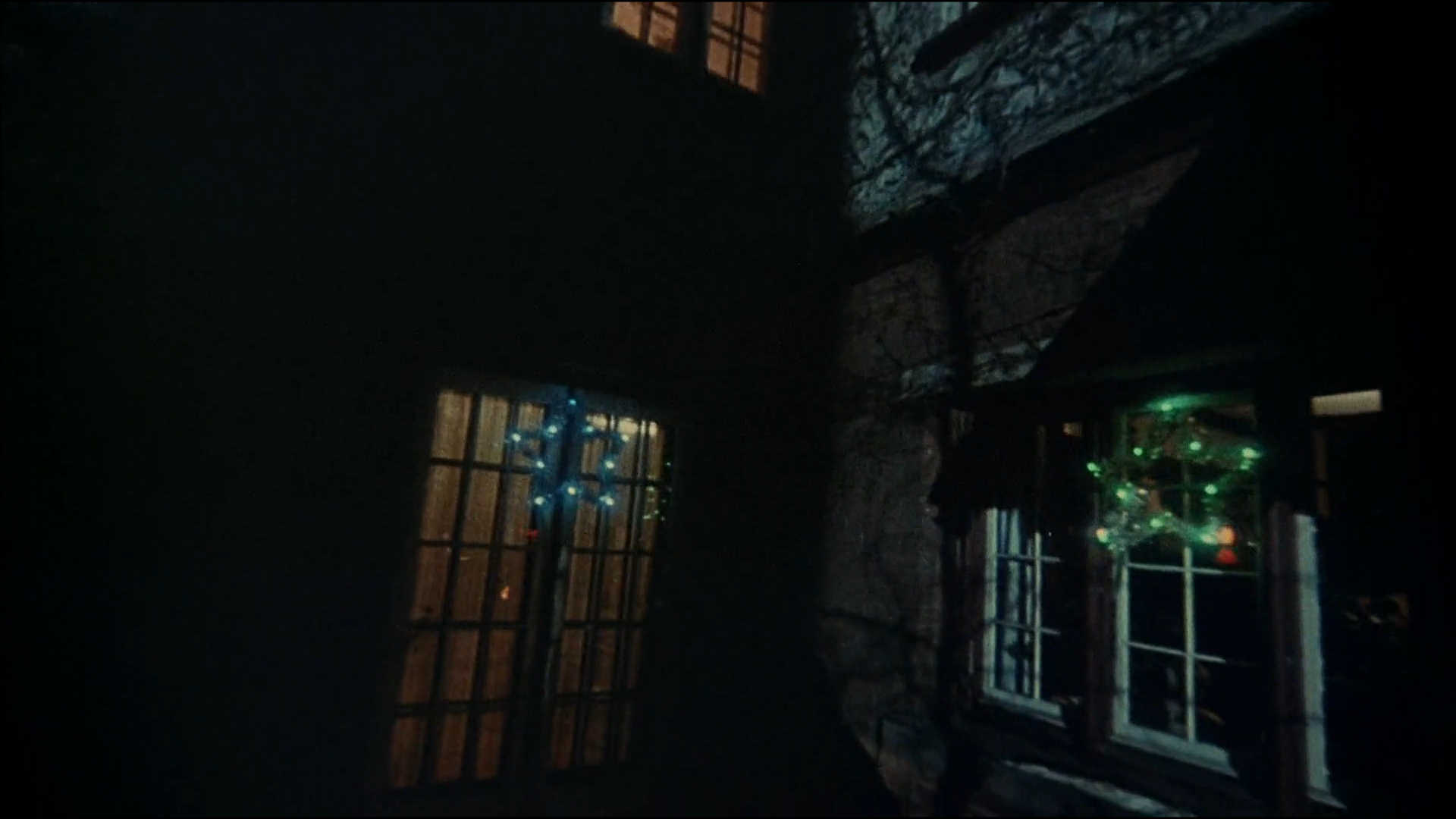
Both the killer and audience enter the house at the same time. We enter through the front, and Billy enters through the attic window.
While Barb is on the phone we are on the stairs. Only we know at this point the killer is in the house. We know he’s in the attic, so the camera’s pan to the right is motivated. It is interesting to note how the camera is positioned on the steps looking down in this shot, and in other shots as well.
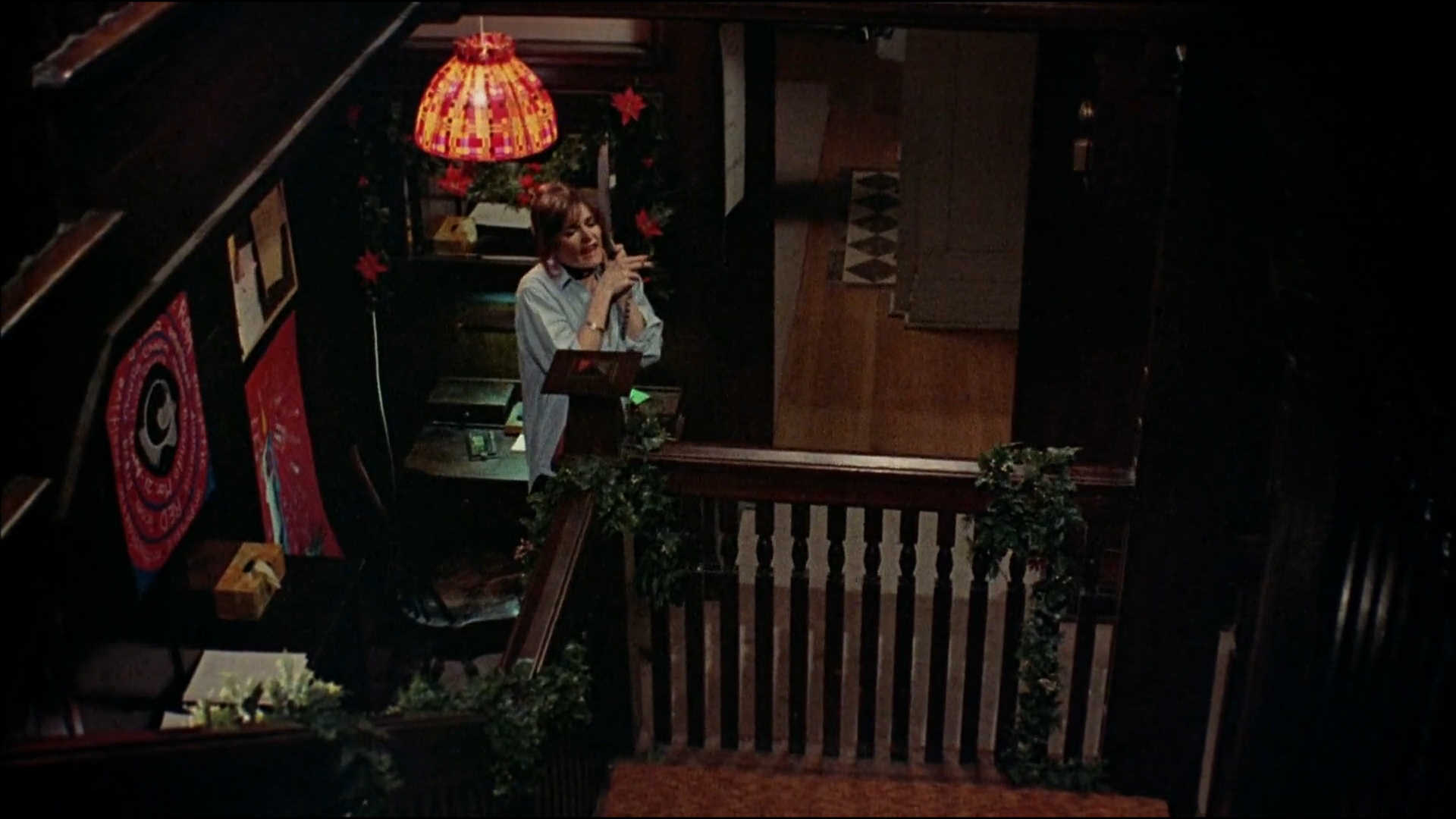
We as the audience are forced to be between Billy and his victims.
We cut to Billy’s POV as he opens the attic trap door and makes his way down.
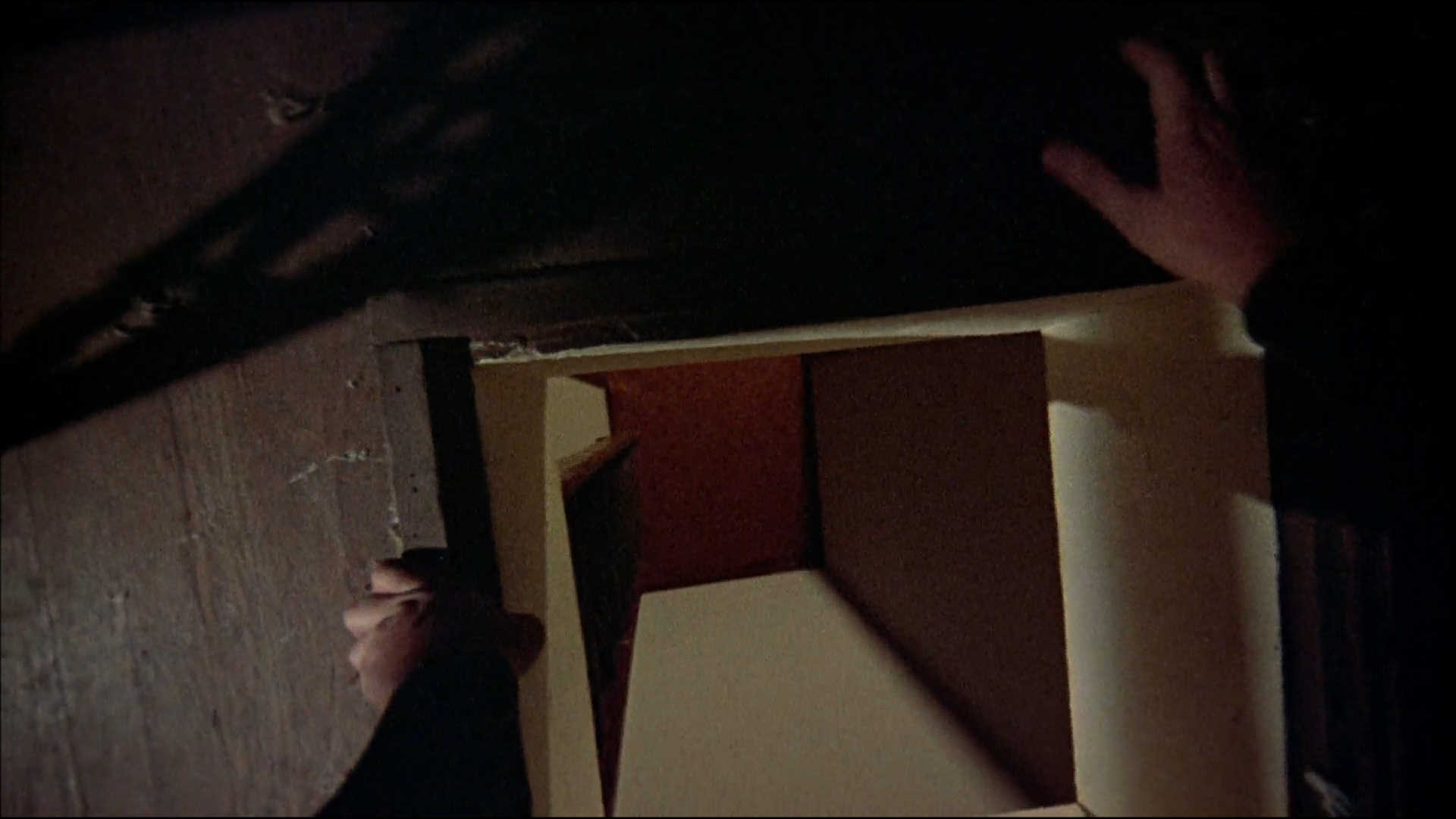
It’s as if we’re watching the same events from two points of view at the same time. It’s like two trains coming at each other. We know what’s going to happen, but we want to see nonetheless, and the suspense is killing us.
This shot from Billy’s point of view really drives the point home:
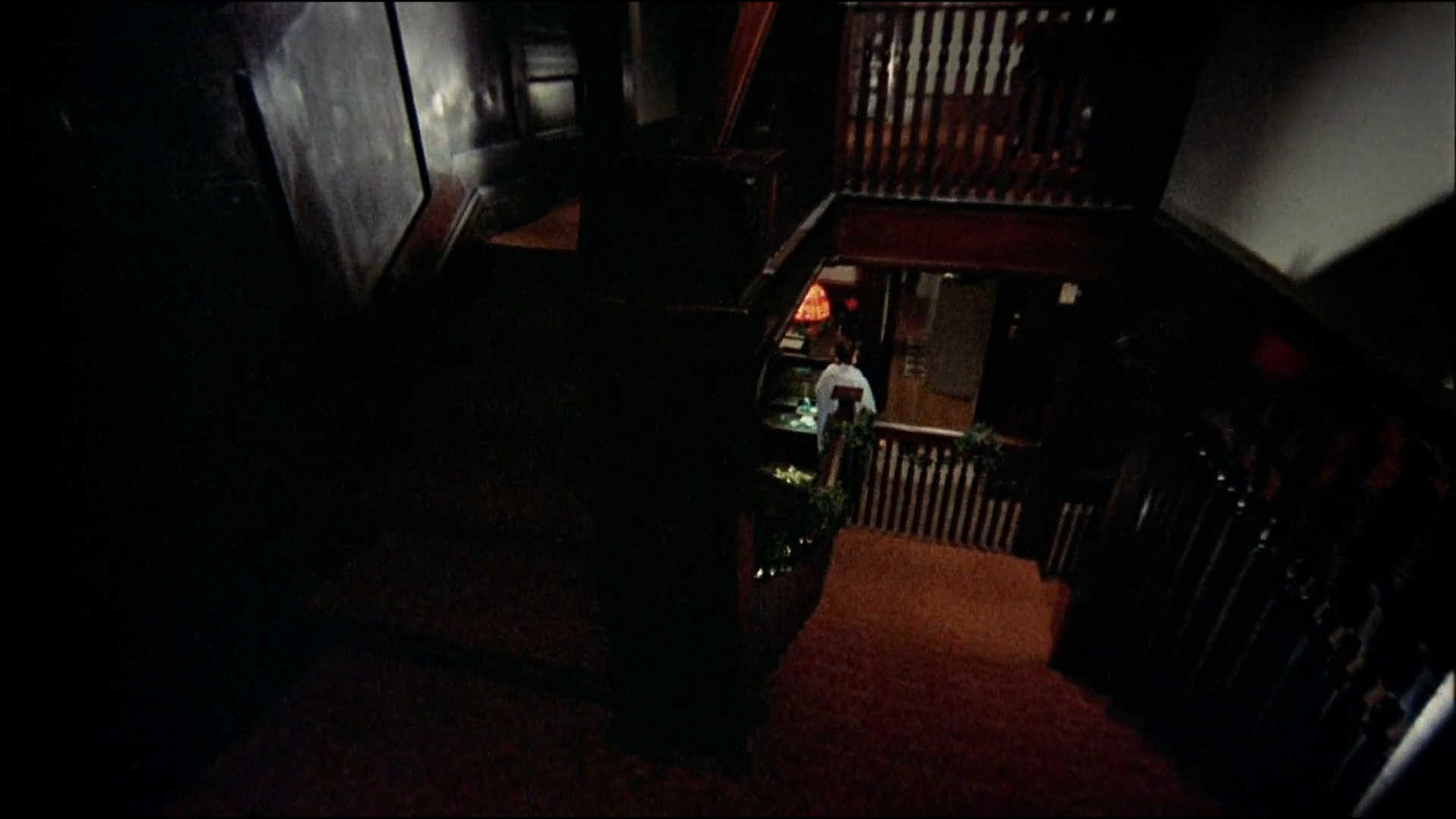
He’s right there looking down and Barb is blissfully unaware of him, or of us. He looks up at the bedroom, and it’s pretty obvious that’s where he’s going.
Then the phone rings, and Jess, the secretary of this sorority, picks it up for the second time. Even though it’s not made clear, we as the audience are pretty certain it’s Billy from the bedroom. I don’t know if this was as obvious in 1974, but I suspect so, because no other threats have been shown so far. We are among the girls in this segment, as they listen to Billy’s smooth talk.
After the phone call, Clare fights with Barb, and she wants to head upstairs to pack. The stairs are what separates the safe zone from the danger zone. Again we look down from the stairs, which is a segue to another murder. Our position changes as we anticipate the worst:
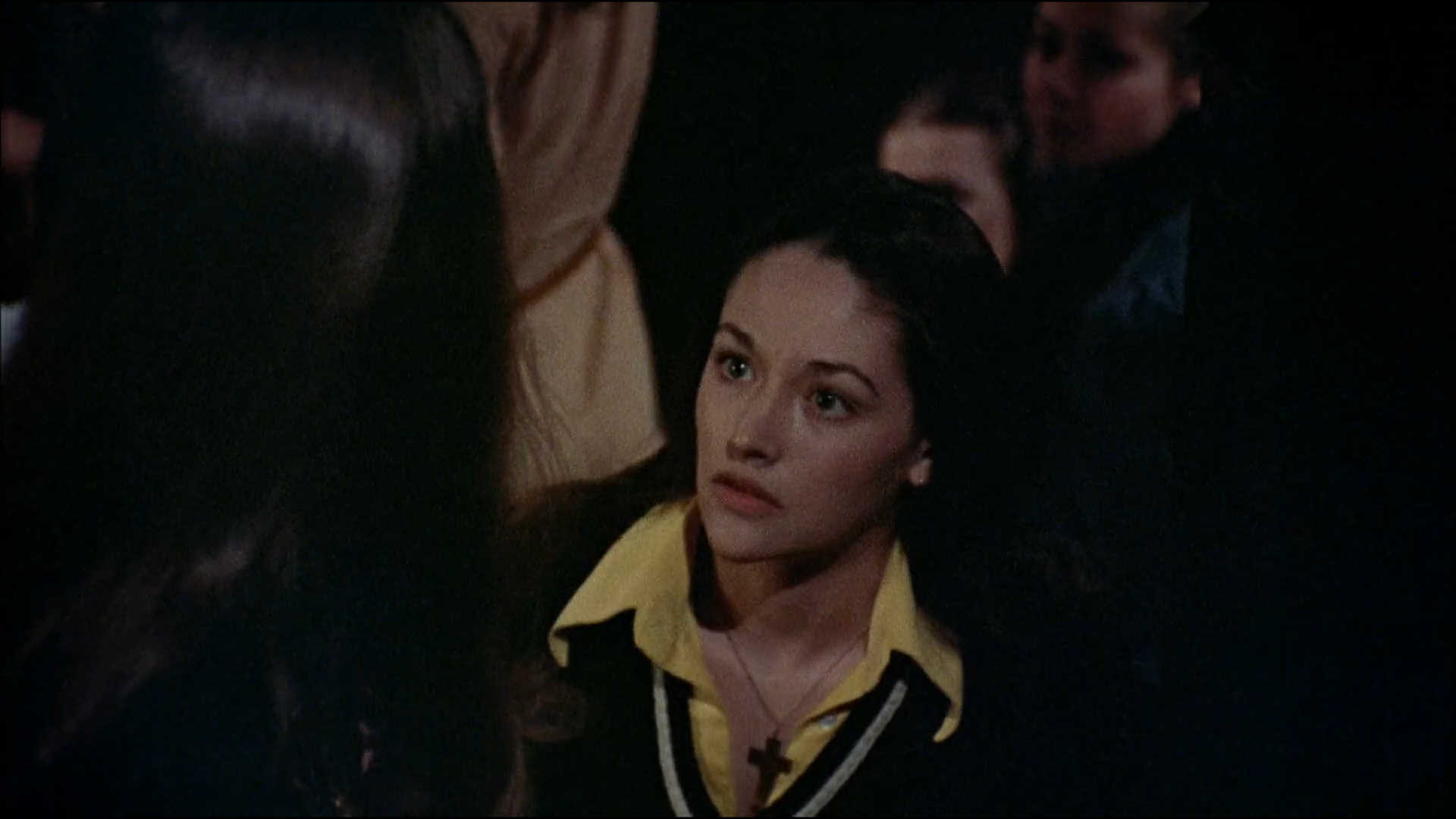
There is time to introduce one other major character, and we cut back to Clare in the bedroom. Clare is alone, and we see the killer hiding behind the plastic wrap in the closet. Immediately we cut to his POV. We cut back and forth between these two points of view as Clare’s job on this film is done.
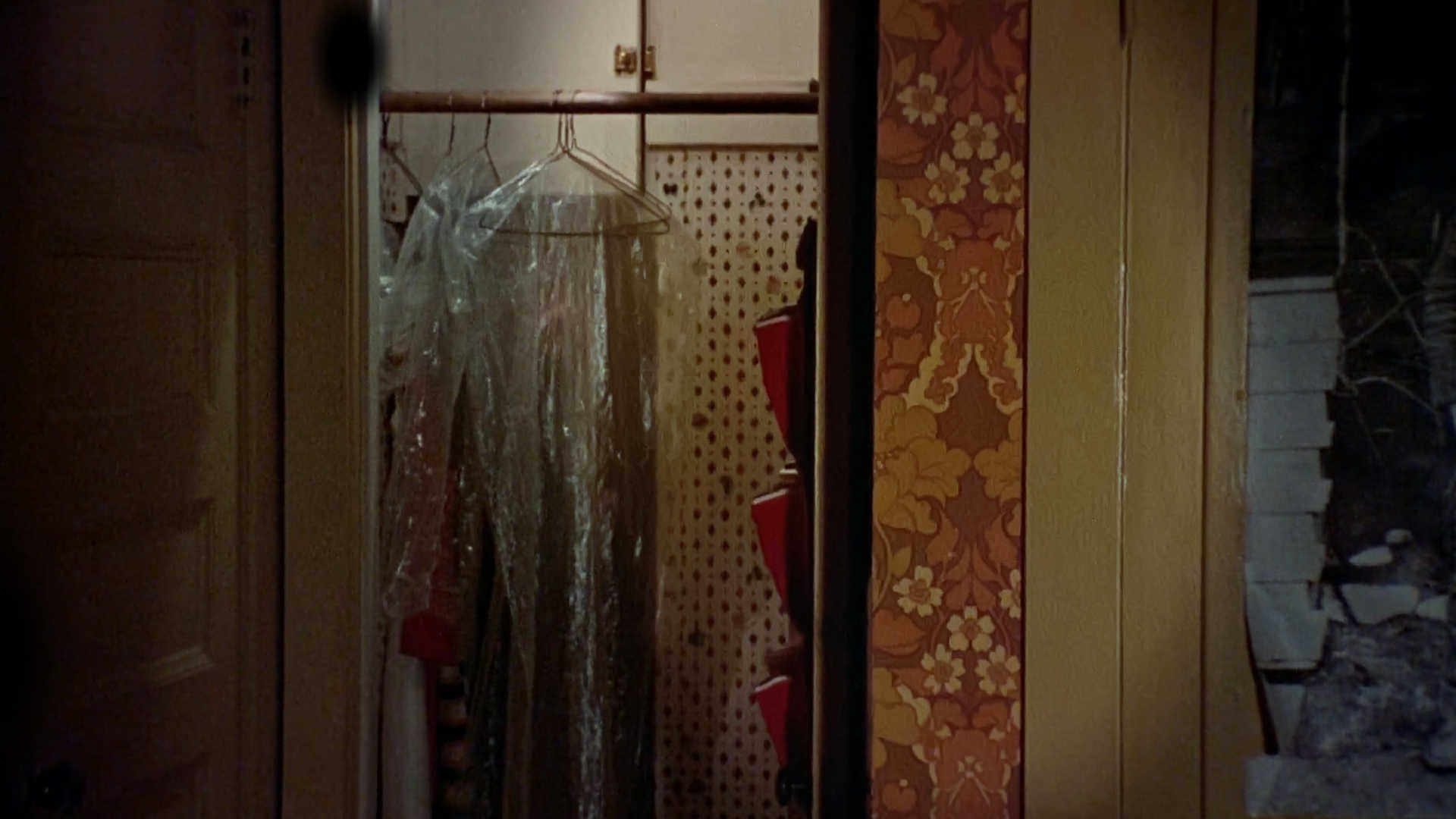

It’s a wrap for her.
Her scream is masked out by the noise downstairs, and there’s a better example of this later in the film where a woman screams but her scream is masked out by a phone ringing. This technique was used by Spielberg in The Lost World.
The points of view in Black Christmas are intercut to keep us on our toes, so we never lose sight of the fact the killer is in the house. Not only that, he’s brave enough to step downstairs in plain sight whenever he pleases.
This kind of alternating point of view shots influenced Evil Dead, where sometimes we see the evil spirit’s point of view. Unfortunately a lot of the other shots are also very wide shots, so the intercuts don’t make as much of an impact as they do in Black Christmas.
This entire opening sequence is more than 10 minutes long, and we didn’t feel a single minute of it. As the killer carries Clare’s body up the attic we take a slow pan around and end up at the attic trap door. Director Bob Clark finds very elegant ways to cut between the tough transitions, and we are never aware of the seams.
The jokes and red herrings are great, too. Peter, the boyfriend, is the prime suspect all along. In the very first shot we see the name of the sorority house:
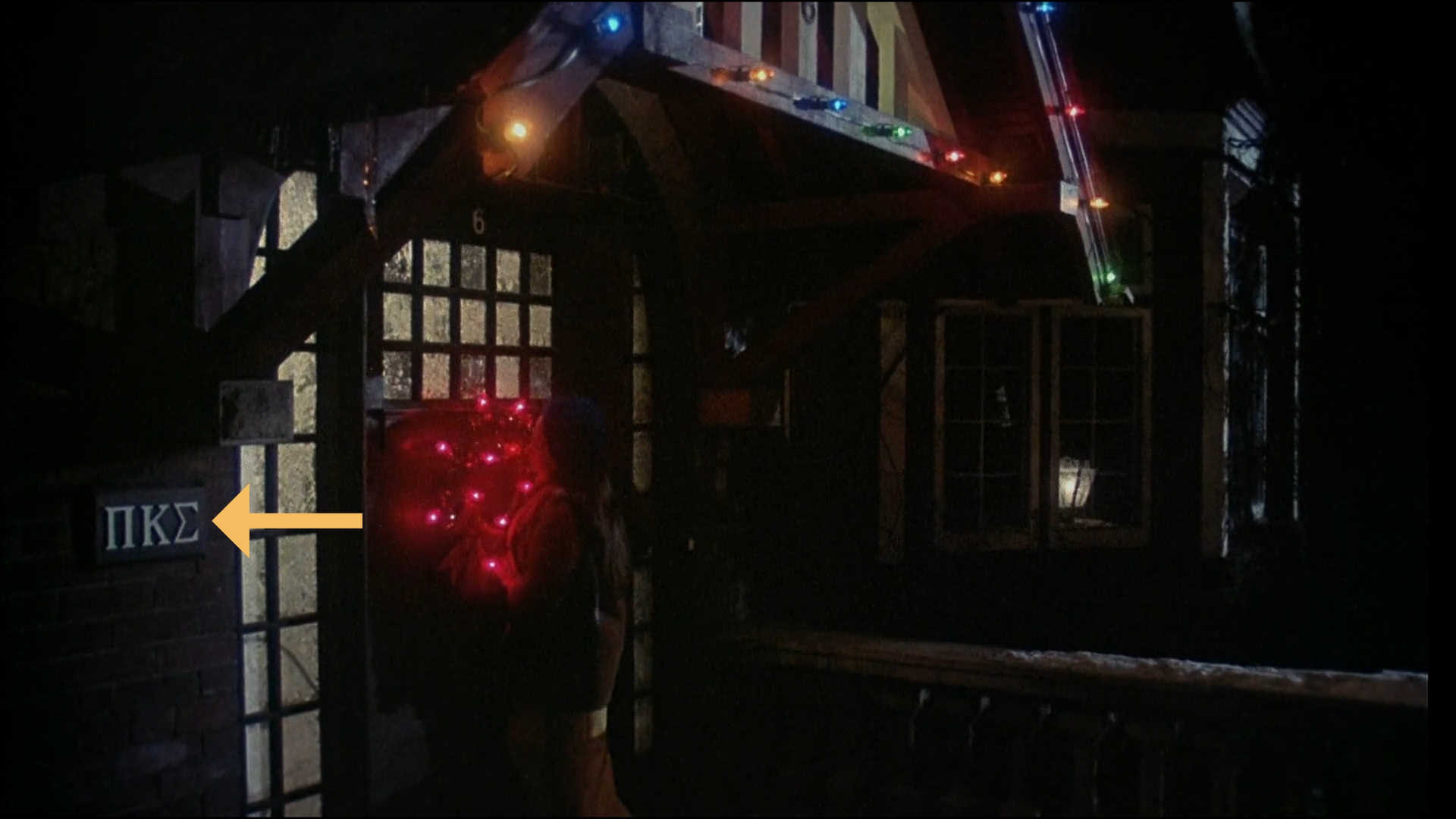
It’s Pi Kappa Sigma, which could also mean Peter Smythe, his full name. We don’t know if he’s got a middle name, or maybe I missed it somewhere. Let me know if you find it.
I hope you found this analysis useful. Let me know in the comments below.
