

Most books (or sites) on cinematography have chapters dedicated to understanding the focal length of a lens.
The first time I tried reading one such book, I had a hard time wrapping my head around the terms the authors took for granted:
“higher or lower magnification”
“wide or narrow angle of view”
“high or low optical power”
“distance from the lens to the film or sensor plane”
“focus on infinity”
“focal lengths in millimeters”
There is a scientific definition for the focal length of a lens, of course, and none of the above are invalid terms. However, I found them utterly confusing.
It took me a lot of time to “get” what a focal length is really supposed to mean.
I couldn’t afford to buy all the lenses to test on my own, and I had no access to lenses (mobile phones and DSLR/Mirrorless cameras weren’t available back when I started). It was not until my first year in college that I finally began to ‘get it’, and I did it without the help of a lens and camera!
This article is my overly simplistic understanding of the meaning of the focal length of a lens. If you’re having a tough time understanding focal lengths, like I had, continue reading.

Two boxes
We know that space is three-dimensional, just like you learned in school. Our mind believes the world works like this:

However, our eyes don’t see the world this way. It sees things like this:

When drawn on paper, this is called a perspective drawing. This is our perspective, if you will.
Notice how things recede into a point through our eyes (and any lens for that matter):

The vanishing point and horizon
The orange box in the image above is the vanishing point, because, seemingly, the world vanishes into this point. While drawing, we can have many vanishing points. In the real world, there is only one. And that’s what the camera sees as well.
The line where the ground meets the sky is the horizon. The vanishing point always lies on the horizon. This is how any lenses works, including our own.
Therefore, it is possible to represent the space any lens sees, like this:

The blue triangle is the side view. You are always at the left end, the widest end. At the other end lies ‘infinity’, which never really happens in reality (but let’s not complicate matters).
How does this help us? Let’s see.
The wide end and the far end
At the wide end, things appear “normal” to us, if we are using our eyes. If the same things were pushed further back, they would appear to get closer to each other (we know they really don’t move, but we feel they are closer).
The further we go, the more ‘crushed together’ things become:
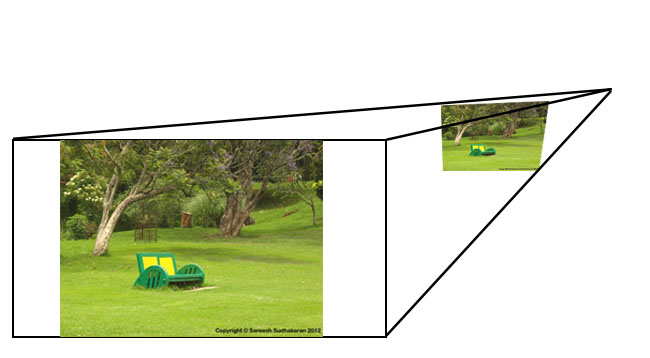
This “crushing together” makes us feel as if the objects are closer to each other. Even with the crappy example shown above, you can feel the effect. The trees and park bench appear closer together.
Go outside and form a loose fist so you can see through it. Focus on an area far away and you’ll experience two objects closer than they really are.
Let’s take an extreme example. What if we wanted to go wider than the eye can see? We know that camera lenses are not the same as the human eye. You could imagine something like this:

If the middle view is how it appears to us, and the smallest image shows how it would appear if the scene were further away, the largest image is what would happen if we walked closer to the scene.
The same palm of your hand that looks normal at arm’s length can cover your eyes completely when brought close. When you go wider than what the eye can normally see, the objects look further away from each other.
The eye can only see one way, and that is the “normal” way. To see more or less of a scene, we normally have to move backwards or forwards.
But, we can get the same effect with camera lenses, while remaining in the same place.
Wide angle lenses versus telephoto lenses
Let’s redraw our box like this (it’s black for a reason, you’ll see):

The normal point is how our eyes would see the scene. Camera lenses have the ability to go wider, i.e., bring more of the scene into the frame. They also have the ability to go further away and show less than what we can see.
Therefore, if the scene is a prism box (or more precisely a cone) that vanishes into a point, a camera focal length represents one slice of the box, and everything else after it, all the way to the vanishing point.
A wide angle lens will show a slice towards the left, and a telephoto lens shows a slice to the right.
A focal length that shows what we see is called a “normal” lens. People don’t agree what the “normal” focal length is, but here’s a cool video about it:
The triangle was in black because it is sort of an empty glass. Depending on how you wish to “fill” it, this is how you could understand the focal length of a lens:
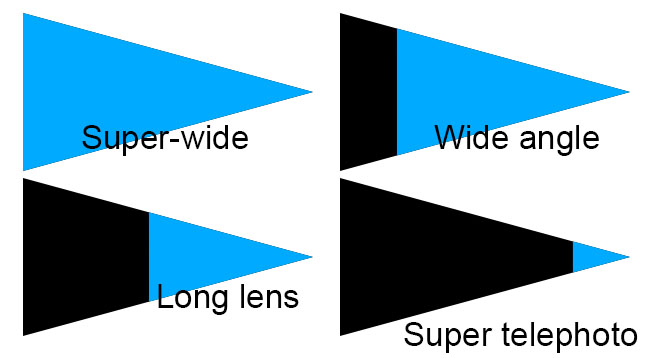
Super-wide Angle
A super-wide angle lens sees the most. Such a lens can be rectilinear or fish-eye (the latter is a distorted view). Objects at the wide end appear further away from each other than you would see with your eye.
Wide angle
A wide angle lens will see wider than what you perceive to be a normal lens. In reality, your eye can see close to 180 degrees, so it doesn’t get much wider than that!
Long lens
A long lens will show you less than what your eye can see. It’s as if you put a box or frame in the scene and you’re looking through that. The perspective remains the same, mind you. What you see in real life will be what is shown. But it will appear more compressed and closer together.
Super telephoto
A super telephoto goes much further away, sometimes farther than what you might be able to see! A telescope works like this. It will show you only a small cross section of the scene, as seen by yourself.
Note: You will never reach infinity, because it doesn’t really exist.
Depth of field
Let’s revisit the last image again:
If you want to see the foreground and background at the same time, you need depth in your lens. One way to achieve this is to stop down your lens (close your aperture).
This isn’t always practical because it needs tons of light, so the other ‘solution’ is to use a wide angle lens. A wide angle lens really does not change the depth of field.
But, a wide angle lens gives the impression of greater depth of field (DOF), while a telephoto lens does not.
We’re just suckers for it!
If you use my box analogy, the more blue you have, the greater the DOF, and the less blue you have, the lesser the DOF.
The idea of perspective
Look at this image:

What’s the difference between what the two people see?
Location.
They are physically located in a different place, and therefore, we say they have two different perspectives.
I had trouble remembering if, whether a perspective change happens with a change in focal length. The answer is quite simple: Any time you physically change the location of the camera, you are changing the perspective.
Remember:
- Changing the focal length does not change perspective. It’s just a different slice of the same perspective.
- Changing the location of the camera changes perspective.
A change of perspective can also happen if you move a camera towards or away from an object along a straight line.
If one has never filmed with a lens or camera, one could argue that this is the same as changing the focal length. This argument can be easily refuted if you actually use tried filming it. Moving the position of the camera always changes the perspective.
By moving closer or further away from an object, you are also changing the object’s relationship (your viewpoint, not in reality) with other objects in the scene. This does not happen with a focal length change. It only happens with a change in location.
We saw earlier that each focal length is a slice of the box:

The angle from the back (the infinity point) to each slice doesn’t change at all. That’s perspective. The moment you move, everything changes.
Angle of view
Look at the last image from your viewpoint (or the camera’s viewpoint):
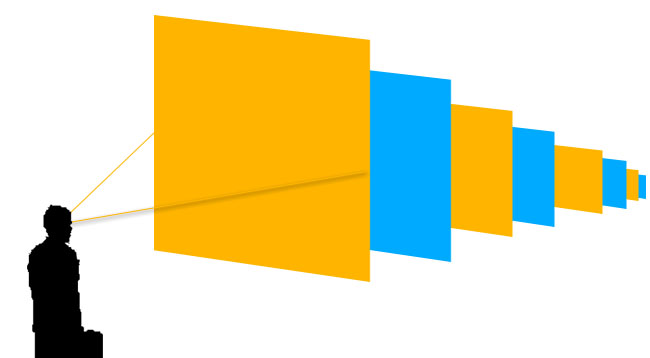
Because you’re only getting a slice from the total possible view, the angle of view for each focal length is different. When you choose a focal length, you are also choosing a suitable angle of view for your scene.
Choosing a lens is part necessity and part art. In this article, I go into great detail about spaces and how that affects your choice of focal length.
It’s not just the focal length. The size of the camera sensor also determines to some extent what the angle of view is.
Remember the complex terminology I wrote out at the beginning? Now let’s tackle that with what we have learned so far:
- “higher or lower magnification” – means a different slice of the box.
- “wide or narrow angle of view” – means a different slice of the box.
- “high or low optical power” – means a different slice of the box.
- “distance from the lens to the film or sensor plane” – the technical definition of focal length.
- “focus on infinity” – the infinity point.
- “focal lengths in millimeters” – focal lengths are written in millimeters (they used to be also written in cm and inches).
Not so hard anymore!
The art of choosing focal lengths
All said and done, lenses are simply tools that you use to tell a story. Just because a focal length is written in millimeters doesn’t mean you need a math and science degree. They could be called anything, who cares?
Enough theory. Let’s see how lenses affect your ‘box’ (scene).
Super-wide and Fish-eye lenses
These lenses tend to distort the image simply due to the nature of optics. A special case of such lenses is the fish-eye lens (Amazon, B&H):

These lenses are used when large expanses have to be covered (large buildings, landscapes, planets, etc.) or if you want the ‘fish-eye’ effect. Either way, you need a solid reason for using them, and their use in cinema and video is rare.
Wide angle
The wide angle lens (Amazon, B&H) makes things in the scene feel further apart:

The easiest way to know if a shot is a wide angle is to compare the foreground and background. In the above still from Touch of Evil, the foreground character is framed normally, but the background character appears smaller than normal. This gives the feeling of greater depth and distance between the two.
Wide angle lenses tend to distort objects as well, and sometimes this is used in the case of close-ups. Obviously, a person’s face distorted is rarely flattering!
Since wide angle lenses cover more of the scene, they are used for long shots, masters, mid shots and so on. Also note the greater ‘depth of field’.
Normal lens
A normal lens (Amazon, B&H) is somewhere in the region of 30mm to 50mm (35mm full frame equivalent). It gives a similar view (how objects are arranged according to our eyes) to the human eye:
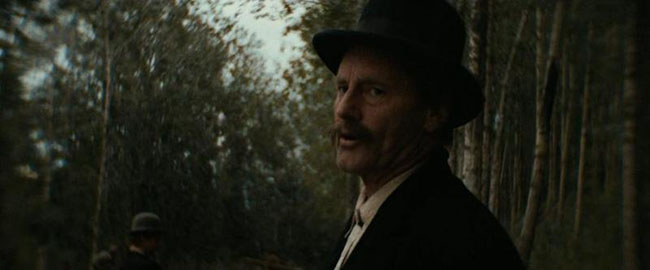
This is probably the most used focal length range in the cinema world, because it covers more scenarios than other lenses – both practical and aesthetic.
Portrait or short telephoto (85mm to 100mm)
A portrait or telephoto lens (Amazon, B&H) is somewhere in the 85mm range (full frame equivalent):

You can see (from Tokyo Story) that this is no longer a ‘normal’ view, as objects are beginning to get compressed and closer to each other. But, it’s still not off by much.
Notice how the depth of field is reduced considerably under normal lighting conditions. To get more depth, Ozu would have had to completely stop down the lens.
Telephoto lenses
Anything above 85mm is a telephoto lens. A telephoto lens (Amazon, B&H) compresses space:

In this shot from Red Beard are no longer seeing a wide scene, but only a small slice of the box.
Everything and everyone appears close to each other, and their relationships take on a different meaning. Characters “share the same fate”, if you will. Compare it to the wide angle shot shown earlier.
Also notice how there’s no shallow DOF here like the image prior. The aperture was stopped down and bucket loads of light was used, hence the greater depth of field.
There you have it!
I hope I have given you enough ideas so you can get started thinking about lenses. My goal with this article was to help you understand what the focal length of a lens means, in practical terms. It’s not always about the numbers.
What next? After a certain point, you will need to stop reading and start practicing with some real lenses. Let the art begin!

Sir: For me this article is the best I can get. Thanks for sharing with me
this is good article for beginners
thank you for article it is useful