
Ikiru, released in 1952, was directed by Akira Kurosawa.
Editor Kôichi Iwashita was working with Kurosawa for the first time. They worked again on Kurosawa’s next project, Seven Samurai, his most acclaimed film.
The pacing of Ikiru
What makes Ikiru interesting even today is the pace of the film. It’s a straightforward narrative.
Kanji Watanabe (portrayed by Takashi Shimura) is diagnosed with stomach cancer and has a limited time left on earth. He realizes that he hasn’t actually lived or enjoyed his life for the last thirty years. The fact that he couldn’t find anything memorable from all these years makes him want to live the rest of his days with purpose.
The editing of Ikiru is a masterclass in film editing technique, as it combines a myriad of forms – creative transitions, cuts, dissolves and so on. It’s instructive to understand how and why Kurosawa used a certain technique in one place, but not in others.
I felt every cut and transition in the film, in addition to taking us to the next part of the plot, also adds meaning to each scene and is cinematically engaging.
There is a mastery of pacing in Ikiru that is hard to put into words, so let’s get to the specifics.
1. Cross-dissolves to stress relationships
Ikiru opens with a cancer-infected stomach X-ray and the patient Kanji Watanabe emerges out of it in a cross-dissolve.
A voice over narrates Watanabe’s ignorance of his disease. Here are the shots in sequence:
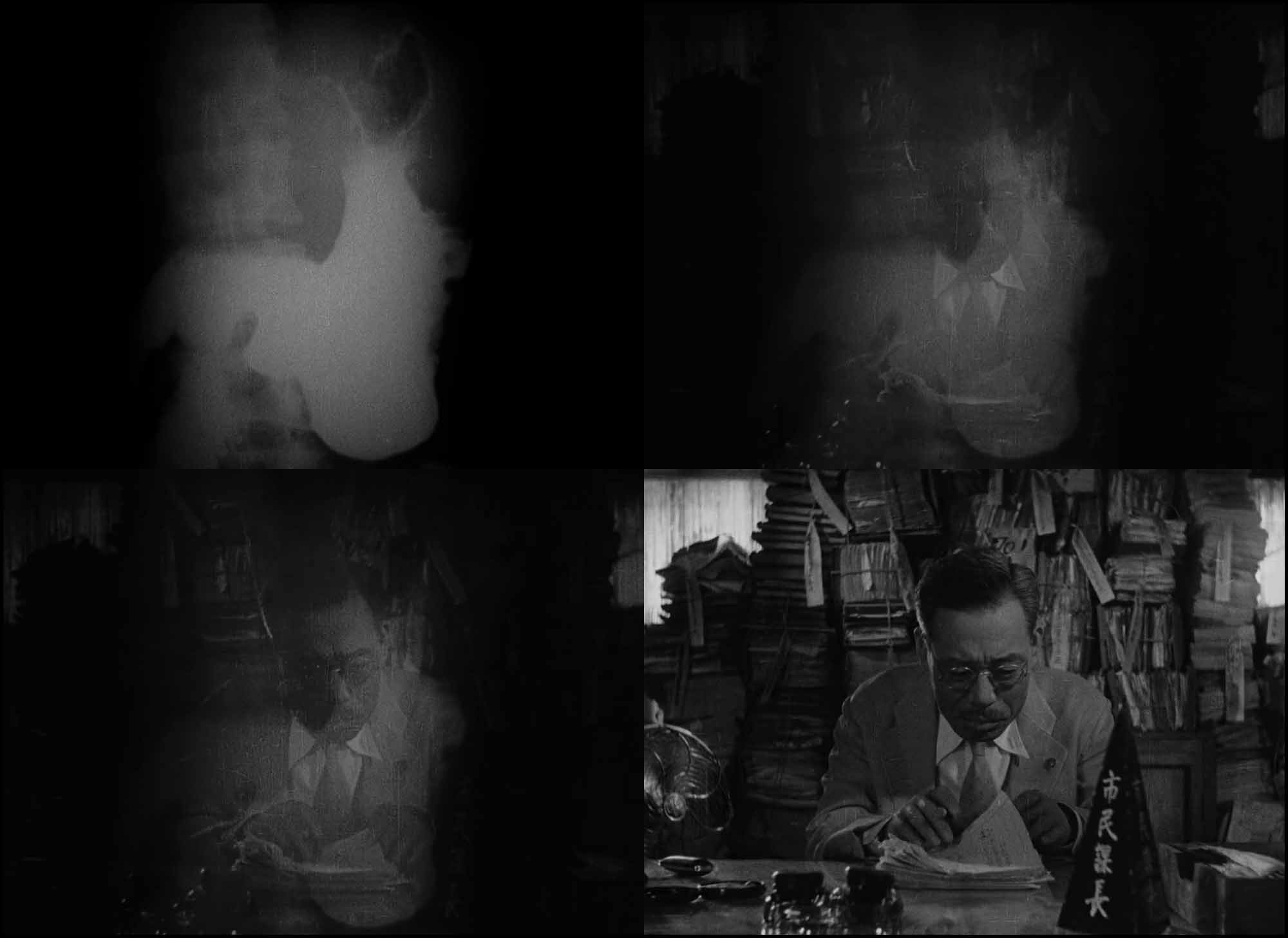
Instead of a cut, Kurosawa used a dissolve. You can visualize a cut by just looking at the first and fourth images and ignoring the transition in between. The difference is striking.
With a dissolve, Kurosawa stresses on the relationship between the two images. There’s no doubt the X-Ray is Watanabe’s, and the voice over underlines it as well. A cut would have delivered a different message.
Cross dissolves are used in many places in Ikiru. Every cross dissolve is relatable and meaningful, both visually and emotionally.
Here’s another example with a similar meaning:

Watanabe looking at his wife’s photo takes him back to the day of her funeral, in a cross-dissolve. The connection is stressed with the dissolve. It wouldn’t have been the same with a cut.
2. Axial cuts for cinematic storytelling
An axial cut is a cut between two shots in which the camera angle and position doesn’t change. To know more, check this out:
One of the examples I’ve given in it is this one:

The hat gets special mention with the axial cut to highlight the beginning of a new day in the rest of Watanabe’s life.
A mundane little object takes on an importance well beyond its price, because the little things are priceless in his life now. It’s what he’s living for.
3. Wipes to connect the discontinuity
Akira Kurosawa uses wipes in most of his films. He’s the first name you’d think of when imagining a film wipe.
Here’s an example:
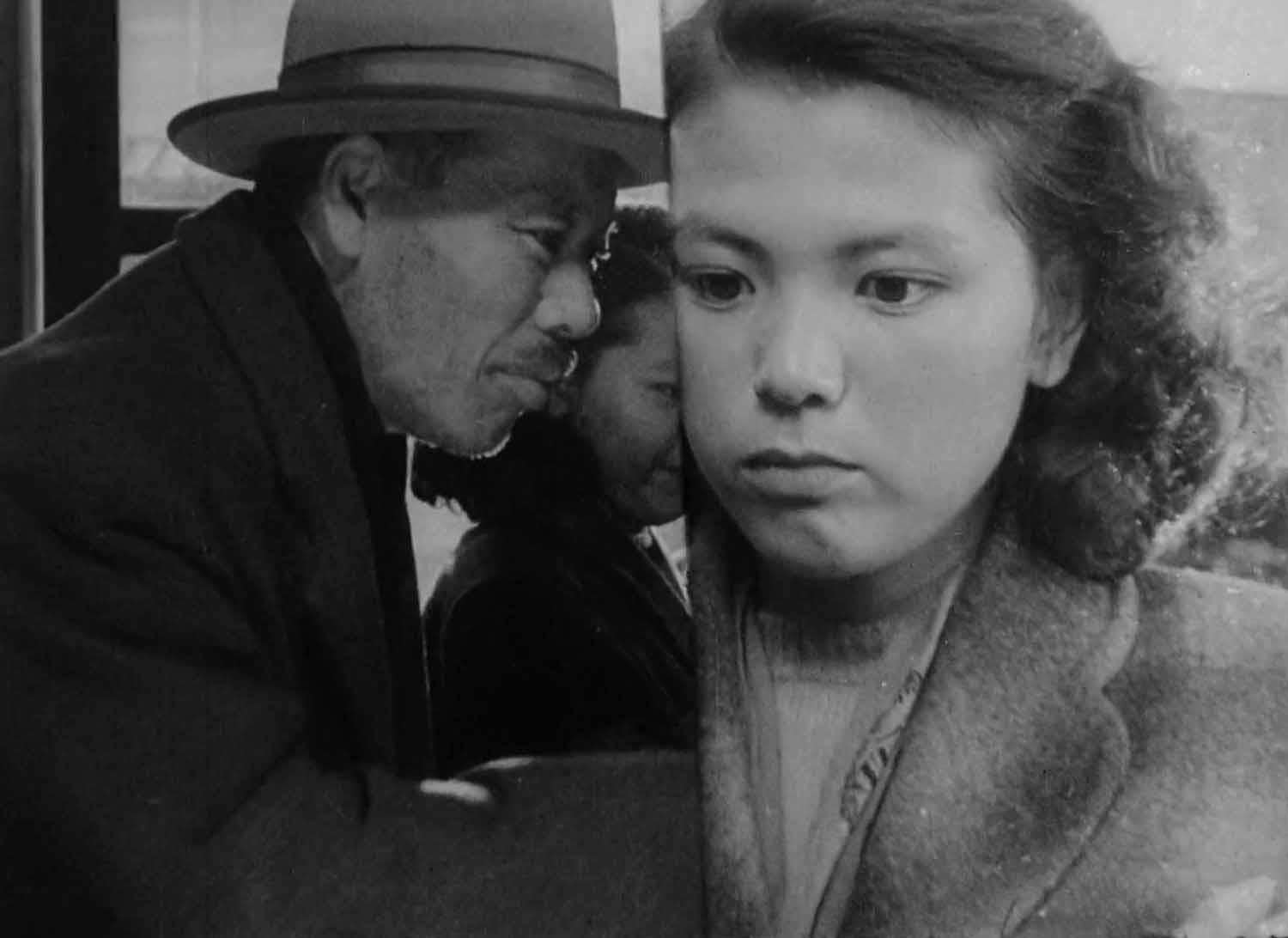
In Ikiru he uses wipes like a bridge between two shots when there is no continuity between them; like in this shot where the wipe travels along with the van:

The wipe makes the transition more logical and interesting. A cut would feel unmotivated, not leading into the next.
A wipe establishes some relationship between the outgoing and incoming shots, but of a different kind to a dissolve. It’s a more unemotional transition.
Here’s a great example of a wipe montage very early in the film:
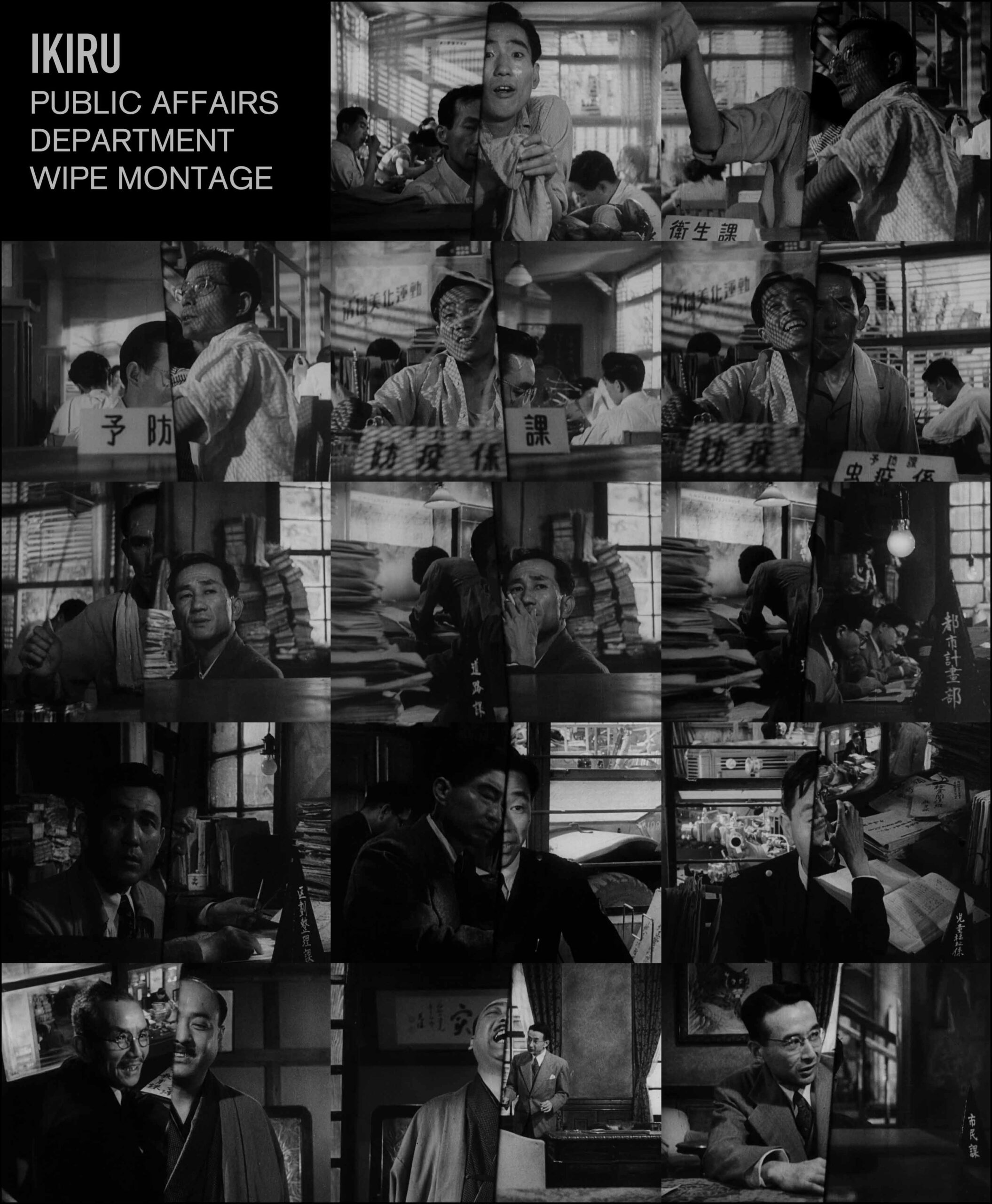
Villagers visit various department officials to fix the sewage issue in their locality. Each official is impersonal, shirking responsibility, and shameless.
Kurosawa wants us to study them objectively, without emotional strings attached. In this context he uses wipes to denote the passage of time, and dissolves are a lot more personal.
4. Crossing the line
The traditional way to edit action is to either cut before, during or after the action, to maintain continuity.
In this example, Kurosawa uses the cut before the action, to give it a sense of alarm:

The action appears more violent than it has to be. Kurosawa is clearly not trying to hide the cut for continuity’s sake.
However, the cut also crosses the axis to the other side in the cut, and this adds to a sense of alarm. The cut comes as a shock.
There’s a reason for this.
In this next shot, the exact kind of cut is used, but it alarms us in a different way:
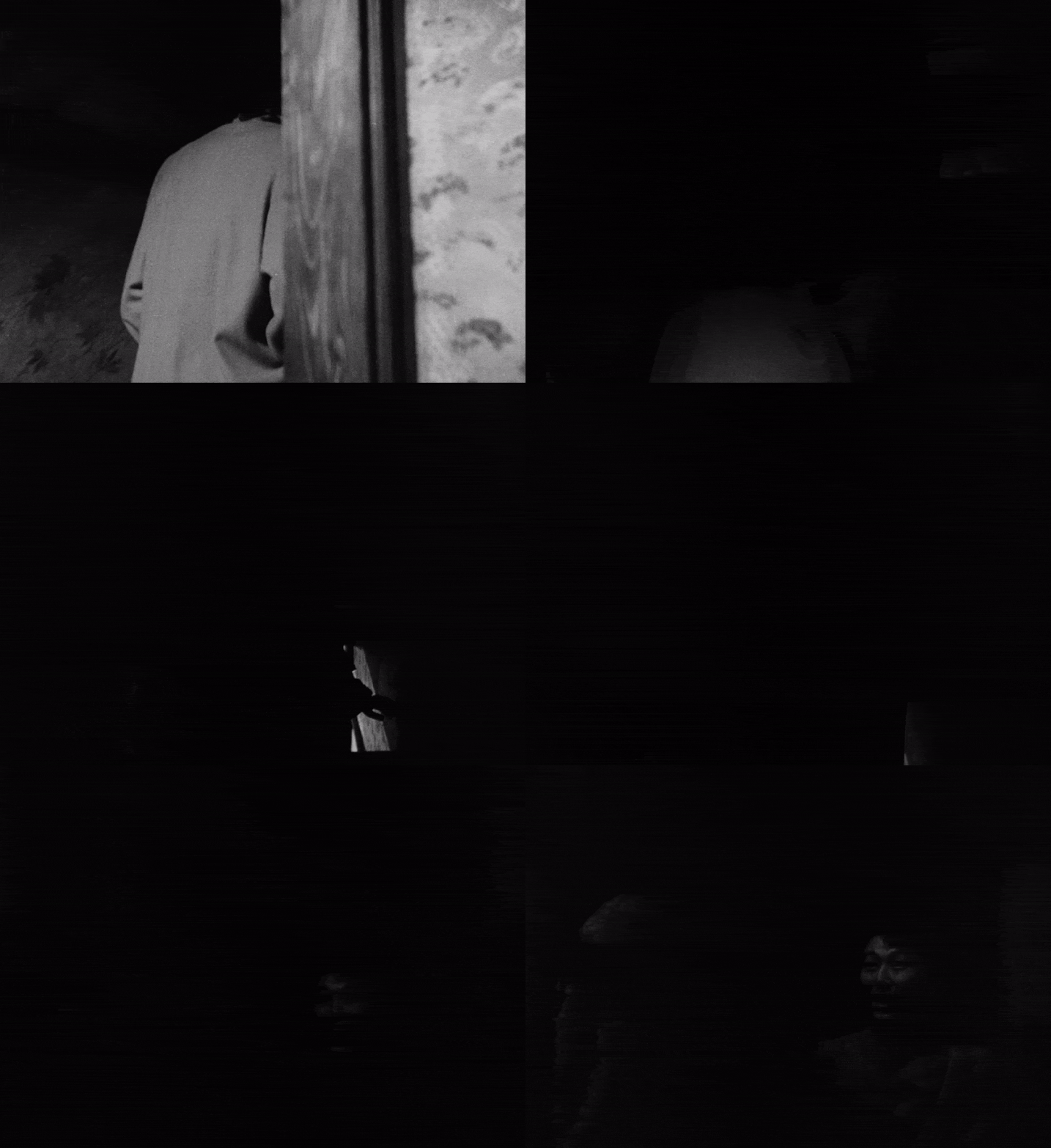
Here the second cut is undetectable, and the wife appears from the opposite direction unexpectedly. Obviously, Kurosawa is using his supreme directorial and editorial skills to toy with us.
The edits also work in context to the dialogue, because the wife says: “I hate Japanese houses”.
The house is something they can’t understand or appreciate, and their impatience with it is manifested in the cut.
Ikiru tells us a simple, straightforward story. But, with Kurosawa, nothing is as simple as it seems.
The editing techniques used in Ikiru makes the film more interesting and meaningful. In the the last hour of the film we watch from Watanabe’s colleagues’ point of view to Watanabe doing his job.
Everything was planned before the film was shot, and Kurosawa is one the rare directors who planned his edits carefully.
I hope this brief article gives you an insight into his editing skills. I would love to know what your thoughts are in the comments below.

very useful as Kurosawa uses transitions with associative context