

On paper the Panasonic S1II (Amazon, B&H) seems like an exciting video camera, probably a worthy upgrade.
In this article let’s look at a few important quirks and video features of the S1II for cinematography – the kind of things you need to know before you dive in.

The New Sensor
The Panasonic S1II (Amazon, B&H) is a full frame camera with a 35.8 x 23.8 mm with a new partially stacked CMOS sensor for high-speed readout.
This means, on paper, the rolling shutter performance should be good. Rolling shutter jello or jitter is one of the banes of mirrorless cameras. You need this because, the faster the readout, the less the rolling shutter artifacts you get, and the more filmic the motion when you pan or tilt the camera.
Out of all the features, this is probably the most important. It’s also what differentiates the S1II from the cheaper Panasonic S1IIE (Amazon, B&H).
If you’re finding it hard to decide between the S1II and S1IIE, pick the former.
Internal RAW Recording
The Panasonic S1II (Amazon, B&H) can record internally in Apple ProRes RAW and RAW HQ, in these modes:
| Resolution for Internal RAW Recording | Max. Frame Rates | Crop Factor** |
|---|---|---|
| 5888 x 3312 | Up to 30 fps | 1.02 |
| 4K* | Up to 60 fps | 1.45 |
**This is just an estimated crop factor based on the resolution provided.
You can only record RAW internal video to a CFexpress B card.
Video Recording Modes
This is what you get:
| Resolution | Max. Frame Rates | Best Codec and Color |
|---|---|---|
| 5952 x 3968 | Up to 30 fps | Long GOP 10-bit 4:2:0 |
| 5952 x 3348 16:9 Aspect Ratio | Up to 60 fps | Long GOP 10-bit 4:2:0 |
| 5.1K* 3:2 Aspect Ratio | Up to 60 fps | Long GOP 10-bit 4:2:0 |
| 4800 x 3600 4:3 Aspect Ratio | Up to 60 fps | Long GOP 10-bit 4:2:0 |
| 4096 x 2160 | Up to 120 fps | ALL-I 10-bit 4:2:2 |
| 3840 x 2160 | Up to 120 fps | ALL-I 10-bit 4:2:2 |
| 1920 x 1080 | Up to 240 fps | ALL-I 10-bit 4:2:2 |
There are crop factors to take into consideration with these modes:
- For C4K at up to 120p/100p: Approx. 1.17x
- For 4K at up to 120p/100p: Approx. 1.24x,
- For 1080p at up to 240p: Approx. 1.21x
- For APS-C 3.3K at up to 120p: Approx. 1.06x
- For APS-C 1080p 121-150 fps: Approx. 1.14x
- For APS-C 1080p 150+ fps: Approx. 1.44x
You also have proxy recording modes. Here are all the modes:
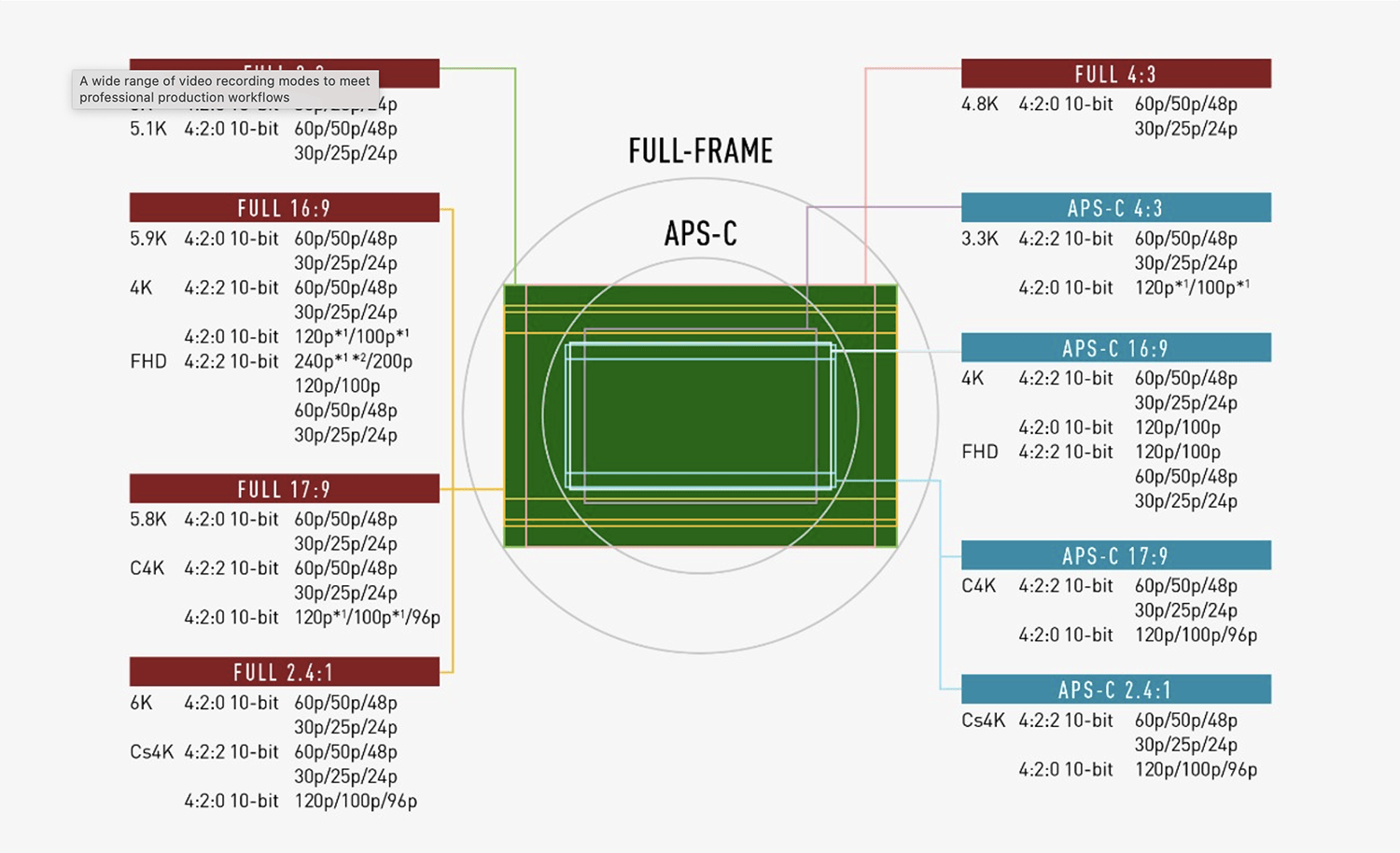
The ISO range for Video is 100 to 12800.
Recording Limit and Overheating
Panasonic does warn us that the camera will overheat and stop recording in some modes.
The only mode you have unlimited recording in is 4K at up to 30 fps. Expect limits for everything else.
Dynamic Range and Log Profiles
The Panasonic S1II (Amazon, B&H) has a native dynamic range of about 14+ stops, but you get up to 15 stops with Dynamic Range Boost.
However, the image quality and ISO sensitivity are restricted and there will be an increase in rolling shutter artifacts in Dynamic Range Boost.
Natively, the best format you can record in is V-Log/V-Gamut:
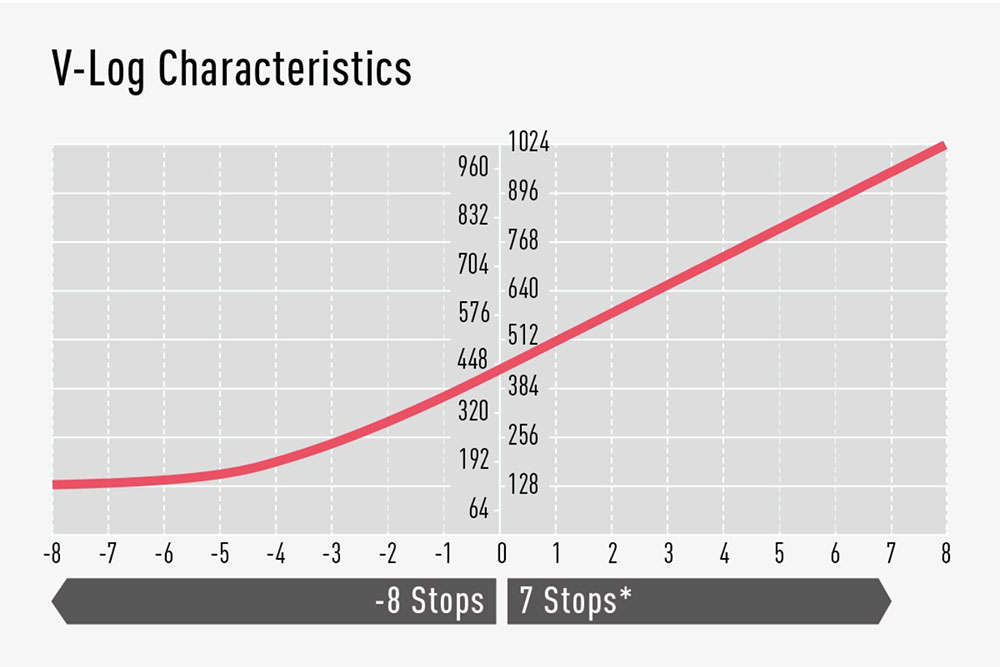
You get 8 stops under middle grey and 7 stops over.
You also have the option to use ARRI LogC3, certified by ARRI, but there are some caveats:
- It is a future firmware update, sometime in 2025, but is a $200 paid update via the DMW-SFU3A key.
- There is no support for ARRI LogC4, which is the newer log profile for new cameras.
- You can only use it in 10-bit recording modes.

External RAW Output
You can record RAW in up to 6K 30 fps (6000 x 4000 3:2 Open Gate) via a Type-A HDMI port.
Supported External recorders:
- ProRes RAW: NINJA V (No 6K) , NINJA V+, NINJA, NINJA ULTRA, SHOGUN CONNECT, SHOGUN (No 6K), SHOGUN ULTRA
- BRAW: Blackmagic Video Assist 12G HDR
When recording external RAW, you need a LUT to view the footage, and a LUT designed for this is available here.

Ergonomics
The Panasonic S1II (Amazon, B&H) is smaller and lighter than the original S1. It is dust, splash, and freeze-resistant down to -10°C or 14°F.
It has a 3″ tilting rear touchscreen and an EVF.
The best new exposure tool you have is the false color tool.
You get 10 frame markers now and with a future firmware update it will increase to 17 and enable simultaneous display of up to three frame markers at the same time.
Media Cards
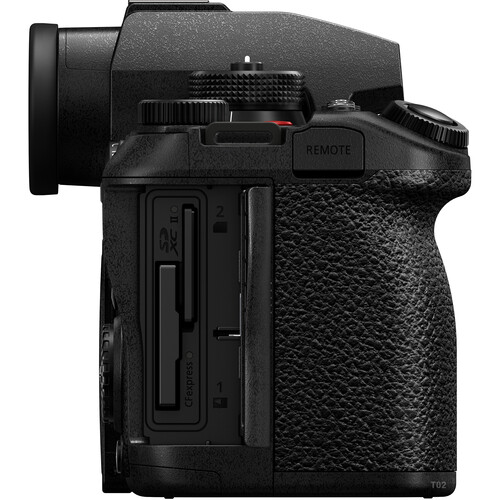
There are two card slots:
- CFExpress Type B
- SD Card slot.
You can write to both cards as a backup, or setup relay recording. However, RAW can only be recorded to CFExpress Type B.
In addition, you can also record to an external SSD via USB-C (up to 2TB).
Autofocus and Image Stabilization
The S1II has Phase Hybrid AF and Advanced AI technology to help focus on eyes and faces even when they’re tilted or partially obscured. I’ll need to test this to see how well it performs against Sony or Canon cameras.
The camera has 8-stop 5-axis image stabilization. With digital IS, you also get a “cropless mode” for wide-angle shots.
Timecode
The Panasonic S1II (Amazon, B&H) supports timecode synchronization via Bluetooth.
You need a Bluetooth-enabled timecode generator like the Atomos AtomX UltraSync Blue to synchronize the video timecodes.

What do I think?
As per some reports, the Panasonic S1II (Amazon, B&H) is NOT an upgrade to the S1H, which leaves me scratching my head.
It does seem like a capable camera, if the following conditions are met:
- Dynamic range in RAW recording is great (at least better than the S1H).
- Autofocus is great.
- Rolling shutter artifacts are minimal.
- Low light ability is decent (there is very less information about this at the moment).
If the camera cannot live up to expectations on these three fronts, I don’t see how it will thrive over established Sony and Canon mirrorless cameras.
However, for regular Panasonic shooters, it seems like a great camera.
What do you think?
