
Topics Covered:
- Wave-particle duality
- Heisenberg’s uncertainty principle
- Wave function
- Function vs Equation
God does not play dice!
Einstein
Einstein, stop telling God what to do!
Niels Bohr
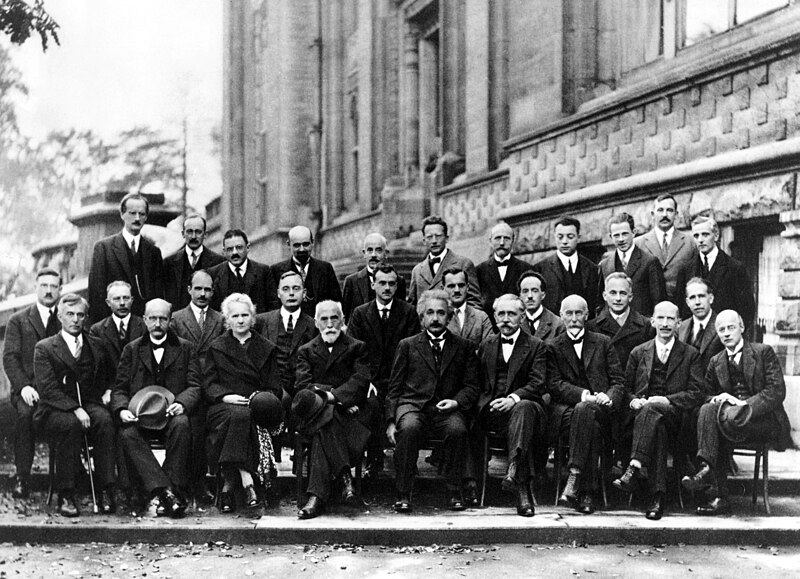
If you feel you have a solid footing on all things science, you feel exactly like every other scientist did before the terrifying prospects of quantum physics was thrust upon them.
Before the discovery of quantum physics, everybody was confident science would continue to slowly and steadily uncover the truths of the universe. Imagine a lioness waiting patiently to spring on a deer, only to be rudely shocked when the deer turns and pounces on her!
This is exactly what happened in 1927.
In the article on waves, you might have noticed that I considered a house as a wave. Surely you found that statement odd? Was that a typo? Nope. This is where science will knock your socks off. Actually, it knocked its own socks off, too.
Ever heard the saying: “Reality is stranger than fiction?” Well, this is its best example, period.
Let’s focus on two of the surprises, one happy, the other, terrifying:
1. Wave-Particle duality
We are quite smug in our assumption that matter is matter, and waves are waves. But the truth is far more bizarre.
All particles exhibit wave-like behavior, and all waves exhibit particle-like behavior.
Did you notice my use of the word ‘behavior’?
Let’s talk about electrons – our scary but loyal friends. It all began with them anyway. Scientists used to think electricity was fluid. One can’t blame them really, after all, electricity “flows” through wires and other conductors. You can’t blame a scientist for being a poet – or being a slave to language.
In 1897 a scientist named J. J. Thomson found that an electric charge could travel through vacuum.
On top of that great scientists like Faraday and Maxwell (the Mozart and Beethoven of electrical science) already knew that electricity and magnetism are actually two sides of the same coin – a changing electric field always produces a corresponding magnetic field, and vice versa (this is the core principle behind electrical engines and motors).
This is today called electromagnetism – hence the term electromagnetic waves. Like two split personalities, except these happen at the same time!
How is it possible that electrons are both particles and waves at the same time?

Answer: We don’t really know why. All we know is that matter – photons, sound, electrons, footballs, cars, houses, galaxies, or even you and me – exhibit both wave and particle behavior.
When the particles are extremely small, the wave characteristics dominate – as in the case of electrons and photons, etc. When the particles are large, like houses or planets, the particle (matter) behavior is more prominent. But we all have wavelengths. It’s another kind of DNA.
So, do buildings oscillate? They do, but on a scale we don’t experience. Just because a dog whistle is silent to us does not mean it isn’t producing any sound waves.
The guy who put all this in writing was Louis-Victor de Broglie, in 1924, and his words are called the de Broglie hypothesis.
So why is this important for our purposes? Well, it tells us that for smaller particles, we are better off studying and analyzing them as waves. So instead of thinking of electrons, photons and pixels as matter (which common sense ambiguously tells us is the case), we are better off thinking of them as waves.
Well, this was the ‘happy’ surprise. Now for the terrifying one.
2. The Uncertainty Principle
The Uncertainty Principle, introduced by Werner Heisenberg in 1925-7, simply states in layman’s terms, that two ‘pairs of properties’ of a particle, like position and momentum (which means velocity indirectly), cannot both be known with precision at the same time.
If we measure the position of the particle accurately, then we can’t measure the velocity accurately, and vice versa. If we pick one, the other is forever away from our grasp.
WTPh?
Is this a problem with our measurement gear, or us? No, unfortunately, it is a fundamental rule of our universe.
Here’s how it works: To observe a particle and understand it, we have to measure some of its properties. The two most basic properties of anything are position in space and velocity. If we don’t know where a particle is and how fast (and in what direction) it is moving, what hope do we have of knowing anything else about it?
But here’s the problem: To measure a particle one has to “interact” with it. To know if your loved one is angry or upset, you might have to give him or her (or it) a nudge. In particle physics, you always have to nudge the particle to know what it is doing.
Imagine an electron happily floating in space. Some dude wants to know its precise location and velocity. To see it, he has to shine light on the particle. Light is made up of photons, so he fires one photon at the electron. The photon hits the electron, and is deflected. By studying this deflection, our dude finds the position.
But… the impact has changed the trajectory of the electron. This is not the case of an elephant going toe to toe with a mouse, but more of what happens when a bike smashes into a bus. The velocity of the electron has changed.
The question to ask is: how can this dude now measure the original velocity of the electron? He has already changed it with his first photon.
Oops.
He realizes:
One simply cannot measure a particle without altering it in some way. And it’s not because we have faulty equipment or brains. That’s how nature is.
By the way, we are wrong if we substitute the word ‘anything’ for ‘particle’ in the above sentence. The Heisenberg Uncertainty Principle only applies to subatomic particles. If it does happen to us at all, we are not in a position to measure it, since the values of change are too small.
So beware of folks who use and extrapolate the Uncertainty Principle to explain politics, cameras or roast turkeys. They don’t understand it.
So why did I call the Uncertainty principle “terrifying”? For one, it caused a great scientist like Einstein to make his famous quote on god and dice. Einstein (and a lot of other eminent scientists) tried very hard to discredit the Uncertainty principle, but didn’t succeed.
Today, we know it can’t be discredited because it has never failed in scientific experiments. It’s just true.
What the uncertainty principle did give us is a very grudging respect for probability. That’s what Einstein meant when he used the word ‘dice’.
Why? Due to the uncertainty principle, we no longer rely on exact values of a particular property. E.g., you might recall this simple diagram of the atom from high school:

Well, this is what it really looks like:

Nowadays, physicians are happy if they know the probability of finding a particle’s position or velocity at any given time. Instead of exact and precise values, we are now humbled into accepting probable values. And there’s no escaping it.
In the above diagram, we hunt for the probability of finding an electron somewhere in a region, but to this day nobody has ever seen an electron whole. We don’t know what it looks like, or its shape.
Enough of that. You probably want to know what this has got to do with us.
Remember I said if we have the values of different properties of a wave, we can map them to gain a better understanding? What if we had to map them, but all we had were probable values, instead of fixed values?
Can mathematics handle this craziness? Sure it can. In terms of weirdness, mathematics has kept step with science.
The mathematical representation of a wave is called its wave function. This is what we get when we mash up wave theory, the wave-particle duality and the uncertainty principle, among others.
What’s the difference between a function and an equation?
If 2+2 = 4 is an equation (it needs the equals sign), then 2+2 is the function.
As you may have noticed, a function needs at least one operator (in this case, the plus sign). Here’s the same thing in another form: a+b = c. In this case, a, b and c are all variables – they can have values that can change. a+b is a function with two variables: a and b.
Simple, right? Think you’re ready to be hit with the wave function?
Here you go:

This is an example of the Schrödinger wave equation. This is where we must stop, or else commit to a lifetime of studying particle physics and mathematics. Suffice to say that a wave function gives us a handle on most waves. With it, we can study, predict and use them for our purposes.
By the way, every scientist mentioned in this article is present in the photograph above. It is priceless.
Takeaways:
- All things exhibit both particle-like and wave-like behavior.
- It is impossible to exactly know both the position and velocity (among other ‘pair properties’) of a particle at the same time. At best, we can make probable guesses.
- The mathematical equivalent of a wave is the wave function.
Links for further study:
