

The Sony FE PZ 28-135mm f/4 G OSS (Amazon, B&H) is primarily a photography lens, though it will be used for video.
In this article let’s take a comprehensive look at the important features and specifications of the Sony FE PZ 28-135mm f/4 G OSS and see how good it will perform specifically for video, cinematography and filmmaking.
The aim of this article is to provide you with enough information and perspective so you can decide for yourself whether this lens is right for your film or video.
Important: This article is a comprehensive overview of the lens with available information; and an analysis based on our experience shooting for almost two decades. It is not a hands-on review. If and when we get hold of the lens we’ll be sure to publish a detailed review. If this is not your cup of tea you can stop reading.
Click to what you want quickly:
- TLDR;
- Features:
- Control:
- Basics:
- Alternatives to the Sony FE PZ 28-135mm f/4 G OSS

TLDR;
What you need to know for video work about the Sony FE PZ 28-135mm f/4 G OSS (Amazon, B&H):
- The Sony FE PZ 28-135mm f/4 G OSS is a great general purpose video zoom lens.
- This could be the most preferred all rounder lens for filmmaking.
- The f/4 aperture is good enough for low light work, especially when pairing it with Sony’s imaging sensors.
- It’s small and lightweight, considering its zoom range.
- It is a Parfocal lens.
- Sony claims to have designed this lens specifically for moviemaking.
- Has two different zoom systems, i.e. Power Zoom and Manual Zoom.
- The focus ring on the lens switches from AF to AF assist to Full MF.
- The only zoom lens with a dedicated iris ring by Sony for the e-mount.
- 9 circular blade aperture.
- Customizable button on the lens body.
- The lens does have image stabilization with Optical Steady Shot.
- Sony claims that their motors work together with Eye AF to provide precise and quick autofocus for video. This also supports contrast AF and Phase Detection AF.
- It exhibits breathing.
Can be great for all types of filmmaking. Exceptions are when you. need wider coverage, greater telephoto reach, or super shallow DOF.
Features

Coverage
The Sony FE PZ 28-135mm f/4 G OSS (Amazon, B&H) is a full frame lens. It is designed to completely cover a sensor the size of 36mm x 24mm.
If you are considering this lens for an APS-C sensor or other cinema camera, check out this article:
Focal Length
The minimum focal length is 28mm. This is considered wide on a full frame 35mm sensor.
The maximum focal length is 135mm. This is considered telephoto on a full frame 35mm sensor.
Not that wide and not that telephoto, at the very best it is a general purpose lens.
Aperture
The constant maximum aperture is f/4 and the constant minimum aperture is f/22.
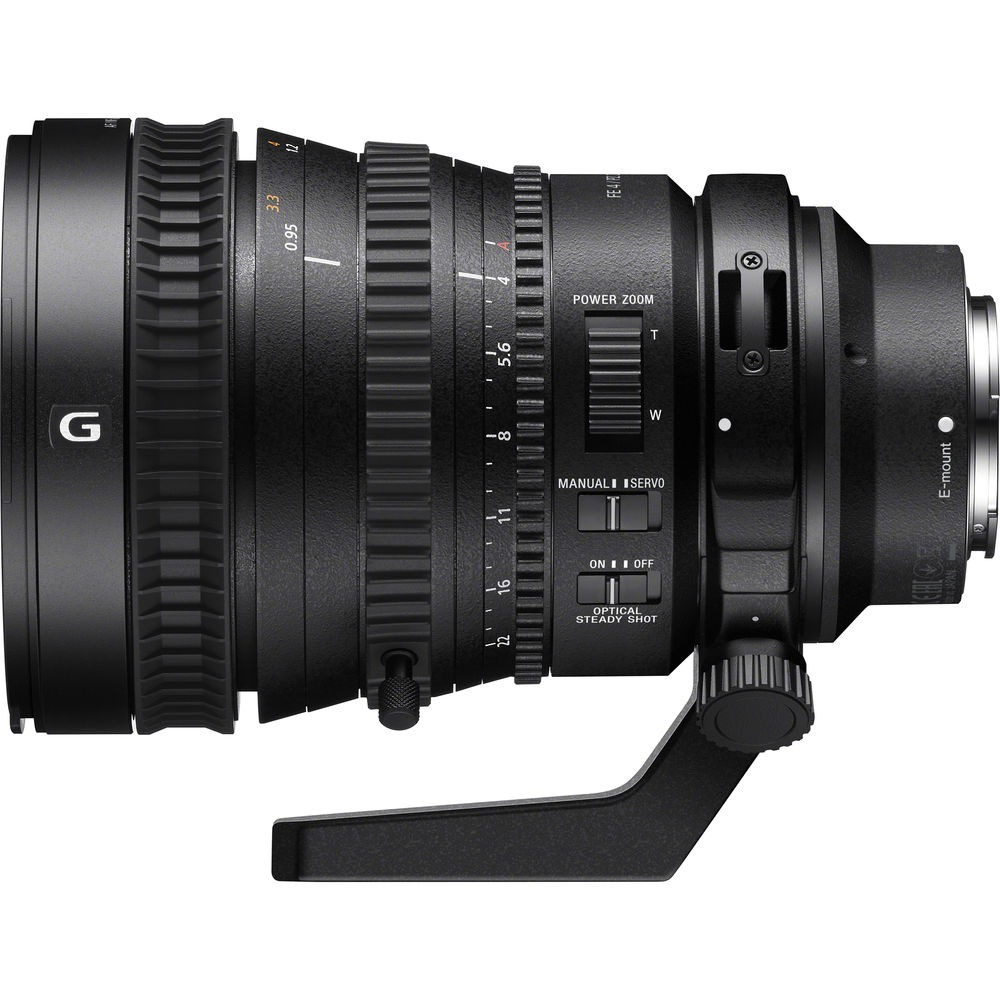
This is the only zoom lens for e-mount which has a dedicated de-clicked aperture ring on the lens body, making it viable for videography.
Having f/4 is enough for low light. Especially when you pair this with Sony and their sensor’s ISO capacity.
The one thing that seems odd to me is the fact that this lens, claiming to be a cine lens, is measured in f-stops and not in T-stops.

The Sony FE PZ 28-135mm f/4 G OSS (Amazon, B&H) has 9 circular diaphragm blades. One expects a smooth bokeh, but it’s not always a given.
To know more about bokeh:
Resolution
From Sony’s official MTF charts:

At 28mm, the Sony FE PZ 28-135mm f/4 G OSS (Amazon, B&H) is sharp enough in the center and has a slight falloff towards the end.
Whereas, at 135mm, the Sony FE PZ 28-135mm f/4 G OSS is sharper than at 28mm but has a much steeper falloff than at 28mm.
Overall, the image quality is somewhat consistent to be intercut with.
With the variance in the Sagittal and Tangential lines, you can infer (somewhat) that the bokeh won’t be proportionally smooth as the best prime lenses on the planet.
If you are curious and want to read the MTF chart for yourself. Here’s a guide on how to read them easily.
Close Focus
The closest focusing distance of the PZ 28-135mm f/4 G OSS (Amazon, B&H) varies depending on the focal length the lens is at.
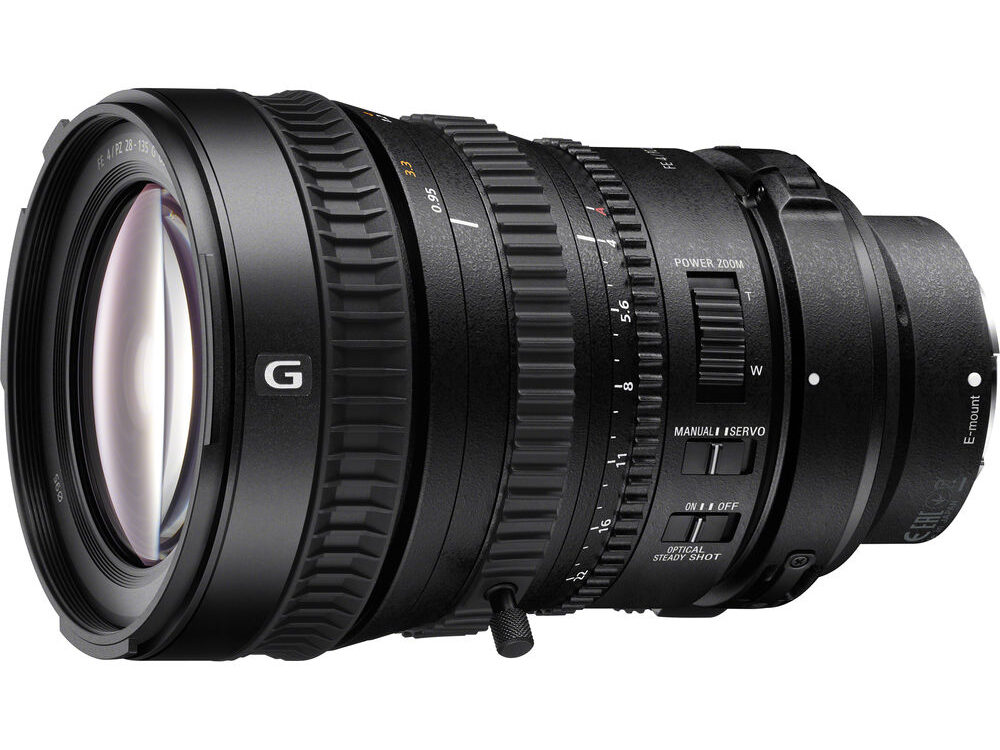
At 28mm, the closest focusing distance is at 0.4m or 1.31ft and at 135mm, the closest focusing distance is at 0.95m or 3.12ft.
This promotes versatility of the lens which can do close ups, macros, wide shots as well as telephoto shots.
Image Stabilization
The Sony FE PZ 28-135mm f/4 G OSS (Amazon, B&H) lens does have 5 axis Optical Steady Shot image stabilization.
Is it a Parfocal Lens?
Yes, The Sony FE PZ 28-135mm f/4 G OSS is a parfocal lens, i.e. it does not lose focus when you change its focal length. This is a major positive for this lens. However, this lens does appear to lose focus when in a close up shot.
Control
Manual focus system
The Sony FE PZ 28-135mm f/4 G OSS (Amazon, B&H) has a finite turn ring for its manual focus ring with a distance gauge to help you get that precise focus. Sadly, it does not have the option to switch from focus by wire to fly by wire.
What is the meaning of focus by wire and fly by wire?
Focus by wire: Let’s say you turn the focus ring to change focus from point A to B. You’d expect the focus to shift accordingly. When you stop point B will be in focus. Now bring the focus point back to A and try again, but at a different speed. Slower or faster, doesn’t matter. Now, even if you precisely rotate to the exact same degree, the focus will not be on point B! The speed of rotation determines which point it is focused on. That’s just completely useless for follow focus work. If an actor or person moves at a different speed, evens lightly, you’ll never get the same focus. Avoid focus by wire lenses like the plague (for video work).
Fly by wire: The distance of focus shifted is directly proportional to the speed at which the ring is turned. This is how a manual focus ring is supposed to operate for video and cinematography.
This decision to exclude fly by wire or linear MF by Sony could lead to cinematographers and videographers thinking twice before choosing this lens for their next shoot.
Despite claiming to be a Cine Lens, this lens does not have a geared focus ring. You won’t be able to set up follow focus systems on this lens. This is a huge let down for a “Cine Lens.”
Autofocus system
Sony’s Autofocus is, without a doubt, one of the most revered video autofocus systems in the world. They claim that this lens supports contrast AF and Phase Detection AF. The focus ring on the lens switches from AF to AF assist to Full MF by pushing it away or closer to the camera.
Zoom Ring
Sony has come up with two systems for zooming in on your subject. These two modes are:
- Power Zoom : You get a button on the side of the lens which you can push up or down to get your preferred focal length.
- Manual Zoom : You have a dedicated zoom ring to get to your preferred focal length. However, it is not completely independent of the motorized zoom. There is a slight lag which might make it frustrating for many people, if not unusable.
Sony claims that they have worked on the zoom ring to make it quieter and smoother. The zoom appears to be very controlled and steady, so you won’t be doing a lot of Tarantino-style crash zooms with this lens.
The zoom ring allows you to shift the focal range from 28mm to 135mm and anywhere in between. This lens zooms internally i.e., there is no lens extension or retraction while zooming in or out.
There are also two additional modes called the Clear Image Zoom and Digital Image Zoom, which allows you to go beyond 135mm at the cost of the quality of the footage. This could be very useful for journalism videography, when you don’t have any other option.

Basics
Filter Thread
The Sony FE PZ 28-135mm f/4 G OSS (Amazon, B&H) has a filter thread diameter of 95mm. This is a larger filter diameter than the rest of the lenses. You might struggle to find the right filters.

Build Quality
The majority of the lens exterior is plastic, though the lens doesn’t feel cheap.
The optical design consists of 18 elements in 12 groups, including ED (Extra-low Dispersion) glass, aspherical lenses,

Size and Weight
The Sony FE PZ 28-135mm f/4 G OSS (Amazon, B&H) has a diameter of 105mm and a length of 162.5mm. It weighs around 1,215 grams. It is slightly heavier than other zoom lenses.
Weather resistance
Sony claims that all G lenses are weather resistant. But again this only holds true if the camera body you will be using is also weather sealed. No camera is truly and officially weather sealed, so the best you can hope for is reliable weather resistance.
This is a G series lens, not a Cine Lens, and we can expect it to perform as such.

What’s in the box
This is what you get in the box (other than the lens):
- Lens hood (ALC-SH135: square shape, bayonet type)
- Lens front cap
- Lens rear cap
- Case
The hood can be useful for video work, but the caveat of this situation is the lens front cap is an absolute travesty. It looks like a lid of movie theatre cola. Many a times, you don’t need to put on the hood and for those instances it is important to have proper front element protection.

Alternatives to the Sony FE PZ 28-135mm f/4 G OSS Lens
The Sony FE PZ 28-135mm f/4 G OSS (Amazon, B&H) is a great wide to telephoto general purpose lens. Due to its power zoom feature, constant aperture, and wide focal range there are no alternatives.
The only unfortunate thing is the lens is old and Sony hasn’t upgraded it with newer optics.
I hope you found this overview of the Sony FE PZ 28-135mm f/4 G OSS (Amazon, B&H) useful. If we have missed out on something, please let us know in the comments below.
