Exposure is one of the most critical elements in cinematography, and understanding the tools that help control it is essential for crafting visually stunning scenes.
While f-stops and T-stops might sound similar, their roles and applications in photography and cinematography are distinct.
This guide focuses on:
- The difference between T-stops and f-stops
- Why T-stops are used in cinematography and f-stops are used in photography
- Which one should you pick, and why?
- How to expose with either
First, watch the video:

What Are f-Stops?
F-stops, short for focal stops, represent a theoretical ratio of the lens’s focal length to the diameter of its aperture. If you’re totally new, watch this video:
The formula for calculating an f-stop is:
f/stop = focal length / diameter of the aperture
This ratio is often used to know how much light enters the lens. For example:
- A lens with a focal length of 50mm and an aperture diameter of 25mm has an f-stop of f/2.
- Reducing the aperture diameter to 12.5mm changes the f-stop to f/4.
The f-stop scale is standardized into common increments such as f/1.4, f/2, f/2.8, f/4, f/5.6, f/8, and so on. Each step in this scale doubles or halves the amount of light entering the lens, making it a useful system for adjusting exposure.
Watch the above video if you’re confused by these numbers. I’ve simplified it!
What f-stops do not do is account for light loss caused by absorption and reflections within the lens, which can create inconsistencies between lenses.
And this is critical to cinematography.
What are T-Stops in Cinematography?
T-stops, short for transmission stops, go beyond the theoretical precision of f-stops by measuring the actual amount of light transmitted through the lens to the camera sensor.
Unlike f-stops, T-stops factor in light loss caused by the glass elements within the lens, offering a far more accurate measurement for exposure. There’s no formula, the T-stop value must come from testing.
T-stops are determined through rigorous testing and calibration during the lens manufacturing process. For instance:
- A lens with a theoretical f-stop of f/2 might have an actual T-stop of T2.2 due to light loss.
- High-quality cinema lenses are calibrated so their T-stops closely match their theoretical f-stops, minimizing discrepancies.
Notice one thing:
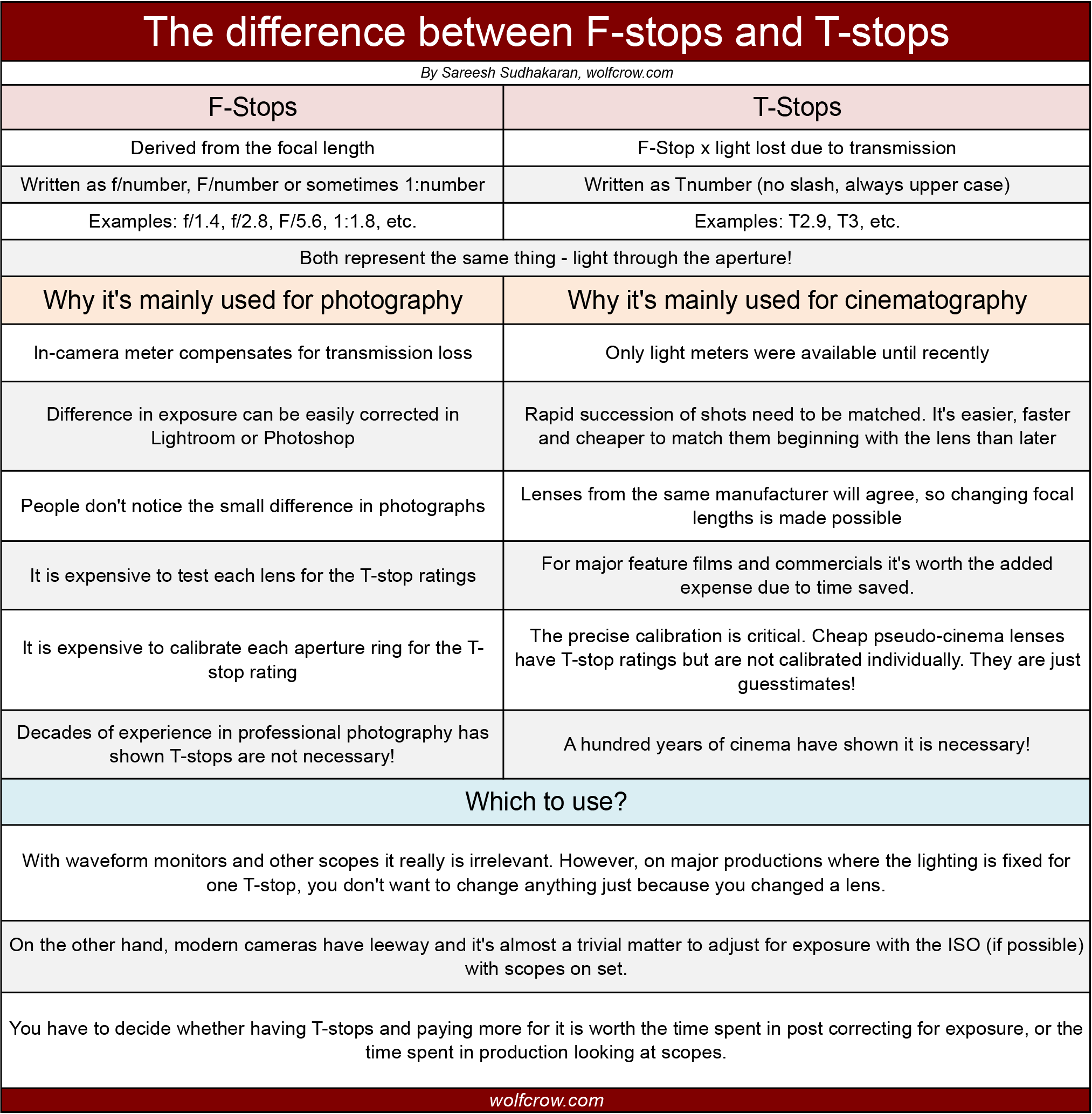
f-stops are written as f/, and T-stops don’t have the “/”
For example, f/2 but not T/2. It’s T2.
Why is this so? My guess is it makes reading the number easier on the lens. These markings were traditionally engraved on metal lens bodies. It’s easier to confuse f and T after a few years of use. Just a guess!
For cinematographers, T-stops are essential for achieving consistent and precise exposure across different lenses and camera setups.
Let me explain that.
Why T-Stops Are Essential for Cinematography
Here are some important reasons:
Consistency Across Lenses
In cinematography, multiple lenses are often used during production. Whether switching from a wide-angle lens to a telephoto or using prime lenses of various focal lengths, consistency in exposure is paramount.
Because T-stops account for light loss, they ensure that the same T-stop value produces the same exposure, regardless of the lens being used. This eliminates the need for recalibrating lighting or adjusting settings every time lenses are swapped.
Multiple Camera Setups
Cinematographers frequently work with multiple cameras to capture scenes from various angles.
Using lenses calibrated with T-stops ensures that all cameras produce identical exposures, creating a seamless visual continuity in the footage. Mismatched exposures can cost more money in the long run because the colorist will have to spend extra time color correcting the footage to match.
Imagine you’re filming a scene with a wide-angle shot on one lens and a close-up on another. If both lenses are set to the same T-stop, you can be confident that the exposure will remain consistent across both shots.
Accurate Light Measurement
Cinematographers rely on precise exposure settings to maintain the integrity of their visual design. T-stops, which reflect actual light transmission, make it easier to achieve the desired exposure when using light meters or waveforms.
Light meters used on film sets are calibrated to T-stops. The readings directly correlate with the lens’s T-stop settings, providing an accurate method for exposing shots. This workflow is a cornerstone of professional cinematography.
When lighting a scene, cinematographers often base their setup on precise exposure measurements. Using T-stops ensures that the light measured during pre-production or test shoots translates directly to the camera, avoiding guesswork or adjustments later. This is especially critical when shooting complex scenes with elaborate lighting setups.
Lens Quality and Performance
Cinema lenses are designed with minimal light loss and are calibrated to provide accurate T-stop measurements. These lenses often feature higher-quality glass, coatings, and construction, making them ideal for cinematographers seeking the best possible optical performance.
The use of T-stops reflects the higher demands placed on cinema lenses, as every element of their design must support accurate and consistent exposure.
To know more, read this:
Multi-Camera Productions
In multi-camera productions, such as live events or action-heavy sequences, exposure consistency is crucial. Cinematographers and camera operators can set identical T-stops across all cameras, ensuring uniform exposure without needing to micromanage individual setups.
T-stops are a vital tool for cinematographers..
With T-stops, cinematographers can focus on their creative vision, confident that their lens and light meter will deliver the accuracy and reliability needed to make their lives easier and save money on set.
I hope you found this helpful. Let me know what you think in the comments below.