
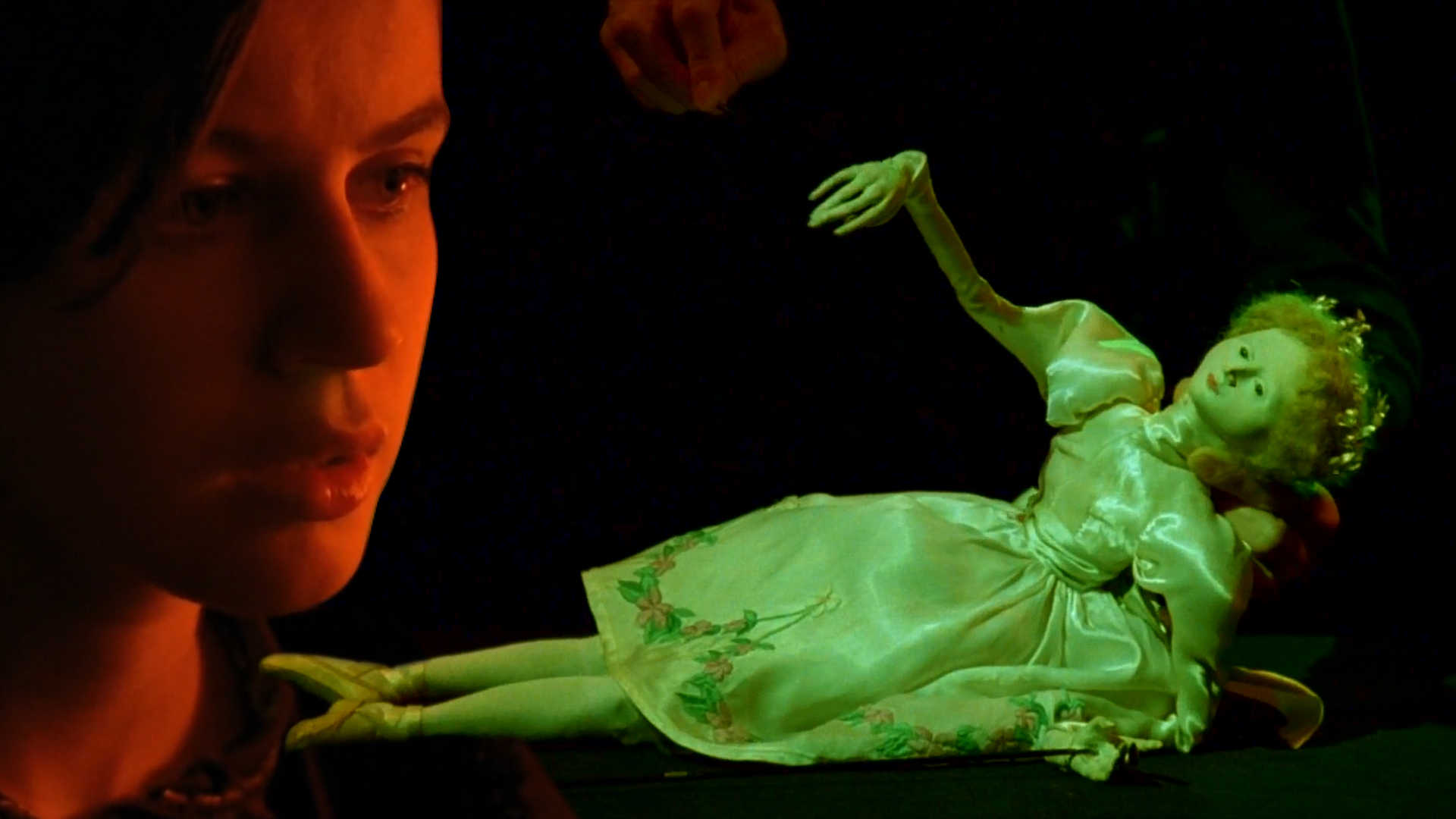
Red and green are the toughest colors to pull off in cinematography. The Double Life of Véronique was shot in 1991, long before DI and color grading was a thing.
The surreal green and red tones were created in film with just lights, filters and camera. Watch the video analysis:

The experiment was so successful It inspired countless green-tinged films. Many still try to pull off green and red today, but only a few are successful – Amélie and The Matrix are films that did a better job than the rest.
The Double Life of Véronique paved the way for these films.
In this article I’m going to show you how director Krzysztof Kieslowski and cinematographer Slawomir Idziak used strong green and red tones to create the surreal and beautiful story of two girls connected through a mysterious force.
Weronika, the first Véronique
Weronika lives in Poland, and Véronique lives in France. Their lives have lots of parallels:
- Music,
- a heart condition,
- an old woman walking alone,
- no mother, only father
- a boyfriend they are ambivalent about,
- a fascination for sleeping the same way,
- making love the same way,
- dressing very similarly, and so on.
They live a kind of parallel life, existing separately until Weronika sees Véronique on her trip to Kraków. At this time Véronique is oblivious to her doppelganger. Later, a photograph she takes reveals to her the existence of Weronika, and it helps her come to terms with a lot of unexplained emotional episodes.
Weronika gets “discovered”, wins a singing competition (or something like an audition), and takes center stage. She is at her most blissful when singing, but it leads to her untimely death.
As she passes, Véronique is overwhelmed by great sadness, and she can’t explain it. This changes her, and I have a theory about it that I’ll explain in a bit. She changes boyfriends, becomes a better person, and returns to her roots at the end. It is never explained what connects the two Veroniques, just that there is a connection.
In order to make this happen, lots of things are common between the two storylines. Some of this I’ve highlighted already, but the strongest subtext is created by the lighting and colors.
Either you have strong green colors, or red colors, or a combination of both.
A quick word on lighting practicality
This was a low budget film, and there’s only so much you can control with lighting and color. Large exterior spaces just can’t have the same color intensity without the help of color grading or expensive production design. A lot of these exterior scenes are neutral or are colored in amber, which is just a natural way to light without making things look silly.
Remember, it’s hard to pull off scenes bathed in reds and greens and not draw attention to the fact. These colors are not motivated by any practical lights on set. Therefore, the predominant colors are green and red, where amber is just red when red was too much.
Once you establish the two primary colors, a simple pattern emerges that’s hard to ignore.
Weronika is clearly lit in red. We are introduced to her story first and we get slowly accustomed to almost every scene having a combination of green or red. The other characters really don’t have a choice, they inhabit whatever the background has in store for them, or they are with Weronika and have the same light. This is especially true of all the people Weronika holds dear – her father, her boyfriend and her aunt. But not always.
The world of Poland, which is the director’s native country, is green:
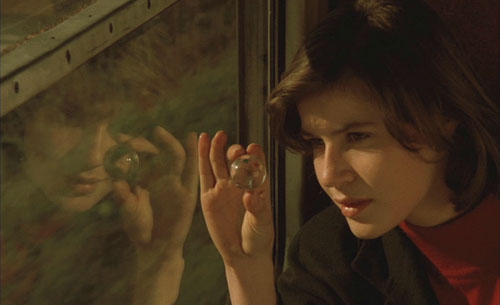
Weronika is a woman who is on the cusp of success. She tastes it. Just before her great performance, her heart condition is revealed to be serious. At this time a curious thing happens. A man flashes her, and it lightens her spirits. She’s one who lives to the fullest, and carries on with the show. During the show she dies, and when she does the very next scene has a point of view of her in her casket looking up at her loved ones, and she sees them through her eyes – everyone in red.
Véronique, the one whose story this is about
Véronique feels a great sense of loss, in Paris, which is the director’s second home. Véronique’s world is red, which means most of the backgrounds are red. She is typically bathed in green:
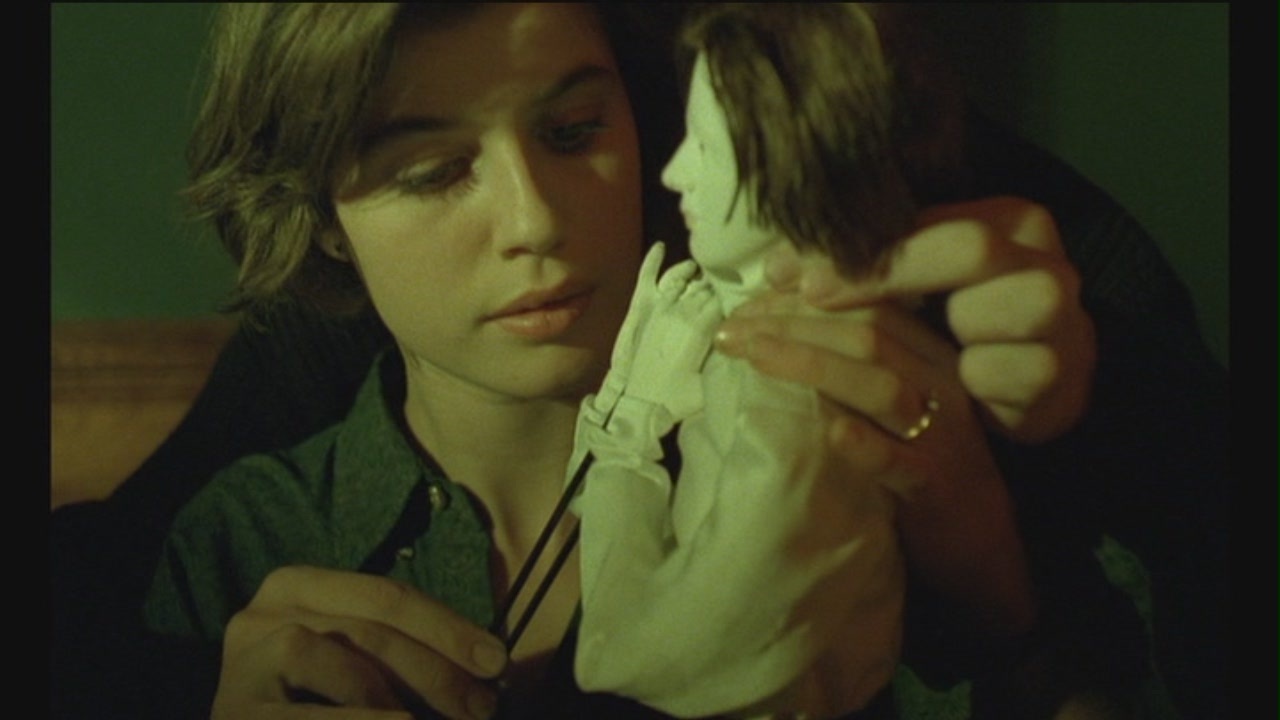
This contrast is not just for show. It has a much deeper meaning.
The life of Weronika serves as a warning. Her passing pushes Veronique to change for the better – starting with her boyfriend. We never see him again, and this first change is brought on my Weronika’s death.
So how do the colors tell this story? Here’s the answer:
Whenever Véronique’s on the wrong path, she is lit with green light.
When she makes the right choices, she’s red, matching the pure life that was Weronika’s.
Their mothers set them on this path right from the very first scene. Where Weronika is destined for the stars, Veronique is destined to deal with her problems on earth.
When Véronique grieves for Weronika, she is lit in red light, not green. The connection begins to make sense, and her life begins to change.
She gets rid of an old man, who threatens her. Was this the parallel of the old man who flashed at Weronika? We don’t know, but only that Véronique is moving on, not sure why she’s doing what she’s doing.
The film’s second biggest scene is the marionette scene, where she meets the puppeteer for the first time. The story of Weronika’s death plays out, and she transforms into a butterfly. Is this what is happening to Veronique?
Véronique, too, gets an ECG done. Why, we don’t know. It’s only natural they share the same heart condition, and it becomes Véronique’s mission to right her life before it’s her time as well. Life is fragile, and she must make amends.
But there are road blocks. She can’t easily overcome her old flippant nature.
She volunteers to lie in court for a friend who has a wayward husband, and here she’s bathed in red light. She’s putting her reputation on the line for a friend. I’m not too sure about the moral and ethical stand here, but the director lights her in red, so he must approve of it.
The puppeteer puts her on a small quest, which is reminiscent of another movie already mentioned in this video.
The quest helps her find her way, and a new lover. Slowly the green gets rarer as she begins to take on a warm light. When she sees the old woman, she doesn’t offer her help, like Weronika did. She’s not a bad person, so she tries to get better in spite of these roadblocks.
When the puppeteer finally helps her find Weronika, everything makes sense. The connection, and her need to change. The puppeteer explains it perfectly in the penultimate scene.
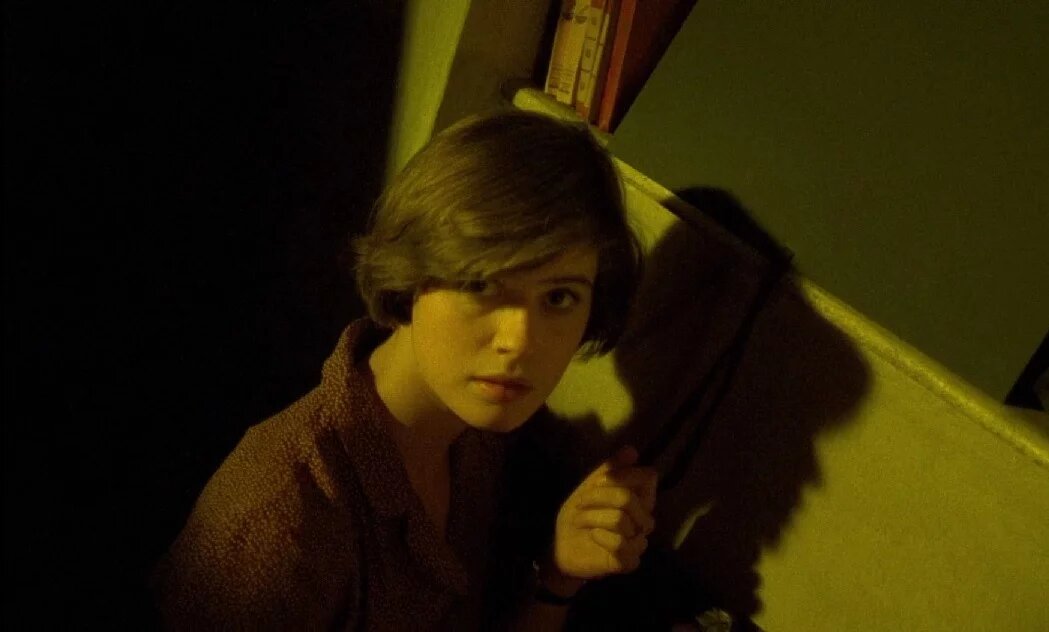
There are two Véroniques because one might die. That’s what happened. The two crucial points in the story are also connected by dutch angles. When Weronika gets flashed, and when Véronique gets flashed by light in her apartment. A moment of decision, from which there is no return:
In the final scene, we echo the first time we saw Weronika. She is singing blissfully in the rain, and Véronique finds her own bliss, a tree in her home, from which the leaves of her beginning are connected. Her father senses it, and understands his daughter is home. She’s at peace.
Director Krzysztof Kieslowski peppers the film with lots of references to red and green – glass balls, clothes, vehicles, but none are stronger or as important than the red and green that colors Irène Jacob’s face, and that which pervade every frame of The Double Life of Véronique.
I hope you found this essay useful. Let me know what you think in the comments below.

I loved this film when I saw it in the ’80s Now I want to view it again with your analysis in mind.