
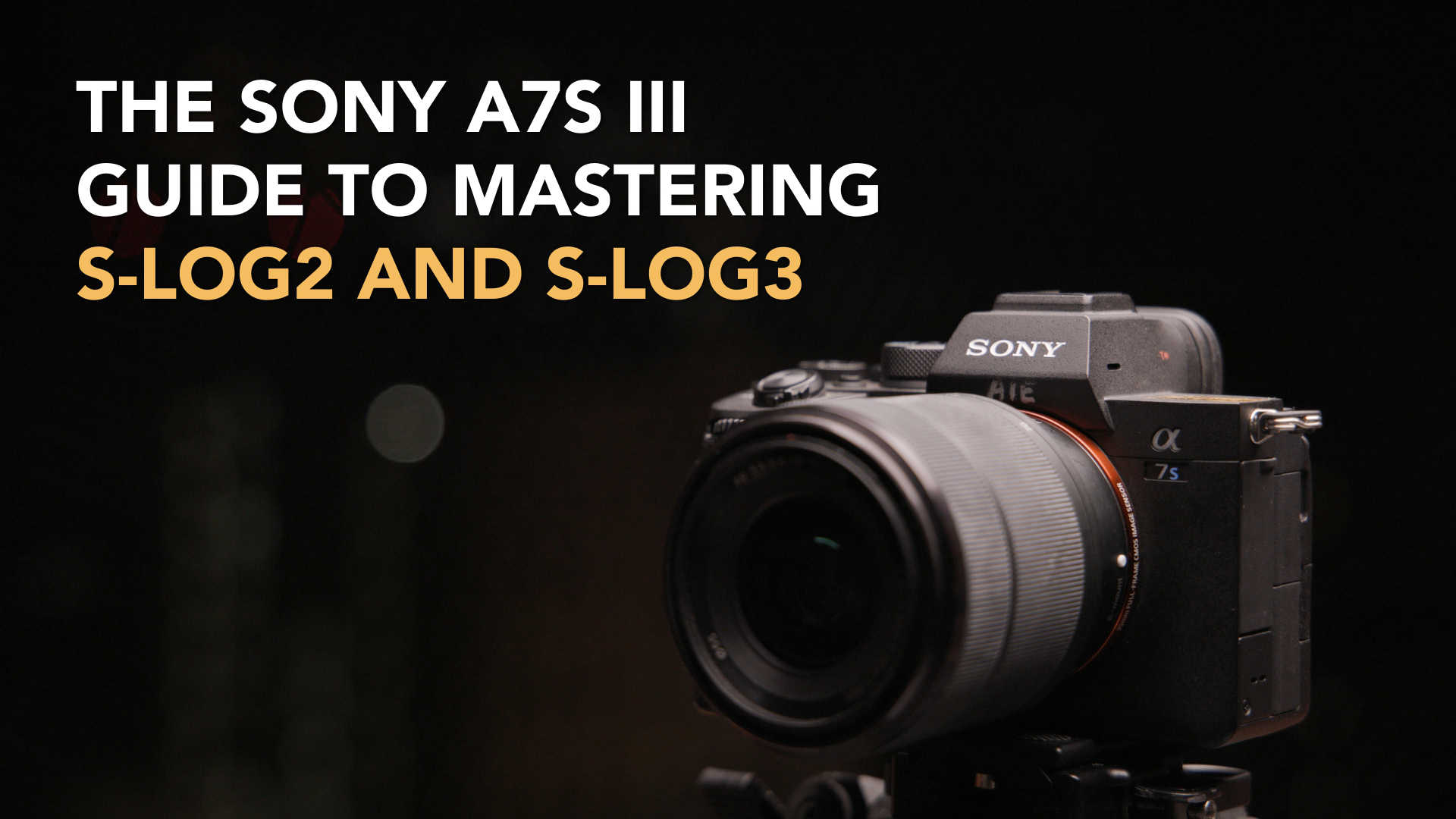
Please watch the lessons in order for best results.

Lesson 1: Full Camera setup
I set up the Sony a7S III from beginning to end, in one go, so you don’t have to worry about it ever again.
Lesson 2: How to use Zebras and the Focus Spot Meter for Exposure
Learn how to use Zebras and the Focus Spot Meter tool before you you learn how to expose S-Log2 or S-Log3:
S-Log2 or S-Log3? Which to pick?
I prefer S-Log2. Two reasons:
- The official LUT Sony provides for S-Log2 to 709 Type A looks better with S-Log2. I get a more pleasing starting image. The S-Log3 LUT is really designed for their higher-end cameras and don’t play well with S-Log3 from the a7S III. This has always been the case for all a7-series cameras, starting from the a7S II.
- I get the full video level range from 0 to 106 IRE. With S-Log3 newcomers are in danger of underexposing when starting out, just to preserve highlights under 94 IRE. Due to this expanded range, I also have an expanded skin tone range from 40 IRE to 90 IRE. This isn’t better, just different.
However, both are fine and you won’t go wrong with either choice. That’s why Sony gives you both options. In this case 3 isn’t better than 2, just another way of doing the same thing.
Lesson 3: How to expose S-Log2
The complete guide to exposing S-Log2, simplified with the Wolfcrow System:
Why is the Wolfcrow System different for the a7S II and a7S III?
The sensor in the a7S III has a much lesser noise floor compared to earlier models. This means you don’t have to overexpose by three stops anymore. With the a7S III, you just have overexpose by one stop.
Download Exposure and Grading Quick Reference Guide (PDF). Combined guide for exposure and grading that you can save to your mobile phone and use in the field.
Download four free LUTs (Use directly on S-Log2 or S-Log3).
The Wolfcrow System of Exposing S-Log2 can be summarized in just two numbers:
1. Keep your ISO between ISO 640 and 6400
2. Keep all skin tones above 40 IRE
Lesson 4: How to expose S-Log3 (Basic)
If you’re new to log, watch this video first as I walk you through the basics of exposing S-Log3:
Lesson 5: How to expose S-Log3 (Advanced)
In this advanced video I go through the finer details of exposing S-Log3, with insights not found in the earlier video:
The Wolfcrow System of Exposing S-Log3 can be summarized in just two numbers:
1. Keep your ISO between ISO 640 and 6400
2. Keep all skin tones above 45 IRE
The exposure system doesn’t change for RAW, as the gamma used during RAW is S-Log3. Use the S-Log3 800% Gamma for View Assist.
Lesson 6: How to prepare S-Log2 for grading
I’ve used Resolve 16.5, and the same would apply with any other software:
Link: Sony LUT Library
Lesson 7: How to prepare S-Log3 for grading
I’ve used Resolve 16.5, and the same would apply with any other software:
Link: Sony LUT Library
