

At first glance, the newly launched Canon C400 and Canon EOS C80 (Amazon, B&H) seem like similar cameras. After all, they share the same sensor!
Add to that the newly discounted C300 Mark III and the choice is even murkier. In this comparison, I’ll try to come away with only one winner.
Let’s get to it.

The basics
| Camera | Price of Camera | Lens Mount |
| Canon C400 | $7,999 | RF |
| Canon C300 Mark III | $6,999* | EF |
| Canon C80 | $5,499 | RF |
In the Canon Cinema universe, the higher the number after “C” the higher the camera sits in the echelon. This is reflected in the price differences of the cameras.
The standard EF mount on the C300 Mark III is non-locking. You need to pay extra for a locking EF mount from Canon. You can also buy adapters for the PL mount and B4 mount.
Canon also sells a PL mount adapter for the C400.
Will different lenses make a difference?
In terms of lenses, generally speaking, full frame lenses cost more than Super35 lenses. This is true of photo lenses and cine lenses.
So, with the C400 and C80, you are looking to purchase heavier, more expensive lenses to cover the full frame sensor that also resolve 6K and higher. Don’t forget to take that into account.
On the other hand, the full frame sensors of the Canon C400 and Canon C80 offers tremendous advantages due to the larger sensor:
- You can still use Super35 lenses in cropped more for 4K
- You can use anamorphic lenses that take advantage of the full anamorphic frame.
If your goal is to film with PL or LPL mount lenses, it doesn’t matter which mount you start out with. Both EF and RF have enough quality adapters available.
However, RF lenses have the advantage of being compatible with Canon EF lenses as well, and any third-party EF lenses too. Since this is a fair comparison, I’ll have to give cameras with the RF mount the edge in the lens department.
Usability and Workflow
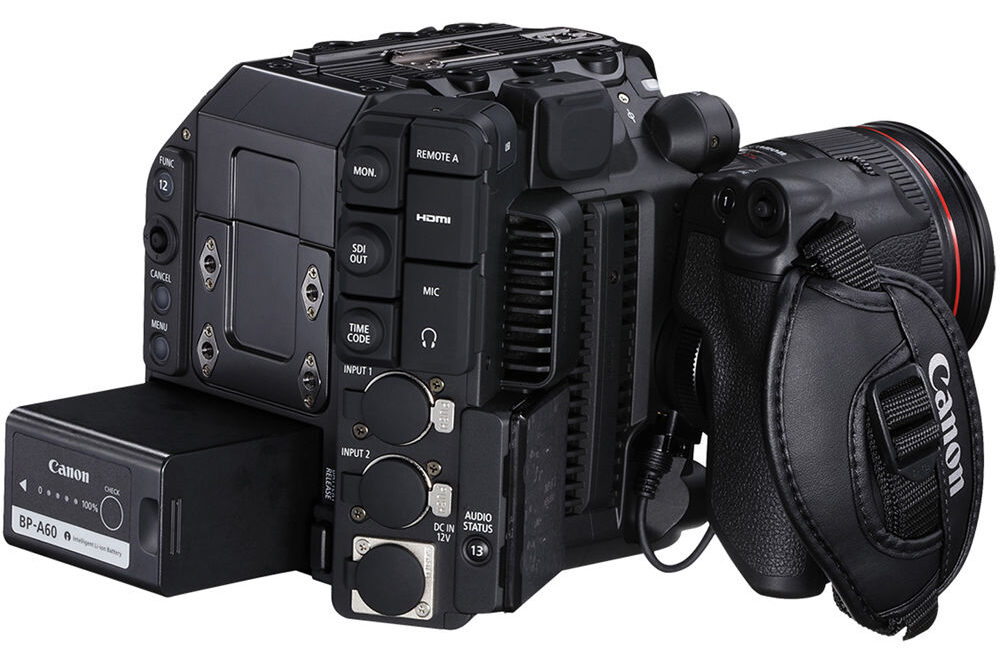
For a lot of professionals, usability is as critical as image quality. This is what the Canon C300 Mark III looks like:
The Canon C400 is different:

And the Canon EOS C80 (Amazon, B&H) is different still:

Those who are purchasing these cameras are probably into documentaries, corporate videos, commercials, high-end weddings and maybe the occasional short or feature work.
These are money-making tools.
One key difference, and not an insignificant one, is that the C400 and C80 have dual mini-XLR inputs. The C300 Mark III has full XLR inputs.
I don’t know about you, but I hate adding another adapter in the audio chain, especially when it’s easy to get audio artifacts. I do own these adapters and I cannot really understand the shift away from full XLR inputs. Maybe I’ll be proven wrong.
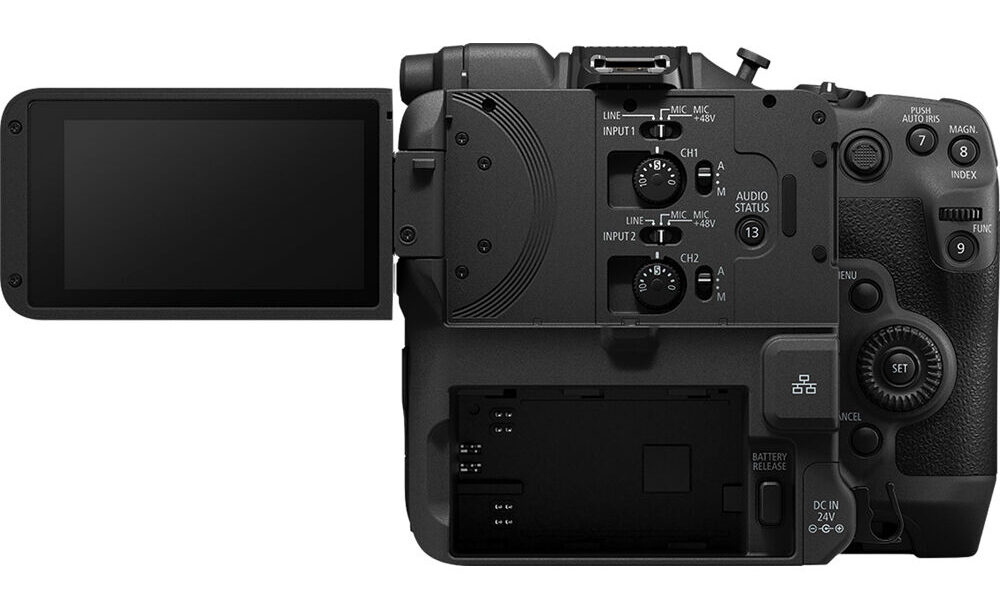
Also, the manual audio controls on the C400 are on the left (operator side) of the camera. On the right are just the XLR Power options:

I don’t understand this placement. Room has been made for Ethernet, Wi-Fi and Return Input. What is Return Input? According to Canon:
(The Return Input) notifies operators which camera is currently being broadcast live.
The return output destination can be selected from the VIDEO, EVF-V50, MON./HDMI and SDI OUT terminal.
Canon USA
For the C300 Mark III, for the most versatile functionality, you need to purchase the Canon EU-V2 Expansion Unit:

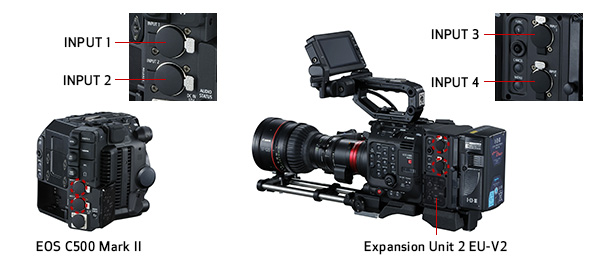
This gives you two audio controls on the operator’s side as well as two additional channels to record audio.
For just Genlock, you can purchase the cheaper Canon EU-V1:

These modules give you:
- Genlock
- Additional XLR inputs (only V2)
- Remote control
- Ethernet control
- V-mount plate with P-tap output (only V2)
- DC output to other devices (only V2)
- Lens control for certain supported lenses (only V2)
It is clear if you need the C300 Mark III for any sort of regular broadcast work you will have to purchase the EU-V2 expansion unit. Also, if you have multiple accessories it’s a good way to power everything together.
However, Genlock and Ethernet are built into the C400, making it ready for broadcast and live streaming work without any additional purchases.
All cameras have an 12G-SDI port for output, and the obligatory HDMI A port. The C300 Mark III and C400 also have a 3D-SDI port for monitoring. You only output 4K 60 fps via 12G-SDI. No 6K.
As far as other ergonomics is concerned, the C400 has a new LCD touch-screen monitor, camera grip and battery pack. All of which ships with the camera body.
The new LCD attachment allows the operator to adjust the angle and distance of the LCD monitor. It connects via a USB-C cable to the body.
However, the LCD of the Canon C80 is fixed, like a typical mirrorless camera. Also, it has a record button and body design similar to a photography camera. I don’t know if anyone will buy the Canon C80 to use it as a photo camera. It’s too limiting to hold it like a DSLR/mirrorless camera.
The C400 also has a new camera grip with three additional assignable buttons. The grip can be articulated to achieve a range of shooting angles.
One last feature that needs to be highlighted in the new RF cameras is the Auto Clear Scan setting. It is an automatic shutter mode that can detect the frequency of light sources between 50 Hz to 2011.2 Hz to help reduce or virtually eliminate the flickering in some LED walls. I can tell you that’s really helpful – assuming you can see the flicker on the small LCD.
On the whole, the C400 clearly is a camera that offers better usability across the board, except for the mini-XLR inputs and the controls on the left. I think a lot of people can live with that.

Autofocus
All cameras have Dual Pixel Autofocus with support for Touch AF and Face Detection AF.
What is dual pixel AF? According to Canon:
For DAF, each pixel in the camera’s CMOS sensor is configured with two photodiodes. Two independent image signals can then be detected at each photosite and compared using phase-difference to provide autofocus with compatible lenses. DAF can survey the scene and recognizes not only whether the subject is in focus or not, but in which direction (near or far), and by how much.
Canon USA
The C400 and C80, though, has an updated Dual Pixel AF II version:
The back-illuminated stacked sensor provides better light-capturing efficiency, widening the area of the sensor that can be used for AF.
Canon USA
The improved EOS Intelligent Tracking and Recognition (iTR AF X) algorithm delivers better subject detection. In addition to human eyes, face, and head, the camera can now detect the body of a person and follow them with high accuracy.? It also improves tracking the eye, face and bodies of some animals.
I’ll have to give this one to the Canon C400 and Canon EOS C80 (Amazon, B&H).
Image Stabilization
According to Canon:
The EOS C300 Mark III includes the same built-in five-axis electronic IS introduced with the EOS C500 Mark II that works with almost any lens, including anamorphic.
Canon USA
What about the C400? On the Canon USA website on the product page there is no mention of image stabilization.
The official press release mentions 5-axis image stabilization, however, it is digital IS only without RF lenses:
5-Axis Combination IS (Optical and Digital) with supported lenses
Canon Europe
Digital 5-Axis IS for non IS lenses.
Due to the better IS characteristics of Canon EOS RF lenses, the overall stabilization of the C400 should be marginally better, but not with PL lenses. This is one area where the C300 is better.
Now let’s talk about video features.

Comparison of video features
Let’s start with the sensor.
Sensor
| Camera | Sensor Size | Dynamic Range | Native ISO* |
| Canon C400 | 38.4 x 20.2 mm | 16 stops | 800, 3200, and 12,800^ |
| Canon C300 Mark III | 26.2 x 13.8 mm | 16+ stops | 800^ |
| Canon C80 | 36.0 x 19.0 mm | 16 stops | 800, 3200, and 12,800^ |
^In Log and RAW modes. C-Log 2 has the highest dynamic range. With C-Log 3 you get 14 stops.
It is pretty clear, according to Canon’s own estimation, the Canon C300 Mark III is clearly better in terms of dynamic range. The C400 and C80 is half a stop worse, being the exact same sensor.
In RAW
| Camera | Max. Resolution | Bit Depth |
| Canon C400 | 6000 x 3164 | 12-bit^ |
| Canon C300 Mark III | 4096 x 2160 | 10/12-bit^ |
| Canon C80 | 6008 x 3170 | 12-bit^ |
The data rates are manageable for all cameras, all things considering. Here are the data rates for the C400:
- Cinema RAW Light LT: 576 Mbps (72 MB/s)
- Cinema RAW Light ST: 886 Mbps (111 MB/s)
- Cinema RAW Light HQ: 1,800 Mbps (225 MB/s)
On the other hand, the Canon C80 has slightly more limited options:
- Cinema RAW Light LT: 576 Mbps (72 MB/s)
- Cinema RAW Light ST (only in Super 35 mode): 470 Mbps (59 MB/s)
In 10-bit 4:2:2 internally
| Camera | Max. Resolution | Data Rate | Format |
| Canon C400 | 4096 x 2160 | 500 Mbps | XF-AVC |
| Canon C300 Mark III | 4096 x 2160 | 160-810 Mbps | XF-AVC |
| Canon C80 | 4096 x 2160 | 500 Mbps | XF-AVC |
This is pretty similar. All cameras can record HD proxies simultaneously.
What about frame rates?
| Camera | Max fps at 6K | Max fps at 4K | Max fps at 1080p |
| Canon C400 | 60 fps | 120 fps | 180 fps |
| Canon C300 Mark III | N/A | 120 fps | 180 fps |
| Canon C80 | 30 fps | 120 fps | 180 fps |
Clearly the Canon C400 combines the advantages of the C300 Mark III and C80, and this is how the C80 has been curtailed.

Super 35mm and anamorphic modes
All cameras can record anamorphic internally. You can desqueeze the image internally instead of having to use an external monitor.
For true anamorphic, the sensor needs to span at least 21.95mm x 18.6mm. Even ‘chopped off’ anamorphic will deliver true 4K.
The Canon C300 Mark III cannot do true anamorphic due to the smaller sensor height.
Media Cards
Media card costs are an important percentage of ownership:
| Camera | Media Cards | Data rate for RAW | Price per GB^ |
| Canon C400 | 1x CFexpress 2.0 Type-B 1x SD UHS-II | 225 MB/s | $0.27 |
| Canon C300 Mark III | 2x CFexpress 2.0 Type-B 1x SD UHS-II | 125 MB/s | $0.27 |
| Canon C80 | 2 x SD UHS-II | 225 MB/s | $0.27 |
This is where the C400 falls behind a bit. You only get one CFexpress Type B slot. It’s not a deal breaker, but once you’ve offered something and then take it away…ouch!
Battery life and Power
Here are the official numbers for RAW:
| Camera | Power Draw | Battery life | Battery Voltage |
| Canon C400 | 32.5 W | 155 minutes | 14.4V |
| Canon C300 Mark III | 31 W | 130 minutes | 14.4V |
| Canon C80 | 14.5 W | 170 minutes | 14.4V |
| Camera | Battery | Cost | Cost of 4 hours of operation |
| Canon C400 | BP-A60N Unknown | $469 | $774 |
| Canon C300 Mark III | BP-A60 90Wh | $389 | $739 |
| Canon C80 | Canon BP-A30N 45Wh | $285 | $402 |
The Canon EOS C80 (Amazon, B&H) draws about half the power so it does better in the battery life department.

Which is the better camera for video?
Obviously the C80 is the cheapest, even considering accessories. But are the others that much better?
Here’s a summary of each round, and the “winner”:
| Feature | Winner – Solo Shooter | Winner – Cinema |
|---|---|---|
| Ergonomics | Canon C400 | Canon C400, C300 Mark III |
| Lenses | Canon C400, C80 | Canon C400 |
| Third-party lenses | Canon C400, C80 | Canon C400, C80 |
| Video features | Canon C300 Mark III | Canon C400* |
| AF for video | Canon C400, C80 | N/A |
| Image stabilization | Canon C300 Mark III | Canon C300 Mark III |
| Media cards | Canon C300 Mark III and C80 | Tie |
| Battery life | Canon C80 | Tie |
Is it obvious which is the best camera?
Canon C80 vs C400. Which is the better deal?
I believe the Canon C400 is better than the Canon EOS C80 (Amazon, B&H), even if it’s $2,500 more. That’s the cost of a lens, or all the accessories you might need with the C80.
But, the C400 gives you:
- Lockable mounts
- Higher frame rates
- More RAW codec options
- Vastly better ergonomics
In many ways, the C80 could be though of as a B-cam for gimbal work, or when you need to a really light package. But the C400 is only about 200 grams heavier.
I think, as an earning professional, the C400 will let you do more jobs over a 3-5 year period, enough to justify the price difference. The C80 is great only if you’ll never need the added features of the C400.
Which camera wins?
The Canon C400 is the winner in this comparison.
If you need the best dynamic range for some reason, and only then, the Canon C300 Mark III is better. The dual-gain sensor definitely gives it an edge.
However, you won’t be getting all the additional features the C400 gives:
- Full frame and 6K
- Anamorphic modes
- Triple Base ISO
- Better Autofocus
- Better compatibility for lenses with the RF mount
- Support for Cooke /i metadata with the PL mount
- New LCD and Grip
I believe these are the features that contribute to food on the table. If you can’t make 16 stops look good you can’t make 16+ do much better, in my humble opinion.
I have no doubt. The Canon C400 wins.
What do you think?

Thank you for this very thorough test. Personally, when faced with difficult field conditions, I find the C400 to be more robust. The C80’s screen does not seem very sturdy around the hinge.
You’re welcome. Thank you for the info!
C300 III has an option built-in EVF. I feel like there should have been a category for monitor/EVF. I think the optional EVF is a HUGE plus for the C300 III and I really wish the C400 provided that. The built-in LCDs on Canon Cinema cameras are not bright enough to see in direct, mid-day sunlight.
Great analysis! I have two C400’s on order, and I needed a way to decide whether to stay with that, or switch to the C80. It is a VERY close call, but I agree with your analysis. I’ll stay with the C400. BTW, a surprise for me was the C80 is BIGGER than the C400.
Thank you! Glad it was helpful.