

There’s often confusion about what exactly makes a camera dolly. The truth is, almost anything with wheels under a platform can be considered one.
In this article, we’ll explore these following questions:
- What is a dolly?
- What are the parts of the dolly?
- How is it different from a slider or DIY dolly system?
- What to look for in a good dolly system?
Keep in mind, this isn’t a how-to guide for using camera dollies, nor does it get into the really fine nuances between various systems. It’s a basic overview for aspiring filmmakers who’ve heard of camera dollies but aren’t sure if they should care.
The short answer is, you should.

What is a dolly?
For simplicity, I’ll divide “dollies” into three broad groups:
- Professional Camera Dollies – the real deal
- Sliders – they use bearings over rails instead of wheels
- DIY systems – from wheelchairs to PVC dollies to plywood dollies on skateboard wheels to table-top dollies
A camera dolly is a platform over wheels. You put the camera and operator on the dolly to move it around for fluid shots involving motion.
From just that perspective they all seems alike. But it’s the small details that makes the difference.
What are the parts of a camera dolly?
Here are the main parts of a camera dolly:
The platform or chassis
The platform is the core of a dolly. Also called the chassis, it should be strong enough to hold whatever’s put on top, which might include a team of humans, a jib, a heavy camera setup, etc.
This also translates into the payload capacity of the dolly, which includes everything above the platform.
Think car chassis. Want a stable and safe car? You start with a stable and safe chassis.
Wheels and tracks
Underneath the platform are two sorts of wheels:
- Either regular wheels, casters or tires, for use on smooth surfaces (dance floor moves)
- Rail wheels (like train wheels)
These wheels have to be tough and durable, and must also be able to turn a full 360 degrees depending on how the dolly grip (the person in charge of executing dolly moves) wants it.
This is what it looks like underneath:

Extensions/boards
This is where our dolly starts to deviate from DIY systems.
Sometimes you’ll see the platform extended out on four sides with additional boards. This is optional on most top-end dollies. You can also connect platforms on the diagonal corners.
These platforms must be sturdy enough to take the weight of humans. They must also be safe and quick to mount and dismount. A good dolly must allow for all kinds of extensions, like this image (foot rest):

Also, what if you load platforms on only one side? Will the dolly tilt over? Imagine a tall car vs a shorter car (like a sports car). Which one is more likely to tilt over a curve? A heavy dolly with a low center of gravity has a low chance of tilting over, while a lighter dolly surely will.
I’ve fallen off a dolly because it wasn’t balanced correctly to let me get down. It’s not as mundane as it seems! Thankfully, nothing except the floor was damaged.
A lot of people complain about heavy dollies, but a heavy dolly is heavy for the same reason a car is heavy – it keeps the people on it safe.
A good dolly will easily hold at least two heavily individuals, and will be strong and stable enough to ‘eat up’ their movements so they won’t translate to the camera.
Steering and movement
Most dollies need some kind of steering system, and there are generally two kinds:
- Steering wheel
- Levers
Like cars and construction cranes, one can’t categorically claim one system is better than another. They are designed for specific scenarios, and you can be rest assured if a dolly has a particular system it’s for good reason.
Either way, the takeaway is the dolly grip must learn to drive the dolly like a car. It is extremely important for the steering mechanism to be precise (no play), strong and controllable. Good dollies have geared mechanisms. If a dolly grip perfects one kind of dolly, it doesn’t mean he or she will be able to drive another kind of dolly.
When it comes to movement, we already saw the four types of dolly moves. However, there are other aspects of movement at play, namely momentum, and Newton’s first law of motion.
Imagine sitting in a car, and somebody brakes hard. You’ll be whiplashed forward because you still carry forward momentum. The same happens when you accelerate suddenly from zero. However, if the car accelerates or decelerates slowly, the effect is almost imperceptible, and that’s exactly how you want a good dolly to start and stop – no jerks.
The only way to handle this is to have grips control the dolly well, but it helps to have a really heavy dolly. A dolly grip(s) either pushes or pulls a dolly to start movement. It is easier to push than to pull (ask your Physics teacher why), but it’s also easier to maintain balance while pulling, so you’ll find dolly grips use both push and pull depending on the situation. Sometimes they lie on the floor. They must operate like ninjas – silent and invisible to camera.
The weight of the dolly makes it hard to set it in motion. When it’s time to stop, it becomes harder to bring it to rest, because now you have to arrest the forward momentum as well. Dolly grips lay tape marks on the floor to ensure they know when to do what, and good grips also watch the actors for any speed variations.
To aid the dolly grip, good dollies have versatile handles and steering systems, as you can see:

Hydraulic arm or column
So far, we’ve only seen the parts that most of us are aware of. But now the dolly pulls ahead with a feature no other DIY system can provide reliably: the hydraulic arm or column:


The purpose of the hydrraulic arm or column is simple: to provide vertical movement. Imagine dollying backward while an actor approaches. You can either tilt up to accommodate the actor, but this only works if you want to show the ceiling.
If you still want to maintain perspective and framing, you need to raise the camera vertically, and this is what an arm or column does. It is the bread and butter of all dolly moves.
The system is hydraulic so it can lift heavy weights (which becomes a drawback with lighter camera rigs. The solution is to add weights) in a smooth and safe manner.
What’s the difference between an arm and a column? The arm can stick out at the front, which gives more space to the operators to sit behind it. It can also extend out further beyond the space of the dolly itself.
On the other hand, a column can go straight up, so it won’t ‘arc’. A center column is also physically the most stable platform, so the chassis can be lighter. Finally, a center column can have a seat that goes up and down at the same distance from the camera, so a camera operator doesn’t have to adjust position during a shot.
Again, there’s no better or worse here. An operator well versed with one system usually tends to disfavor the other. Instead of wasting time understanding the different nuances of design (there will be time enough for that in the real world), the only thing to understand is that the dolly grip is responsible for raising or lowering the arm/column – so that’s one more thing to do.
Turret or turnstile mount or slider
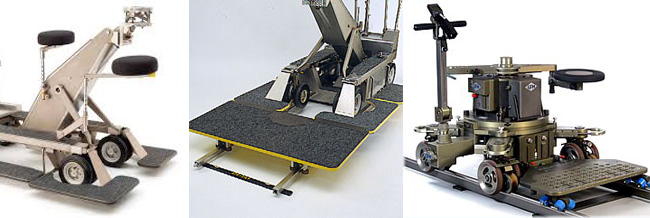
At the end of the arm or column, you can either terminate with a bowl adapter or riser (usually 150mm. Mitchell or 100mm) to take a fluid head, or you can extend out further with a turret, slider or turnstile mount. See the side-by-side three images ago.
This mount can be slid in or extend out. Simple physics dictates the more something leaves the center of gravity, the less stable it becomes.
Low mode
A hydraulic arm or column can only go so low, but cannot execute low mode shots, especially those that are under the platform itself (close to the floor). For this you’ll need to add a low mode attachment (similar to how you would do so on a Steadicam):
You can see from just this basic list the sheer level of movements a professional dolly is designed for. Put it into any situation within reason and the dolly must perform.
A cinematographer will pick two or more spots in space and now it’s the dolly grip’s job to figure out how to get from one to the next without drawing attention to itself or getting in the way of anything else.
Wireless operation
Many dollies allow at least two persons to sit on the platform – the operator and focus puller. The dolly grip must operate the dolly manually through levers or the wheels.
However, sometimes it is too dangerous to operate the dolly this way, especially when it impairs line of sight. For this reason, some top end dollies come with wireless operation capabilities. This also allows dolly grips to delegate responsibilities while maintaining safety at all times.
Battery operation
Dollies operate on batteries and/or AC for full versatility (which include power to hydraulic pumps). However, a few dolly designs need more power than most, and will need a change of batteries every often.
Jibs and telescopic arms
This is not technically part of the dolly, but is the one thing that gives it superpowers. These jibs and arms are different from other systems because they are precise and telescopic. They can extend and cover any point within a hemispherical space, and then repeat the exact same movements again and again.
Two popular examples are:
- The Technocrane
- The Hydrascope
However, most good camera dolly brands also manufacture their own jib arms.
What is a Dolly Movement?
There are four basic ways a camera dolly can move:
- In a straight or curved track – if this is important, they usually lay down tracks/rails
- Front or back wheels free, while the other two are straight – for turns, just like a car
- All wheels free – for really tight turns and complex moves, a dolly can just circle in place if necessary.
- All wheels locked at the same angle – so a dolly can move in a diagonal (or right angle) while pointed in another direction. This is called a crab movement (a crab looks in one direction while walking sideways).
Depending on which planet you live in, dolly moves have their own names:
- Dolly in or dolly out – usually refers to moving towards or away from the subject being shot, or moving along their path (to keep the same frame, e.g.)
- Tracking or trucking – refers to moving sideways from the subject being shot (E.g., following two people on the side of the road)
There are two ways to control movement:
- Tracks – like a railway track, to keep the dolly ‘on track’, and
- Smooth floor – popularly known as the ‘dance floor’, even if nobody’s dancing (the dolly’s dancing)
When on rough terrain or uneven surfaces, it pays to lay down tracks. Professional dolly tracks come with all sorts of accessories to make this process fast and safe. It is not uncommon for dolly tracks to have either ends at different heights, or even look like a small roller coaster. This is the most stable platform, and produces the smoothest moves – especially at high speed.
Some studios have smooth floors, but most don’t. In order to create dance floors, one might have to rig layers of plywood to get a smooth surface. A full dance floor gives unlimited freedom to the dolly to move around at will. In this configuration a dolly is the most versatile and fastest.
So, tracks or dance floor? It depends on what you want. Total control vs speed and uncertainty (improvisation by actors, etc.), that’s the call.
Here are some ways you can interface wheels to track (pay attention to the amount of variations possible!):

How is a Camera Dolly different from a Slider or DIY Dolly?
Now you know how versatile a professional camera dolly really is.
Think about the following:
- A wheelchair cannot turn its wheels.
- A slider loses stability the longer it gets. It also gets very inconvenient.
- A slider cannot hide bumps or imperfections very well.
- A slider cannot do both horizontal and vertical moves without motorized control.
- Dolly grips can prepare a track and dolly as fast as a solo filmmaker can set up two stands for a slider. You need to see it to believe it.
- Once a dolly is in dance floor mode, it can actually be used to move from one setup to the next, and even be used as a framing device. The time and effort grips invest in a system pays off in speed and quality.
- Professional dollies are totally silent and safe.
- A DIY dolly is hard to troubleshoot. A professional dolly (with a professional dolly grip team) will get the dolly up and running with minimal downtime.
- A professional dolly is serviceable, just like a car. If parts fail or are lost, they can be replaced.
- A dolly allows the filmmaker and cinematographer to concentrate on the shot and action, rather than setting up the shot.
- You can make complex and precise moves with a professional camera dolly, faster.
- There is no DIY dolly, slider or wheelchair that can perform repeated complex or compound moves take after take. (Motorized sliders can, but they can’t change speed if an actor does so).
- Professional dollies are tough and easy to maintain. They last forever.
This does not mean sliders or DIY dollies are bad. They do have their place. But let’s not start assuming they are replacements for a real camera dolly. They are compromises that can do some things well, but only a real camera dolly fulfills all demands.
Here’s a great video about the beauty of dolly design, motion and productivity from ChapmanUK Dennis Fraser on one of the Chapman dollies, the Hybrid IV:
And here’s Jack Sanders on how to use a Fisher 9 dolly system:
Finally, here’s the Panther Tristar:
What to look for in a good dolly system?
To wind up this article, let’s see what to look for in a good dolly. First up, the sad part: the brand name matters.
I’ll explain. An obscure brand can have a great dolly, but if you are buying or renting a dolly, you are faced with the following decisions:
- Buying: Service, and whether or not it will be in demand in your area
- Renting: Skilled operators, and whether or not they want to use that dolly
Most times you’ll see that dolly grips have their own preferences, and they don’t want to change. If they prefer a particular brand or model, then that’s what they’ll have. If you buy an obscure brand, even if it’s the best dolly on the planet, it won’t get rented and it’ll be hard to recover your money.
Professional dollies easily cost upwards of six figures (USD), and some are only available on lease. For most filmmakers it’s a rental item, and you are better off taking the advice of your dolly grip.
Here are four big brands that make camera dollies:
- Chapman-Leonard – probably the most respected brand worldwide. The Chapman Peewee is legendary.
- J.L. Fisher – equally popular to the Chapman dollies in the US. They’re like the Pepsi and Coke of the camera dolly world.
- Panther – mostly popular in Europe and Asia, and unfortunately not very popular in the US. As we saw before, the Panther center column design takes getting used to, and maybe those who have learned on hydraulic arms don’t want to learn a new system.
- Grip Factor Munich (GFM) – A great alternative to the Panther system. I’ve used both GFM and Panther systems in India. Most rental houses don’t carry Fisher or Chapman dollies here.
There are other brands too, but few come close to these four. Chapman and Fisher dollies have to be leased (but there are exceptions. I know of at least one person who has bought a Chapman dolly outright).
I hope this article has helped you understand what a professional camera dolly is, does and is needed for.
I have barely scratched the surface. If you want to know more, you can take courses from Chapman or Fisher, or work your way up in the dolly grip department. There’s nothing like experiencing these things first hand.
If you’re an aspiring filmmaker, think about how much time and money you can save with a professional camera dolly and dolly grip crew. Some gear just can’t be replaced.

What a great article. The engineering alone seems something you would see from the aerospace industry. One thing I personally am taking from this article is the secret of “weight” = “smooth fluid movement” in a professional dolly. Thanks for posting.
You’re welcome!
This was a very enlightening article. The Chapman Hybrid IV video was ridiculous. This is a clear example of the things that you can only achieve with a proper Hollywood budget I believe. It’s not just a matter of having acess to a dolly, you also need the grips to operate it etc. Nice stuff.