
For many cinematographers, bokeh is an essential tool in their visual storytelling arsenal. You can do a lot with bokeh!
In this article, we’ll dive into what bokeh is, why it works, the different types of bokeh, and how to use it effectively in your cinematography.

Why do some images have blurry bits to them?
Let’s start from the most basic idea.
Every image has a plane that is in focus. If you’re not using a tilt-shift lens, then the plane is perpendicular to the ground, parallel to the image sensor.
What is outside this plane of focus is said to be out of focus. This area is both in front of and behind the plane of focus.
This is the out of focus area. Here’s a typical image with foreground and background elements blurred, from Blade Runner 2049:

Her eyes are on the plane of focus, as is parts of her face, hair and shoulders.
However, the person standing in front of her is far away from the plane of focus, and is blurred. So is the wall and light in the background.
What you’ll notice though, is that the person in front looks a lot more blurred than the light in the background. You’d assume the light was further away, so shouldn’t it be more blurred?
Many people confuse the out of focus area with blurriness.
When you stop down a lens to increase the depth of field, you also increase the range of the focus zone so objects in this area appear sharp, sometimes as much as the objects on the actual plane of focus. These are still out of focus areas, but they don’t have to be blurred.
So, depending on the lens focal length, the optical qualities of the lens, the T-stop and distances between elements in the frame, the blurriness will vary.
What we’re concerned about in this article, is when the out of focus elements begin to have an artistic quality to them.
In the above example, the person in the foreground is blurred purely as a functional choice to keep our attention on the woman. We are not supposed to notice him, but only to be subconsciously aware of his presence.
The same applies to the light fixture in the back. Sometimes, though, we want our out of focus backgrounds to have more character.
That’s where bokeh as a practical tool comes in.
What is Bokeh in Cinematography?
What is bokeh? Simple – it’s everything that stands out in the out of focus areas.
Here’s a shot from Taxi Driver:

His eyes are in the plane of focus, everything behind should be blurred. Most of it is, except the lights.
That’s what I meant when I said: Don’t confuse blurriness with the out of focus areas. Not everything in the out of focus area has to be blurred.
So the question is: Why are the lights not blurred even though they should be “out of focus”?
What causes bokeh?
When lights in the out-of-focus regions of a shot still appear with clearly defined edges, even though they are technically “out of focus,” it’s due to several specific and technical reasons related to lens optics:
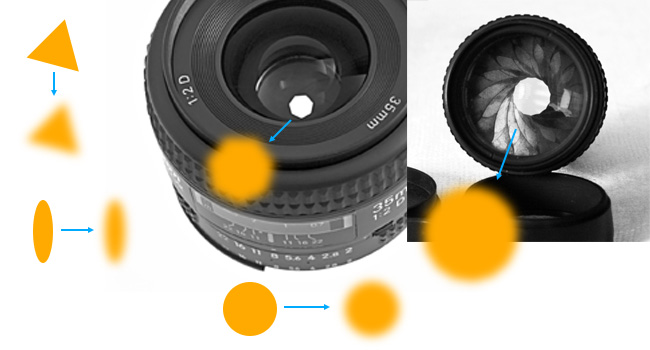
- Aperture Shape: Cut a hole in a piece a paper and shine light through it, the light takes on the shape of the hole. Same for windows. So, why should it be different for lens apertures? The shape of the aperture directly affects how out-of-focus light sources appear. If the aperture is circular or polygonal, the points of light in the out-of-focus area are not truly “blurred” into oblivion. Instead, they take on the shape of the aperture itself. This is why you often see lights as circular or polygonal shapes. If the aperture blades are more, the shape formed is near-circular, and the bokeh will tend to be circular. However, if the aperture blades are lower, the shapes formed are more angular, and the highlights can take on a triangular, hexagonal or octagonal shape.
- Anamorphic lenses: Anamorphic lenses squeeze the background to a different degree compared to the plane of focus, so you get oval highlights. The aperture is “round”, but it’s the shape of the front or back element in the lens itself that causes this anomaly.
- Lens Aberrations: Optical imperfections in lenses, such as spherical or chromatic aberrations, can cause highlights to appear with clearly defined edges, even when out of focus. These aberrations make certain parts of the light rays bend differently as they pass through the lens, affecting how the light is spread on the sensor and keeping the edges sharper than you might expect.
- Point Light Sources: Point light sources (e.g., street lights, fairy lights) are so intense that they stand out more clearly, even in out-of-focus areas.
- Contrast: The strong contrast between bright light sources and the darker background exaggerates the clarity of the out-of-focus highlights. These points of light are bright enough that their boundaries remain visible against the dimmer parts of the image, making them seem less blurred.
- Spherical Aberration: Lenses with well-corrected spherical aberration produce smooth bokeh with soft, diffused edges. However, lenses with less correction may produce bokeh with harder, more defined edges around the highlights.
- Focal lengths: Depending on the focal length and distance to the subject, the zone of focus can be long or short. E.g., if you’re using a telephoto lens with a wide aperture, the change is abrupt. This is called fall-off.
To summarize, by controlling the lens, the aperture and the lights used, you can create shapes in the background that add to the composition of an image.
The shape and quality of this “non-blur” are what we refer to as bokeh.
The practical role of bokeh is its aesthetic quality, similar to other optical characteristics like flare, horizontal lens flare, and so on.
Where does the word “bokeh” come from?
From Wikipedia:
The term “bokeh” comes from the Japanese word boke (??/??), which means “blur” or “haze”, resulting in boke-aji (???), the “blur quality”.
Wikipedia
One thing I can’t settle is the pronunciation of the word ‘bokeh’. I pronounce it as Bo (as in So) + Ka (as in Cut without the t sound). I’ve also seen people pronounce it as Bow-Kay.
Does bokeh have to always have sharp edges?
No!
The way the out of focus elements blend together can also create an impression on the viewer. I would also consider this as bokeh.
Take a look:

In the above image, the first bokeh is brighter at the edges. In the second bokeh, the light is even. In the third bokeh, the light is brighter in the center and gradually drops off.
Try mentally mixing these bokehs with each other. The first one won’t mix very well, which is why you see individual circles overlapping each other without mixing. The third will blend in very well, while the second one can go either way (in theory it should work but in practice nothing is that even – the edges are still discernible).
The edges can also be brought into sharp relief with chromatic aberrations in the lens. The question of bokeh might as well be reduced to:
Do you like edges in your bokeh?
What difference does it make? Let me give you a few examples.
How to understand the practicality of bokeh in cinematography
In this first image from Interstellar, the background elements are blending in nicely, as a creamy layer:

Now here’s a stock image where the background elements don’t blend together so gracefully:

Do you find it distracting from the subject (the woman, who is in focus)?
It’s subjective! Some people like it, as in this frame:
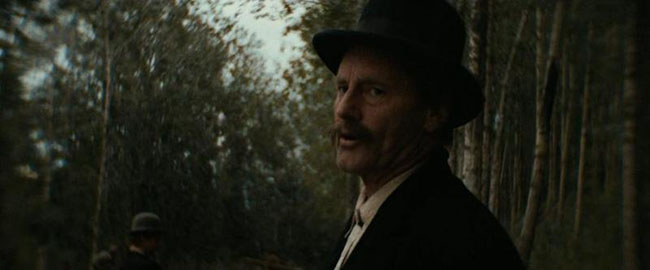
This is an example of what is popularly known as “swirly bokeh”.
Only you can decide.
So remember, in cinematography, bokeh helps viewers perceive depth and focus in different ways. It’s a visual tool that can add richness and dimension to your composition.
It should be a controlled visual effect.
Now let’s get back to bokeh with sharper edges. Here’s a busy bokeh effect:

You make up your own mind as to whether it’s good or bad bokeh, but it is busy.
Here’s a bokeh that we are more familiar with:

Somehow, even though this is busy as well, it doesn’t look too bad. Or does it?
Finally, when you blend colorful bokeh, you can get interesting effects:

I hope you get the idea.
In cinematography, creating a sense of depth is essential, especially in narrative storytelling where isolating a subject can heighten the emotional impact.
By controlling bokeh, you can emphasize the subject while still providing a textured, artistic background. That’s the whole idea.
Types of Bokeh in Cinematography
Here’s a look at some of the key names you’ll encounter in association with bokeh:
- Smooth Bokeh: Smooth bokeh blends well with the surrounding out-of-focus areas. High-quality cinema lenses with circular aperture blades can give this look. Smooth bokeh doesn’t distract from the subject. For example, lenses like the ARRI Signature Primes are known for their 11-blade apertures, which create very round and smooth bokeh.
- Harsh Bokeh: Harsh bokeh is characterized by sharp edges around the out-of-focus highlights. The resulting bokeh can appear busy or distracting. As we’ve seen in the examples earlier, the harshness can be used artistically well, or not.
- Swirly Bokeh: Swirly bokeh is created when the background elements seem to twist or swirl around the subject. This effect is more common with vintage or specialty lenses and can add a surreal or dreamlike quality to a shot. vintage lenses like the Cooke Speed Panchro or Canon K35s are known for their unique, often imperfect bokeh.
- Common bokeh shapes:
- Triangle, Hexagonal, Octagonal bokeh: Caused by the shape formed by the aperture.
- Cats-eye bokeh: Caused by the distortions of lenses at the edges of the frame.
- Oval Bokeh: Anamorphic lenses create oval-shaped highlights. It is the hallmark of the anamorphic look and is highly sought after.
Here’s a tip: Longer focal lengths inherently produce more noticeable bokeh. When you use telephoto lenses the background appears more compressed and out of focus, making the bokeh more prominent.
How to use Aperture Blades to control the shape of the Bokeh
The shape of the bokeh is influenced by the number and design of the aperture blades in the lens. Cinema lenses with more blades (often 9 or 11) create rounder, more aesthetically pleasing bokeh, while lenses with fewer blades may create polygonal bokeh shapes.
Wide open lenses with a large aperture like T1.3 or T1.5 tend to create circular bokeh. However, as you stop down, the shape of the aperture can become more angular, and the bokeh may start to take on a hexagonal or octagonal shape, depending on the number of blades.
Bokeh is a powerful cinematic tool that adds depth, emotion, and visual texture to your shots. Whether you’re using a wide-open lens to create creamy, smooth bokeh, or experimenting with vintage lenses for a more artistic effect, understanding how bokeh works will elevate your cinematography.
I hope my explanation has provided a bit of clarity about bokeh in cinematography.
Now, go out and experiment, that’s the only way you can know what you like. After all, whatever you do in one shot is not as consequential as the emotional impact it has as part of a series of shots that tell a good story.
That’s what interests me the most.

Thank you for you article. Loved it!
Any recommendation for vintage lens with creamy bokeh ? Especially for video ?
Creamy bokeh is not about vintage lenses. Also, there are lots of nuances with focal lengths, apertures and distance the only way to know if something works is to test it.
You may want to mention the use of internal circular ND for perfect bokeh. The famous example came from Minolta, but since Sony acquired their patents, there is the 100mm f2.8 STF now: https://www.sony.co.id/en/electronics/camera-lenses/sel100f28gm
Bokeh doesn’t get any creamier than that!
Fuji has one too, but it was not that great when I shortly tested it.
And on the other end of the spectrum is the donut bokeh from RF lenses. My wife loves it in photography (and is wishing for something shorter than 250mm).
Thank you!
URL to Zeiss download fail to authenticate. I searched google and found it: