

ARRI has long been a pioneer in pushing the boundaries of cinematography. Their latest release, the ALEXA 265, cements their reputation for being the de facto standard for filmmakers worldwide.
The Arri ALEXA 265 is a digital 65mm camera, a newer and updated version of the original Arri ALEXA 65 camera that I’d covered here. The ALEXA 265 redefines what’s possible in 65mm filmmaking by combining 65mm image quality with a compact and lightweight design.
In this article, I’ll explore what’s new on the ALEXA 265, and what it means for the future of cinema.
If you want to know what the hype about 65mm cinema is all about, check out this definitive article:

What is the Arri ALEXA 265?
Here’s a detailed comparison table for the ARRI ALEXA 265, summarizing its key features and specifications (main differences to the ALEXA 65 are highlighted in color):
| Feature | Specification |
|---|---|
| Camera Type | 65mm format digital cinema camera |
| Sensor | ARRI A3X Rev.B CMOS |
| Image Aperture | 54.12 mm x 25.58 mm |
| Sensor Resolution | 6560 x 3100 |
| Dimensions | Length: 199.4 mm (7.85 in) Width: 163.9 mm (6.45 in) Height: 147 mm (5.79 in) |
| Weight | 3.3 kg (7.3 lbs) |
| Lens Mount | ARRI LPL Mount (LBUS) ARRI PL Mount (LBUS) ARRI PL Mount (Hirose) ARRI EF Mount (LBUS) Leitz M Mount for ARRI |
| Shutter | Electronic, 5.0° to 358.0°, adjustable with 1/10° precision (1s – 1/8000s) |
| Frame Rates | 0.75 to 60 fps (All resolutions) |
| Exposure Index | EI 160 to EI 6400, base sensitivity EI 800 |
| Dynamic Range | 15 stops |
| White Balance | 2000K to 11000K |
| ND Filters | Not built-in, External Drop-in Filter Cartridge System from 0 to 2.7 ND (0 to 9 stops) |
| Recording File Format | ARRIRAW only, MXF Container |
| Recording Media | Codex Compact Drive 1TB and 2TB |
| Recording Time | Approximately 11 minutes at 24 fps on a 1 TB drive i.e. 1,588 MB/s or 1.59 GB/s. |
| Viewfinder | OLED MVF-2 with 4″ flip-out touchscreen LCD monitor, 1920×1080 |
| Outputs | 2x 12G-SDI (BNC) up to 4:4:4 12G UHD, Audio via SDI |
| Audio Input | 1x LEMO 6-pin balanced stereo line in with 12 V power 2x built-in microphones for scratch audio |
| Audio Format | 4-channel linear PCM, 24-bit 48 kHz |
| Power Input | 1x PWR (LEMO 8-pin) 1x BAT (camera rear interface/battery adapter) 20.5 – 33.6 V DC |
| Power Consumption | 75 W (Camera body and MVF-2) |
| Operating Temperature | -20° C to +45° C (-4° F to +113° F) at 95% relative humidity max |
| Weather Protection | Non-condensing, splash and dust proof (IP 51) |
| Storage Temperature | -30° C to +70° C (-22° F to +158° F) |
| Operating Sound Level | Less than 20 dB(A) at 30 fps 6.5K at less than +30° C ambient temperature |
| Price | Rental Only |
Is there a new sensor?
Sort of yes, I guess. In their own words:
Does the ALEXA 265 have a new sensor?
Yes, a comprehensive sensor revision has resulted in the new 6.5K ALEV3X Revision B sensor, incorporating new hardware, not just new software.
Is the ALEXA 265 image better than ALEXA 65?
Yes. Higher dynamic range, higher sensitivity, richer blacks, more accurate colors.
Arri
From what I can gather, it’s an overhauled and re-engineered stitched ALEV III A3X sensor, the same as in the ALEXA 65, but with completely new circuitry and thermals.
I also assume the optical low pass, UV, IR filters have been re-designed as well, but I could be wrong because the pixel pitch, resolution and sensor size is exactly the same as the ALEXA 65.
However, the differences in image quality is substantial:
- 15 stops of dynamic range
- Up to ISO 6400, so it will be cleaner and better in low light
- Up to 60 fps in all modes
Bottom line I think productions have no reason to ask for the original ALEXA 65, though it hasn’t been officially discontinued. Both cameras are rental only, so if you have special requirements it’s worth speaking to Arri directly.
Do the images look the same as the ALEXA 65?
No.
The ALEXA 265 incorporates ARRI REVEAL color science, and the log mode is LogC4, not LogC3.
Arri has a substantial look library for LogC4. It’s worth noting that LUTs from the ALEXA 65 are not compatible with the 265. You need LUTs for LogC4.
Both are available for download from the Arri website.

A game-changing form factor
One of the most significant updates in the ALEXA 265 is its size and weight. Compared to the ALEXA 65, the 265 is about three times smaller and lighter, weighing only 3.3 kg (7.3 lbs).
This leap in portability makes handheld operation, gimbal use, and mounting on stabilizers far more practical.
Here’s a comparison between three 65mm systems in terms of size and weight:
| Camera | Dimensions in inches | Volume in cubic inches | Weight in kg |
|---|---|---|---|
| Arri ALEXA 265 | 7.85 x 6.45 x 5.79 in | 293 | 3.3 kg |
| Arri ALEXA 35 | 5.8 x 6 x 8 in | 278 | 2.9 kg |
| Blackmagic Design URSA Cine 17K* | 11 x 6 x 6 in | 396 | 3.96 kg |
| Arri 765 65mm Film Camera | 22.4 x 14.6 x 15.7 in | 5,134 | 32 kg |
The ALEXA 265 is probably the smallest 65mm camera ever. It’s a sign of things to come, I think the day isn’t far off when cameras will weigh just a kilogram. We are at risk of losing it on set!
Here’s a comparison of its sensor size to traditional 65mm and other 65mm cameras:

How the ALEXA 265 fits in with the ALEXA 35
One important distinction between the ALEXA 265 and ALEXA 35 is the former only draws 75 Watts of power, while the latter draws 90 Watts. The Alexa 35 offers Prores and greater processing but even so, it’s an odd difference.
And it’s even more impressive considering the ALEXA 265 is as quiet as any other Alexa.
The ALEXA 265 is fully compatible with accessories from the ALEXA 35, with only minor modifications required.
Do the two cameras match? From Arri:
All ALEXA 265 and ALEXA 35 cameras are super color-matched to each other, simplifying color grading, and the ALEXA 265’s advanced LED calibration streamlines virtual production and LED volume work.
Arri
Important to test: In may ways the look of the ALEXA 265 will be similar to the Alexa 35, though it will be interesting to see if we can match between both cameras through looks alone. The sensors are totally different.
I don’t doubt the images will be as good as the Alexa 35, though the latter has a greater dynamic range.
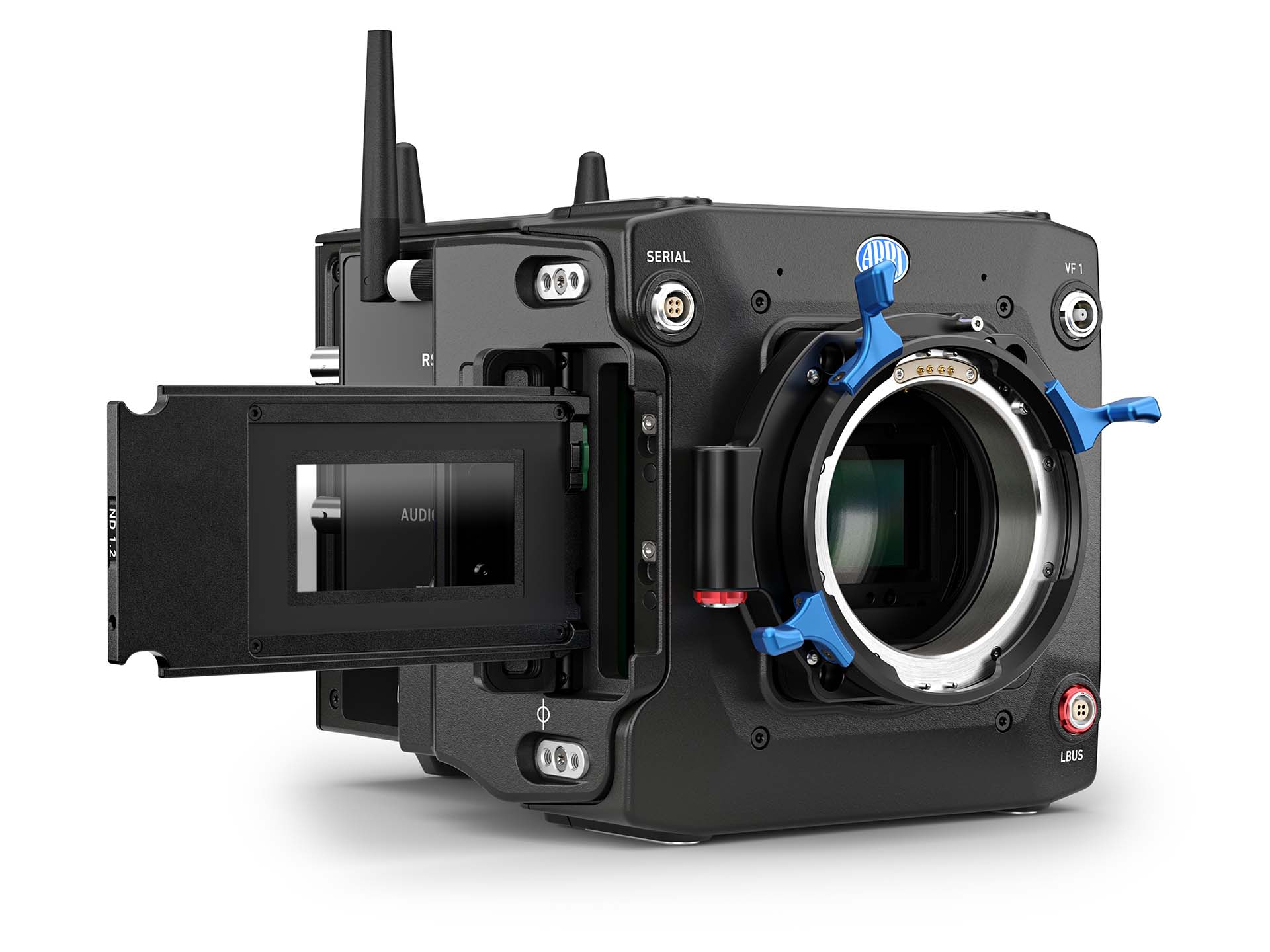
The new filter cartridge system
One of the standout innovations in the ALEXA 265 is its unique filter cartridge system. A hinged door allows filters to slide directly in front of the sensor, with options including:
- ARRI FSND filters (0 to 2.7, i.e. 0 to 9 stops) in single-stop increments
- Diffusion and creative filters (currently under development)
Each filter is encoded with a chip for metadata integration, streamlining tasks on set and in post-production.
You don’t have to use these filters if you don’t want to, but as the ALEXA 265 is a rental item I can’t imagine anyone not taking advantage of full spectrum ND filters designed specifically for the camera sensor.
HDE
The ALEXA 265 records exclusively in ARRIRAW (no Prores) in an MXF container.
The Codex High-Density Encoding (HDE) ensures the file sizes are reduced by up to 40% without compromising image quality. Still, the data rate is pretty high at about 1.58 GB/s.

Improved Connectivity
The ALEXA 265 includes updated inputs and outputs. Some highlights:
- Two 12G-SDI outputs
- One SERIAL (LEMO 4-pin) for distance measuring accessories
- One USB-C for user setups, look files, etc.
- Ethernet and WiFi (built-in) for metadata streaming and camera control
- LBUS for motorized lens control
- Various power outputs
These features make it easier to integrate the camera into modern production environments, including virtual and LED-based setups.
Who Is the ALEXA 265 For?
The ALEXA 265 is not just for large-scale productions anymore. Its improved usability and reduced weight make it suitable for:
- Independent filmmakers looking for the 65mm look.
- Documentarians requiring a lightweight camera with jaw-dropping visuals (though it is restricted to 60 fps)
- Commercial productions where high-end visuals are demanded by the client.
Pretty much anyone who can afford it! The caveats are:
- Data rates will be much higher than an ALEXA LF or ALEXA 35.
- You need 65mm lenses. There are lots of lens mount options so you’re really spoilt for choice. For a list of lenses rented out by Arri, click here.
- It’s rental only so there might be added costs for imports, shipping and insurance.
- It’s up to 60 fps only.
It’s definitely going to be a popular camera, as the ALEXA 65 shows already. What I’m more interested in is to see how well people will adopt the REVEAL color science and looks. It’s totally different from the out-of-the-box look you get with LogC3 to 709 everyone loves on the Alexa LF and original Alexa cameras.
The only thing missing is that the ALEXA 265 doesn’t have a 120 fps recording mode. That would have made it a game changer. The Arri 765 can go up to 100 fps. Can’t think of anything else.
Whether you’re an industry veteran or an emerging talent, the ALEXA 265 is a camera that inspires you to push the boundaries of cinematic storytelling.
What do you think?
