

If you’ve ever shopped for a camera or lens, you’ve probably heard the term “crop factor.” While it’s a common topic in cinematography, many people find it confusing.
But don’t worry, this article will break down what crop factor really means, and how to use them to your advantage when selecting lenses.
By the end, you’ll be equipped with the knowledge to make smarter decisions and avoid falling for marketing gimmicks.
Are there really four types of crop factor?
Yes, there are actually four types!
If you’re confused, don’t worry, it’s not your fault. I’ll simplify it for you.
By understanding these four crop factors, you’ll be able to make informed decisions when choosing lenses for your camera. Let’s get to it.

What is a crop factor?
You use the crop factor when you need to use a particular lens on a camera with a sensor it wasn’t designed for.
Let me explain.
E.g., a Canon RF 50mm f/1.2 L USM lens is designed for a full frame sensor. A full frame sensor has a size of 36mm x 24mm, which is what you have on cameras like the Canon EOS R5 Mark II, etc.
This is what it a hypothetical frame might look like:

The lens is designed specifically to cover full frame sensors. And, that is how it will deliver all the characteristics it was designed to deliver. We’ll talk more about this later.
But, what if you want to use the same lens on a Canon APS-C camera? An APS-C sensor might have a sensor close to 22.3mm x 14.8 mm.
Can you do that? Yes, you can, because both cameras have the same lens mount, canon RF. However, when you do that, you see some parts have been cropped off:

This is what it roughly looks like (trying to keep it simple in layman’s terms):
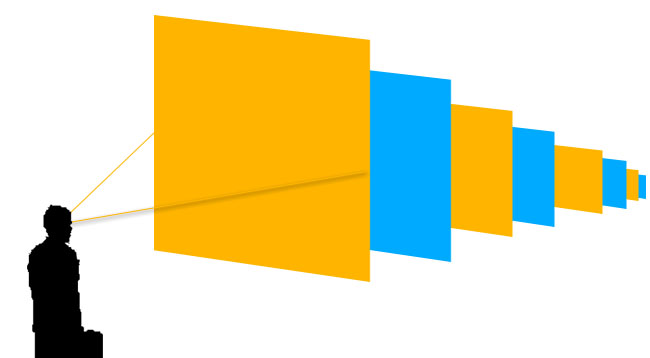
The smaller the sensor, the higher the “crop”. The field of view gets smaller and smaller.
In the modern cinematography age, it’s common for cinematographers to use lenses on systems they were not initially designed for. So, before you do that, it might benefit in knowing how much of the image area is being cropped.
That’s where the crop factor comes in.
What is the crop factor?
Crop factor is the ratio of (something) of one sensor to the same (something) of another sensor, so you know how they compare in field of view terms.
What is this “something”? It can be any geometrical aspect of the sensor.
One of the most common is the diameter of the sensor:
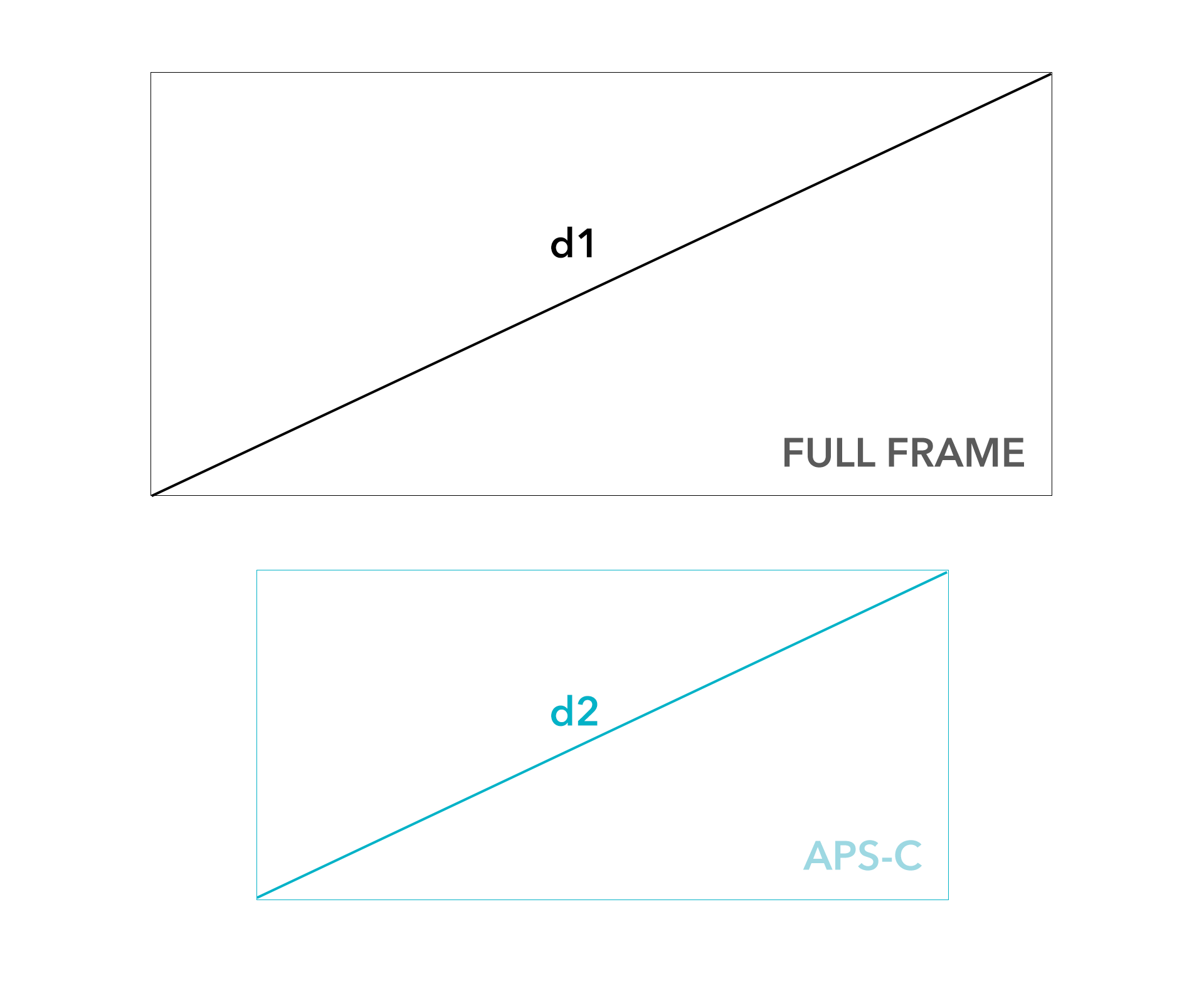
In this case, if the “something” is the diameter, the crop factor is d1/d2.
In our hypothetical example above, the diameter of a full frame sensor is 43.27mm. That’s d1. The diameter of the APS-C sensor is 26.76mm, which is d2.
Therefore, the crop factor is d1/d2, or 43.27/26.76 = 1.62.
That is, if the “something” is the diagonal. What if you pick another “something”?
The four types of crop factors
For a sensor with width W and height H, there are four “somethings” you can use to calculate the crop factor:
- Length or Width = W
- Height = H
- Diagonal = D
- Area = W x H
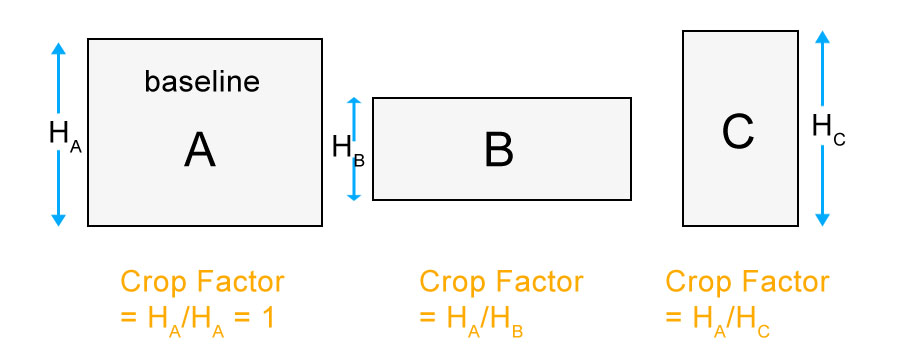
The Horizontal Crop Factor
In this crop factor the “something” is the length or width horizontally. In the cinema world, the horizontal length is longer than the vertical height. For more information on this, check out this video on aspect ratios:
Here’s how it works:

You compare the horizontal lengths or widths of two sensors. What you get is the Horizontal Crop Factor.
The Vertical Crop Factor
You guessed it, the Vertical Crop Factor compares sensor heights:
The Diagonal Crop Factor
We already covered this in our earlier example. This is what it looks like:

There is a good reason for the existence of the diagonal crop factor: the image circle.
A sensor is always designed to fit within the image circle of a lens. If a sensor fits perfectly, the diameter of the image circle should correspond to the diagonal of the frame:

The “Area” Crop Factor
This is a rare one, but some people still use the area of the sensors as the “something”:

The Area Crop Factor is as beneficial as a megapixel, or a pat on the back when you’re sinking in quicksand.
Why? Now let’s compare the four crop factors for which is the most practical and why.
Which is the best type of crop factor to use?
Cinema frames are longer horizontally than vertically. When a director frames a shot, he or she is typically thinking of both the horizontal and the vertical axis.
If you want to fit a house or car in the frame, the horizontal aspect is important. If you’re cropping off the house or car, you’ll step back to get them the frame.
Unless, your house is a skyscraper or any tall building. In that case, you’ll still have to step back to get the building to fit in the vertical space available.
Aspect ratios like 16:9 have a greater height available when compared to the more famous 2.39:1 aspect ratio. On the latter, you’ll step back even more to get the building in the shot, and you’ll have more space on the sides.
One scenario the vertical crop factor comes in handy is if you want to match the shot size (close-up, mid-shot, long-shot, etc.) between different sensors. Here’s an example:

As you can see, the width of the sensor just ‘hangs around’ as you pin your model to the desired height. When you change a sensor, you want to keep this height constant, so you will choose the vertical crop factor to find a lens that will give you a similar angle of view – in the vertical direction.
However, you’re always limited by the size of your set. You can only step back so far in filmmaking.
Use either the horizontal or the vertical crop factor. Both have good practical uses. Leave the diagonal and area crop factors for the kids and the trolls.
Out of the two, though, I prefer the horizontal crop factor because a sensors size is fixed. Yet, a typical cinema camera will allow me multiple aspect ratios. Here are the options you get with an Arri Alexa LF:
- 1.44:1 Open Gate 4.5K: 36.70 x 25.54 mm
- 16:9 UHD: 31.68 x 17.82 mm
- 2.39:1 4.5K: 36.70 x 15.31 mm
Many cinematographers film in Open Gate and just crop to the desired size later. But you can also use Open Gate for Anamorphic filming.
When you use the same Open Gate for 2.39:1 the vertical height is cropped, but the horizontal size is the same. When you use a 50mm lens in both, you get the same horizontal field of view, but a cropped field of view in the 2.39:1 frame. However, very few people do this, because Open Gate isn’t a standard delivery mode anyway.
In the UHD mode, the horizontal size is smaller, but so is the vertical size, in proportion.
You have to remember that crop factor is all about comparing sensors, not aspect ratios. Your goal is to understand the change in field of view from one sensor to the next. I’ve found, in practice, specifically in cinematography, the horizontal crop factor is more useful all round over the vertical crop factor. I’ve rarely needed the latter.
The diagonal crop factor makes sense in theory, but is neither here nor there for practical cinematography. You don’t get an exact value for the horizontal or vertical fields of view.
If you’re filming in vertical mode, especially for social media, the vertical crop factor might be more useful.
However, I recommend you stick to the horizontal crop factor when you’re starting out and only change when you really need it.
Crop factors of a few formats
The following table shows a few formats, the sensor or frame sizes and the horizontal and vertical crop factors. All compared to 36mm x 24mm full frame:
| Format or Camera | L in mm | H in mm | H Crop Factor | V Crop Factor |
|---|---|---|---|---|
| Super 8mm Film | 5.79 | 4.01 | 6.22 | 5.99 |
| Super 16mm Film | 12.52 | 7.41 | 2.88 | 3.24 |
| Academy Film | 21 | 15.2 | 1.71 | 1.58 |
| Alexa 35 4.6K Open Gate | 28 | 19.2 | 1.29 | 1.25 |
| Super 35 3-perf Film 1.85:1 | 24.89 | 13.45 | 1.44 | 1.78 |
| Full Frame 35mm | 36 | 24 | 1 | 1 |
| Vista Vision Film | 36 | 18.3 | 1 | 1.31 |
| 65mm Film | 52.63 | 23.01 | 0.68 | 1.04 |
| 645 Film | 56 | 41.5 | 0.64 | 0.58 |
| Alexa 65 | 54.12 | 25.58 | 0.67 | 0.94 |
| IMAX 70mm Film | 70.41 | 48.5 | 0.51 | 0.49 |
| 4×5 Large Format Film | 118.11 | 92.71 | 0.30 | 0.26 |
| 8×10 Large Format Film | 250 | 200 | 0.14 | 0.12 |
You don’t have to stick to full frame 35mm. You can pick any two formats and find the crop factors for those. E.g., Alexa 35 compared to 65mm film will have a 0.97 horizontal crop factor and a 0.9 vertical crop factor.
Once you know the crop factor you can use it for all lenses between the two formats. If the crop factor between two sensors is 1.90, say, then no matter what lens you use, you can multiply it by 1.9 to find the equivalent focal length on the smaller sensor.
When you compare a sensor to full frame 35mm, you call it the 35mm equivalent. Read more about it here:
With the 35mm equivalent, you are comparing focal lengths of lenses to full frame 35mm, whereas with the crop factor you can compare any two sensors directly.
I hope you have a firmer grasp on crop factors now that you’ve read the article.

Thank you for all these very usefull informations. I think you made a little mistake for the sensor super 35mm 3 perf height, right?
You’re site is fantastic. Thank you!