
First, the video:

This is a fun exercise, a proper study is required. Here are the major errors in this data:
- It only accounts for 10 films per year.
- The filming dates are from IMDb or Wikipedia and might be wrong.
- I could have made errors counting days (error of ±5 days).
- The filming dates might not include breaks or gaps in the shooting schedule.
- It doesn’t account for the number of hours shot per day. A more accurate estimate is from the number of hours shot.
- I’ve tried to mix low budget films and big blockbusters, but the sheer variety of films made per year was not taken into account.
- It does not take into account action vs dialogue scenes, etc.
- It does not take into account the movie’s running length, or shooting ratio (how much was shot vs thrown away).
- The problem is compounded because there’s relatively more accurate data for recent films over older films.
- The equipment and type of shooting was different over the ages.
- And on and on and on.
So let me stress again this is not a scientific study, nor a definitive statement. But I thought the results are interesting so I’d share. Maybe a film school could take on the challenge and publish the data.
First the films. I’ve chosen ‘great’ films as recommended by Google search, of which filming dates were available. I thought keeping it random like this would improve the odds of accuracy. Bias can still creep in, because Google never recommends the same thing to everybody.
Here’s the complete list:
1920s
| # | Title | Released | Shot (approx.) | Approx. Days |
|---|---|---|---|---|
| 1 | The Birth of a Nation | 1915 | 1914 | 90 |
| 2 | The Cabinet of Dr. Caligari | 1920 | 1919 | 30 |
| 3 | Nosferatu | 1922 | 1921 | 60 |
| 4 | Ben Hur | 1925 | 1924 | 660 |
| 5 | Faust | 1926 | 1925 | 180 |
| 6 | The General | 1926 | 1925 | 100 |
| 7 | Metropolis | 1927 | 1926 | 510 |
| 8 | The Jazz Singer | 1927 | 1926 | 60 |
| 9 | The Cameraman | 1928 | 1927 | 74 |
| 10 | Un Chien Andalou | 1929 | 1928 | 55 |
1930s
| 1 | Frankenstein | 1931 | 1930 | 40 |
| 2 | City Lights | 1931 | 1930 | 180 |
| 3 | M | 1931 | 1930 | 42 |
| 4 | Freaks | 1932 | 1931 | 24 |
| 5 | It Happened One Night | 1934 | 1933 | 40 |
| 6 | L’Atalante | 1934 | 1933 | 120 |
| 7 | Gone with the Wind | 1939 | 1938 | 330 |
| 8 | The Rules of the Game | 1939 | 1938 | 90 |
| 9 | Mr. Smith Goes to Washington | 1939 | 1938 | 94 |
| 10 | The Grapes of Wrath | 1939 | 1938 | 44 |
| 11 | The Great Dictator | 1940 | 1939 | 539 |
1940s
| 1 | Citizen Kane | 1941 | 1940 | 115 |
| 2 | How Green Was My Valley | 1941 | 1940 | 64 |
| 3 | Casablanca | 1942 | 1941 | 75 |
| 4 | The Magnificient Ambersons | 1942 | 1941 | 84 |
| 5 | Double Indemnity | 1944 | 1943 | 57 |
| 6 | It’s a Wonderful Life | 1946 | 1945 | 102 |
| 7 | The Big Sleep | 1946 | 1945 | 92 |
| 8 | Notorious | 1946 | 1945 | 100 |
| 9 | The Treasure of the Sierra Madre | 1948 | 1947 | 165 |
| 10 | The Third Man | 1949 | 1948 | 42 |
1950s
| 1 | Singin’ in the Rain | 1952 | 1951 | 156 |
| 2 | On the Waterfront | 1954 | 1953 | 69 |
| 3 | Rebel Without a Cause | 1955 | 1954 | 58 |
| 4 | 12 Angry Men | 1957 | 1956 | 21 |
| 5 | The Bridge on the River Kwai | 1957 | 1956 | 165 |
| 6 | Touch of Evil | 1958 | 1957 | 42 |
| 7 | Vertigo | 1958 | 1957 | 45 |
| 8 | Ben-Hur | 1959 | 1958 | 240 |
| 9 | Some Like it Hot | 1959 | 1958 | 92 |
| 10 | Psycho | 1960 | 1959 | 80 |
1960s
| 1 | Breakfast at Tiffany’s | 1961 | 1960 | 120 |
| 2 | Lawrence of Arabia | 1962 | 1961 | 126 |
| 3 | Sound of Music | 1965 | 1964 | 155 |
| 4 | Blow-up | 1966 | 1965 | 90 |
| 5 | The Graduate | 1967 | 1966 | 120 |
| 6 | Bonnie and Clyde | 1967 | 1966 | 88 |
| 7 | Rosemary’s Baby | 1968 | 1967 | 105 |
| 8 | Night of the Living Dead | 1968 | 1967 | 180 |
| 9 | Butch Cassidy and the Sundance Kid | 1969 | 1968 | 120 |
| 10 | Midnight Cowboy | 1969 | 1968 | 126 |
1970s
| 1 | The Godfather | 1972 | 1971 | 100 |
| 2 | Chinatown | 1974 | 1973 | 90 |
| 3 | Barry Lyndon | 1975 | 1974 | 240 |
| 4 | Jaws | 1975 | 1974 | 159 |
| 5 | Rocky | 1976 | 1975 | 55 |
| 6 | Halloween | 1978 | 1977 | 21 |
| 7 | The Deer Hunter | 1978 | 1977 | 195 |
| 8 | Apocalypse Now | 1979 | 1978 | 238 |
| 9 | Alien | 1979 | 1978 | 98 |
| 10 | Friday the 13th | 1980 | 1979 | 30 |
1980s
| 1 | Raiders of the Lost Ark | 1981 | 1980 | 120 |
| 2 | The Evil Dead | 1981 | 1980 | 72 |
| 3 | The Thing | 1982 | 1981 | 84 |
| 4 | Blade Runner | 1982 | 1981 | 90 |
| 5 | ET | 1982 | 1981 | 88 |
| 6 | Nightmare on Elm Street | 1984 | 1983 | 32 |
| 7 | Aliens | 1986 | 1985 | 150 |
| 8 | Dirty Dancing | 1987 | 1986 | 52 |
| 9 | Do the Right Thing | 1989 | 1988 | 55 |
| 10 | Goodfellas | 1990 | 1989 | 100 |
1990s
| 1 | Reservoir Dogs | 1992 | 1991 | 33 |
| 2 | Schindler’s List | 1993 | 1992 | 73 |
| 3 | Pulp Fiction | 1994 | 1993 | 51 |
| 4 | Forrest Gump | 1994 | 1993 | 138 |
| 5 | Seven | 1995 | 1994 | 55 |
| 6 | Before Sunrise | 1995 | 1994 | 33 |
| 7 | Titanic | 1997 | 1996 | 235 |
| 8 | Psycho remake | 1998 | 1997 | 52 |
| 9 | Fight Club | 1999 | 1998 | 138 |
| 10 | The Sixth Sense | 1999 | 1998 | 52 |
2000s
| 1 | Ocean’s Eleven | 2001 | 2000 | 115 |
| 2 | The Royal Tenenbaums | 2001 | 2000 | 90 |
| 3 | Catch Me if You Can | 2002 | 2001 | 52 |
| 4 | Napoleon Dynamite | 2004 | 2003 | 25 |
| 5 | Million Dollar Baby | 2004 | 2003 | 40 |
| 6 | Little Miss Sunshine | 2006 | 2005 | 30 |
| 7 | The Departed | 2006 | 2005 | 127 |
| 8 | The Devil Wears Prada | 2006 | 2005 | 57 |
| 9 | Iron Man | 2008 | 2007 | 102 |
| 10 | The Dark Knight | 2008 | 2007 | 200 |
2010s
| 1 | Drive | 2011 | 2010 | 48 |
| 2 | Zero Dark Thirty | 2012 | 2011 | 88 |
| 3 | Dallas Buyers Club | 2013 | 2012 | 25 |
| 4 | The Guardians of the Galaxy | 2014 | 2013 | 92 |
| 5 | The Hateful Eight | 2015 | 2014 | 137 |
| 6 | La La Land | 2016 | 2015 | 30 |
| 7 | Get Out | 2017 | 2016 | 23 |
| 8 | Us | 2019 | 2018 | 67 |
| 9 | Once Upon a Time in Hollywood | 2019 | 2018 | 133 |
| 10 | The Irishman | 2019 | 2018 | 108 |
Movie schedules over the decades
Now here’s a summary, per decade:
| Decade | Average (<100 days) | Total average |
| 1920s | 67 | 182 |
| 1930s | 53 | 140 |
| 1940s | 77 | 90 |
| 1950s | 58 | 97 |
| 1960s | 94 | 123 |
| 1970s | 66 | 123 |
| 1980s | 72 | 84 |
| 1990s | 50 | 86 |
| 2000s | 57 | 84 |
| 2010s | 60 | 75 |
| Grand Average | 65 days | 108 days |
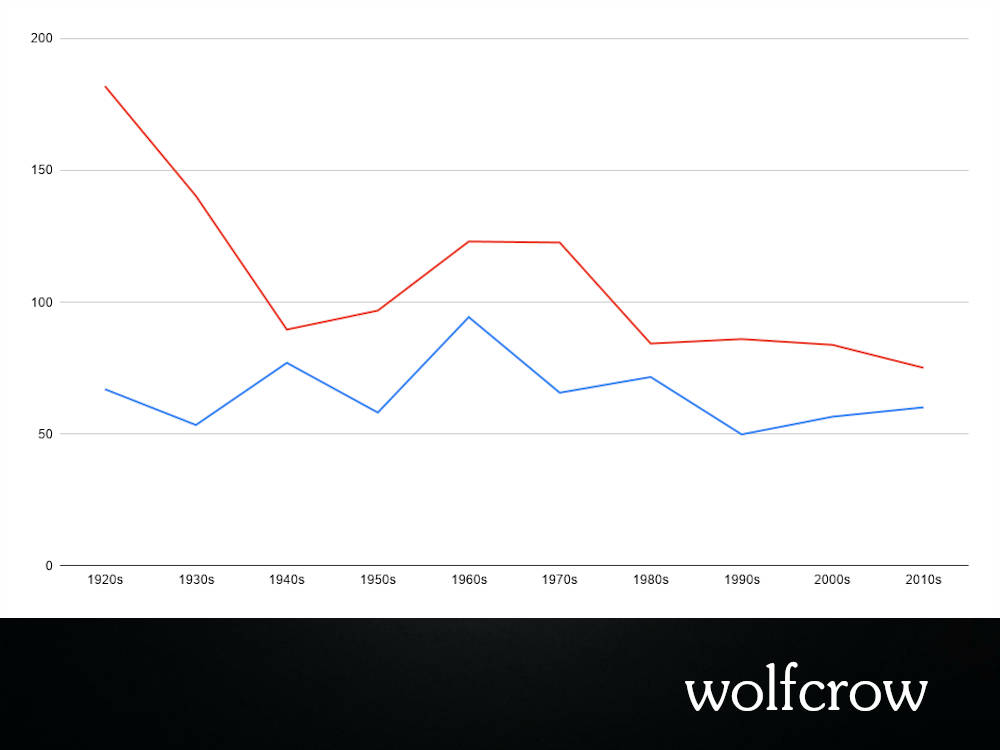
I’ve made two averages. One is the total, taking into account all films in that decade. The second is the average of movies that have a schedule less than 110 days. This eliminates those movies that took too long.
Here’s a graphical representation:
Does it take half as long to make a movie today than 50 years ago?
As I write this, it’s 2020. Fifty years ago it was 1970. As you can see, the average was almost twice (not exactly, but different enough for fun’s sake).
Did film directors in the 1960s-70s have a greater luxury in terms of shooting schedules? Let’s take a couple of examples.
Psycho
Psycho is a very instructive example because both Psychos (1961 vs 1997) are almost shot by shot copies. It should have taken roughly the same amount of time to shoot both. Hitchcock didn’t waste time on a film set!
But Psycho (1961) took 80 days to shoot. Psycho (1998) took 52 days to shoot. Assuming the data is accurate, that’s a huge difference.
Why should this be so? Cameras were lighter, lights were lighter. What about budgets?
| Movie | Original Budget | Budget in 2020 dollars |
|---|---|---|
| Psycho (1961) | $806,947 | $7,027,990 |
| Psycho (1998) | $60,000,000 | $96,372,710 |
The newer Psycho had a huge budget, even accounting for inflation. More than 10 times!!! If you account the cost per shooting day it’s even higher.
Let’s take another example.
Ben-Hur
Ben-Hur (1925) took 660 days. Ben-Hur (1959) took 240 days. Assuming the data is accurate, that’s three times the difference.
Here are the budgets:
| Movie | Original Budget | Budget in 2020 dollars |
|---|---|---|
| Ben-Hur (1925) | $4 million | $60,303,391 |
| Ben-Hur (1959) | $15 million | $133,804,671 |
That’s twice the difference, but one-third the shooting dates!
Let me stress again the we need a lot more data to generalize, but for fun’s sake I’m going to do it anyway and say movies used to take a lot longer to make – maybe because it was cheaper.
Filmmakers could afford to spend more time. Actors gave more time. Crew unions charged lesser. Locations were cheaper, transportation and food was cheaper. There were no computers or visual effects. Sound and music was cheaper.
How long should an average movie take to film?
Keep in mind this is just about principal photography. There’s pre-production before and post production after.
It seems the gold standard is around the 60-day mark. Over the decades that hasn’t changed all that much.
A 90-100 minute film should take about 60 days to make, on average. That’s 1.5 script pages a day.
Of course, for low budget films this time is halved.
A 90-minute low budget film should take about 30 days to make, on average. That’s 3 script pages a day.
And, if you really want to make a movie like the big directors, you might have to go longer.
A 90-150 minute film can take 100 days to make, if you really want to indulge like they did in the 60s and 70s.
Note these movies:
| 1 | Breakfast at Tiffany’s | 1961 | 1960 | 120 |
| 4 | Blow-up | 1966 | 1965 | 90 |
| 5 | The Graduate | 1967 | 1966 | 120 |
| 6 | Bonnie and Clyde | 1967 | 1966 | 88 |
| 7 | Rosemary’s Baby | 1968 | 1967 | 105 |
| 8 | Night of the Living Dead | 1968 | 1967 | 180 |
| 9 | Butch Cassidy and the Sundance Kid | 1969 | 1968 | 120 |
| 10 | Midnight Cowboy | 1969 | 1968 | 126 |
Some of the movies have action scenes, but nothing extraordinary. Night of the Living Dead took long because of money issues. Putting that aside, you’d think these movies should only have taken 60 days according to today’s standards.
But the directors were lucky to get about 100 days on average. Again, this is going by the data and hoping it is accurate.
Now let’s look at the reverse and look at these movies from the last 10-20 years:
| Catch Me if You Can | 2002 | 2001 | 52 |
| Iron Man | 2008 | 2007 | 102 |
| The Guardians of the Galaxy | 2014 | 2013 | 92 |
| The Irishman | 2019 | 2018 | 108 |
Marvel movies, with their enormous budgets, are getting done in about 100 days. It shows how efficient they are at production. They should really have an Oscar for production.
And finally, note how fast Spielberg shoots:
| Movie | Days |
|---|---|
| Jaws | 159 days |
| Raiders of the Lost Ark | 120 days |
| Schindler’s List | 73 days |
| Jurassic Park | 96 days |
| Catch Me if You Can | 52 days |
| Minority Report | 115 days |
| Munich | 90 days |
| Lincoln | 60 days |
Jaws had tons of problems, but over the years his production unit works at a blistering pace.
Why it takes half as long to make a movie today than 50 years ago
I can only make guesses:
- You can roll for longer with digital cameras, so you can shoot faster and more per day.
- Cameras have become lighter and a lot cheaper, so you can have multiple cameras on set to cover all kinds of scenes.
- Films are a lot costlier to make due to astronomical labour costs.
- Locations are expensive. People know they can charge the big bucks if they have a good location.
- Actors charge too much, though that’s reducing nowadays.
- Markets have shrunk and competition is fierce, so studios need to cut costs.
- Marketing and advertising costs have skyrocketed due to social media costs and the additional manpower it takes to handle this behemoth.
- And here’s the worst: The perceived worth of a feature film has fallen dramatically. E.g., if a streaming platform charges $9.99 per month, and you watch one movie a day, that’s $0.03 per movie. If you want one movie a week that’s $2.50. One movie a month? Still only $9.99. And you’re competing with a library of content that just gets bigger and bigger…and bigger.
As far as I understand it, the indulgent filmmaking style is really tough on the wallet, no matter what kind of producer you are. And the falling perceived worth of a film is the nail in the coffin.
Today, asking for more than 30 days means you have major stars or the marketing muscle to get noticed in all this noise.
What do you think?

Sareesh,
I have been a full time professional still photographer for over 50 years. For many years i made enough money to rase 3 children buy a home and a studio building. In about 2006 I could see what digital photography, ie cell phones and the relative cheep very good quality fully automated digital cameras were doing to the professional photographer. One by one most of my very good commercial accosts were being taken over by in house staff that could operate a pretty good DSLR camera. Even my video training films went to in-house staff using an inexpensive camcorders. In short the perceived value of almost all types of media has been devalued by the glut of easy to make and have available for personal use .
I sold almost all my contract school photography contracts to a large national school picture company in 2007. This was a very good move for me. Very much fo the most profitable part of that business has disappeared Much the same problems affect the movie industry. I still love and am passionate about making ll types of images still and moving! I just don’t make a hole lot of money now.
Thank you for sharing your story, Danny. Today the wedding industry is probably the only one left with a decent margin.
Like when a student is asked to write an answer to a question.. if it is a 5 mark question, he will write it in 50 words, and if it is 15 mark question, he would elaborate it.. In a similar way, a story can be told in grand scale, and even in a small scale. It is director’s capability to get that marketing muscle to make a film of 15 mark, rather than the film actually requires… Just an opinion.. I liked your video…
Thank you!
Thanks sareesh,
What a cool topic to talk about.
I’ve seen most of the films you reference for timings and most of them you can kind of see why they would take less time with the dialogue vs action argument.
Catch me if you can seems like a fast paced film with a lot of locations and movement but really it’s dialogue heavy and contain locations that could all be booked logically and shot fast. I guess it really is down to dialogue being faster to shoot than action. I wonder if the action lines per film data would follow the production days graph accurately?
Great suggestion! I’m sure there are lots of factors I haven’t considered.