

Watch the video:

When I think of Alfred Hitchcock, the first film that comes to mind is Rear Window. Even 70 years after its release, it remains one of the most gripping and thrilling films ever made.
It’s a movie that keeps you on the edge of your seat, and it does so in a way that’s incredibly unique: the camera almost never moves from one spot. But why? Let’s dive into it.
The Story and Setting
Rear Window is set entirely in one location: Jeff’s apartment in Manhattan. Jeff, played by James Stewart, is a photographer who’s stuck at home with a broken leg.
Bored and restless, he starts spying on his neighbors through the rear window of his apartment. The movie unfolds from this one spot, and we see everything just as Jeff sees it.
Jeff’s apartment overlooks a courtyard surrounded by other apartments. Each of these apartments houses a different character with their own story.

To the left are the newlyweds. Directly across is Miss Torso, a dancer trying to make it big.
To the right are the Thorwalds, a couple with a troubled marriage. Below them are Miss Hearing Aid and Miss Lonelyhearts, both struggling with their own issues.
And on the far right is a songwriter, trying to create his next big hit.
These characters aren’t just random; they reflect different aspects of Jeff’s life. The newlyweds represent what Jeff fears in marriage. Miss Torso shows what he thinks he might lose if he settles down with his girlfriend, Lisa.
Miss Lonelyhearts is a glimpse into what his future could be without Lisa. The songwriter mirrors Jeff’s life as an artist, and the Thorwalds give him yet another reason to dread marriage.
Though these neighbors each have their own stories, Miss Torso catches Jeff’s eye the most. She isn’t central to the plot, but she’s the reason Jeff starts his voyeuristic venture.
Soon, however, his attention shifts to something far more disturbing.
The Incredible Set Design
Hitchcock’s team built a massive, realistic set on a soundstage to bring this world to life.
The courtyard and all the surrounding apartments were fully functional, with working lights, furniture, and even running water. This set was designed specifically to be viewed from Jeff’s apartment window, making the camera’s fixed position essential to the storytelling.
Most of the time, the audience sees the world from Jeff’s perspective, as if we’re looking out the rear window ourselves.
Even when the camera turns to show Jeff, Lisa, or his nurse, Stella, inside the apartment, it feels like we’re still standing at the window, now looking in.

Keeping the Camera in One Place
Why did Hitchcock choose to shoot the entire film from one position?
He wanted the audience to feel like they were in Jeff’s shoes, stuck in his apartment and forced to watch the events unfold from his limited perspective. By keeping the camera inside Jeff’s apartment, Hitchcock ensures that we only see what Jeff sees.
Even when Lisa breaks into Thorwald’s apartment, the camera never cuts to her point of view. We’re always with Jeff, feeling just as helpless as he does.
This kind of shot, where the camera stays in one spot, is called a point-of-view shot. Rear Window is filled with some of the best examples of this technique in cinema.
We even get shots through Jeff’s binoculars, which add to the feeling that we’re right there with him, peering into the lives of his neighbors.
When the camera does move, it does so in a way that’s still connected to the window. Hitchcock uses subtle movements like panning and tilting. Even when the camera turns inward, it doesn’t move far. It still feels chained to the window.
This subtle restriction on camera movement subconsciously makes us feel even more trapped, just like Jeff.
Hitchcock’s Mastery of Camera Movement
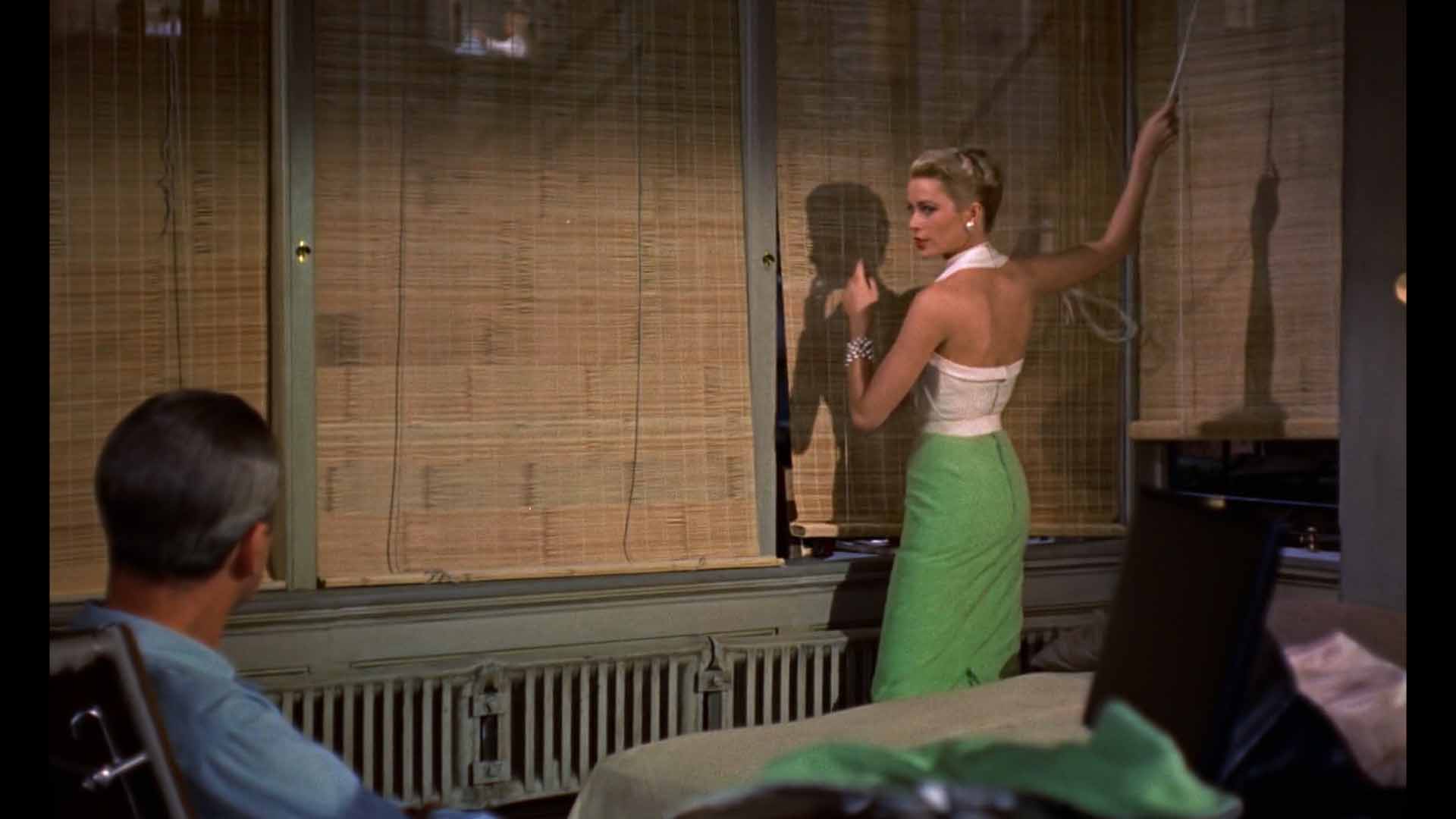
Hitchcock was a genius when it came to using the camera. He didn’t like it when camera moves were too obvious.
Usually, he only moved the camera when the actor moved. For example, when Lisa and Jeff argue and she angrily gets up and walks across the room, the camera follows her closely to keep the tension high. Hitchcock keeps the shot going until she calms down.
He was a master at holding the tension, even when it’s not obvious to us.
One of Hitchcock’s signature moves was using the camera to introduce surprises. You can see this in the very first shot of the film, which is a long camera move that tells us the whole backstory.
The camera pans from one point of interest to another, following Jeff’s attention as it shifts from Miss Torso to Thorwald, and later from Miss Lonelyhearts back to him. When the camera move ends, it usually ends with a surprise.
If you watch the film again, you’ll notice that the pace is relentless. Rear Window is as gripping as an action movie.
Building Suspense
Hitchcock’s decision to limit the camera’s perspective also builds suspense in unique ways. We can only see what Jeff sees, so we’re constantly wondering what’s happening just out of view.
This limited perspective forces us to piece together the story with the same incomplete information Jeff has, making us active participants in the mystery.
Sometimes, the camera moves behind Jeff, giving us a view of his window and the apartments beyond. Even in these shots, you can see the people in the background, living their lives.
The Cinematography of Rear Window
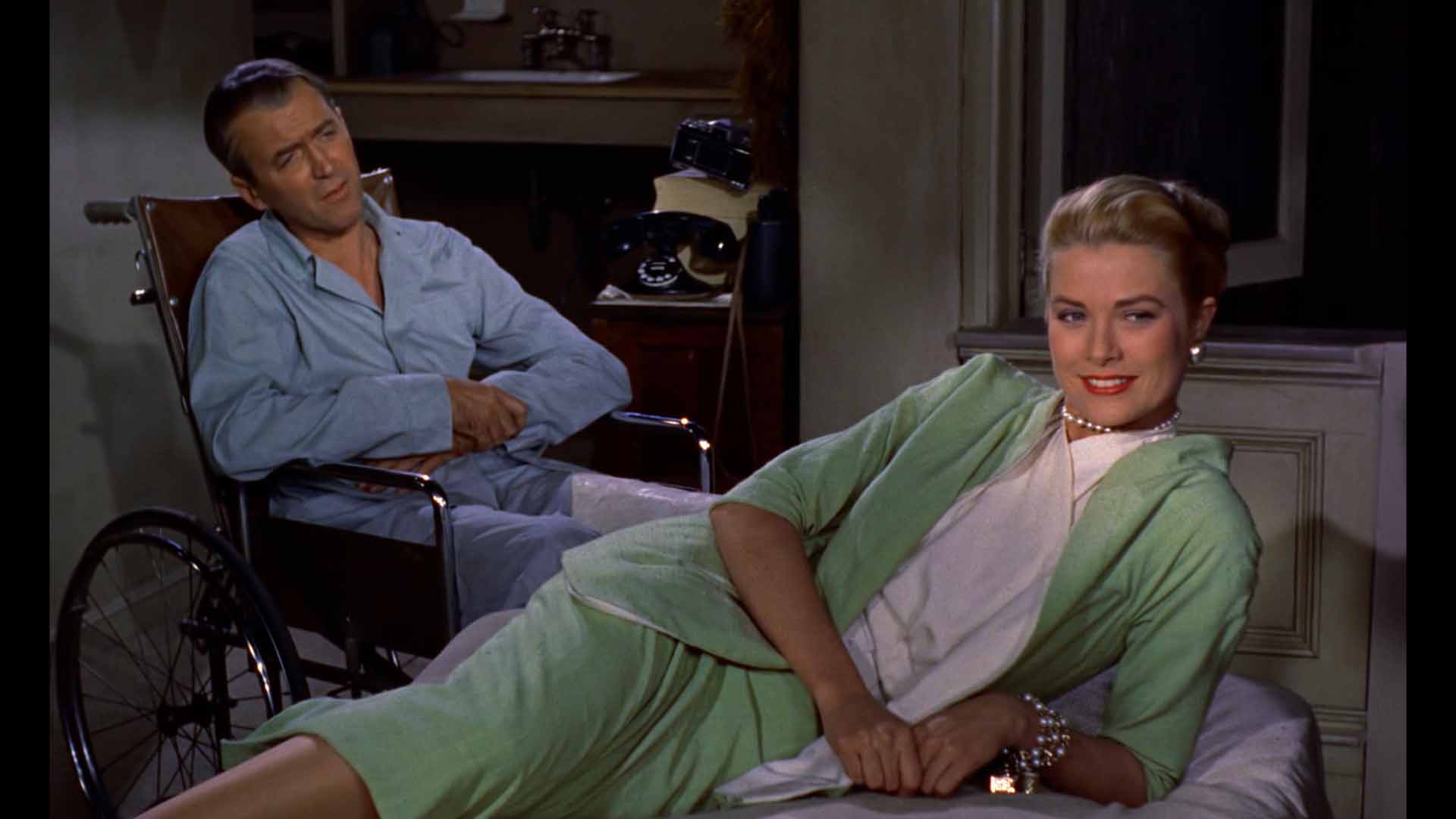
The shot sizes in Rear Window are particularly instructive. From Jeff’s point of view, it’s almost always a long shot, just like what we would see if we were perched at the window.
The characters look small, but you have to remember this film was meant to be seen in cinemas, where the people would appear clearer. This distance shows that Jeff isn’t emotionally attached to any of them.
It’s only in his scenes with Lisa that we get closer shots, revealing a deeper connection.
When Jeff starts using his binoculars, the shots are still at best a medium long shot or medium shot. Then he pulls out his super telephoto lens, an Exakta camera with a 400mm f/5.6 Kilfitt lens.
But even with this, all we get is a medium close-up at best. It’s like Hitchcock intentionally set a limit on how close we could get, frustrating both Jeff and the audience!
The closest we get is in the wedding ring shot when Thorwald finally realizes who’s been watching him.
There’s a common belief that Hitchcock only used a 50mm lens on Rear Window, but that’s not true. According to cinematographer Robert Burks, they used a 50mm T2.5 Bausch & Lomb Baltar lens to represent what Jeff sees with the naked eye.
However, they also used a 75mm lens for many shots and even a 152mm lens for the binocular and telephoto shots. Initially, they planned to use a super telephoto lens, but it wasn’t sharp enough in 1954, so they used a crane to boom out to reach the windows for those shots.
To get the depth needed to see the apartments in the background, they shot at an aperture of f/5.6, which would be about a T5.7 or T5.8.
The original Baltar lenses, designed in the late 1930s, weren’t known for being sharp but were consistent across focal lengths.
Rear Window was shot on 4-perf 35mm film, cropped to a 1.66:1 aspect ratio. The film stock was Eastman 25T 5248, which is an ISO of about 50, according to Kodak.
That’s less than the smallest ISO most cameras have today. They had to light the set to an insane 1,600 foot-candles, or about 17,000 lux, to get an aperture of f/5.6.
Hitchcock wanted a realistic feel, at least as much as was possible in 1954. He avoided glamorous backlighting, opting for a spartan and business-like look. The same team shot Vertigo, one of the most beautiful films Hitchcock ever made, so you have to believe they knew what they were doing.
The Role of Sound Design
Sound design plays a key role in Rear Window. Often, we hear a scream or a crash that Jeff can’t see. T
hese sounds increase the tension because they suggest something important is happening just beyond our field of vision, heightening our anticipation. The sound of busy streets with blaring horns is always present, along with the bickering, music, and other sounds from the neighboring apartments.
The Screenplay and Character Development
The screenplay in Rear Window is incredibly sharp, filled with clever dialogue and subtle character development. One of the standout moments is when Stella, Jeff’s nurse, challenges him to look at his own life with the same detachment he uses to observe his neighbors.
She points out how he can see every flaw and issue in the lives of the people he watches, yet he’s blind to the problems in his own life, particularly when it comes to his relationship with Lisa.
This moment is significant because it forces Jeff to confront the irony of his situation. He’s so focused on the lives of others that he’s ignoring the one person who is truly there for him.
The film gradually peels back the layers of Jeff’s character, showing his vulnerability, his fears, and his inability to commit to Lisa. Even though he dismisses her as being too “high society” for his adventurous lifestyle, the camerawork and the way Hitchcock frames their interactions suggest otherwise.
As the story progresses, we see how the relationships between the characters outside Jeff’s window reflect his inner turmoil. T
he newlyweds represent the commitment Jeff fears, while Miss Lonelyhearts’ isolation echoes his own potential future if he continues to push Lisa away. Miss Torso, the dancer, represents the carefree life he thinks he wants, but deep down, he knows it’s an illusion. The songwriter, struggling to create his next hit, mirrors Jeff’s own struggle to find meaning in his work and life.
The Secret to Suspense
The tension in Rear Window builds slowly, but relentlessly. Hitchcock masterfully uses the confined space of Jeff’s apartment to create a sense of claustrophobia and unease.
As the camera never leaves Jeff’s perspective, we’re drawn into his growing obsession with the Thorwalds, especially when he starts to suspect that Mr. Thorwald has murdered his wife.
Hitchcock’s decision to keep the audience in the dark, just like Jeff, heightens the suspense. We’re constantly on edge, piecing together clues and wondering if Jeff’s suspicions are correct or if he’s simply projecting his own fears onto the situation. The limited viewpoint makes every small detail significant.
Every glance, every sound, every subtle movement is magnified.
The climax of Rear Window is one of the most memorable in film history.
The final scene, where the camera moves through Jeff’s apartment one last time, offers a sense of closure and reflection. We see how the events of the film have changed Jeff, both physically and emotionally.
His broken leg, now in a second cast, symbolizes the cost of his voyeurism, while his deepened relationship with Lisa suggests that he’s finally starting to see what’s truly important in his life.
In the end, the brilliance of Rear Window lies in its simplicity. By confining the camera to a single position and focusing on the perspective of one character, Hitchcock was able to create a film that is both intimate and expansive, personal and universal.
If you’ve never seen Rear Window, or if it’s been a while since you last watched it, I encourage you to revisit this classic with fresh eyes. Pay attention to the camerawork, the lighting, the sound design.
Every element has been carefully crafted to enhance the story and draw you deeper into the world of Jeff and his neighbors. And as you watch, think about how Hitchcock’s choices shaped the way you experience the film, making you an active participant in the suspense and drama.
What do you think?
