

Road-show spectacles once ruled mid-century movie palaces, but most of them feel quaint beside Stanley Kubrick’s Spartacus. Released in 1960, the film still startles with its clarity, its muscular framing, and its control of color and shadow.
The reasons run deeper than star power or production budget. Spartacus married a bleeding edge format to a graphic visual strategy, and it did so at a moment when Hollywood was scrambling to keep television at bay.
Six decades later, digital tools have given filmmakers armies of synthetic extras and skies that change at the click of a mouse, yet few blockbusters match the raw tactile power that Kubrick and cinematographer Russell Metty achieved with light, glass, paint, and celluloid.
Watch the video:

Format as Philosophy
Universal chose Super Technirama 70 for Spartacus, a process that began life as VistaVision.
Technirama ran eight-perf frames sideways, doubled the image area, squeezed the picture with an anamorphic lens, and then printed the result onto 65mm release stock.
The final aspect ratio of roughly 2.20:1 sits comfortably between standard widescreen and the ultra-wide 2.76:1 of Ben-Hur.
The format forced discipline. Everything entering the frame – face, costume, banner, cloud – needed to earn its place or risk being exposed as clutter.
The Long Lens Gamble
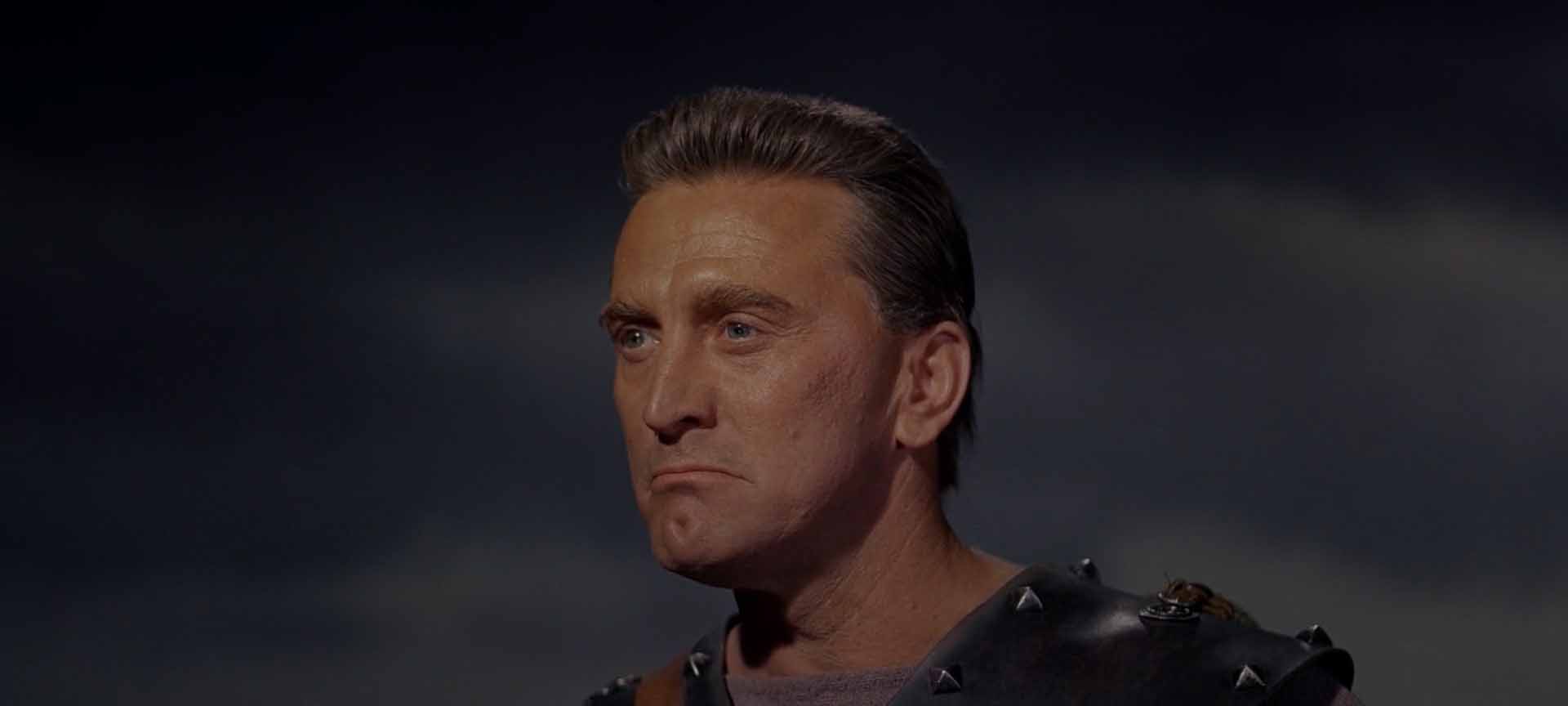
Large format epics of the era typically leaned on moderate wide lenses so audiences could drink in the sets. Spartacus flips the playbook. Metty’s primary glass was a suite of Cooke Telepanchro primes ranging from 100mm through 406mm, mounted behind a Delrama anamorphic adapter.
Those focal lengths flatten distance, stacking foreground and background until 6,000 extras read like red and brown brushstrokes on a fresco. Telephotos made sense thematically: Roman order presses down on slave chaos, the camera literally compressing space as the Empire does its subjects.
Spartacus is an epic that feels both vast and strangely intimate, where an army’s advance and a close-up of Kirk Douglas’s eyes can share the same impact.
Softness in the Age of Foot Candles
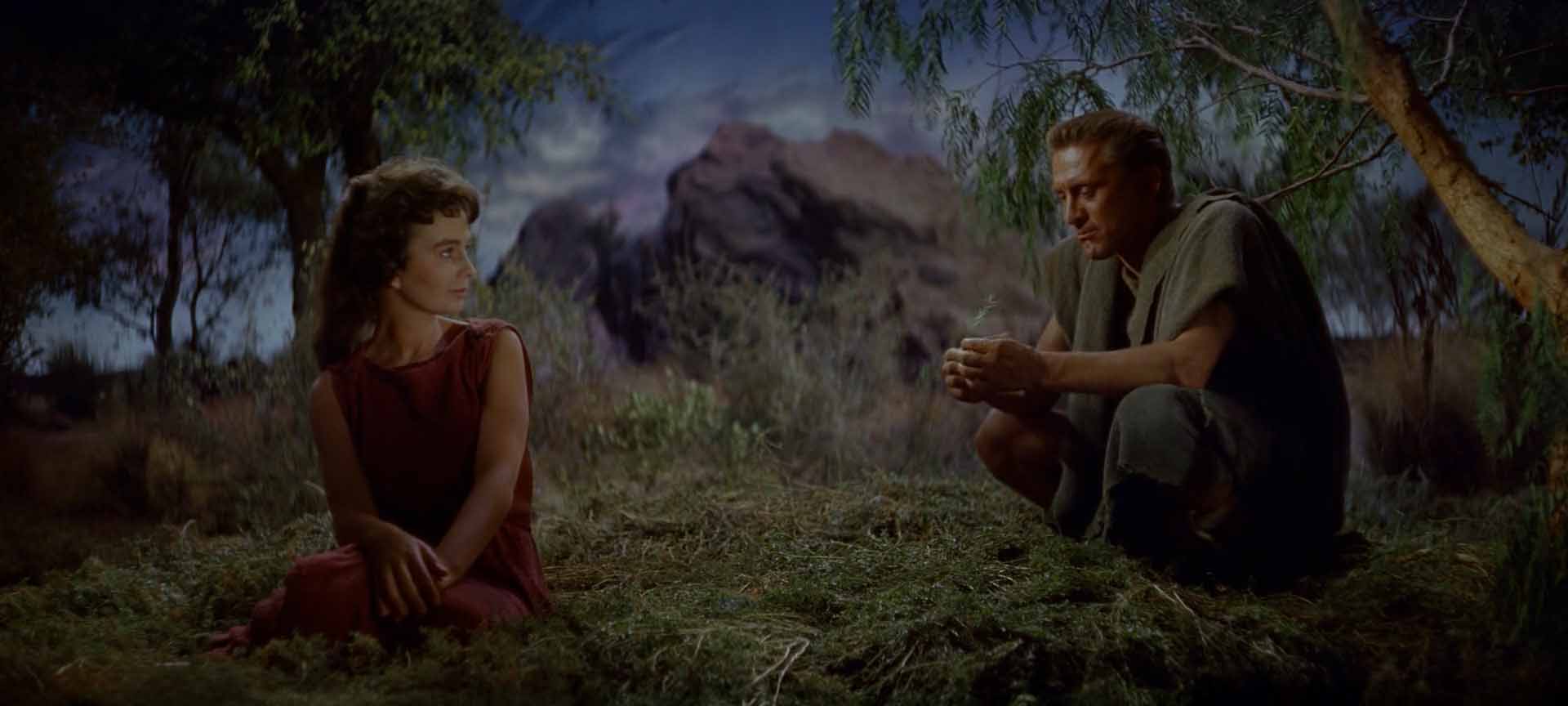
Spartacus embraced selective focus and allowed shadows to close in. The production carried freshly released Eastman 50T stock alongside 25T, doubling light sensitivity and letting Metty reduce overall wattage.
He keyed faces with large lamps, left fill to a minimum, and allowed blacks to roll off into velvety pools. Interiors glow with a painterly modulation that prefigures today’s HDR aesthetic.
Kubrick’s background as a photographer shows in the strict orchestration of color. Roman authority wears crimson, ivory, and polished bronze. Slaves appear in desaturated earth hues, their drabness occasionally broken by Varinia’s pale linen or Spartacus’s weathered tunic.
The palette becomes narrative shorthand: one glance at the frame and the viewer’s eye locates power.
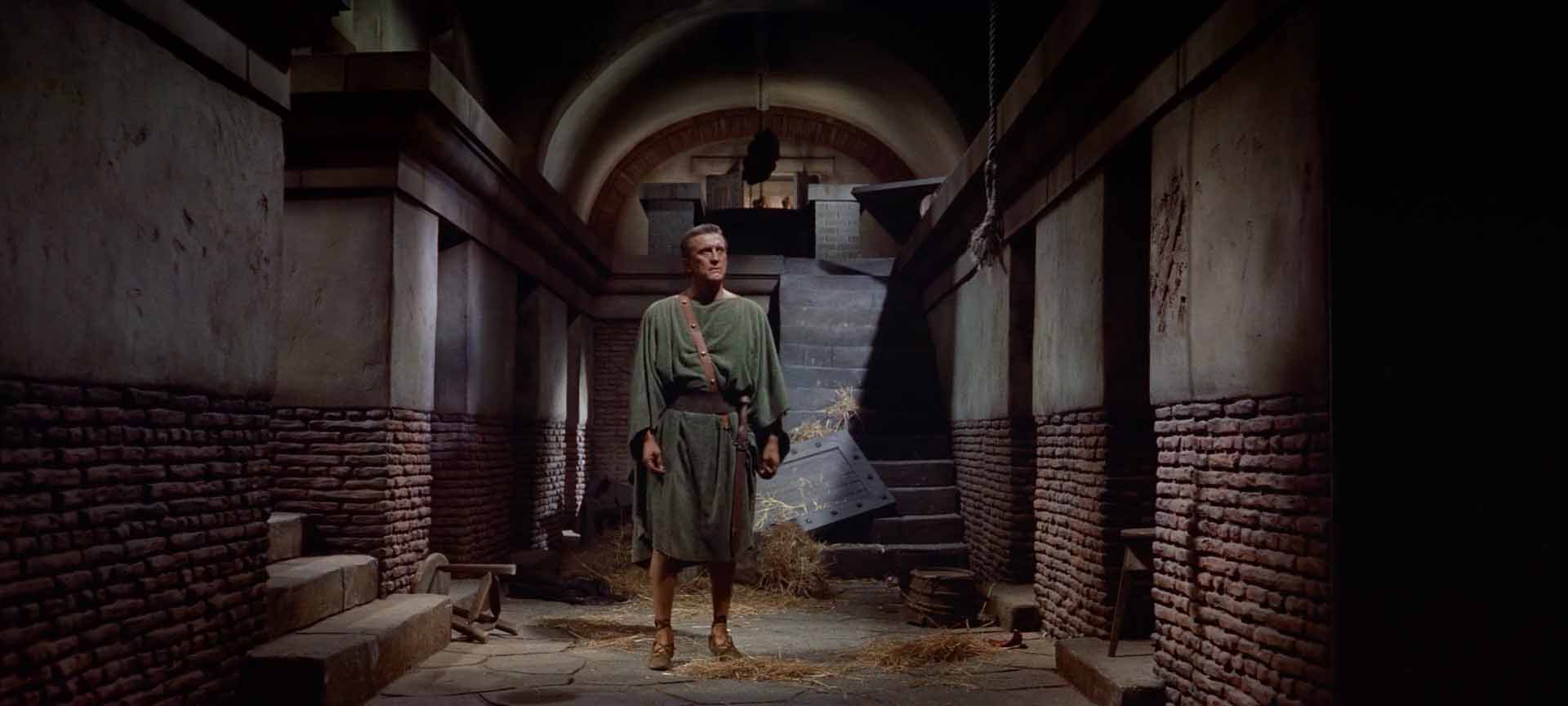
Great cinematography is often a partnership with equally invisible departments, and Spartacus leans heavily on matte painting and production design.
Universal’s resident master Russell Lawson and a crew of artists extended battlefields, added miles of aqueduct, and built Forum vistas on sheets of glass. Large format projection is unforgiving, yet the seams disappear thanks to a cocktail of techniques.
Modern epics multiply crowds with motion-capture arrays and simulation software, but practical scale obeys physics in ways pixels still approximate. Spartacus fielded thousands of extras on location in Spain.
The dust clouds kicked up by cavalry were real, their diffusion pattern changing the moment wind shifted. Visual effects today can mimic such behavior, yet the subconscious registers difference.

Legacy in Lens and Light
Kubrick never repeated Metty’s telephoto style, yet traces of Spartacus echo throughout his later work.
The disciplined color blocking resurfaces in A Clockwork Orange, where droogs in white assault a pop-art London. The calculated blend of practical and painted vistas informs the lunar landscapes of 2001: A Space Odyssey. Even Barry Lyndon’s famous candle-lit interiors owe a debt to the bold shadow ratios Metty.
Spartacus gave Kubrick a living laboratory on how far celluloid could be pushed and what price perfection demanded: time, film, and, occasionally, a bruised ego.

Spartacus keeps taking the breath away. It stands on the far bank of a technological river that Hollywood rarely crosses now.
It is a monument to a moment when mistakes were expensive – but also when limitations forced inventive solutions. The film’s endurance is not nostalgia; it is evidence that the crafts of cinematography and visual effects, executed with rigor, can transcend the tools that created them.
For cinematographers and filmmakers searching for lessons, the film offers a master class: choose your format with intent, control color the way a composer controls key, and let technique serve feeling, not the other way around.
Achieve those things, and your work may still look like a billion bucks 65 years from now.

Hi Sareesh ji, I thoroughly enjoyed watching your Wolfcrow channel, learned a lot, really inspiring. Finally found out you were Indian, with that accent, and in Mumbai.
Sareesh ji, I hope this message reaches you. I am a scriptwriter looking to assist you in writing your next project. To write original stories, scripts inspire me and keep me motivated. I have written a spiritual science fiction script, which took me 3 years to complete it, but it’s worth it. I would like to send it to you so that you can assess whether I could write or not.
I have made some short films, some directed, written, and even one shot at several local stations, some co-directed with a friend, who owns soulmotionpictures.com. He mostly did corporate work, but I always wanted to make fiction films.
Then I worked with Vishesh Mankal, another friend from college, a brilliant artist, wrote 3 episodes of 7 for his series on chess(not yet sold), we worked on outlining together. Then last year, we also made an 84-minute Giallo Slasher film directed, written, shot, and post-produced by him on a shoestring budget of $18000 in a 13-day schedule. I was 2nd AD in it, but did many other jobs there. It is winning several awards too.
I am a passionate cinephile, grew up watching mostly American and many other great films from around the world. So always wanted to work with artists with an eye for the right aesthetics in filmmaking. To make artistic-commercial films is the goal. So please let me know where I can send you my script to be judged for my skill, so that I can work with you. Hope to hear from you soon. Thankyou.