

The Sound of Music, released in 1965, is one of the most beloved films in cinema history. Its breathtaking visuals and emotional storytelling made it one of the greatest blockbusters of all time.
But what is it that makes The Sound of Music look as visually stunning today as it did when it first graced the big screen? Let’s dive into the technical mastery, behind-the-scenes decisions, and iconic cinematography that keep The Sound of Music looking like a billion bucks, 60 years after its release.
Watch the video:

Shot on Todd-AO 70mm
One of the primary reasons The Sound of Music still dazzles viewers is its cinematography, shot in the Todd-AO 70mm format.
This format was known for its ability to capture wide, detailed landscapes with incredible clarity and richness. The large 70mm format gave the cinematographers the ability to shoot expansive, panoramic shots of the Austrian Alps in stunning detail.
Here’s an image of the camera and projection apertures of Todd-AO, which is similar to Panavision 70:

The final aspect ratio is 2.20:1, with a six track stereo sound.
The film’s iconic opening sequence, where Julie Andrews spins atop a mountain singing “The hills are alive with the sound of music,” showcases the power of this format.
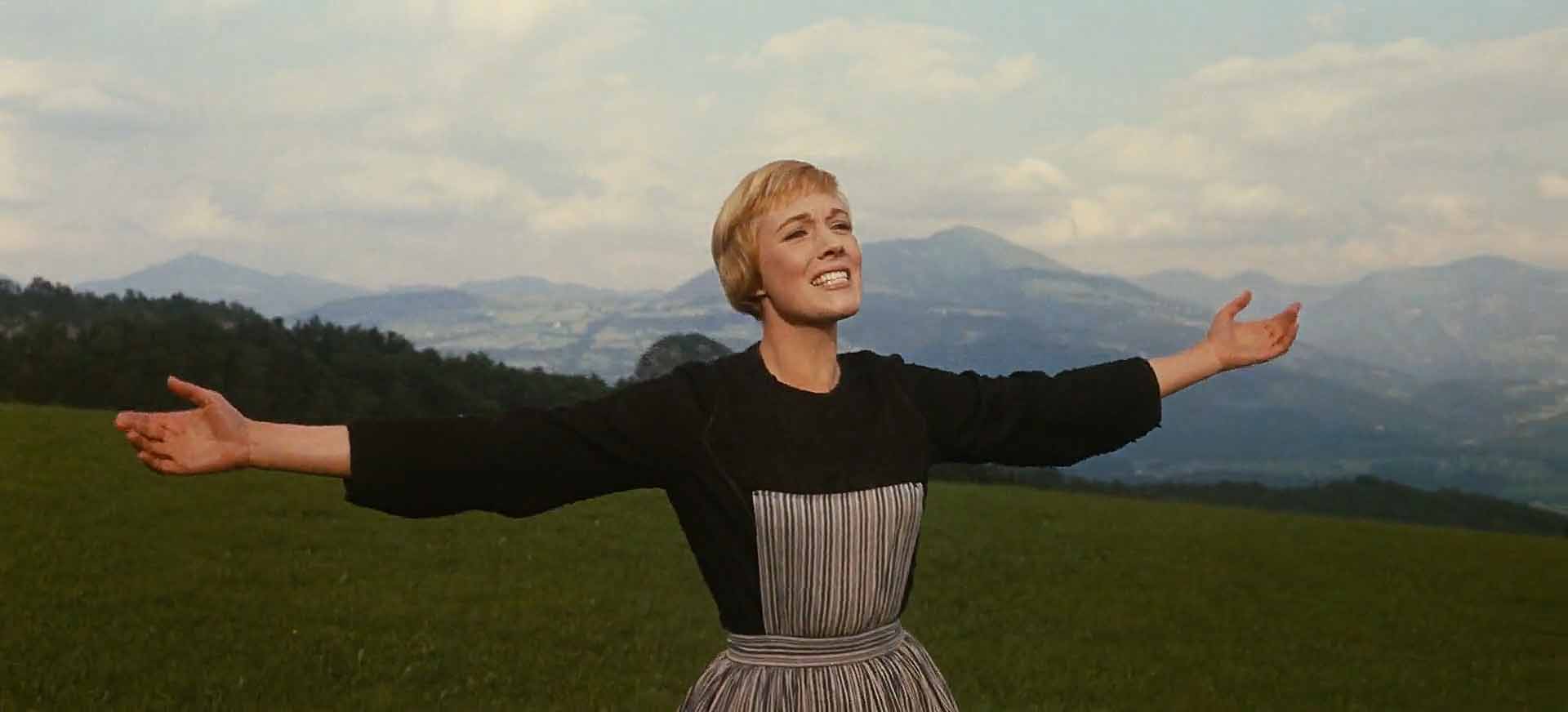
The camera sweeps over the lush green mountains and blue skies, capturing the immense scale and beauty of the setting. Every blade of grass, every cloud, and every distant mountain peak is crisp, making the scene feel larger than life.
Ted McCord, the film’s cinematographer, took full advantage of this widescreen format. His use of aerial shots, crane movements, and dolly work helped create a fluidity that matched the rhythm of the film’s music.
The opening shot of Maria twirling on the mountain was shot from a helicopter, a challenging task given that it was the 1960s, but it was a gamble that paid off and remains one of cinema’s most iconic scenes. The aerial shots were filmed with a Modern Cinema Systems MCS-70 camera.
The film was shot on Cooke Speed Panchro lenses.
Natural Lighting and DeLuxe Color
While many films of the era relied on artificial lighting for both interior and exterior scenes, The Sound of Music is notable for its use of natural light, especially in its outdoor sequences.
Ted McCord leaned on the natural daylight of Austria, which created a soft, warm look that allowed the vibrant colors of the landscape and costumes to pop on screen. The lush greens of the fields and the bright blues of the sky were captured in vivid detail, thanks to the DeLuxe Color film process, which enhanced the natural colors without over-saturating them.
They did use fill lighting and reflectors, because the film stock was Kodak Eastman 50T 5251, rated for ASA 50 (about ISO 100 according to Kodak).
The interiors, particularly in the von Trapp household, were illuminated with a mixture of tungsten lighting to give a more intimate, cozy feel, balancing the grandeur of the house with a sense of warmth and family connection.
This balance between natural light and controlled indoor lighting gave the film its signature glow, inviting viewers into the world of the von Trapp family.
Camera Movement and Rhythm
One of the defining features of The Sound of Music is how the camera moves in harmony with the musical numbers.
Whether it’s the famous “Do-Re-Mi” sequence, where Maria leads the children through Salzburg, or “Edelweiss,” where Captain von Trapp sings his final emotional farewell to Austria, the camera acts classically. It starts when the actors start, and it stops when they stop moving.
McCord’s use of dolly shots, especially during musical numbers, adds a dynamic flow that makes the audience feel the energy of the characters. For example, prior to “Do-Re-Mi,” the camera tracks the von Trapp children and Maria as they run, jump, and sing through the city and fields, seamlessly matching the joy and energy of the song.
In quieter moments, such as the “Edelweiss” scene, McCord opted for tighter shots, allowing the emotional intensity of the moment to shine through.
Production Design
The visual design of The Sound of Music was equally important in immersing the audience into its world. The von Trapp mansion, with its grand interiors, was designed to reflect both the family’s wealth and the warmth that Maria brings into their lives.
The production designers took great care to create a space that felt both elegant and inviting. Most of what you see are film sets created in the US. It was built on the basis of the storyboards director Robert Wise created.
The exterior shots, especially in Salzburg, used real locations to ground the story in its historical setting. Key scenes were filmed in the Mirabell Gardens and the Nonnberg Abbey, adding authenticity to the film’s portrayal of pre-World War II Austria.
This use of real-world locations gave The Sound of Music a sense of place that was rare for musicals at the time, many of which were completely shot on sound stages. Add to that the beauty of the Austrian light!
The costumes, designed by Dorothy Jeakins, also played a key role in the film’s visual identity. From Maria’s simple yet iconic outfits to the children’s matching play clothes made from curtains, the costumes enhanced the storytelling.
The visual contrast between the von Trapp family’s clothing and the Nazi uniforms in the film’s second half is particularly striking, highlighting the growing tension and danger as the story progresses.
A Dramatic Visual Tone Shift: Light to Dark
One of the most impressive visual feats of The Sound of Music is how it transitions from the bright, carefree tone of the first half to the darker, more oppressive atmosphere in the second half.
The first half of the film is filled with bright colors, wide-open spaces, and joyful musical sequences, reflecting the innocence and hope of the characters.
However, as the threat of the Nazi regime grows, the film’s visual style shifts. The colors become more muted, and the camera work becomes tighter and more claustrophobic.
The performance at the Salzburg Festival is a perfect example of this shift. The stage is stark, the architecture looms over the von Trapp family, and the Nazi presence is felt in every frame. Shadows and stark lighting create a sense of tension, isolating the family from the audience as they sing their way to freedom.
In the final act, when the von Trapps flee through the cemetery to escape the Nazis, the cinematography becomes even darker. The lighting is minimal, with only flashlights and moonlight illuminating the tense chase scene. The use of tight shots and shadows heightens the suspense, turning the film into a thriller.
Every sound, mostly footsteps and clanging gates, is amplified, making the audience feel the urgency of the moment.

Box Office Phenomenon
The combination of these technical and artistic choices helped The Sound of Music become not just a visual masterpiece but also a box office triumph. Filming took just over five months, and the film earned over $286 million worldwide, an astronomical number at the time. Adjusted for inflation, that’s $2+ billion, placing it sixth on the top grossing films of all time.
The film’s cultural impact is equally significant. It has become a staple of family viewing, and its influence can still be seen in musicals and films today.
The decision to shoot on location, use real lighting, and capture the natural beauty of Austria set a new standard for musicals and made The Sound of Music feel more grounded and real, even as it told a larger-than-life story.
So that’s what a Billion Bucks looks like!
So, why does The Sound of Music still look like a billion bucks?
It’s the combination of Ted McCord’s stunning cinematography, the innovative use of the 70mm Todd-AO format, and the film’s masterful blending of music, light, and movement.
The natural beauty of the Austrian Alps, the authenticity of the real-world locations, and the meticulous production design all contribute to a film that feels both timeless and immediate.
The film’s visual style evolves with the story, starting with bright, open landscapes and ending with darker, more intense moments that reflect the growing tension. The Sound of Music’s ability to balance joy and suspense, light and darkness, and music and silence is what makes it such a visual delight, and why it continues to captivate audiences, generation after generation.
The Sound of Music looks like a billion bucks because it was crafted with care, innovation, and a deep understanding of how visuals can enhance and elevate storytelling.
It’s a true cinematic masterpiece, both in its emotional depth and its technical brilliance.
Watch The Sound of Music again to remind yourself of the glory of cinema!

Just want to add that it was shot for release in 70mm which required 70mm projectors with magnetic sound readers, an elaborate audio system (5 screen speakers and surround speakers) to accommodate the high fidelity 6 channel audio track and a screen to suit the 220:1 aspect ratio of the 70mm format. The amount of theatres that were fitted for screening 70mm were limited as the predominant format across the industry was 35mm.
So the 35mm ratio closest to 70mm’s 220:1 ratio was 235:1 – an anamorphic distortion lens process known as CinemaScope, developed by Twentieth Century Fox in 1953 (ratio was initially 255:1 until 1956) which also featured 4 track sound with most presentations being single track mono analogue. As CinemaScope’s aspect ratio had less height than 70mm, 35mm prints would have been cropped to a limited amount top and bottom of the image.
The Blu Ray release is a scan of a 70mm print of the film and features also the 6 track audio track.
Thank you for sharing!
A nice article!
A big part of The Sound of Music’s visual appeal stems from it having been filmed in the Todd-AO 70mm format, which was first used by the film Oklahoma! in 1955. The process gets its name from producer Mike Todd, one of the backers of the original three-camera Cinerama process, who contracted with the American Optical Company to develop “Cinerama outta one hole.”
After Mike Todd’s sudden death in an airplane accident in 1958, his interest in the process was inherited by his wife, Elizabeth Taylor, who when hired by 20th Century Fox to star in Cleopatra (1963), insisted that it be filmed in Todd-AO. From then on, most big-budget Fox films also used the process. In addition to The Sound of Music (1965), these include:
Those Magnificent Men in Their Flying Machines (1965)
The Agony and the Ecstasy (1965)
Doctor Dolittle (1967)
Star! (1968)
As you may be aware, 20th (now 21st) Century Fox was acquired by The Walt Disney Company in 2019. This brings me to my major concern, which is that as of now (2024), Disney has not released any of these 70mm films in the format most appropriate for them todayy, which is 4K, either streaming or preferably, 4K Blu-Ray. The best we’ve gotten so far is standard Blu-Ray, which is 1080p.
While all of these titles may not merit 4K home video releases, one would hope that Disney will at least see fit to transfer the original 70mm elements to 4K or even 8K digital before they deteriorate.
Cleopatra, released in 1963, was the most expensive film up to its time. It is now over 60 years old. How much longer will we have to wait?
Thank you! I think Blu-ray sales are falling every year, which might explain it. Shame, really.