

When you watch The Ten Commandments today, nearly 70 years after its release, you’re really watching a kind of cinematic monument.
It’s not just big in scope, it’s big in feeling, in style, and in intent.
Director Cecil B. DeMille wanted to engrave it into the audience’s memory, because he’d already made it once in 1923. He flip flopped between different ideas but settled on The Ten Commandments again by pulling out all the stops.
In this essay, we’re going to explore how the visual craft of The Ten Commandments helped turn it into one of the most enduring epics in film history. Watch the video:


Technicolor and VistaVision
The Ten Commandments was shot in Technicolor, using a process known as dye transfer. The system used layers of cyan, magenta, and yellow dye to create each print, pressing the colors into the film like ink on a page.
Combined with the sharpness of VistaVision – a wide format that ran the film sideways through the camera (the equivalent to a full frame sensor today) – they created an image that was sharp, rich, and full of color depth.
Skin tones looked warm and alive. Reds glowed. Blues shimmered. Golds and earth tones carried weight. Even today, when you watch a good transfer of the film, the level of sharpness and color is surprising. And unlike early color prints that faded over time, dye transfer prints held up beautifully.
The colors still sing!
VistaVision was a great choice. It was a high-resolution format developed by Paramount that ran 35mm film horizontally, giving it more space for detail. The result was a smoother, less grainy image – perfect for large sets, wide landscapes, and big visual effects. The original aspect ratio was 1.85:1, but the 4K Blu-ray gives us 16:9, which is what I’ve presented.
Film Sets You Can Step Into
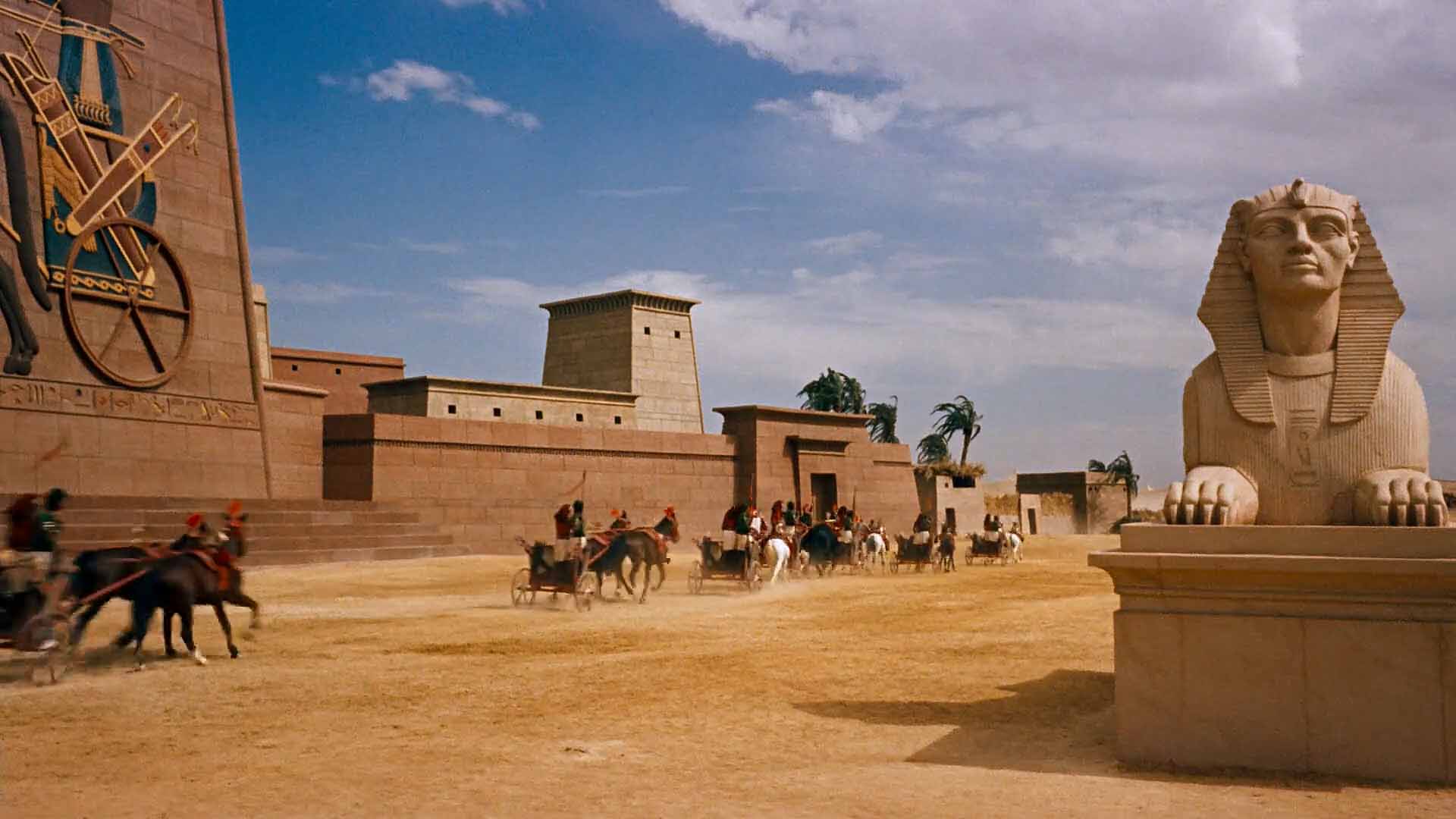
One of the most powerful aspects of The Ten Commandments is how real it all feels. That’s because so much of it was real!
The sets were massive. The gates of cities were carved out of full-size constructions. Statues rose stories high. The filmmakers took their crew all the way to Egypt to shoot some of the exterior (but most of it was shot in the USA).
Thousands of extras were brought in and dressed in full period costume. It brings the world to life in a way that CGI often can’t replicate.
You’re watching Moses walk through a world that feels ancient, alive, and true. It gives you the sense of what it might have actually felt like to live during the time of Pharaohs and prophets.

Effects that Changed the Game
The film’s special effects were supervised by John P. Fulton, who had access to a powerful tool of the time: the optical printer. With it, filmmakers could blend blue screen footage with miniature models, matte paintings, and footage shot in different locations.
But – they had to be precise. You can see black outlines in many of the shots. I’ve heard their excuse was they didn’t have enough time to fix it. But – I just think it’s part of the charm!
The parting of the Red Sea was done with layers of real water, shot in reverse, combined with matte paintings, miniatures, and clever editing. It might not be perfect by modern standards, but because the emotion behind it lands, it feels earned.

A Director Who Believed!
Part of what makes The Ten Commandments so special is how deeply Cecil B. DeMille believed in it. It wasn’t just another project. This was the story he felt the world needed.
You can feel that this meant something to him. And that belief filters down to every department. The epic film invites you to step into a world so carefully built, so beautifully lit, so confidently staged, that it still holds up all these years later.
Some movies entertain. A few leave a mark.
This one carves its place in stone!
