

Shotgun microphones, renowned for their precision and directional audio capture, are essential for anyone looking to elevate their sound quality. This guide delves into five budget-friendly shotgun microphones that promise not to disappoint.
Finding the right shotgun microphone without breaking the bank is crucial for enthusiasts and professionals alike.
Each microphone in this list is selected for its outstanding performance, durability, and relative affordability. A good shotgun microphone will last you decades.

You can’t even judge a shotgun microphone by how it looks. They all look alike! But, they don’t sound alike.
It’s your job to find the microphone that best suits the kind of sounds you want to record. Ideally, if you have the means, you should test all the shotgun microphones at your disposal before you invest in one. It might not be feasible for a lot of people, though.
Even if you had the microphones available, without the relevant experience, you wouldn’t know what to look for, or listen for.
If you’re a complete beginner, here’s a tip:
As long as you buy a microphone from a reputable brand, there’s no good or bad, only different.
What are shotgun microphones?
Shotgun microphones are one of the most widely used kinds of microphones in filmmaking. They are highly directional, and pick up sounds typically in the direction they are pointed at.
What do they look like? Shotgun microphones are long, narrow tubes with slits evenly placed on their sides and a capsule near the ends. They don’t look like shotguns, but they’re designed to be directional. Typically, you would aim the microphone at the mouth of the person you are recording. That’s why they’re called a shotgun microphone.
A shotgun mic can be put on top of your camera or can be attached to a boom pole (hence it is sometimes called a boom mic). Here’s an image with shotgun microphones in both positions:

On the left a boom operator directs the angle of the microphone with the help of a boom pole. The boom pole helps the microphone come as close to the talent as possible without being in the frame.
On the right the second shotgun microphone is placed on top of the camera, also pointed at the speaker. I’ve used this second microphone as a backup. The one of the left was the primary microphone for this job.
How directional are shotgun microphones?
Shotgun microphones are designed to allow sound in front of the microphone to pass through to the tube into the capsule. At the same time sounds from the sides enter through its slits. This results in a phase cancelling effect which rejects off-axis sounds.
The result? Well-rounded directional sound.
However, even though shotgun microphones are highly directional, they are not completely immune to ambient noise.
Their sensitivity to sound from the front does not entirely prevent the pickup of ambient sounds from other directions, especially at higher frequencies. The design includes slits along the barrel that help in narrowing the pickup pattern, yet sound waves can diffract around the microphone body and enter the pickup pattern.
So, don’t forget, just because you point a shotgun microphone at someone, it doesn’t mean every other sound will be blocked. They are somewhat susceptible to ambient noise, particularly from the sides and rear, albeit to a lesser degree than non-directional microphones.
There are two general rules of thumb to know how directional a microphone is:
- The longer the microphone (from a reputable brand), the better directionality it will have
- The tighter the polar pattern (e.g., a super cardoid), the better the directionality.
You know the first by looking at the microphone and finding the length. The second is usually published by the microphone manufacturer. Let’s look at that.
What is a polar pattern?
One of the most important things you need to look for when buying a shotgun microphone is its polar pattern. It is basically the ‘reaction’ of a mic to a given SPL (Sound Pressure Level) plotted over space.
This type of pattern is highly directional. It makes shotgun mics excellent choices for recording audio while cutting out extraneous noise.
A typical shotgun polar sound pattern is displayed in this way:

It takes in more from the front, a little less from the back, and the least from the sides. That’s a simplistic interpretation, but good enough when you’re new and have to purchase a microphone.
Polar patterns are like signatures. Each mic has its own unique signature, and manufacturers can design microphones with a mixture of patterns for their own unique blend.
Anybody can play back a recorded sound and judge its quality, but only an experienced production mixer will really know whether the sound is worthy of sitting correctly in the final mix.
Some types of polar patterns are:
- Omnidirectional – Sensitive to sounds from all directions.
- Bidirectional – Equally sensitive to sounds from the front and back with a ring of silence at the sides.
- Cardioid – Most sensitive to the sounds from the mic’s on-axis with a null point in the exact opposite direction. It is the most commonly used polar pattern.
- Super-Cardioids – They are more directional than cardioids but have a rear lobe of sensitivity.
- Hyper-Cardioids – They are more directional than cardioids and super-cardioids with a larger rear lobe of sensitivity.
- Sub-Cardioids – Also called wide-cardioids, it can be thought of as a superposition of omnidirectional and cardioids mics. It has no null points with lesser rear sensitivity.
- Lobar – They are based on the hyper and super-cardioids pattern and require interference tubes to achieve their directionality. They have rear and side sensitivity. Also called the shotgun polar pattern.
The biggest gotchas with microphones is, every type has a benefit and disadvantages. There are situations where a hyper-cardoid is just right for the job but wrong for when an omnidirectional microphone is required.
If there were one perfect polar pattern, everyone would be using it!
The advantages of a shotgun microphone
A shotgun microphone is a flexible and useful tool. A boom operator can direct a shotgun mic like a musical instrument. A lavalier mic, on the other hand, is usually stuck in one place.
Traditionally, longer sound devices (with greater length) have more harmonics and are more pleasing to the ear. It just sounds good, at least to me.
For decent sound, you’re looking to spend about $200-400 on a shotgun microphone. That’s a budget-friendly range. Prices are going up every year for all products, and shotgun microphones are a long-term investment. They last a lot longer than your camera.
Considering all of the above, here are my five picks for a beginner-level budget-friendly shotgun microphone, in no particular order:
Five Budget Shotgun Microphones
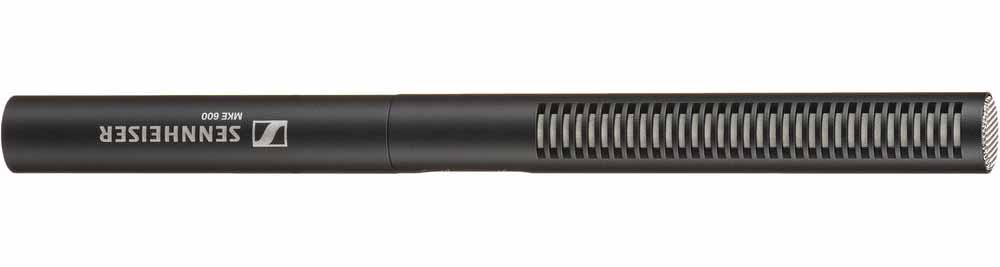
Sennheiser MKE 600
Sennheiser is a legendary brand when it comes to shotgun microphones, and you cannot go wrong with it.
Here are the important specs of the Sennheiser MKE 600 (Amazon, B&H):
| Length | 10″ |
| Weight | 128g |
| Capsule | Condenser |
| Operating Principle | Line Gradient |
| Polar Pattern | Lobar, Super-cardioid |
| Frequency Range | 40 Hz to 20,000 Hz |
| Maximum SPL | Phantom – 132 dB Battery – 126 dB |
| Dynamic Range | N/A |
| Impedance | N/A |
| Mounting | Camera/Shoe-Mount |
| Power Supply | Phantom and Battery |
| Approximate Battery Life | 150 Hours |
Sennheiser MKE 600 (Amazon, B&H) is known for solid performance indoors as well as outdoors.
The Sennheiser MKE 600 boasts a highly directional pick-up pattern, ensuring clear audio capture by focusing on the subject while minimizing background noise. Its robust construction and battery power option make it ideal for outdoor shoots.
However, the MKE 600’s sensitivity means it requires careful handling to avoid picking up unwanted sounds, particularly in windy conditions without a proper windscreen. Despite its slightly higher price point, its performance and durability offer significant value, making it a preferred choice for professionals seeking reliability and exceptional sound fidelity.
Some users have complained it’s a big gain hungry, but that can be sorted with a good pre-amp.
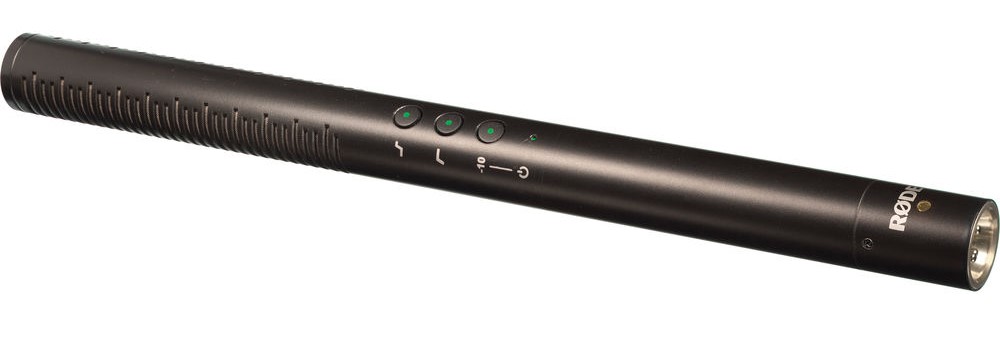
RODE NTG4+
The Rode NTG4+ (Amazon, B&H) has been hugely popular over the years.
Here are the specs:
| Length | 10.9″ |
| Weight | 176g |
| Capsule | Condenser |
| Operating Principle | Line Gradient |
| Polar Pattern | Super-cardioid |
| Frequency Range | 20 Hz to 20,000 Hz |
| Maximum SPL | 135 dB |
| Dynamic Range | 119 dB |
| Impedance | 200 Ohms |
| Mounting | Mic Clip/Stand Adapter |
| Power Supply | Phantom and Battery |
| Approximate Battery Life | 150 Hours |
The Rode NTG4+ (Amazon, B&H) offers broadcast-quality sound with a tailored frequency response that enhances vocal clarity.
A distinctive advantage is its built-in rechargeable battery, providing up to 150 hours of operation, which is ideal for extended field use. The NTG4+ also boasts convenient digital switches for high-pass filter, pad, and high-frequency boost, enhancing versatility in various recording conditions.
However, its sensitivity requires careful positioning to avoid background noise. Additionally, while it offers excellent value, it might not match the absolute sound fidelity of higher-end professional microphones, making it a balancing act between quality and price.

Audio-Technica AT897
The Audio-Technica AT897 (Amazon, B&H) is the oldest and cheapest of this bunch. Here are the specs:
| Length | 11″ |
| Weight | 145g |
| Capsule | Condenser |
| Operating Principle | Line Gradient |
| Polar Pattern | Lobar, Super-cardioid |
| Frequency Range | 20 Hz to 20,000 Hz |
| Dynamic Range | Phantom – 112 dB Battery – 98 dB |
| Maximum SPL | Phantom – 129 dB Battery – 115 dB |
| Impedance | Phantom – 200 Ohms Battery – 300 Ohms |
| Mounting | Mic Clip/Stand Adapter |
| Power Supply | Phantom and Battery |
| Approximate Battery Life | 1200 Hours |
The Audio-Technica AT897 (Amazon, B&H) is a tried and tested shotgun microphone, and is affordable. If price is your problem, this is the microphone to get.
And, with alkaline batteries, it’s battery life is unbeatable.
It is a compact shotgun microphone that delivers high-quality sound in a lightweight design. Its narrow acceptance angle is excellent for capturing audio directly in front of the microphone while attenuating side and rear sounds, ideal for focused recording in noisy environments.
However, its shorter length, while beneficial for portability, may limit its effectiveness in isolating distant sound sources compared to longer shotgun microphones.
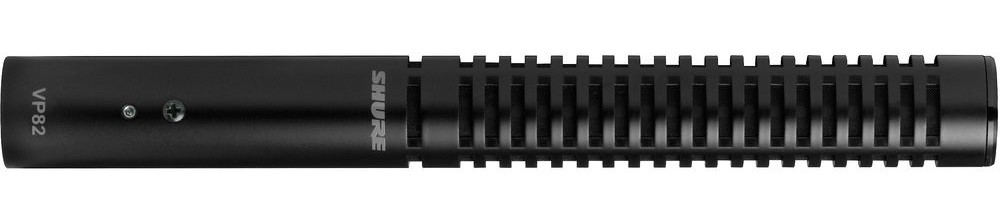
Shure VP82
The Shure VP82 (Amazon, B&H) is an old and solid performer, and is also the shortest:
| Length | 7.7″ |
| Weight | 76g |
| Capsule | Electret Condenser |
| Operating Principle | Pressure Gradient |
| Polar Pattern | Lobar, Super-cardioid |
| Frequency Range | 90 Hz to 20,000 Hz |
| Dynamic Range | 122.5 dB (2500 Ohms) 116.5 dB (1000 Ohms) |
| Maximum SPL | 137.5 dB (2500 Ohms) 131.5 dB (1000 Ohms) |
| Impedance | 144 ohms |
| Mounting | Mic Clip/Stand Adapter |
| Power Supply | Phantom only |
| Approximate Battery Life | – |
The size and weight of the Shure VP82 (Amazon, B&H) makes it great for run and gun shoots. Its small footprint allows for easy mounting on cameras and boom poles.
However, its relatively shorter range compared to larger models may limit its effectiveness in capturing sound from distant sources, and it’s phantom-power only.
While offering a lower cost, the VP82 does not compromise on build quality, maintaining Shure’s reputation for durable, reliable microphones. I have other Shure microphones and they are industry standards for build-quality. I don’t think you can go wrong with Shure.
If your shotgun microphone is going to always be on camera, this might be the most practical choice.

Deity S-Mic 2
The Deity S-Mic 2 (Amazon, B&H) is from a brand that’s up and coming (from the Aputure family, if I’m not mistaken). It has taken then some time to gain respect, and reminds me of how Rode were about 20 years ago. Who knows where they’ll be in the next ten years?
Here are the specs:
| Length | 9.8″ |
| Weight | 198g |
| Capsule | Condenser |
| Operating Principle | Line Gradient |
| Polar Pattern | Super-cardioid |
| Frequency Range | 50 Hz to 20,000 Hz |
| Dynamic Range | N/A |
| Maximum SPL | 130 dB |
| Impedance | 75 Ohms |
| Mounting | Mic Clip/Stand Adapter |
| Power Supply | Phantom only |
| Approximate Battery Life | – |
The Deity S-Mic 2 (Amazon, B&H) doesn’t come with a battery (it’s phantom-power only), and in spite of that it’s the heaviest of the lot.
The Deity S-Mic 2 has been known to offer natural sound profile with low self-noise, capturing clear and detailed audio. However, its weight and size may pose challenges for run-and-gun filming or mounting on smaller cameras. This is one brand I highly urge you to listen to before buying.
I hope you found my suggestions useful. If you have any recommendations of good shotgun microphones, please let me know in the comments below.

Thank you