
The Sony A7s has a full frame E mount, sometimes called the FE mount. The most revolutionary aspect of the Sony E mount is that its flange focal distance is one of the lowest possible for full frame sensors. This means, you can practically use any full frame lens on it, as long as there is a suitable adapter.
Here’s a comparison of various mounts compared to the E mount. We are comparing flange focal distance (FFD), aperture ring, image stabilization, adapters, replacement parts and whether or not the mounts offer a full range of prime lenses:
| Mount ~ | FFD in mm | Ap. Ring | IS^ | Adapter # | Replace /Parts^^ | Full Range* |
| Sony E (FE) | 18 | No | No | No | E | No |
| Sony FZ | 18 | No | No | No | H | No |
| Leica M | 27.8 | Yes | No | M | E | Yes |
| Canon Manual FD | 42 | Yes | No | M | NE | Yes |
| Canon EOS EF | 44 | No | Yes | E | E | Yes |
| Minolta/ Sony A | 44.5 | No | No | E | E | Yes |
| Pentax K Manual | 45.46 | Yes | No | M | NE | Yes |
| Zeiss Contax C/Y RTS MM | 45.5 | Yes | No | M | NE | Yes |
| Nikon F (D and G) | 46.5 | Yes (D) | Yes (G) | M (D), E (G) | E | Yes |
| Leica R | 47 | Yes | No | M | NE | Yes |
| Arri PL** | 52 | Yes | No | M | NE | No** |
Notes:
- ^Image Stabilization in lens
- ^^How hard is it to replace a lens or fix it with parts? E- Easy, NE-Not Easy, H-Hard and/or Expensive
- *A full range of prime lenses – from 21mm to 135mm in at least f/2.8
- **Most PL lenses are designed for Super35mm frames, and not full frame. Very few samples of the top-of-the-line Arri and Cooke lenses will cover a full frame sensor. There is also the problem of adapters (next section).
- #What kind of adapter will be required. M-Manual, E-Electronic for Aperture, Autofocus, etc.
- ~I’m not covering medium format lenses, though they are also acceptable. Examples include Contax/Yashica/Mamiya/Hasselblad/Fuji etc. The ‘problem’ with medium format is that the focal lengths and apertures don’t correspond to what people are used to normally. That, and the fact that these lenses will be heavier, without the equivalent aperture advantage, gives them an ergonomic disadvantage.
Problems with each mount summed up:
| Mount | Problems |
| Sony E (FE) | Full range of lenses not available |
| Sony FZ | ditto |
| Leica M | Too expensive, no super telephoto options |
| Canon Manual FD | No IS option |
| Canon EOS EF | No aperture ring |
| Minolta/Sony A | No aperture ring |
| Pentax K Manual | No IS |
| Zeiss Contax C/Y RTS MM | No IS |
| Nikon F (D and G) | Have to choose IS vs aperture ring |
| Leica R | Too expensive |
| Arri PL** | Very few full frame options |
Native Sony E mount lenses are too few to count. Here’s the Sony/Zeiss roadmap for prime lenses in this mount:
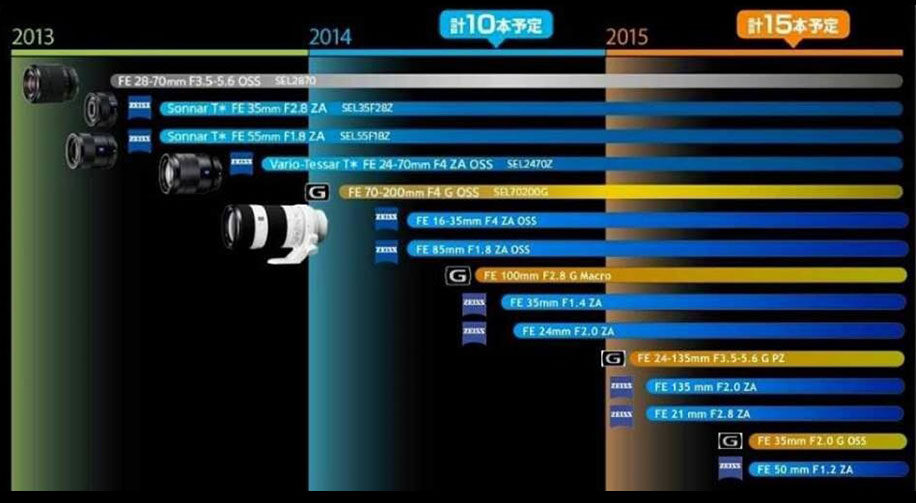
Here are the prime lenses lined up for 2014-2015:
- Zeiss FE 85mm f/1.8 ZA OSS (overdue at the time of this writing)
- Zeiss FE 35mm f/1.4 ZA
- Zeiss FE 24mm f/2.0 ZA
- Zeiss FE 135mm f/2.0 ZA
- Zeiss FE 21mm f/2.8 ZA
- Sony FE 35mm f/2.0G OSS
- Zeiss 50mm f/1.2 ZA
Of course, the sad part is, you have to wait till the end of 2015 for the full set. Secondly, if the 55mm f/1.8 costs $998 how much will the 50mm f/1.2 cost?
Cost is also a factor for both Leica mounts, as well as the PL mount, and even the Sony A mount lenses (at least the newer ones). Leica M has one great benefit – the lenses are much smaller and lighter due to the smaller focal flange distance. If you don’t have the budget, you could use cheaper Zeiss or Voigtlander glass instead. However, none of them are really suitable for video work.
Now, if you already own prime lenses for any of the above mounts, you should purchase an adapter (next section) for that mount and get on with it. The lenses themselves have different character, and they are a matter of personal taste. I wouldn’t fault a single mount on any technicality, only convenience.
Which adapter I use and why
If you are building your kit from scratch, you should be extremely careful about selecting a set of prime lenses. After studying the above chart, my top choices for a ‘kit’ are
- EF mount
- FD mount
- Nikon F mount
- Zeiss Contax C/Y MM RTS
Allof these are easy to find, not expensive, and offer excellent image quality, even for 4K. My personal favorite? I feel the best bet is the Nikon F system. It is the only mount that ticks all boxes:
- You want aperture ring and image stabilization? No problem.
- You want to use cheaper lenses or more expensive ones? No problem.
- It has a flange focal distance that makes it adaptable to even Canon cameras if the need ever arises in the future.
- Great prime lenses are available for cheap. Thankfully, Nikon has hardly changed their SLR mount, and you’ll never have a shortage of lenses.
- Not only do Nikon primes come in all focal lengths, you have various choices of year (like wine!) and model.
- Excellent resale value because millions of people still shoot with Nikon SLRs.
- No problem with service because Nikon still services them.
You won’t regret siding with Nikon on this one. Here’s a video I’ve made about the Metabones G to E mount adapter (same principles apply to other adapters):
List of adapters for the Sony A7s
Just in case you feel like going with another mount (or even the Nikon mount), here is a list of adapters for each mount (for more information on judging quality of lens adapters, click here.):
| Mount | Adapters^* |
| Leica M | Metabones, Generic |
| Canon Manual FD | Metabones, Novoflex, Fotodiox, Generic |
| Canon EOS EF | Metabones#, Commlite |
| Minolta/Sony A | LAEA3, LAEA4, Novoflex |
| Pentax K Manual | Fotodiox, Generic |
| Zeiss Contax C/Y RTS | Metabones |
| Nikon F (D and G) | Metabones and Novoflex (G), Generic (D) |
| Leica R | Generic, Metabones, Novoflex |
| Arri PL** | Generic** |
^As mentioned in the video, some manual adapters for the Sony NEX (APS-C) mount will not work, so don’t buy without confirmation from others. Also, cheaply machined adapters don’t have the structural strength to support heavier metal lenses.
#There have been many complaints about the Metabones adapters, even the latest one at the time of this writing (Mark IV, I believe). Many reviewers now prefer the Commlite version because it offers the same features for cheaper. If you’re looking for a ‘dumb’ adapter, Fotodiox is okay.
Notes:
- *If you need aperture control and auto focus, the adapters tend to get expensive and heavier. Don’t go for the cheapest adapter possible, that’s counter-productive.
- **There are few lenses that cover the full frame sensor. Generic adapters aren’t usually strong enough to withstand heavy PL lenses, so be extra careful. Look for the ones that say PL to FZ mount.
Again, I prefer the adapters for the Nikon F to E system. If you have the cash, a good adapter like the Metabones G ($139) comes with an aperture ring as well.
About the Speed Booster
Avoid the Speed Booster, it’s pointless, unless you’re shooting in APS-C mode. In that case, why bother with the Sony A7s full frame camera anyway? However, if you have these lying around, there’s nothing wrong in using them. It’s just not a wise ‘investment’ for a full frame line of cameras.
That’s all about lens adapters. To buy lens adapters from B&H, click here.
FAQs
These are important topics raised by subscribers that shed more light on this lesson.
Q. Which Metabones adapter should I use for EF lenses?
A. Metabones has multiple versions for EF lenses. Get version IV. Both version III and II have problems.
Q. Is there an alternative to the Metabones adapter for EF lenses?
Yes, Commlite has been reviewed recently by many and offers similar features for a lesser price point. If you’re looking for a dumb adapter, then Fotodiox is okay.
Q. If I had a choice should I go for an adapter or not?
If you have a choice, never use an adapter. There’s no exception to this rule. People usually go for adapters because lens choices are limited.
