
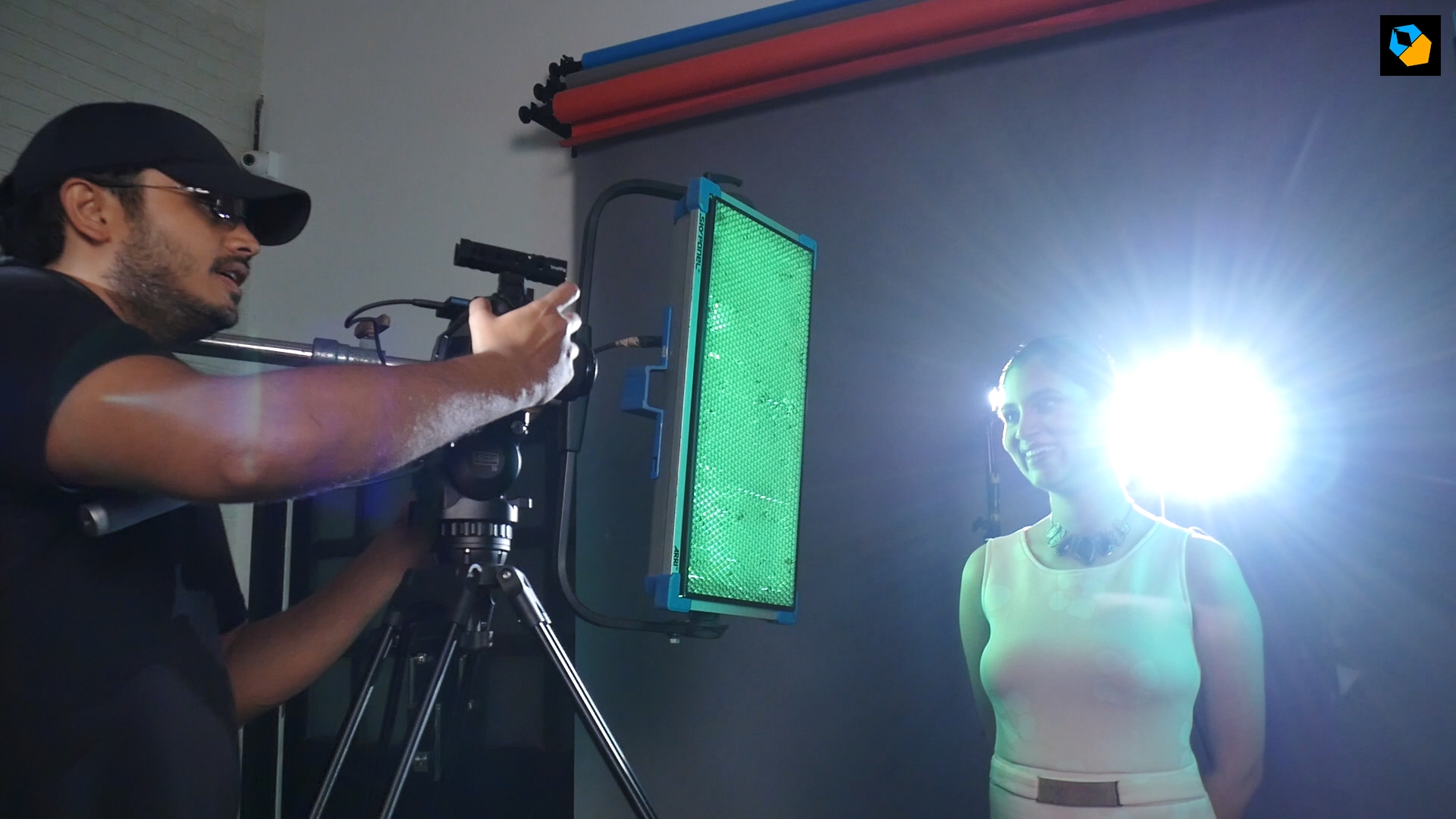
A professional-level industry standard LED panel is one that has proven itself in the rental field.
What’s so special about the workhorse LED light panels?
- These lights are designed to withstand a ton of abuse on set, getting unloaded and loaded into trucks, handled by rough crew, withstand dust, smoke, haze and a few sprays of water. This is de rigueur in the industry. Also, the build quality also extends to the cables, the power supplies, pins and anything else connected to the panel.
- They have to maintain their light output over many years of use. A cinematographer depends on a light. If he or she uses a panel today and the same one three years down the line, he or she expects the exact same response. Cheaper LEDs tend to lose their power output over time.
- They have to have the best electrical circuitry to withstand fluctuations in voltage and current. This is all too common with generators, poor wiring and long cabling.
- They have to maintain color accuracy over many years of use. Again, dependability is key. You can’t have a different red every time you switch on the fixture! The color accuracy reduces over the lifespan of the LED panel. In fact, it is not uncommon for the color accuracy to shift over just a few months of use!
- No color shifts while dimming.
- Flicker-free for high-speed filming.
- They must come with a ton of accessories to allow the light to be shaped and moulded. Manufacturers also augment these panels with other kinds of lights, like spotlights, tube lights, etc., so you can solve large scale lighting challenges.
- Availability of accessories. Many cheap LED products change year after year. If you want a part or accessory for a particular panel in about 5 years, you might not be able to get it if the manufacturer moves on. Higher-end panels made by reputable companies are designed after a lot of thought, and they tend to support their products a lot longer.
- They must be capable of being chained together for wireless or DMX operation without any issues.
Again, the lights in this list are rental items. They are expensive for the owner operator to buy and maintain, but there’s nothing stopping small crews from acquiring lights for commercials and corporate films.
Here are my top picks based on personal experience:

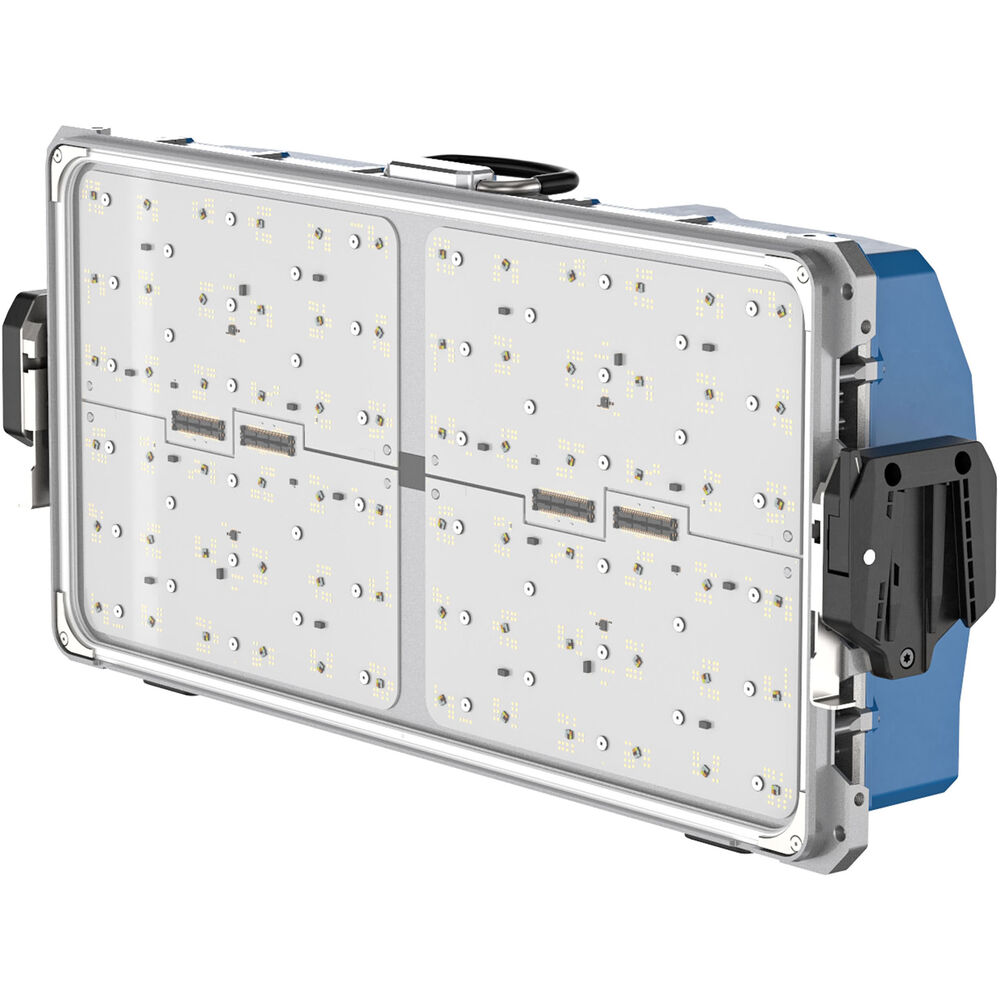
1 Arri SkyPanel
Arri SkyPanels are the probably the most ubiquitous LED light panels out there. You’ll be hard pressed to find a decent lighting truck that doesn’t carry a few of these.
You have the newer series like the X21, X22, and X23, and also the older time-tested series like the S30-C, S60-C and so on. Here’s a quick comparison of the two series:
| Feature | SkyPanel S60-C | SkyPanel X21 |
|---|---|---|
| Power | 400 Watts | 800 Watts |
| Weight Light/Power Supply | 13/5 kg | 15/3 kg |
| Size | 27.1 x 13.6 x 5.2″ | 29.1 x 13.3 x 6.1″ |
| Color Range | 2800 to 10,000K | 1500 to 20,000K |
| Photometrics at 5600K with Filter at 3.3′ / 1 m | 11,100 Lux | 13,589 Lux |
| Photometrics at 3200K with Filter at 3.3′ / 1 m | 11,322 Lux | 12,890 Lux |
| Color Accuracy | CRI 95 TLCI 90 | CRI 99 TLCI 93 |
| Weather Rating | IP 20 | IP 66 |
As you can see, the newer X series draws more power but is weather proof against rain, storms, and cold water pressure washers. And, the color range is incredible, and accurate. These lights are designed for AC power on a film set.
To understand the series, the larger the number, the bigger the light in terms of size as well as light output. The most useful one is the Arri Skypanel S60-C, which has color effects and filters, but I’ll need to test the X21 too soon.
Any SkyPanel a versatile light that can be used in a myriad of situations. Most times I rent a truck, I have a couple of S60s in them. I’ve found them to be dependable and versatile panels and I’ve been consistently using them for years now. You really can’t go wrong with an Arri SkyPanel.

2 Kino Flo Image
Here’s the thing. Kino Flos have been around for decades, and they have established themselves as a dependable brand.
Older accessories and products that interface with Kino Flo fixtures can be used with these modern designs that share similar physical characteristics. From a business continuity perspective, it makes a lot of sense to continue with the tried and tested.
Even if you are an independent filmmaker, I would recommend Kino Flos if you’re traveling around the globe. You’ll find replacements, dealers and accessories a lot easier to match your existing lineup or to replace them when things go south. There are lightweight options like the Diva-Lite and the Freestyle Air, that are also great as fill lights.
However, my pick is the Kino Flo Image series, the L40 and L80. These LED panels are narrow and are designed to light small to medium-size green screens, as well as for key lights in a studio setting. One of the cool features of the Image series is the light output does not change when changing Kelvin settings.
You get 7320 lux at 1m, but draw way less power than the X21.
Buy Kino Flo Image LEDs on B&H

3 Litegear LiteMat Spectrum
The Litegear LiteMat Spectrum is an extremely versatile “tile-type” LED system. I’ve never seen one in India, but they are popular in the USA.
If size and weight are your primary concern you should give these babies a look. These lights are designed to be rigid, lightweight, ultra-thin, and easy to rig. You can put them literally anywhere.
The downsides are that they don’t have the same functionality as multi-color RGB panels, nor are they as durable, but that’s an understandable tradeoff considering what you’re getting in return.
Buy Litegear LiteMat Spectrum on B&H

4 Litepanels Gemini
The biggest draw about the Litepanels Gemini is the price. Litepanels don’t have the pedigree of an Arri or Kino Flo, but they are a reputable brand that have been around for over a decade.
You don’t compromise on any features, and the build quality is there. The Gemini 2×1 Hard RGB LED panel has a decent light output of 23,000 lux at 9.8 feet.
If you want a real-world comparison of lights, check out this article I’ve written:
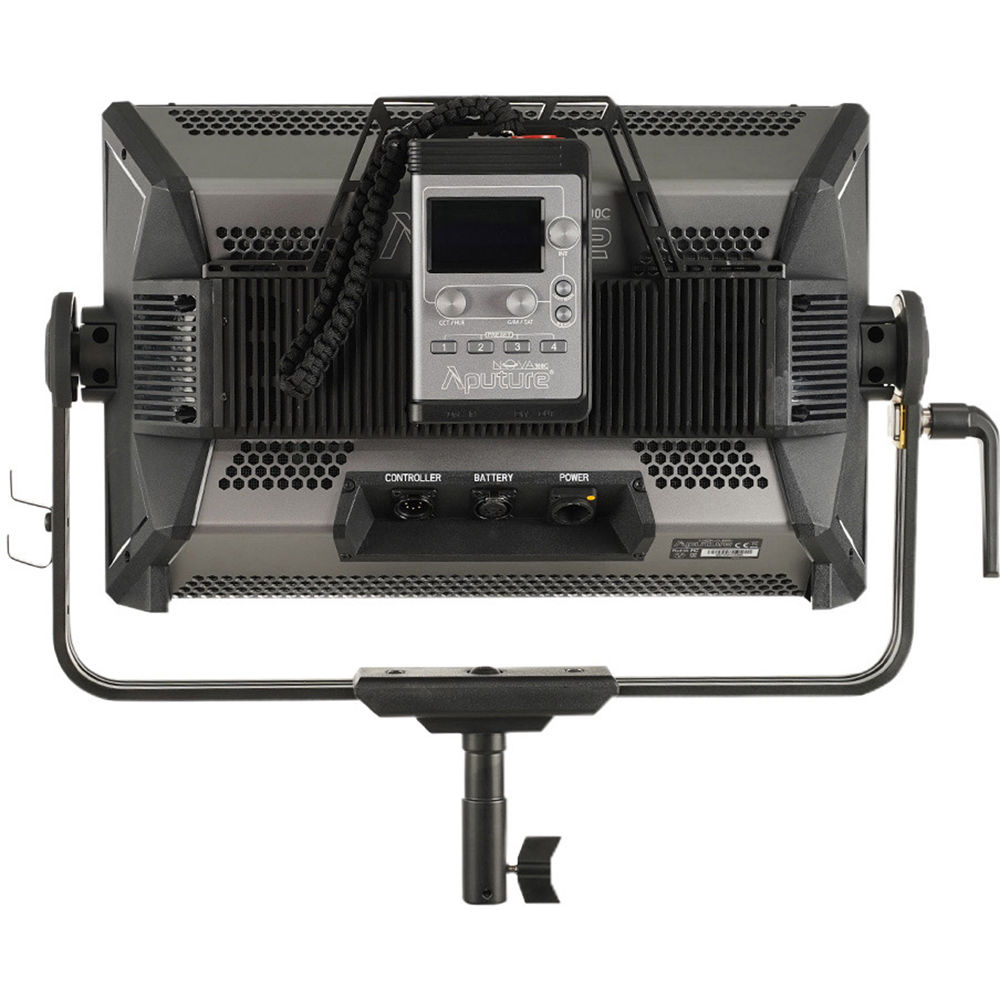
5 Aputure Nova P300c
The Aputure Nova P300c (Amazon, B&H) is the cheapest large panel on this list. Aputure has really stepped up its game over the last decade or so.
It goes from 2000K to 10,000K and has all the RGB and FX features. It draws 360 Watts and outputs 9,000 lux at 3.3 feet. It’s not as powerful as the SkyPanel but if you’re looking for a light to own then this will do well. Time will tell how well Aputure respond to the demands of the rental market. It’s not easy to change industry standards quickly.
Buy Aputure Nova P300c on B&H or Amazon
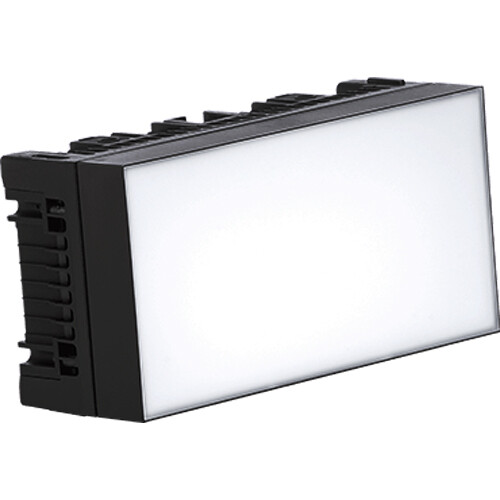
6 Astera FP6 HydraPanel
The Astera FP6 HydraPanels are a very different type of LED light. It’s small but packs a punch for times when space is at a premium.
It measures only 6.5 x 3.3 x 1.7″. The color temperature ranges from 1750K to 20,000K. It runs for an hour and 45 minutes at maximum brightness on its built-in battery power. It draws 17 Watts. You can an impressive 516 lux at 3.3′ / 1 m.
You also get modifiers like a diffuser, egg crates, and a gel holder. The panel can be mounted via an included FlexBase accessory, baby pin, or rear magnet.
Buy Astera FP6 HydraPanels on B&H
7 Aputure MC RGBWW
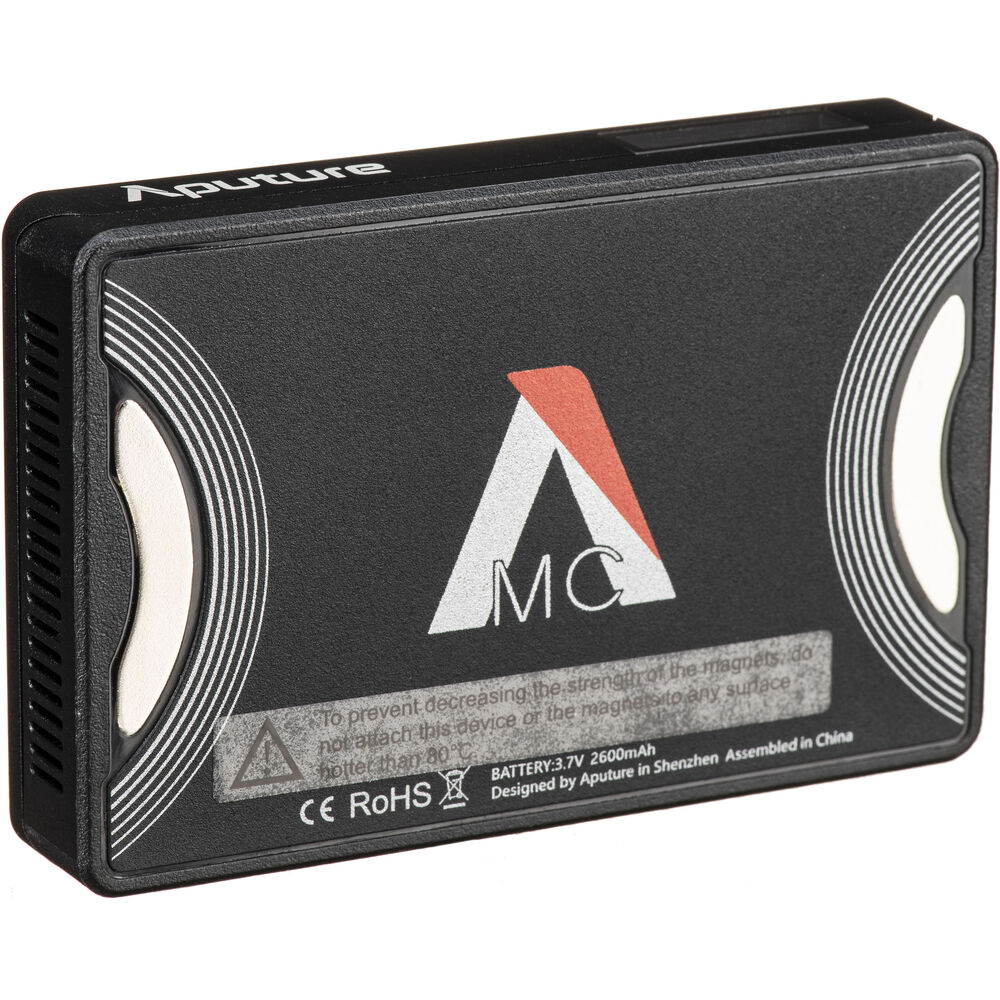
The Aputure MC (Amazon, B&H) is a smaller version of the Astera FP6, but is a light I’ve personally used. You can hide it in so many places for those accent and fill lights.
The MC has a size of only 3.7 x 2.4 x 0.7″. It can be mounted via a 1/4″-20 thread or via its built-in magnets. It’s not as powerful as the FP6. You get 100 Lux at 3.3′ / 1 m. The color temperature range is also lower, at 3200K to 6500K.
However, it draws a ridiculously low 5 Watts and runs for 2 hours at full brightness. I’ve used it on three shoots and they’ve held up very well on rentals. For the price you can’t go wrong. You can buy four of them for the price of an FP6, and Aputure sells them as a 4-light kit as well, which includes a charging case.
Buy Aputure MC on Amazon or B&H
That’s it for my list of seven industry standard LED panels that you’ll find everywhere on film shoots.
What do you think? Let me know in the comments below.

Did you look at the led panels by Lupo, an Italian company? Very bright and well made.
No, never had the opportunity.