

What is “Giallo” in relation to cinema?
Giallo means “yellow” in Italian.
Yellow was the color of many covers of Italian Mondadori crime pulp publications (I guess it made them stand out):

From Wikipedia:
The popularity of these series eventually established the word giallo as a synonym in Italian for a mystery novel. In colloquial and media usage in Italy, it also applied to a mysterious or unsolved affair.
Somehow the name “Giallo” stuck for a certain genre of films specifically made in Italy in the 60s, 70s and 80s. These films are called Giallo films.
What is a Giallo film?
A Giallo film is typically an atmospheric Italian mystery thriller with a body count.
You might be thinking: “But that’s exactly what a slasher is!”, except for four key differences:

- Giallo films came first, in the 60s and 70s, and slashers as we know them came later, in the 70s and continues to this day. Slashers were clearly inspired by Giallo films. Alfred Hitchcock’s Psycho (1960) and Michael Powell’s Peeping Tom (1960) are probably the ancestors of Giallo films. The influence is unmistakable.
- Both slashers and Giallo films hide the killer’s identity from the audience. Sometimes they did this with masks, other times with camera angles. In Giallo films, the masks were just a perfunctory way for the killers to hide their identity. In slasher films the mask is an important mode of self-expression.
- In many slashers the kills tend to be action sequences. Giallo films tend to veer towards horror and suspense, where the kills come as a shock and end abruptly.
- Giallo films were more artistic, expressive and often tackled socially taboo subjects. Slashers tend to play it safe, being designed for a worldwide audience.

What elements make a Giallo film?
This isn’t an exact science. In art you classify at your own peril! Still, having watched my fair share of Giallo films, I’ve arrived at criteria that are necessary in a Giallo film:
- It should have been made in Italy in the 60s, 70s or 80s. Nothing stops anyone from calling a film a Giallo, though it wouldn’t really classify as “Giallo” anymore because of the worldwide prevalence of slashers. Giallos are a done deal. Feel free to disagree.
- Directors who made Giallo films tried to outdo each other in how creative they could get with every kill. This is one aspect Giallo films have in common with slashers.
- Giallo films typically cast beautiful women even if they were unsuitable for the character they were playing. Nudity was common in Giallo films and is a mode of expression.
- Characters in most Giallo films are stereotypical at best (a fair generalization!) and, dare I say, racist and misogynistic? Clearly that’s how the Italian audience and directors predominantly saw women and black people during those decades,. Sometimes it’s hard to watch and comprehend, so be forewarned.
- Giallo films typically have great music featured in the film itself. Two names you have to know are Goblin and Ennio Morricone.
- A lot of attention is paid to color and art direction in Giallo films. Some of the best Giallo films look absolutely divine, on par with Hollywood films of the same era.
- There is a lot of intrigue in Giallo films, and substantial screen time is spent on the exploration and investigation of the crime.
- Giallo films have long titles that usually relate directly to what the films are about!
- The audio, ADR and/or dubbing sucked. Giallo films were made for many film markets, and the poor ADR work is a turn off. Try to watch the films in Italian with subtitles; even so, don’t expect the quality of Hollywood films of the same era. It’s shameful considering the attention that went into the cinematography, music and mis-en-scene.
What make a great Giallo film?
Not everyone has to like a Giallo film for the same reasons. I have my own, and they are:
- It must be a creative film that breaks new ground, not just breasts-kiss-slap-hack-to-death-rinse-repeat.
- One shouldn’t be able to guess who the killer is.
- Ingenuity in cinematography and the visual treatment of the film. This includes camera work, lighting, art design and editing.
- Great music.
- Focus isn’t on gore but the suspense and atmosphere. More Psycho and Peeping Tom, less Saw please. Most directors of Giallo – Bava, Argento, Fulci included – started out and became famous with the first but moved on to more gore.
- No supernatural forces or monsters, etc. This rules out gems like Suspiria.
- It shouldn’t insult my intelligence, be boring or tedious to watch. A few good scenes does not make a good film. This should go without saying for any film but you’d be amazed how many subpar Giallo films are put on a pedestal for just a few brief flashes of brilliance.
- Should pass the test of time. Does it make sense to a modern audience?
- Some form of art and culture is always at the forefront of a good Giallo film – dancing, painting, music, rituals, you name it. Either the characters are in creative professions, or the setting is designed around art and culture.
Who are the best directors of Giallo films?
These four film directors are the “Mount Rushmore” of Giallo films, without a doubt:
- Mario Bava
- Dario Argento
- Lucio Fulci
- Sergio Martino
Two films that aren’t Giallo but you must watch are The Perfume of the Lady in Black (1974) and Short Night of Glass Dolls (1971).
The 10 best Giallo films ever made
It goes without saying I haven’t seen every Giallo film, just my fair share, all the usual suspects you’d typically find in any top 50 list.
With this in mind, here are the 10 best Giallo films:

10 The Psychic (Murder to the Tune of the Seven Black Notes) (1977)
Director: Lucio Fulci
What’s The Psychic about? From Wikipedia:
The film involves a woman who begins experiencing psychic visions that lead her to discover a murder, her husband is charged with the killing. The psychic must embark on an investigation with a paranormal researcher to clear her husband’s name of the crime.
In my childhood I watched a Bollywood film that was inspired by The Psychic. The original is better!
Director Lucio Fulci is one of the Giallo greats. His later films are known for their expressive and elaborate violence. The Psychic isn’t one of those films. Think of the walls closing in, that’s the feeling you get.
Everlasting memory: The chime, which explains the longer Italian title.

9 The Girl Who Knew Too Much (The Evil Eye) (1963)
Director: Mario Bava
What’s The Girl Who Knew Too Much about? From Wikipedia:
The plot revolves around a young woman named Nora, who travels to Rome and witnesses a murder. The police and Dr. Bassi don’t believe her since a corpse can’t be found. Several more murders follow, tied to a decade-long string of killings of victims chosen in alphabetical order.
This is widely considered to be the first ever Giallo film, and is the bridge between Alfred Hitchcock’s Psycho and Giallo films. You can’t claim to be a Giallo fan if you haven’t watched this film, also called The Evil Eye.
Director Mario Bava was usually his own cinematographer. He creates a terrific atmosphere through the use of light and shadow.
Everlasting memory: Early murder at the piazza.

8 Eye in the Labyrinth (1972)
Director: Mario Caiano
What’s Eye in the Labyrinth about? From IMDb:
A woman searches for her missing lover, a psychiatrist who has suddenly vanished for no apparent reason. She ends up at a villa populated by a group of eccentric individuals. A string of murders commences immediately.
Eye in the Labyrinth is one of the rare Giallo films that hold up to modern viewing. What I love about it is the complexity of all the characters, lead actress included, and the unexpected ending that actually explains all the eccentricity!
Everlasting memory: The burning car scene (first image on this page).

7 Don’t Torture a Duckling (1972)
Director: Lucio Fulci
What’s Don’t Torture a Duckling about? From Wikipedia:
The plot follows a detective investigating a series of child murders in an insular village in Southern Italy whose residents are riddled with superstition and mistrust.
Lucio Fulci’s isn’t afraid to tackle multiple taboo subjects head on. The ending is not too hard to guess for a modern audience, but on the whole it’s still a great film. Don’t Torture a Duckling holds its value as a powerful use of the cinematic medium. You can’t look away even if you want to.
Everlasting memory: Barbara Bouchet and the boy.

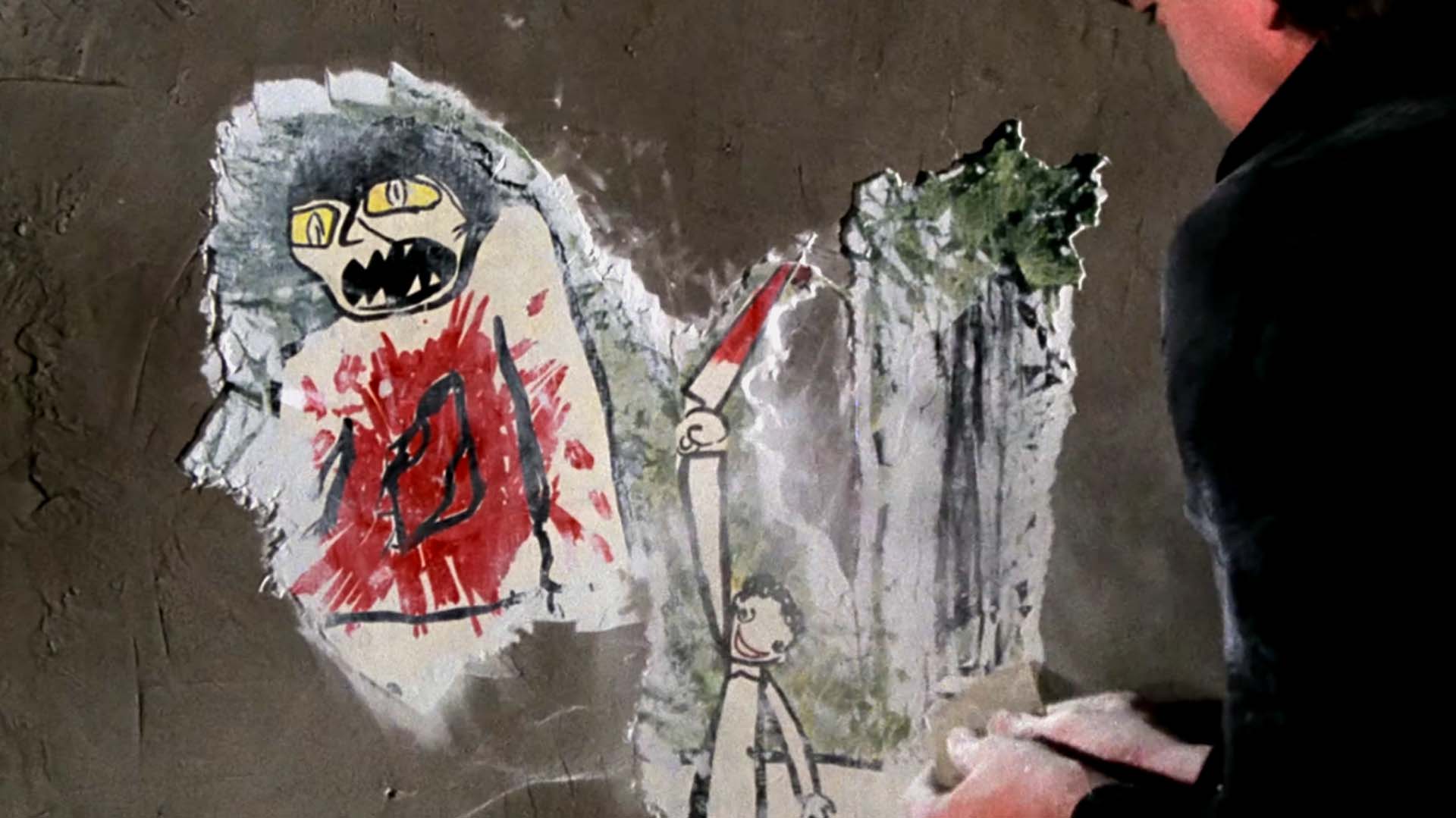
6 The House With The Laughing Windows (1976)
Director: Pupi Avati
What’s The House With The Laughing Windows about? From IMDb:
Stefano, a young restorer, is commissioned to save a controversial mural located in the church of a small, isolated village.
I don’t know if this one’s inspired by The Texas Chainsaw Massacre (1974), but it’s certainly different in most respects. It’s a slow burn, but ratchets up towards the end in one horrific climax.
Everlasting memory: The house with the laughing windows (image above).

5 All the Colors of the Dark (1972)
Director: Sergio Martino
What’s All the Colors of the Dark about? From IMDb:
A woman recovering from a car accident in which she lost her unborn child finds herself pursued by a coven of devil worshipers.
Sergio Martino’s best film deserves to be on this list because it teases us into thinking it’s about the supernatural, but isn’t. It’s also a great lesson in the perils of gaslighting. You’re often manipulated by the very people you take for granted.
Everlasting memory: The ritual, you’ll know it when you see it.

4 A Lizard in a Woman’s Skin (1971)
Director: Lucio Fulci
What’s A Lizard in a Woman’s Skin about? From Wikipedia:
Set in London, the film follows Carol Hammond, the daughter of a respected politician, who experiences a series of vivid, psychedelic nightmares consisting of debauched sex orgies and LSD use. In the dream, she commits a graphic murder of a neighbor whose life she is envious of and awakes to a real-life criminal investigation into the murder of her neighbor.
Lucio Fulci’s best film. If it weren’t for a certain Dario Argento Fulci would be the greatest Giallo director ever. A Lizard in a Woman’s Skin shows how one can use cinematic deception to hide an inevitable ending, and you’ll still never see it coming.
Everlasting memory: The vision of murder in slow motion (image above).

3 Blood and Black Lace (1964)
Director: Mario Bava
What’s Blood and Black Lace about? From Wikipedia:
The story concerns the brutal murders of a Roman fashion house’s models, committed by a masked killer in a desperate attempt to obtain a scandal-revealing diary.
Mario Bava single-handedly created the Giallo genre. In Blood and Black Lace he shows incredible cinematic acumen and a confidence that transcends everything else that came before. If Psycho (1960) was the inspiration for The Evil Eye then Peeping Tom (1960) is the inspiration for Blood and Black Lace.
Everlasting memory: The bath tub scene.

2 The Bird with the Crystal Plumage (1970)
Director: Dario Argento
What’s The Bird with the Crystal Plumage about? From IMDb:
An American expatriate in Rome witnesses an attempted murder that is connected to an ongoing killing spree in the city, and despite himself and his girlfriend being targeted by the killer, he conducts his own investigation.
In his directorial debut, Dario Argento hits it out of the ball park. Some people think The Bird with the Crystal Plumage isn’t a Giallo film, others think it’s borderline. I think it meets all my criteria; especially the most important one: You can’t guess who the killer is!
Everlasting memory: The iconic scene from which the image above is taken.
1 Deep Red (Profondo Rosso) (1975)
Director: Dario Argento
What’s Deep Red about? From Wikipedia:
A musician investigates a series of murders performed by a mysterious figure wearing black leather gloves.
The logline might seem insipid, but it hides and incredibly visceral film on so many levels – music, art, kills, mystery (you see the killer but you still don’t know who did it!).
Deep Red is the quintessential Giallo film, the greatest ever, and you’ll find it at number one on most Giallo lists. It’s special, and nothing else before or since comes close to the experience that is Deep Red.
Everlasting memory: The entirety of the film is one spine tingling experience. If I had to pick, it would have to be the murderer’s table of toys.
That’s it! I hope you liked my list! If you want to nerd out a bit more, continue reading.
A brief history of Giallo Films
As mentioned at the beginning, the term “giallo” translates to “yellow” in English, a reference to the yellow covers of the pulp mystery novels published by Mondadori since the 1920s.
The genesis of Giallo can be traced back to the early 20th century, but it wasn’t until the 1960s and 1970s that the genre truly flourished in Italian cinema. The first film considered to be a true Giallo was Mario Bava’s The Girl Who Knew Too Much (1963), which introduced audiences to the genre’s trademark blend of mystery and horror. Bava’s work, including the visually striking Blood and Black Lace (1964), set the standard for Giallo with its stylish cinematography, complex murder plots, and elements of psychological horror.
However, it was director Dario Argento who became synonymous with the genre, elevating it to new heights of artistic and commercial success. Argento’s The Bird with the Crystal Plumage (1970) was a watershed moment for Giallo, garnering international acclaim and inspiring a wave of films that embraced the genre’s core themes.
His subsequent works, such as Deep Red (which is at the top of my list) and Suspiria (1977), though the latter is often categorized separately as supernatural horror, further defined Giallo’s aesthetic with their use of vivid colors, elaborate set pieces, and haunting scores, notably by the Italian rock band Goblin.
The golden age of Giallo films in the 1970s was characterized by a prolific output, with directors like Lucio Fulci, Sergio Martino, and Umberto Lenzi contributing iconic entries to the genre. We’ve already looked at the visual signature of the typical Giallo film earlier.
Giallo’s influence extended beyond Italy’s borders, impacting international cinema and inspiring filmmakers across different genres. Elements of Giallo can be seen in the works of contemporary directors such as Quentin Tarantino, David Fincher, and Nicolas Winding Refn, who have borrowed its stylistic flourishes and themes of obsession, identity, and madness.
The genre’s emphasis on visual storytelling and mood over coherent plotlines has also resonated with the rise of neo-noir and psychological thrillers.
The history of Giallo films is a testament to the genre’s enduring appeal and its ability to evolve while retaining its core elements. From its origins in pulp fiction to its cinematic expression, Giallo has fascinated audiences with its unique blend of suspense, horror, and artistry.
It has also influenced me personally. My second feature film, called Gin Ke Dus (A Count of Ten) (2024) is an Indian Giallo film I produced and directed. Check out the trailer below:
I’ve avoided the use of gore and eroticism in my film, but the style is very much Giallo, including the music!
If you feel I’ve left out a great Giallo film please let me know in the comments below.

Great list! Giallo films have such a unique style and atmosphere. I’m especially glad to see “The Bird with the Crystal Plumage” included—it’s a classic that truly captures the essence of the genre. I can’t wait to dive into the ones I’ve missed. Thanks for the recommendations!
You’re welcome!
Fabuleux listing du Giallo par un passionné je te remercie pour ton immersion en psyché jaune italiana…
Le CHat à neuf queues ( gatto a nove code ) est pour moi l un des gialli les plus oufs de tous les temps sans oublier quattre mouches de velours gros et ” qu’avez vous fait à Solange
GRAZIE PER TUTTO
You’re welcome!
Ya know… it’s interesting. I did the exact same thing as you but in reference to “Spaghetti Westerns” and you wouldn’t believe the flack I got concerning people telling me I couldn’t call it a spaghetti because it wasn’t an international co-production with Italian crew shot in Spain. Wondering if you got any similar grievances calling yours a “Giallo”.
I of course believe, much like I can make a “Kung-Fu Flick” or an “Anime”, it has nothing to do with geography and everything to do with tropes and style. Imagine telling someone in India they can’t make a lavish Hollywood-esque “Musical”. Ugh.
People need to be able to respect but separate origins and genres.
I think the only thing that matters is if your audience likes your film or not. The names don’t really matter. A Giallo would be a slasher today. Maybe something else tomorrow.
Right, but let’s consider this: if I label my film a “western,” and viewers notice all the spaghetti western influences and tropes, would they be wrong to call it a spaghetti western? Of course not. So why can’t I categorize or differentiate my film for the purposes of discussion or classification? It’s a genre piece, not a geographical one. It’s crazy to think otherwise.
If you type “peplum” into Google right now, you won’t find a single Italian production in the top 10 results, and yet…
It’s ludicrous. When does a film truly become a genre? Can I make a samurai movie and label it as such? Can someone in Albania create a film noir? These are questions that shouldn’t need to be asked. Alas…
My point is: You can label it anything you want. I have spoken to thousands of people about my movie being influenced by Giallo films, but nobody cares. Genres are useful for marketing and the sales process, but if the genre of your film isn’t marketable then it doesn’t really matter.
BTW, the other main actress in “Don’t Torture a Duckling ” is worth mentioning too: Irene Papas. Sehe was the female lead (the widow) in “Alexis Sorbas”, played in about 80 movies and was a singer too. With different kind of spine tingling on the album “666” by Aphrodite’s Child” ;-)
Thanks for the tidbit! I’ve been a fan of Vangelis as a kid but never knew he formed a band.
That album actually brought rock from Greece to international attention (they made three in total). Demis Roussos was the other one to be mentioned.
P.S. sorry for the typo.