

Let’s say you want to use medium format lenses on full frame cameras. There are two possibilities:
- You can use a lens adapter to fit the medium format lens to the full frame camera, with no other optics in between, or
- You can use a focal reducer (Speedbooster), which is also a lens adapter but with optics in between.
What a focal reducer actually does
A focal reducer (Amazon, B&H), also called a speed booster, uses extra glass between the lens and the sensor to shrink a larger image circle into a smaller one.
That does two things:
- It widens the field of view, and
- increases the effective brightness of the lens.
These reducers come with a reduction factor, typically 0.7x or 0.8x or whatever.
Take the original focal length and multiply it by the reduction factor, and divide the aperture number by the same factor.
E.g., if your medium format lens is a 50mm f/2.8, when using a focal reducer with a reduction factor of 0.7x, it becomes a 35mm f/2 lens. In other words, if you were to use a 35mm f/2 lens, you’d theoretically get the same field of view and aperture.
I’ll focus more on medium format on full frame, because you already have a great range of full frame lenses and Super 35 lenses, so it doesn’t really make sense to use a focal reducer when options are already available. Medium format is a different kettle of fish.
To know more about focal reducers, check out this video:
Why would anyone in their right mind take a lens built for a larger sensor and squeeze its image down to a full-frame sensor (or smaller)?
The promise
In short: More light, wider view.
Medium format focal reducers let you squeeze Mamiya 645, Pentax 67 and even Hasselblad V lenses onto full-frame cine bodies without the usual crop penalty. You can do the same for full frame lenses on Super 35 sensors and so on.
These adapters are fully manual. No electronics, no autofocus and no metadata.
Here are the clear advantages:
- Free light! Because the same photons are compressed onto a smaller sensor, exposure brightens by roughly one stop. Older medium format lenses hardly went wider than f/2.8, and mostly stayed at about f/3.5 or f/4. Now, these lenses can become an f/2 or thereabouts. A real f/2 medium format lens will be a lot more expensive.
- Older Medium format optics tended to resolve as well as or better than full frame lenses from the same time period. Newer medium format lenses are even better, are designed for 100 MP sensors, and are used for art conservation, scientific imaging, etc. So, if you’re able to get even more sharpness by adding in a focal reducer, those lenses get even more sharp!
- Wider field of view than what the focal length would indicate. E.g. an 80mm is normal on medium format, but is telephoto in full frame. With a focal reducer, the 80mm delivers a 50mm field of view on full frame.
- Compressing a larger image circle often reduces cat-eye edges and smooths spherical highlight transitions.
Here are the marketing promises:
- Medium format lenses have their own characteristics and fall-off. The promise is you can retain that character (which will be cropped off without the focal reducer) on full frame lenses.
- For filmmakers chasing a 65mm look or anamorphic look can get the 65mm or medium format or anamorphic look with a relatively affordable focal reducer without having to rent expensive lenses.
- Because a focal reducer makes the image sharper, there’s no optical penalty. Adding optics between the lens and sensor almost always reducers resolution, and comes with light loss. A focal reducer promises to go the other way!
These are the promises. What does reality say? Do focal reducers deliver on the promises?
Let’s get started.

The Gotchas
Here are the gotchas with focal reducers you should be aware of, one by one:

Chromatic Aberration and Edge Softness
Compress rays and you steepen their entry angle at the sensor’s edges. Color fringing flares up, especially on high-contrast edges near frame corners. That aberration is hardest to hide in skin-tone highlights where viewers notice first.
If you’re thinking of correcting it in post, you soften detail you gained with the reducer, sort of cancelling one benefit.
It is at the edges of the image were the focal reducers really suffer. You get janky effects that don’t match from shot to shot. It’s not just color aberrations, but also distortions, as you can see from the graphs above by Kipon.
Breathing and Focal-Length Drift
Many medium format lenses breathe heavily. They were not designed for cinema use, but for photography, where this doesn’t matter.
Add a focal reducer and the frame shift becomes larger because field of view is wider to begin with. Pull from five feet to infinity on a Pentax 67 105 mm f/2.4 (Amazon, B&H) and the framing feels like a slow zoom.
But that’s not the main problem. The main problem is this sometimes ruins one of the clear advantages of using a focal reducer. If an 80mm lens becomes a 55mm with a focal reducer, because of breathing and where you’re focusing, the 55m might become a 60mm or even a 65mm!
In other words, the field of view changes depending on where you focus. You get the best results at infinity, but that’s not how cinema focusing works. This is a gotcha a lot of people only realize one they start using focal reducers.
There’s one more problem. Medium format lenses were not designed for focus pulling. You might need shimming that need to be modified for each lens.
Flare and Contrast Loss
A reducer adds three or more optical surfaces. More glass means more internal reflections. Modern coatings help, but even a small ghost flare can wash blacks in a night scene.
When you light with hard sources, controlling veiling flare demands extra flags and matte boxes. You pay that price every setup.
So, for the sharpness you gain in the center, you lose overall contrast, and uncontrollable flares. Again this makes shot matching a huge problem.
Mismatch Across T-Stops
Open the lens wide and the look is dreamy. Stop down for daylight inserts and the bokeh, contrast, and color shift. Again, refer the MTF chart above and see the huge variation between different f-stops.
This is less a problem with the focal reducer and more an issue with the kind of medium format lenses available to play with. They were not designed to match (at least not the cheap ones). The f-stops don’t match either.
But the biggest problem is, an f/2 will not behave the same way as an f/4. If you use a focal reducer, an f/2 becomes an f/1.4, with a dreamy image.
However, if you need to stop down to f/2.8 or f/4 in another scene or shot, the image will look so different they won’t belong in the same movie. Color and shot matching them will become a nightmare.
If you cannot run the entire production at one or two stops, the adapter’s strength becomes its weakness.
Corner Tint and Vignetting
Some full-frame sensors with thick cover glass show magenta edges with some reducers. There is also vignetting that depends on the flange focal distance of the lens mount.
Vignette removal in Resolve raises noise floors in the same corners, undercutting the extra stop of light you thought you won.
Mechanical Clearance Risks
Medium format rear elements stick deep into mounts. A Mamiya 645 80 mm f/1.9 (Amazon, B&H) sits millimeters from the reducer’s rear group. Any play in the mount can scratch coatings or knock the lens off center.
This is a problem with the lenses available, but that’s all you have to play with. Not all lenses clear the focal reducer. This means, some medium format lenses cannot be used without heavy modification – which is something outside the scope of most low budget productions.
It’s frustrating!
Are you really getting the medium format or 65mm look?
No. Not if you get different corner performance, a sharper center frame, no consistency from aperture to aperture, or lens to lens, and not even the full field of view at different focus depths.
Are you really getting the exact same look? An 80mm f/1.9 Mamiya lens on a Mamiya 645 or an 80mm f/1.9 Hasselbad V on a Sony FX3 (Amazon, B&H) won’t look or behave the same as they would on their native camera systems.
It’s not the same look!
Why is that? One of the main reasons for the medium format look or 65mm look is the size of the film area or sensor. Check out this article to know more about it:
And, what if “The Look” is not longer exclusive?
A decade ago shallow depth of field, low-contrast imagery felt fresh. Now every web series and film copies the style. The look is no longer unique or hard to achieve.
Sharp, controlled, high-contrast frames are creeping back, using lenses like the Zeiss Supreme Prime T1.5 or even fast still-glass such as a Sigma 50 mm f/1.4 Cine. These kind of primes give you the stop, the sharpness, and the color match without optical hacks.
But what if you want the “vintage” aspect of the look? Yeah, that’s under siege, too.
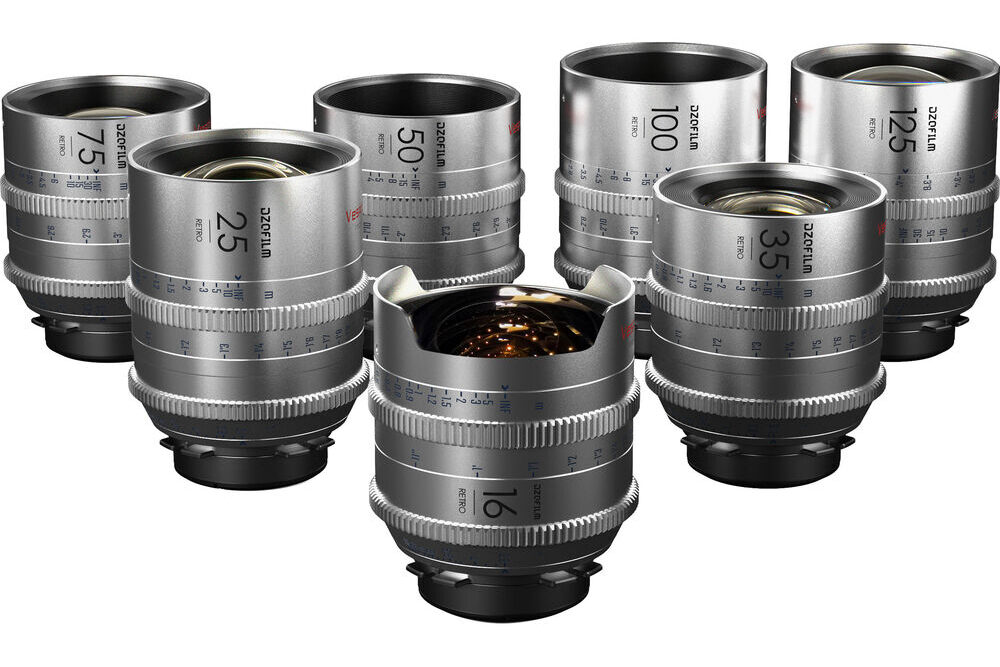
Lens makers now ship cinema glass built for artistic flare and vintage features. An Angénieux Optimo Prime offers user-swappable elements that add bloom without killing contrast. A DZOFilm Vespid Retro ships with controlled halation baked in.
These lenses mount natively, focus consistently, and match from shot to shot.
They give the “organic or vintage” look without adapters or guesswork.
Why not just buy a fast Lens?
A modern T1.4 lens delivers the same exposure gain as a reducer on an f/2.8 vintage lens. And, it focuses more accurately, shows less breathing, and keeps coatings consistent across the set.
For many professional cinematographers, that reliability outweighs the romance of squeezing old glass. Most producers and directors can only see the shallow depth of field look and can’t see past that. They wouldn’t even be able to tell which image is medium format in a blind test. Is the juice worth the squeeze here?
When a Focal Reducer Still Makes Sense
I wouldn’t say focal reducers are useless. They are a tool like everything else. Here are some scenarios where a focal reducer actually makes sense:
- Experimental flare or optical effects are part of the look of the film.
- You’re filming in one or two focal lengths that are color and aperture-matched.
- You need a lighter run and gun setup. Medium format lenses are lighter compared to cinema lenses.
I’ll be honest, when I looked at focal reducers first my main priority was getting the same lens characteristics and look. When I realized that won’t happen, I lost interest.
I’ve shot music videos with vintage 35mm lenses and have used optical tools to get interesting effects – all without focal reducers. You can achieve a hell of a lot without them – and no one pays extra for them, or for all the hassle you have to go through to get everything to work.
When all you have is a limited set of medium format lenses, your look isn’t as unique as you think it is. Experiment, and see for yourself.
If you do decide to go ahead, here’s a quick checklist to know what to look for.
Checklist Before You Commit
- Confirm rear-element clearance for every lens and the sensor. Check the chart below for a guide.
- Shim the adapter until infinity is razor sharp the apertures you want.
- Shoot a gray card for every lens at working stop to map vignetting and color shifts. This will help you to decide on the use of color filters or correcting white balance – and stay ahead of things.
- Check breathing against blocking distances. I know this is tedious but you’re going to run into this problem when the actors move during a dialogue scene.
- Read MTF curves – Some manufacturers publishes MTF plots that show edge contrast changes so you can use it as a guide on what to expect.
- Budget post hours for shot matching. You can limit this with a lot of prep work, but it’s still going to be needed sometimes.
| Lens | Works with 0.7×? | Works with 0.8×? |
|---|---|---|
| Mamiya 645 80 mm f/1.9 | Yes | Yes |
| Pentax 67 105 mm f/2.4 | Yes | Yes |
| Hasselblad V 50 mm f/4 CFi | It’s tight | It’s tight |
| Bronica SQ 150 mm f/4 | Yes | Yes |
| Mamiya 7 65 mm f/4 | No | No |
Medium format lenses with leaf shutters or those designed for bellows, like Mamiya RB67 and RZ67 lenses will need to be modified before they can be used. Panavision does this for some Hollywood productions that can afford it.
Final Verdict
Focal reducers were never frauds; they were over-marketed by YouTubers who are not filmmakers.
Use a focal reducer when its defects serve the story. It isn’t a magic wand; it’s a precision tool. Use it with discipline – matching flange depths, watching rear-element clearance, embracing the stop of free light but respecting the telecentricity limits.
Treat it like a cheap shortcut and you’ll end up with color-shifted edges, soft corners and a very expensive lesson in optical design.
My recommendation: Pick fast glass designed for your sensor and spend your saved energy on lighting, framing, and performance. That choice will age better – and so will your footage.
