
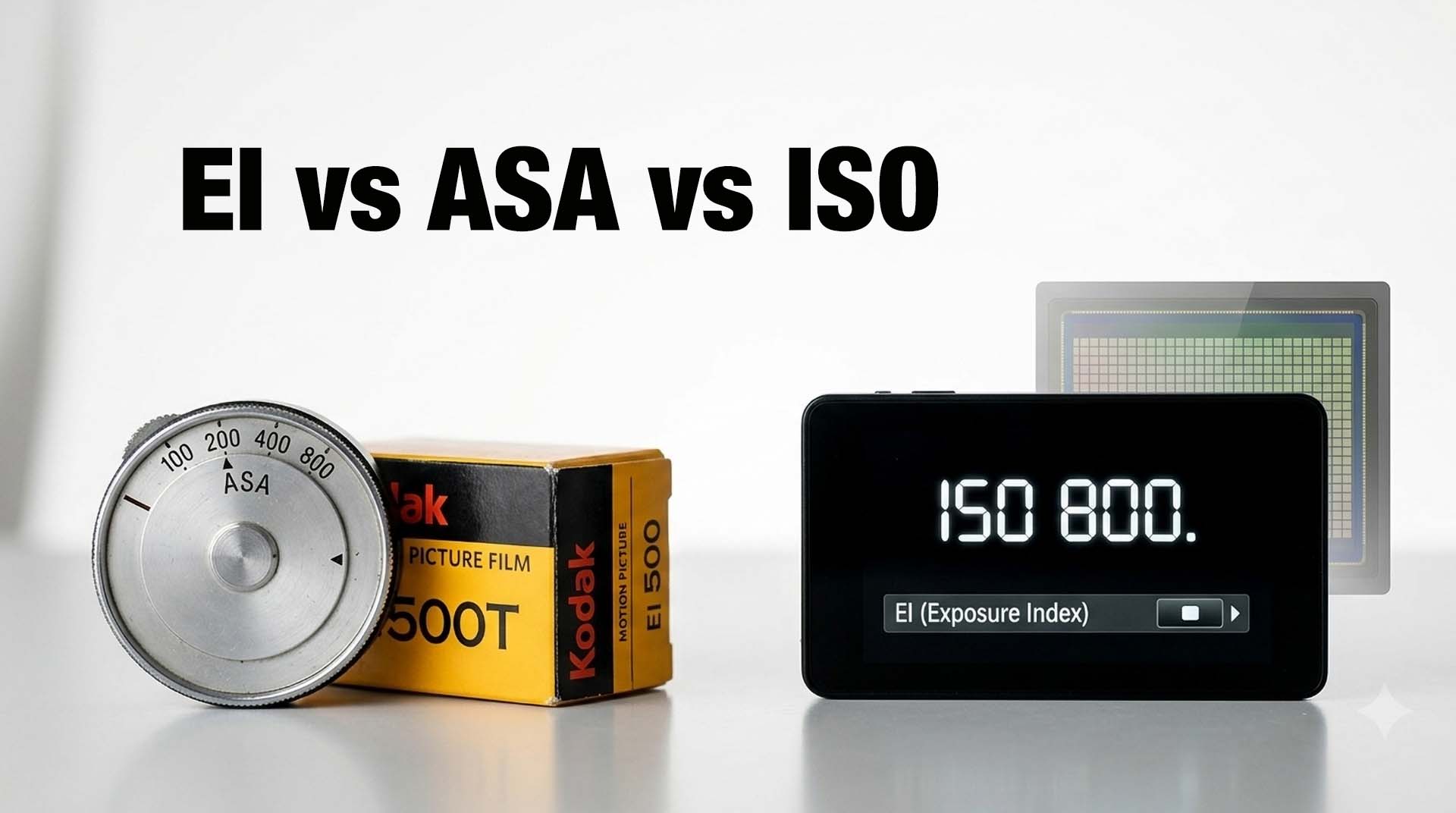
Every digital cinema camera worth anything has an ISO. If you talk to someone who worked on a movie set a few decades ago, they will likely use the term ASA.
If you read the technical manual for a roll of professional movie film, you will encounter a third term called EI.
These three terms often seem to mean the exact same thing. They all relate to how your camera handles light. However, they are not identical. Many of the words we use today are often ghosts of old technologies. ASA, EI, and ISO are perfect examples of this survival.
Understanding the differences between them will completely change how you think about exposure and lighting – and this is what I’ll cover in this article.

The Chaos of the Early Days of Film
In the earliest days of photography and motion pictures, there were no universal standards for measuring film speed (what we call ISO today, but hold that thought!).
Every manufacturer invented their own system. If you bought a box of photographic plates in the late nineteenth century, you had to trust the specific instructions printed by that specific factory. The numbers did not translate if you switched brands. This made the job of an early filmmaker incredibly difficult. Exposure was largely an art of guesswork and intuition.
There were many systems to rectify this, and one worth noting is the DIN system, introduced in Germany. The DIN system was highly accurate but used logarithmic math. If a film speed doubled, the DIN number only went up by three. This confused many people who preferred simple, linear numbers.
Filmmakers needed a global standard that made practical sense on a busy movie set.
The Birth of ASA
During World War II, military operations required absolute precision in photography. In 1943, the American Standards Association stepped in to solve the problem. They created the ASA rating system.
ASA stands for American Standards Association.
The ASA system used a linear scale. This was a massive relief for photographers and cinematographers. Linear math is incredibly easy to calculate on the fly. If you double the ASA number, you double the chemical sensitivity of the film. For example, a film rated at ASA 200 is exactly twice as sensitive to light as a film rated at ASA 100. If you switch from ASA 100 to ASA 200, you only need half as much light to get the exact same exposure.
This predictability allowed light meters to become sufficiently accurate tools. I say “sufficiently accurate” because light meters are not scientific measuring tools, and they only have to be sufficiently accurate for the purposes of photography and cinematography. E.g., most modern digital cameras allow you to change exposure in 0.3EV increments, which is sufficient accuracy.
Major film manufacturers like Kodak in America quickly adopted the ASA system. European companies like Agfa and Japanese companies like Fuji also began printing ASA numbers on their boxes alongside their local systems. For the first time, a photographer or cinematographer could travel from New York to London or Tokyo and know exactly how their film would behave under the lights.
The ASA number was a strict laboratory measurement. It told you the exact point where the film chemistry began to react to light. However, it was not enough.
And the reason was the latitude of film stock to changes in exposure.
The Great Tri-X Secret of 1960
A fascinating piece of trivia in film history involves the legendary Kodak Tri-X film stock. For years, photographers and and documentary filmmakers used Tri-X at a rated speed of ASA 200. Then, in 1960, the American Standards Association revised their testing methods. They realized that the original ASA formulas included a massive safety margin to prevent users from underexposing their images.
The committee decided to eliminate this safety margin from the official calculations. Overnight, the official rating of Kodak Tri-X jumped from ASA 200 to ASA 400.
The most surprising part of this event was that Kodak did not change a single ingredient in the film emulsion. The chemical recipe remained exactly the same. The film did not magically become more sensitive to light. The industry simply changed the way they measured it!
This proved to cinematographers that laboratory speed ratings were helpful, but they were not absolute laws. In other words, ASA was theoretical, but a more practical number was useful.
Say hello to the Exposure Index (EI).
What is the Exposure Index?
Cinematographers need a way to describe how they chose to expose their film, regardless of what the box said.
You would scratch your head if someone said: the camera shows ISO 200, but you’re supposed to use ISO 400. That doesn’t make much sense, does it? We need one number, one practical number – a deliberate choice a cinematographer can make and be done with it.
That’s the Exposure Index.
When you use an Exposure Index, you are telling your light meter to treat the film as if it has a different speed than its laboratory rating. For example, a cinematographer might shoot a roll of Kodak film rated at ASA 500 but set their light meter to EI 320. By doing this, the cinematographer is intentionally giving the film more light than the lab recommends. This is called overexposing the film.
Why would a filmmaker do this? In film cinematography, giving the film extra light creates a denser negative. This results in richer colors, finer grain, and cleaner shadow details when the film is processed. The Exposure Index is a creative dial.
So this is what it comes down to:
ASA tells you what the film is under perfect lab conditions. EI tells the lab how you actually chose to shoot it for the sake of the story.
Why did cinematographers choose to rate their film stock differently than what’s on the label? Creativity – you got different looks that way.
During the golden age of celluloid, Kodak, Fuji, and Agfa competed fiercely for the loyalty of cinematographers. Each company designed its film chemistry differently, which affected how their speed ratings translated to the screen. This also indirectly gave cinematographers a lot of leeway in exposure – and development.
But the byproduct of all this was the ASA rating was sort of a vestigial number at this point. Kodak eventually stopped using the term ASA on their professional motion picture film boxes. Instead, they began printing the letters EI directly on the cans, starting with Eastman Color Negative 5247 (debuted in 1950 as a 35mm daylight film and not to be confused with the more popular and Tungsten balanced Eastman Color Negative II 5247 released in the 70s).
Kodak did this because there was no official, up-to-date international standard for measuring the speed of motion picture film as opposed to still photography film. By labeling it as EI 500, Kodak was saying that “this is our strongly recommended rating for the best look on a movie theater screen”.
Cinematographers working with Kodak, Fuji or Agfa would still often run extensive tests before a shoot. They would expose the same scene at EI 400, EI 320, and EI 250. After developing the film, they would look at the results on a projector to decide which Exposure Index delivered the perfect look for their specific project.
The rating on the box was merely a starting point for a conversation. But with EI, it was a more accurate and useful starting point.
Now all we have to do is figure out how EI compares with the new kid on the block, ISO.
ISO Arrives to Unify the World
By the late 1980s, the global market required a single, definitive standard that merged all regional systems. The International Organization for Standardization stepped in to create the ISO system. The ISO rating we use today is a direct combination of the old American ASA system and the German DIN system.
To know more about the basics of ISO and how it related to cinematography, watch this video:
If you look at a film box from the 1990s, you might see the rating written as ISO 400/27. The first number was the linear ASA rating. The second number was the logarithmic DIN rating. Eventually, the industry dropped the second half of the equation. The math remains exactly the same as the old ASA system. It is a linear scale where doubling the number doubles the sensitivity value.
The creation of ISO brought total clarity to the consumer photography market (yes, I did not say cinematography!). It meant that any camera, light meter, or film stock anywhere on earth used the exact same scale.
In other words, if your light meter says you need a certain exposure at ISO 400, you can input those exact numbers into your camera and get a predictable result.
How ISO Works in Digital Cameras
The underlying technology of film and digital cameras is completely different. The ISO of film is not the same as the ISO of a digital camera.
A roll of film has physical silver halide crystals inside a gelatin layer. A fast film has larger crystals that catch light quickly. A slow film has smaller crystals that need more light. Your digital sensor does not have crystals. It has a fixed grid of millions of tiny light collection buckets called pixels. These pixels convert photons of light into electrical signals. The physical sensitivity of your digital sensor is permanent. It never changes.
When you change the ISO setting on a digital camera, you are not making the sensor more sensitive to light. Instead, you are adjusting a volume knob on an electronic amplifier. If you raise your ISO from 400 to 800, you are telling the camera computer to take the existing electrical signal and multiply it by two. You are boosting the signal after the light has already hit the sensor.
This is why high ISO settings introduce digital noise. It is exactly like turning up the volume on a quiet audio recording until you hear an annoying background hiss.
The Concept of Native ISO
Because digital sensors have a fixed physical sensitivity, every digital cinema camera has what is called a Native ISO, or Base ISO. This is the optimal setting where the sensor operates at its peak performance. At the Native ISO, the camera delivers the highest dynamic range, the cleanest shadows, and the lowest amount of digital noise. To know more, watch this:
Many cinema cameras today have a Native ISO around ISO 800. Some modern cameras even feature Dual Native ISO circuits. These cameras have two separate physical paths for the electrical signal, allowing you to shoot in low light without generating massive amounts of noise. There’s still only one real native ISO, the second one is close enough visually to the real Native ISO for all practical purposes – even though they call it dual native ISO.
So, as of today, just like with film stock, you only have one native ISO with digital cameras. Takeaway:
- With film, you are free to deviate from the suggested EI by under or overexposing the negative, or playing around with lab chemistry and processing.
- With digital, you are free to deviate from the Native ISO by… changing the ISO.
Is there a way to equate film EI to digital ISO? In other words, when Gordon Will filmed The Godfather, he used Eastman Color Negative 5254, rated at EI 100. Does that equate to ISO 100 today, or something else?
Let’s find out!
Equating Exposure Index to ISO
Turns out the calculation is a straightforward mathematical conversion:
ISO = 2 x Exposure Index
This is what Kodak states in their reference manual. To find the true ISO of a Kodak film stock, you must multiply the box Exposure Index by two. If you have a roll of film labeled as Exposure Index 500, its underlying chemical formula behaves like a standard ISO 1000 film in a test laboratory. If you are shooting on a movie stock labeled as Exposure Index 200, its physical chemistry is equivalent to ISO 400.
All this only applies to film stocks released after 1950. Prior to that Kodak did not use EI. The official Chronology of Film by Kodak states that Eastman Color Negative 5247 debuted in 1950 as a 35mm daylight film. The factory printed the rating of Exposure Index 16 directly on the product data sheets.
Does this formula apply to Fuji or Agfa motion picture film stock?
I don’t see why not.
Fujifilm and Agfa engineered their cinema stocks to directly compete for the exact same Hollywood and global movie sets as Kodak. A cinematographer needed to be able to pull a roll of Kodak Vision 500T out of the camera and instantly load a roll of Fuji Eterna 500T without re-lighting the entire set or recalibrating their light meters.
In other words, Fuji and Agfa had to match Kodak’s conservative exposure baseline. Though to be fair, they never officially wrote it down like Kodak.
Does this formula apply to photography film?
No. It only applies to cinematography stock. Curiously, for photography-based motion picture stock, like Tri-X, Kodak still only prints a number – 400 or 320 – and doesn’t tell us whether it’s EI, ASA or ISO:
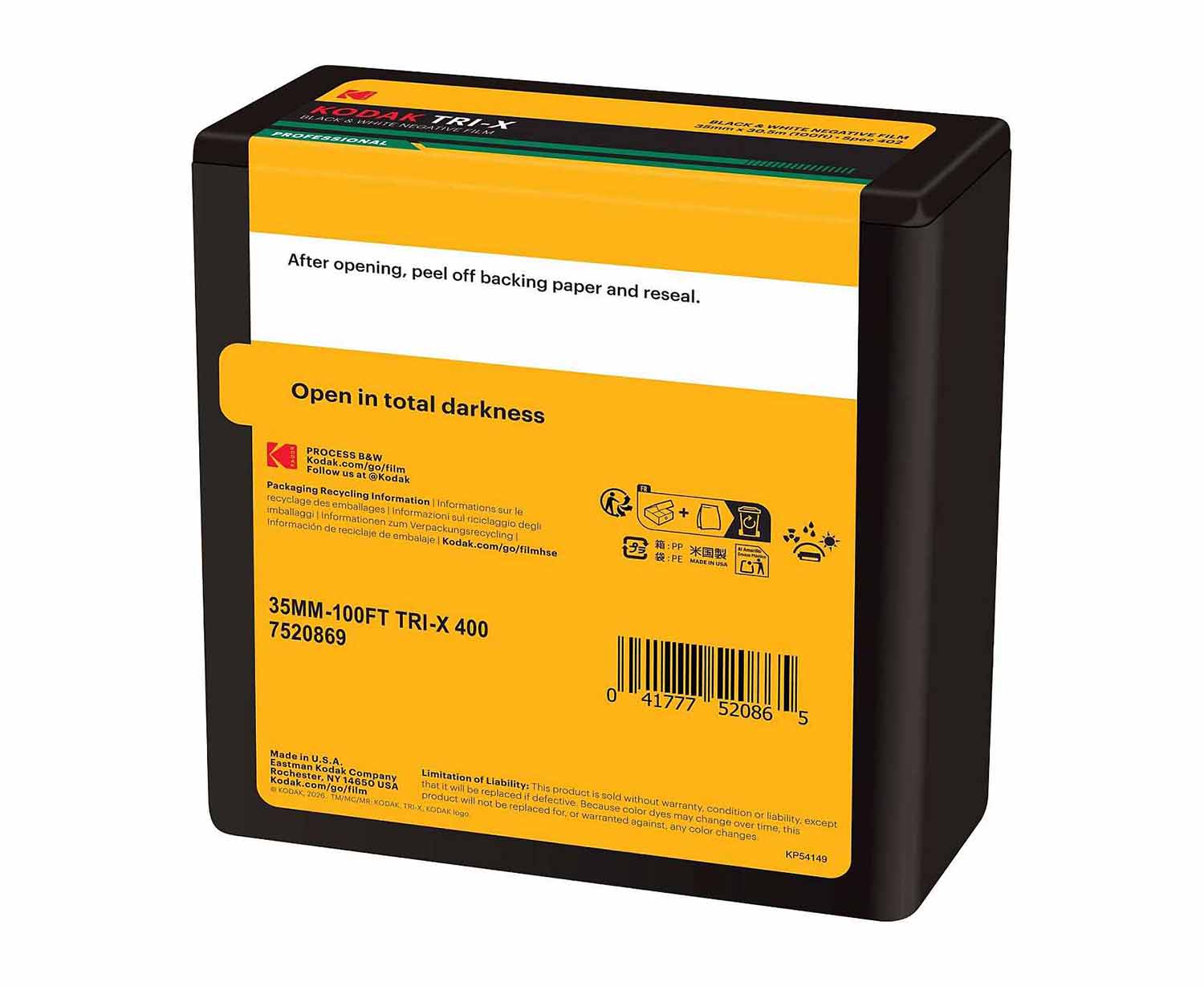
On the other hand, for EKTACHROME E100, they say: “is a daylight-balanced color reversal film with a nominal sensitivity of ISO 100/21”.
In other words, photography film is rated as ISO, and cinematography film as EI.
What about ASA, then? Why does everyone still use ASA?
The answer comes down to muscle memory and vintage hardware. If you pick up a classic twentieth-century light meter or a vintage mechanical film camera, the physical dials are not labeled with ISO or EI. They have the letters ASA stamped right into the metal.
Because the math of the old American ASA system is completely identical to modern ISO numbers, the term simply became a permanent piece of filmmaking slang. It remains an easy shorthand way to say film speed, even if the camera in your hand is a modern digital cinema rig.
Furthermore, there is a major dividing line between still photography and motion pictures. In the world of still photography, a roll of consumer film is built to meet strict international laboratory baselines. Photographers rely heavily on standard ISO numbers because they expect a predictable result from a standard commercial photo lab. Exposure Index remains a specialized tool primarily used by cinematographers who have the luxury of custom laboratory processing and digital color grading suites to tweak their images for a massive movie screen.
What do we do with this information? One fun exercise is we can estimate the true chemical sensitivity of the film stocks used to shoot famous masterpieces.

Estimating the Light Speed of Cinema Masterpieces
In the silent era of filmmakers like Charlie Chaplin and D.W. Griffith, film chemistry was in its absolute infancy. Cameras utilized early orthochromatic film stocks that required massive amounts of light.
If we translate their chemical sensitivity to modern terms, these early silent films were shot at a true speed of roughly ISO 1 to ISO 5. Because the film was incredibly slow, actors had to perform under blistering sunlight or blinding studio arc lamps just to register an image on the negative.
By the 1950s, film technology had advanced significantly but remained slow by modern digital standards. For Vertigo in 1958 and Ben-Hur in 1959, they used Eastman Color Negative 5248. This historical color stock possessed a recommended rating of Exposure Index 25 under studio tungsten lights. Applying our conversion ratio, the true chemical sensitivity of the film was a meager ISO 50.
During that same era, black and white filmmaking achieved an expressionistic pinnacle. For the southern gothic thriller The Night of the Hunter in 1955, cinematographer Stanley Cortez relied on black and white film stocks like Kodak Plus-X. This stock carried an ordinary rating of Exposure Index 50 to 80 for studio work. That means the movie was captured on a medium with a true chemical sensitivity of roughly ISO 100 to ISO 160. Cortez used heavy shadows and pinpoint key lights to create a dreamlike atmosphere with very little baseline sensitivity.
In the 1970s, Hollywood transitioned to richer, more flexible color palettes. Cinematographer Gordon Willis shot The Godfather on Eastman Color Negative 5254 film. This legendary stock had a box recommendation of Exposure Index 100 under tungsten illumination. Using our standard calculation, the film possessed a true chemical speed of ISO 200. So, what did Gordon Willis set his light meter to? ISO 100 or 200?
Instead of setting his light meter to 100 ASA, Willis rated his meter to ASA 250. This meant he was intentionally underexposing the negative by 1? stops.
To save the image from being completely pitch black, Willis sent the film to the laboratory with strict instructions to push-process (force-develop) the chemistry by exactly one stop. Pushing film means leaving it in the chemical developer bath longer than normal to artificially “boost” the highlights and midtones.
Because he underexposed by 1? stops on set but only pushed by 1 stop in the lab chemistry, the resulting negative was left roughly ?-stop to ½-stop “thin” (slightly but permanently underexposed).
Why on earth did he do this? Two good reasons:
- In the 1970s, studio laboratories had a habit of “correcting” a cinematographer’s lighting by printing the image brighter during the final photochemical replication stage. By delivering a physically thin negative where the shadow detail was crushed entirely onto the bottom curve of the film chemistry, Willis made it physically impossible for a lab technician to “creatively alter” his work.
- Willis also preferred the aesthetic results of this specific chemical treatment. Leaving the negative slightly thin gave The Godfather its famous, rich, sepia-toned grit and impenetrable black shadows that defined its iconic look.
So even though we can theoretically equate EI to ISO by multiplying it by 2, the cinematographer might have played around with exposure and chemistry – so don’t go just by the numbers. This is only a fun exercise!
Modern celluloid films enjoy far greater technical capabilities while preserving traditional chemistry. For the period drama Once Upon a Time in Hollywood in 2019, cinematographer Robert Richardson used Kodak Vision3 500T as his primary choice for low light night scenes. The film carries a factory recommendation of EI 500. By applying our calculation, we know the true chemical speed of this modern emulsion is ISO 1000.
So, did Richardson pick ASA 1000 or ASA 500? Here’s what I’ve read:
According to production records published by Kodak, Richardson did not stick strictly to 500; he chose to push the exposure between a half-stop and a full stop for specific sequences.
In practical terms for his light meter, this means he rated the film at ASA 800 (for a half-stop push) or ASA 1000 (for a full-stop push). By doing this, he deliberately tricked his meter into thinking the film was more sensitive than its box rating, allowing him to shoot in much darker environments.
To compensate for the lack of light hitting the film negative on set, Richardson had the laboratory alter the chemistry by push-processing the film in development by that same half-stop or full stop. This brought up the underexposed shadows and mid-tones back up to normal viewing levels.
You have to remember modern film stock behaves differently than film stock from the 70s. The decision is a creative one, and rarely a technical one.
Just to help you understand, here are the differences in a nutshell:
| Film | The Godfather | Once Upon a Time in Hollywood (Night Scenes) |
|---|---|---|
| Rated EI | EI 100 | EI 500 |
| Light Meter Rating | ASA 250, this means underexposing by 1.3 EV | ASA 1000, this means underexposing by 1 EV |
| Lab Correction | +1 EV | +1 EV |
| Final rating | -0.3 EV, slightly under, so about EI 125 | 0 EV, so EI 500 |
| Estimated ISO Equivalent* | ISO 250 | ISO 1000 |
| How you would do the same thing on an Arri Alexa, Native ISO 800 | Bring down the ISO to ISO 320, and then bump up the mid-tones by 1 EV in grading. Final ISO 640. | Bring down the ISO to ISO 400, and then bump up the mid-tones by 1 EV in grading. Final ISO 800. |
Summary of Practical Differences
To keep everything completely straight in your mind, think of the three terms through a simple set of definitions.
ASA is the historical standard for chemical film sensitivity. It is a linear number born out of wartime necessity and laboratory tests. You will see it mostly in historical texts or when talking to veteran filmmakers.
ISO is the modern global standard. It functions exactly like ASA but applies to both film boxes and digital camera menus. It ensures that light meters and cameras share a common language across the globe. It represents the standardized measurement of light sensitivity in the modern age.
EI is a personal, creative choice, and a recommendation. It is the number you choose to assign to your camera or film for a specific aesthetic outcome. And if you were unsure, Kodak tells you the EI they recommend (like a waiter recommending a dish at a restaurant).
Have I made it worse? What do you think?

The Tri-X story, where the rating jumped from ASA 200 to 400 overnight without Kodak changing the emulsion, is the clearest illustration I’ve seen that these numbers are a measuring convention, not a property of the stock. It maps neatly onto digital: rating a camera below native EI to protect shadows in log is the same idea as a cinematographer over-exposing film. Do you think the “dual native ISO” label has caused as much confusion for new shooters as ASA versus ISO did?
This also indirectly game cinematographers a lot of leeway in exposure
I think you mean gave?
Thank you, John. I’ve fixed it.