
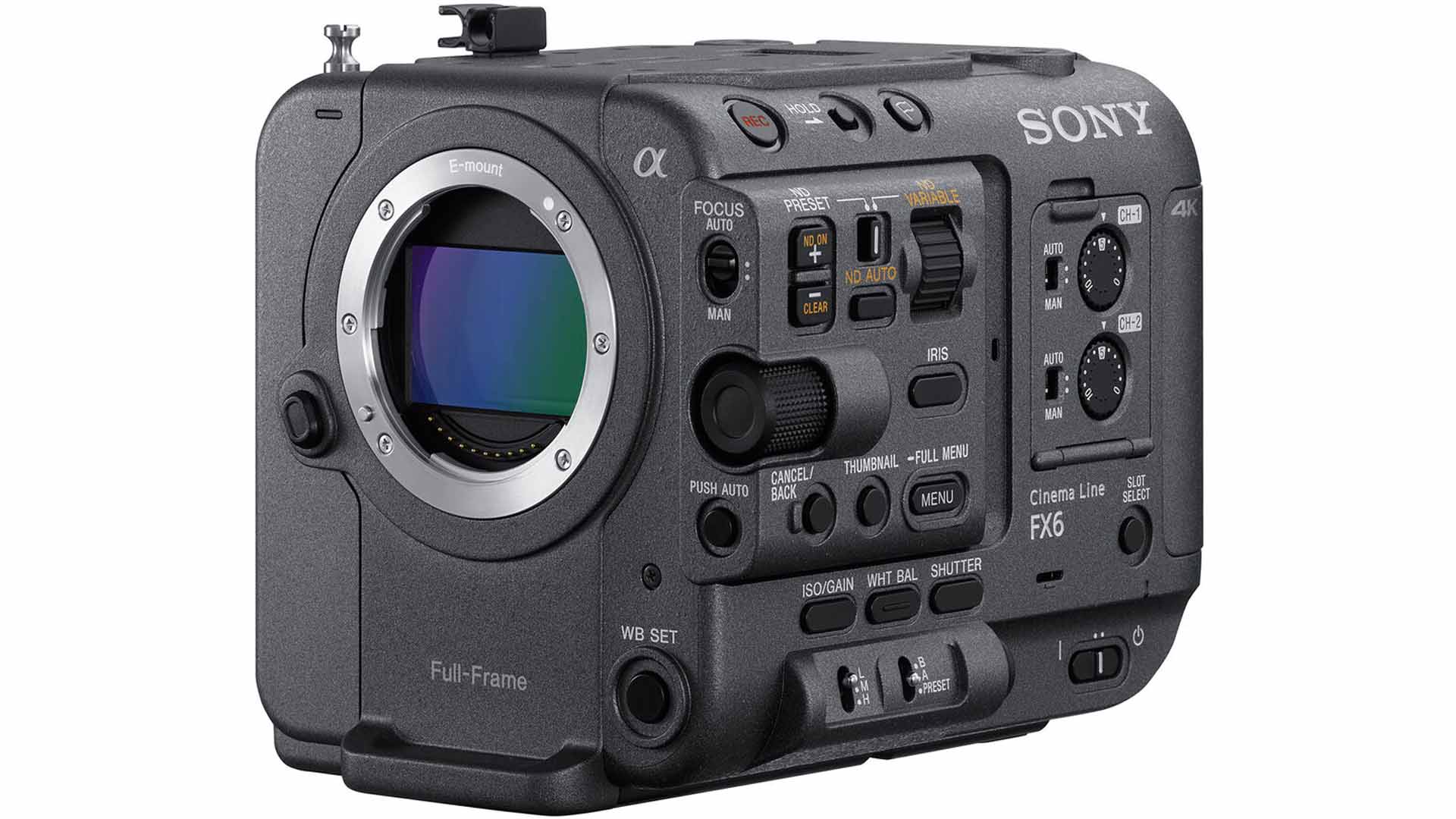
The Sony FX6 (Amazon, B&H) is a surprising addition to the Sony cinema camera lineup. Let us see what’s really new about it, and if it’s really worth it.
A quick overview of Sony’s official video enlightens the finer points:
It’s natural for a serious video shooter and filmmaker to be interested in this camera. Let’s go over some important quirks and features of the Sony FX6 (Amazon, B&H) for cinematography and video.
The lightest cinema camera?
The Sony FX6 weighs only around 890g (body only); lower than the Red Komodo’s weight by 10g. What is actually commendable about this achievement is that Sony did not make any huge sacrifices when it comes to the overall performance of the camera to achieve this weight. In practical terms though, adding accessories, heavier batteries, etc., will change this.
4K up to 120p. What do you really get?
Sometimes it’s worth reading the fine print:
- There is a 10% crop in 120p, and with RAW over SDI.
- You get continuous auto focus all the way to 120p. But not at true 24p!! That’s a real head scratcher.
- There is no audio recording in 120p. You’ll have to use an external recorder.
- You get 4K DCI (4096 x 2160) up to 60 fps and UHD up to 120 fps.
- Best file format is XAVC-I (up to 60p) and XAVC-L (up to 120p).
- You get 10-bit 4:2:2 internally in all modes.
- Dynamic range is claimed to be 15+ stops in S-Log3 (S-Gamut3, and S-Gamut3.Cine).
- 16-bit RAW output is available in both 4K DCI and UHD up to 60p, via SDI.
- Proxy files can be written in 8-bit 4:2:0 XAVC-L 1080p at 8Mbps.
- You can transfer video directly to a computer via USB-C 5Gbps (USB 3.2).


What is the crop factor in 4K?
There is a 10% crop factor. E.g., a 50mm lens will give you a 35mm equivalent of about 55mm. It’s not a big difference, but it’s important to highlight, especially if you’re trying to match the FX6 to other full frame cine cameras.
This crop also applies to 16-bit RAW externally.
What are the data rates for 4K?
Here are the data rates for 10-bit 4:2:2 for the Sony FX6 (Amazon, B&H):
| Frame rates at 4K | Codec | Data rate |
|---|---|---|
| 23.976p to 59.94p* | XAVC-I | 240 to 600 Mbps |
| 23.976p to 119.88p | XAVC-L | 100 to 150 Mbps |
If you want to grade your videos, you might want to stick to XAVC-I, because it gives you the least compression in 10-bit 4:2:2. 600 Mbps is 75 MB/s.
Just to put some perspective, this equates to:
- About 36 minutes on a 80 GB card at 240 Mbps for 24p
- About 15 minutes on a 80 GB card at 600 Mbps for 59.95p
- About 74 minutes on a 160 GB card at 240 Mbps for 24p
- About 30 minutes on a 160 GB card at 600 Mbps for 59.95p
What about 1080p or HD?
The maximum frame rate for HD is 240 fps. No crop at all. Proxy files are also written in 1080p.
What is the dynamic range of the Sony FX6?
According to Sony, the dynamic range is about 15+ stops in S-Log3. It is distributed in this way:

The camera has a dual native ISO of ISO 800 and ISO 12800. To know more about dual native ISOs, check out this article:
You can see, at ISO 800, Sony distributes more into the shadows and less for the highlights. Sony did not publish what would happen at ISO 12800, which is strange.
What is the recording time limit for 4K ?
There is no internal recording time limit mentioned by Sony’s official website. There is an active fan though:
…the FX6 features an innovative heat dissipation structure. A complete redesign of the chassis structure assessed the placement of internal heatsinks and the entire airflow structure, from louvers to circuit board layout. When required, a silent12 fan provides ventilation for continuous recording13 at full resolution, with intake and exhaust air structurally isolated to maintain strong dust and moisture resistance.
Sony

What media card do you need?
The Sony FX6 (Amazon, B&H) has dual CFexpress Card Type A slots.
These slots are also compatible with SDXC cards supporting UHS-I and UHS-II speed classes.
If you need sustained 4K at the highest frame rates, CFExpress cards are recommended by Sony. You can use any UHS-II card, preferably V90, to record in UHD XAVC-I up to 60fps. While the camera won’t stop you from using a V90 or even a V30, it will pop up a “not recommended media” warning and halt the recording.
Sony doesn’t include a card in the camera package, and CFexpress Type A cards are still rare (and expensive).
Note: Other camera brands have preferred to use the faster Type B CFexpress card. Unfortunately, Type B is not supported.

What is the ISO range for 4K?
The ISO range for video is 160 to 409,600 in S-Log3. There are two Native ISOs for the Sony FX6: One at ISO 800 and the other is ISO 12800. It is a true low light monster.
Having two base ISOs will provide documentary filmmakers, wildlife filmmakers and journalists with a massive amount of freedom on the field.
What is clear from the launch video is the low light performance has improved a lot. I guess it should be easy to shoot with this camera to ISO 80,000 without penalty. It remains to be seen what effect it has on dynamic range. If we get our hands on a review sample we’ll let you know what the reality is.
What type of stabilization is in the Sony FX6?
There isn’t any. You are limited to the stabilization available in Sony lenses.
Sony claims that it is impossible to squeeze in IBIS with a variable ND filter. However, much like the FX9, the FX6 also has a gyroscope in it. So you can use the gyro data to stabilize the footage in the post using Sony’s own Catalyst Software.

What video exposure tools are available in camera?
You get a Waveform Display in the Sony FX6 (Amazon, B&H). You also get the ability to upload LUTs, preset looks and the new S-Cinetone profile. You also get HLG for HDR video.
It also comes with Zebras and Focus Peaking. This is all expected of a camera in this price class.
Does the Sony FX6 have built-in ND Filters?
Yes, the Sony FX6 comes with an in-built electronic ND filter. The range is from 2 to 7 stops.
The revolutionary electronic Variable ND Filter controls the opacity of the neutral filter seamlessly from 1/4 to 1/128 ND to achieve unmatched creative control and fluidity. Unique to Sony, it can manually or automatically adjust exposure without affecting the depth of field or shutter angle, letting you achieve perfect exposure even moving between different environments such as from indoors to out.
Sony Asia
The FX6 also has the facility of ND being automated by the camera. Whether it will be used or not solely depends on the operator. Some kinds of journalism, event and wildlife filmmaking could use automatic ISO, if the range is set.

What about the LCD?
You get a 3.5 inch 2.76 million dot (720p) LCD touchscreen. It’s a huge step up from something like the Canon C70:
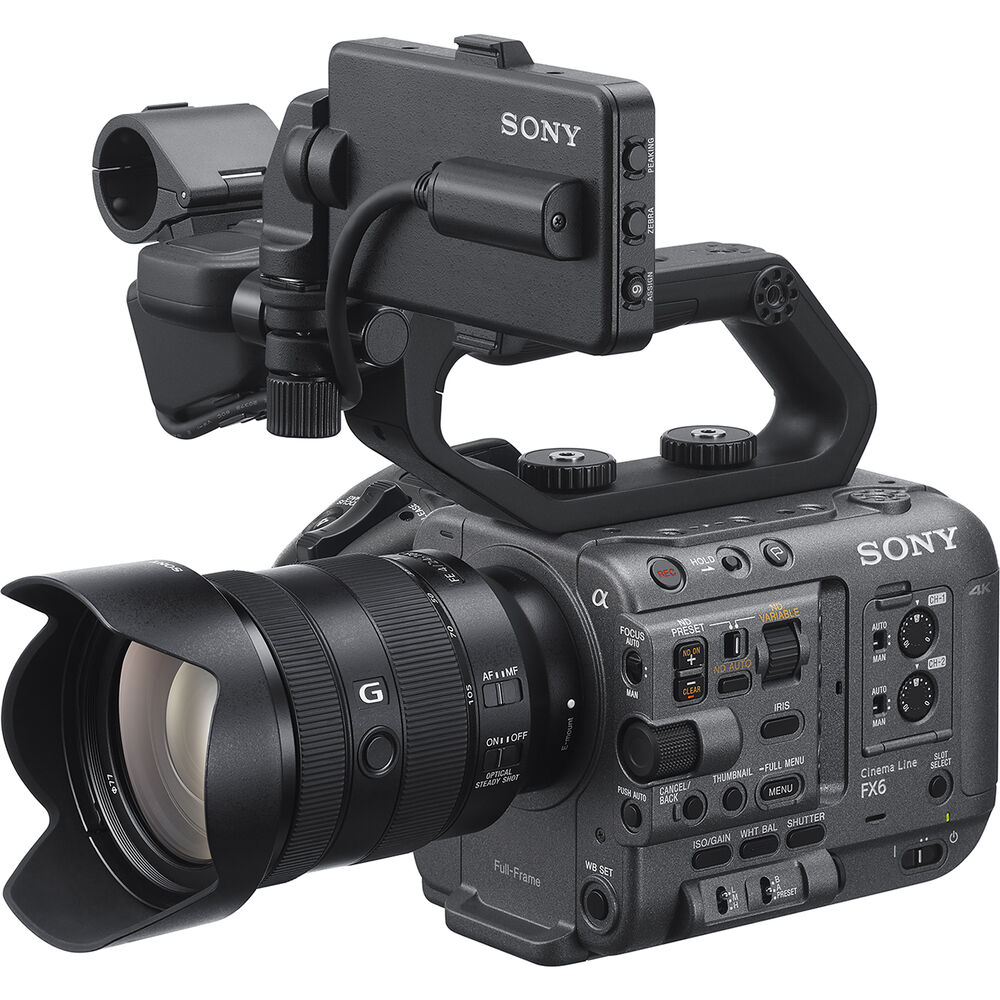
The LCD is mounted on an extended pedestal, and adjustable to a wide range of angles for easy video monitoring regardless of camera rigging and shooting angle. Mounting points are provided at three places on the handle and two on the body. With touch panel support, it also provides intuitive control for many camera settings, even where camera body controls are less accessible.
Sony
Can you upload and use LUTs in the camera?
Yes, the Sony FX6 already has 4 pre-loaded LUTs which work in synergy with the S-Log3.
What is the best format for external video recording?
The best video format that can be exported is 16-bit 4K RAW via SDI. The maximum frame rate is 59.94p.
Currently, the Atomos Shogun 7 (Amazon, B&H) supports 16-bit RAW recording to Apple Prores RAW and since you need SDI for RAW with the Sony FX6 (Amazon, B&H), this will be your safest bet.
What format should I choose for the best video quality on the Sony FX6?
I suggest S-Log3, XAVC-I in 10-bit 4:2:2. This would give you the best dynamic range and the most flexible video for post production.
What about timecode?
The Sony FX6 (Amazon, B&H) has timecode input and output for multi camera sync complete with a BNC connector. However, Sony has omitted the Genlock connector in the FX6.
Can you record simultaneously to both CFexpress cards?
Sony has not mentioned the feature of Dual Recording anywhere on their official website, though I would be surprised if it were not possible.
There is a proxy recording mode as well, so you can record to a lower quality in 1080p on the second card.
How good is the autofocus for video?
It’s going to be absolutely fabulous, if Sony’s marketing premiere on Youtube is to be believed. Real eye tracking looks precise and consistent. Sony has also released Face only Focus Detection where the focus only shifts if the face moves.
Even if the subject goes completely out of frame, the Sony FX6 makes sure that the focus does not move on to any other subject but stays on the last location of the face. This will allow the subject to move back on their mark without any hassle to the operator.
One new and interesting thing that caught my eye was the fact that the even in AF mode if you want to shift the focus you can just turn the lens ring to do that. You don’t have switch to Manual Focus specifically. The moment you leave the ring it switches back to AF automatically. We would love to get our hands on this camera and check out these features in an in-depth review.
The good news is AF is available in most 4K modes, including 120p. The bad news, is, you don’t get AF in true 24p, if you set the base frequency to 24 Hz. It has to be either in 50 Hz (PAL) or 59.94 Hz (NTSC). This is stupid, no sugar coating it.
What are the audio specs?
The audio is recorded as Linear PCM in 24-bit mode. The cold shoe can transmit power directly to a Sony mic or XLR. The 2 XLR inputs are on the top handle of the Sony FX6. Thankfully, the top handle comes with the camera so it won’t be an added expense.
The FX6 offers up to 4-channel audio recording by combining sources from the dual XLR inputs, the 2-channel multi-interface shoe input, and the stereo mic built into the camera’s top handle.
It also has a 3.5mm Stereo mini headphone jack.

Content Browser Mobile Compatibility
If you want remote control of your camera but not to the precision of a remote controller, Sony FX6 can now be somewhat remotely controlled from you phone using the Content Browser mobile app. The FX6’s Wi-Fi function will allow you to monitor the camera remotely and have full control of the zoom, iris and the focus.
I wonder how useful this feature can actually be on the field for run and gun work, but it could be useful for events and live streaming work.
Any word on battery life for video for the Sony FX6?
You get 105 mins (1 hour 45 minutes) of operation with a BP-U35 battery and 215 mins (3 hour 35 minutes) of operation with a BP-U70 battery.
The FX6 draws about 18 Watts. I believe with three batteries you should be able to get through even the most demanding days.
Is the Sony FX6 weather sealed?
Not really. Sony claims to have improved weather resistance:
In response to pro opinions, enhanced sealing is applied to the media compartment lid, terminal cover and all joints in the chassis. Routes to dust and moisture entry have been re-examined to ensure reliable operation in challenging environments.
Sony Asia
However, in the fine print, we have this:
Not guaranteed to be 100% dust- and moisture-proof.
Sony

The Sony FX6 (Amazon, B&H) is shaping up to be one hell of a camera for low budget shooters of all kinds of videography. In the coming weeks I’ll be comparing it to the Sony a7S III and FX9, to see what the real value proposition is.
Stay tuned.

I’ve had my Sony FX6 for about a week. I’m very impressed with the image quality. However, I can’t seem to get audio to work. I’ve tried adding a couple different mics and change settings. However, no audio is registering. I’ve obviously missed a particular setting. Any suggestions?
Just off the top of my head: Assuming the camera settings are correct try turning off Phantom power or using a microphone that is battery operated. Try raising the audio levels to max – do the levels move at all? The last option is to check if you’re reading the right audio channels.
Hi Sareesh, thank you for replying. After some very frustrating moments and referring to manuals etc, I found a setting (Proxy Rec) which was set to off. Setting that to on made all the difference. Still uncertain why it has made the difference, but I’m very happy that I now have the option to record audio, as well as video.
Kind regards
Trevor
The Sony menu system sometimes has glitches. The a7S III I’m reviewing currently does some strange things.
Where did you find that dynamic range chart? I wonder if it’ll get updated to show the higher ISO range.
Sony’s official website has this exact same chart, we found it there.
In regards to your statement, “The best video format that can be exported is 16-bit 4K RAW via SDI. The maximum frame rate is 59.94p. Currently, the Atomos Ninja V supports 16-bit RAW recording to Apple ProresRAW,” is correct, however, the Atomos Ninja V inputs raw through HDMI – the FX6 only outputs raw via SDI. The correct external raw recorder that is compatible with the Sony FX6 is the Atomos Inferno 7″- it can input raw via SDI which is what the FX6 outputs. It would be unfortunate is people bought the wrong Atomos product following the advice from this website.
Rectified the mistake, thank you for pointing it out to us.
I recently purchased the fx6 and I have very little knowledge about the menu system. It is complicated and cumbersome to say the least. Is there a school or place someone could explain the manual or this menu system? I live outside of LA so there must be someplace they have info.
Also, there is no 3.5mm microphone input. Only 2x XLR, internal scratch mic on body, internal stereo mics on the handle, and the MI shoe for a K3M etc.
There is some misinformation here. The cropfactor of 1.1x makes a 35mm lens essentially a 38.5mm lens. Not a 55mm. You cannot record RAW to the Ninja V, it’s the Shogun over SDI. You don’t need a CFEpxress A card for the “higher bitrate 4K” footage. A V90 Sd card will do for anything except the highest FRAMERATES in 4K All-I. You can shoot up to 4K 60p All-I with a high speed SD card without issue. May amend with more.
The article states “a 50mm lens will give you a 35mm equivalent of about 55mm,” not a 35mm lens.
Thanks!! I have been saving for a Canon C300 Mark iii but the Sony FX6 looks pretty good at about half the price. What do you think Sareesh?
I’d pick the C300 Mark III. If and when I get my hands on an FX6 I’ll know for sure.
Thank you Sareesh, I place a lot if weight on your opinion. I haven’t been able to work much since Covid 19 so I have to spend very wisely .
cropping in 4k ?? I sendt back by FX9, after the Coned magazine found that is acutally got 11.5 Stop D. range, and not 15+. I actually shot a whole movie on that camera, on witch I am grading a dn clipping ringt now.
But to the crop .
So when I use the SONY 28-135, it will be more like a 33- 140 ? Cined also tested the latitude on both A7 s III , and FX9, and the performance on A7 s III, with the same sensor as the FX6, is better at that parameter too .
The Gyro stabilisation, will often, fi not everytim introduce banding, and spots in the clips ! just so you know ! SONY is not warinig about this error, witch can potentioally ruin many great footages. That was one of many reasons I sendt it back.
I wil see some test from Cined, before I trust anything, anymore, from SONY.
My SONY a7 s II, si of course still a great peace of gear :)
Thanks for the insight!